Mastering Software Project Risk Management for On-Time Delivery
A practical guide to software project risk management. Learn to identify, assess, and mitigate risks to deliver complex software projects on time and on budget.
Software project risk management isn't just a box to check. It's the strategic process of finding, sizing up, and neutralizing the threats that can derail your project's timeline, budget, and goals.
Think of it as proactively hunting for problems—from creeping technical debt to a sudden talent gap—and building a plan to disarm them before they blow up. It's about clearing a smoother path to a successful launch.
Why Proactive Risk Management Is Your Greatest Asset
In software development, ignoring risk is a recipe for disaster. Let's be honest: ambiguity, unforeseen dependencies, and shifting requirements aren't the exceptions; they are the norm. Effective software project risk management isn’t about creating more bureaucracy or endless meetings. It's about wrestling back control over outcomes and turning uncertainty into a strategic advantage.
For a lot of engineering leaders, risk management can feel like a chore. The key is to reframe it. It’s the difference between constantly fighting fires and preventing them from ever starting.
The Real-World Cost of Unmanaged Risk
Small oversights have a nasty habit of spiraling into major crises. Picture a scenario where a vague API spec leads to weeks of rework because two teams built their components on different assumptions. Or what about that critical project hanging on a single senior developer who suddenly resigns, taking all the essential domain knowledge with them?
These aren’t just hypotheticals. They're the daily realities that lead to blown budgets and missed deadlines. Across the board in IT, unmanaged risk is one of the biggest reasons projects fail. Studies consistently show a huge number of projects don't deliver what they promised, often because the risks were never even identified, let alone owned.
In fact, some analysis estimates that up to 11.4% of every project dollar is wasted due to poor performance, which almost always ties back to weak risk controls.
The greatest project risk is believing there is none. Proactive identification isn't pessimism; it's the foundation of predictable delivery and professional engineering leadership.
From Reactive Firefighting to Strategic Advantage
For CTOs and VPs of Engineering, getting a handle on this discipline is what separates the pros from the amateurs. It’s how you achieve predictable delivery and protect your ROI. By building a culture where people are aware of risks, you empower your teams to navigate tough situations with confidence, whether it's an ambitious AI integration or a critical platform migration.
This proactive approach pays off in a few key ways:
Improved Predictability: When you spot potential roadblocks early, you can build much more realistic timelines and budgets.
Enhanced Decision-Making: A clear picture of potential risks helps you make smarter calls about where to put your resources and when to pivot.
Greater Stakeholder Confidence: Showing you have a mature approach to risk management builds a massive amount of trust with clients, executives, and investors.
Reduced Rework and Waste: Tackling potential problems before they happen saves countless hours of debugging and refactoring down the road.
A structured approach helps you lead the way in managing software development instead of letting unexpected events run the show.
Building Your Risk Identification and Assessment Toolkit
A solid risk management framework isn’t built on theory; it's forged from practical, repeatable actions. This is how you shift from anxiously wondering what could go wrong to systematically identifying threats and sizing up their potential damage. It's about building a toolkit that turns reactive firefighting into proactive control.
The whole thing kicks off with identification—actually uncovering and documenting potential risks before they have a chance to materialize. This can't be a solo mission. The best insights come from a collaborative effort, tapping into the collective wisdom of your entire team, from developers and QA engineers to product owners and key stakeholders.
Uncovering Potential Project Threats
You need a few different angles to find potential problems. Relying on just one method is a surefire way to develop blind spots. A multi-pronged approach gives you a much clearer picture of the risk landscape.
Consider these proven methods I've seen work time and again:
Collaborative Brainstorming: Get your team, client reps, and maybe even key vendors in a room. Ask the simple but powerful question, "What could go wrong?" The key is to encourage open, honest discussion without immediately shooting ideas down.
SWOT Analysis: A classic for a reason. Analyze your project's Strengths, Weaknesses, Opportunities, and Threats. Your Weaknesses (like a skill gap in a new technology) and Threats (a competitor launching a similar feature first) are direct inputs for your risk log.
Post-Mortem Mining: Your organization's history is a goldmine of risk data. Seriously, go read the post-mortems from past projects, especially the ones that struggled. Did a specific third-party integration cause delays last time? That's a risk for this project.
The cycle is predictable. When risk oversight gets neglected, it leads directly to cost overruns and, eventually, project failure.
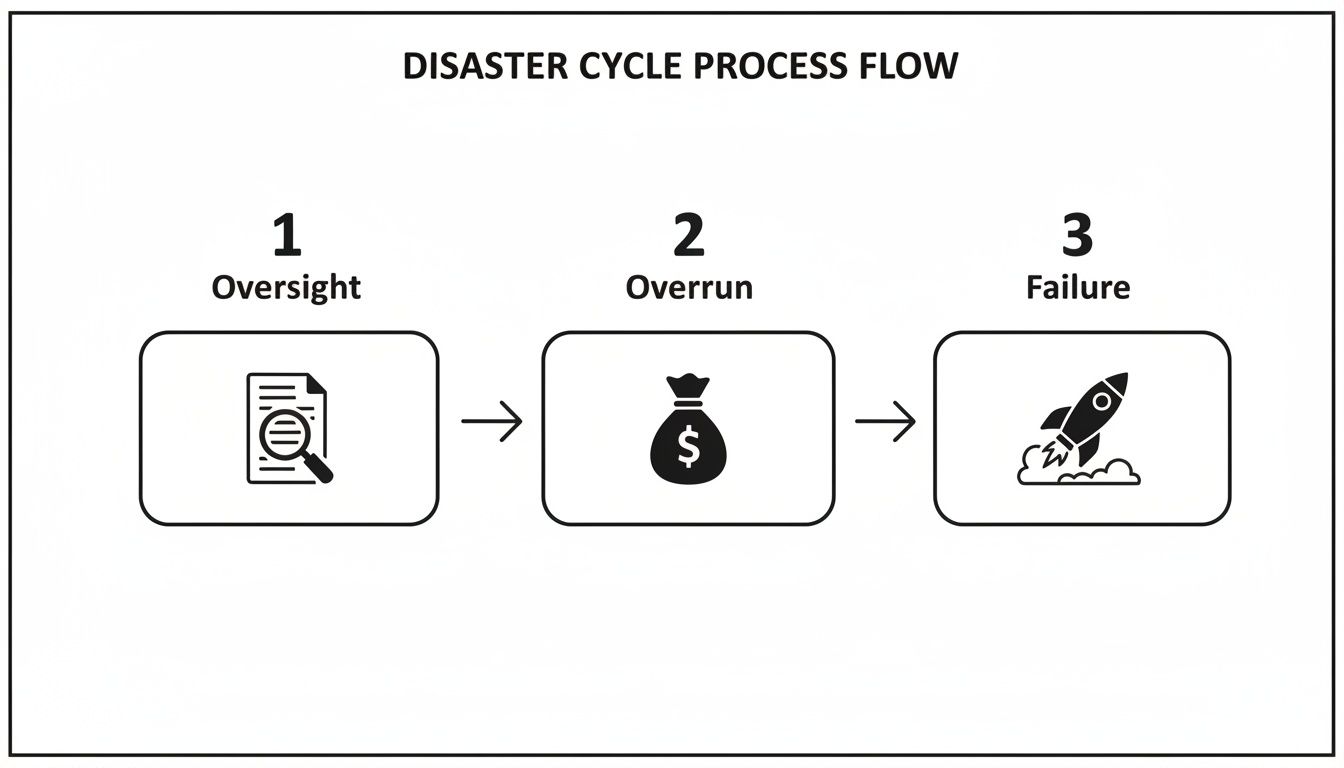
This visual just hammers home how a failure in that initial oversight phase creates a domino effect. Budget and schedule blowouts become almost inevitable.
Documenting and Categorizing Risks
Once you've identified a potential risk, it needs a home. This is your Risk Register—a living document that serves as the single source of truth for everything risk-related. It's not a file-and-forget document; it evolves right alongside your project.
At its core, a Risk Register is a simple but powerful tool for organizing chaos. Here's a sample of what one looks like in practice, showing how to document, categorize, and score potential risks to create clear priorities.
Sample Risk Register for a Software Project
Risk ID | Risk Description | Category | Probability (1-5) | Impact (1-5) | Risk Score (P x I) | Mitigation Plan | Owner |
|---|---|---|---|---|---|---|---|
T-001 | Unforeseen integration issues with legacy CRM API. | Technical | 4 | 4 | 16 | Allocate 2 extra sprints for integration spike; develop fallback manual data entry process. | Jane D. (Lead Dev) |
P-002 | Key backend developer resigns mid-project. | People | 2 | 5 | 10 | Cross-train another developer on the backend architecture; document all critical processes. | Mark S. (Eng Manager) |
E-003 | Change in data privacy regulations requires rework. | External | 3 | 3 | 9 | Consult with legal team quarterly; build services with flexible data handling modules. | Sarah L. (Product) |
S-004 | Scope creep from stakeholder requests post-sprint lock. | Scope | 4 | 3 | 12 | Implement a strict change control process; defer non-critical requests to Phase 2. | Sarah L. (Product) |
This register makes it impossible for risks to get "lost." It creates accountability and a clear path forward for each potential issue.
Assigning a specific owner to each risk is non-negotiable. Without clear ownership, risks get lost in the noise of daily tasks, and accountability evaporates.
The complexity of modern software, especially for large-scale initiatives, makes this documentation essential. Stats show that software and IT projects are uniquely exposed to risk. In IT, a staggering 1 in 6 projects experiences a cost overrun of around 200%. Large projects, those with budgets over $1 million, are 50% more likely to fail to meet business objectives than smaller ones. This is exactly where global cloud migrations and AI engineering programs sit. You can find more project management statistics that paint a similar picture.
Assessing and Prioritizing What Matters Most
With a list of risks, the next challenge is separating the critical threats from the minor annoyances. Not all risks are created equal, and trying to tackle everything at once is a recipe for paralysis. This is where the Probability-Impact Matrix becomes your best friend.
It's a straightforward tool for qualitatively assessing risks by scoring them on two dimensions:
Probability: How likely is this to happen? (Score it 1-5, from Very Low to Very High).
Impact: If it happens, how bad will it be? (Score it 1-5, from Insignificant to Catastrophic).
Multiply those two numbers, and you get a Risk Score. This simple calculation allows you to stack-rank your risks, creating a clear, data-informed priority list. A high-probability, high-impact risk demands an immediate, robust response plan. A low-probability, low-impact risk? Maybe you just keep an eye on it.
This process transforms a long, intimidating list of worries into a manageable, prioritized action plan. It lets you focus your team's limited time and energy on the threats that can truly derail your project.
Key Risk Categories Every Tech Leader Should Monitor
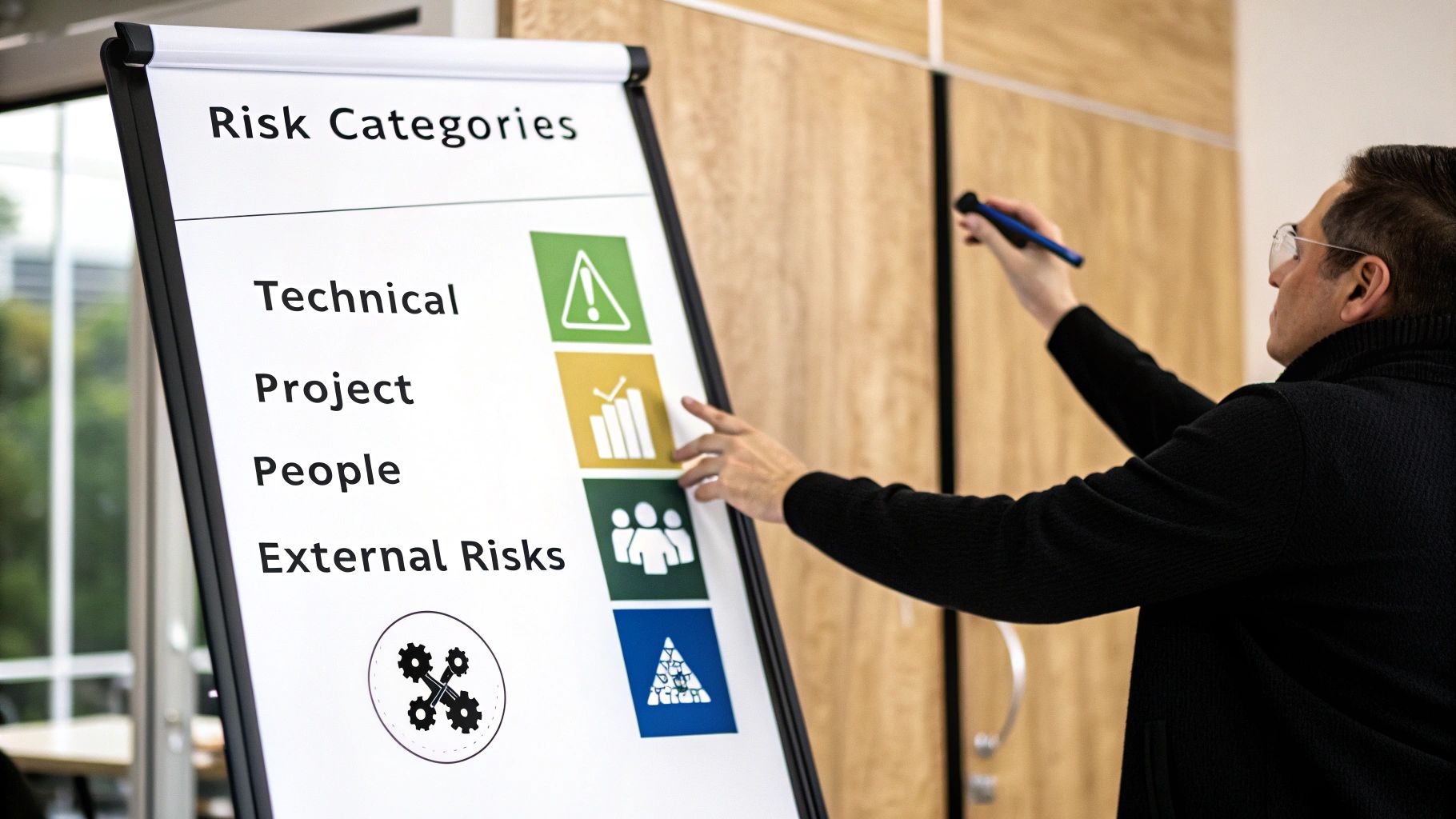
Knowing where to look is half the battle in managing software project risk. While every project has its own unique flavour of chaos, most threats fall into a few predictable buckets. If you organize your thinking around these core categories, you can systematically scan for trouble spots instead of waiting for them to find you.
This isn't about creating a laundry list of every possible thing that could go wrong. It's about building a mental model that helps you and your team proactively identify the most common and impactful risks before they gather momentum.
Let’s break down the major areas where risks consistently hide.
Unpacking Technical Risks
Technical risks are born from the code, the architecture, and the tools your team uses every single day. Engineers can usually spot these a mile away, but their cascading effects on timelines and budgets can be subtle until it's too late.
Watch out for these classic technical gremlins:
New Tech Adoption: Bringing a new framework or cloud service into the stack always comes with a learning curve. Underestimate it, and you’re looking at implementation delays and rookie mistakes. I’ve seen teams adopt serverless for the first time and get absolutely crushed by debugging complexities and unexpected costs.
Legacy System Integration: Trying to plug new software into an aging, poorly documented system is a nightmare waiting to happen. An undocumented API endpoint in a legacy CRM can stall a high-priority project for weeks.
Technical Debt: Quick fixes and shortcuts are like taking out a high-interest loan on your codebase. They accumulate over time, making the software brittle and painfully slow to change. High tech debt means a simple feature request can balloon into a complex, high-risk refactoring effort.
Proactive strategies for managing technical debt are non-negotiable. Let it fester, and it will eventually bring your velocity to a crawl.
Navigating Project Management Risks
These risks have nothing to do with code and everything to do with process—or the lack of it. They live in the gaps between communication, estimation, and control. When the fundamentals of project management are weak, even the most brilliant engineering team is set up to fail.
Keep a close eye on these areas:
Scope Creep: This is the silent killer of project timelines and budgets. It often starts with "just one small change," but uncontrolled additions to the project's requirements will bleed you dry.
Poor Estimation: Constantly underestimating the effort required for tasks is a direct path to unrealistic deadlines, team burnout, and broken promises. This is usually a symptom of rushing the analysis phase or succumbing to pressure for aggressive timelines.
Inadequate Quality Assurance: Rushing or skipping proper testing is like shipping a product with a ticking time bomb. It introduces a massive risk of bugs, performance bottlenecks, and security holes making their way to production. Our guide on what quality assurance is in software development dives deep into why this is a critical part of de-risking any release.
A project without a change control process isn't a project; it's a hobby. Documenting and approving scope changes is your primary defense against uncontrolled expansion.
Addressing People and Resource Risks
At the end of the day, software is built by people. This makes the human element one of the most critical—and complex—risk categories you'll face. These risks are tied directly to the skills, availability, and dynamics of your team.
Here are the people-related risks you absolutely have to monitor:
Skill Gaps: The team simply lacks the expertise in a technology that’s critical to success. Trying to launch an AI-powered feature without a single engineer who understands machine learning isn't a risk; it's a guaranteed failure.
Key Person Dependency: All the knowledge about a critical system is locked in one person's head. If that person wins the lottery, gets sick, or just quits, your project grinds to a halt. It's a massive single point of failure.
Team Burnout: An overworked, stressed-out team doesn't do its best work. They're more likely to make mistakes, cut corners, and eventually leave. High churn isn't an HR problem; it's a major continuity and knowledge-loss risk.
These risks get amplified when you're managing distributed or nearshore teams. Time zone differences can introduce communication delays, and cultural nuances can lead to misunderstandings if you're not proactive about bridging those gaps.
Preparing for External Risks
Finally, some risks come from completely outside your organization's walls. You have far less control over these, but that doesn't mean you can't prepare for their potential impact.
Think about things like:
Vendor Instability: A key third-party service you depend on could go out of business, get acquired, or push a breaking change to their API with little to no notice.
Market Shifts: A competitor might drop a game-changing feature, or customer preferences could pivot, making your project's entire premise obsolete overnight.
Regulatory Changes: New data privacy laws (like GDPR) or industry-specific compliance rules can force significant, unplanned rework, derailing your entire roadmap.
Integrating Risk Management into Agile and DevOps Workflows
Let’s be honest. Formal risk management can feel like pumping the brakes on a bullet train, especially in a fast-paced Agile or DevOps shop. The common fear is that it just adds red tape and slows down delivery when speed is the name of the game.
But the most resilient teams I’ve worked with don’t see it that way. They don’t treat risk management as some separate, clunky process. Instead, they’ve gotten incredibly good at weaving it directly into the fabric of their daily work.
The goal isn't to bolt on a heavy framework. It's about building a continuous, lightweight awareness of what could go sideways. When you get this right, it doesn’t slow you down—it makes your development process smarter, more resilient, and way more predictable. Suddenly, your agile ceremonies become your best risk-spotting tools.
Weaving Risk into Agile Ceremonies
Your existing Agile meetings are the perfect place to embed risk management activities without adding a single extra calendar invite. All it takes is a slight shift in the conversation to proactively catch and tackle risks as part of your natural development rhythm. This approach keeps things lean and gets the whole team thinking about potential problems.
To show you what I mean, we've put together a quick guide on how to integrate these activities into your existing ceremonies.
Mapping Risk Management to Agile Ceremonies
This table breaks down how you can seamlessly blend key risk management activities into your regular Agile and Scrum events.
Risk Management Activity | Agile Ceremony Integration | Example Action |
|---|---|---|
Risk Identification | Sprint Planning | As the team pulls in user stories, ask: "What could stop us from nailing this story?" This immediately surfaces risks like vague requirements, tech unknowns, or dependencies on another team. |
Risk Monitoring | Daily Stand-ups | Listen for recurring blockers. When a developer says they're "still waiting on the API from the data team" for the third day in a row, that's not just a blocker; it's a dependency risk that needs a bigger conversation. |
Root Cause Analysis | Sprint Retrospectives | Retros are a goldmine for learning. When a "near miss" or a full-blown issue happens, the retro is where you dig in. The point isn’t to assign blame but to find the underlying risk and build a plan to make sure it doesn’t bite you again. |
By asking these simple questions in the right forums, you transform routine meetings into an effective, ongoing risk assessment process.
For a deeper dive into making these meetings more effective, check out these 10 Agile development best practices; you'll see how they reinforce a more resilient workflow.
Making Your CI/CD Pipeline a Risk Monitor
In a proper DevOps culture, the CI/CD pipeline is the lifeblood of the whole operation. It’s also a seriously powerful tool for automated risk monitoring. By building automated checks and quality gates right into your pipeline, you can catch technical risks before they ever get close to production.
This is a game-changer. It shifts risk detection from a manual, after-the-fact chore to an automated, real-time feedback loop.
Embedding risk checks into your pipeline isn't about adding steps; it's about making your existing steps smarter. Every automated test is a small, proactive mitigation strategy running on every single commit.
Think about adding automated gates like these to your pipeline:
Static Analysis Security Testing (SAST): These tools scan your code for common security vulnerabilities, flagging risks like SQL injection or cross-site scripting before the code even gets merged.
Performance Regression Testing: Automatically run performance tests against a baseline. If a new commit tanks response time by more than 5%, the build fails. Simple. This stops performance risks from quietly creeping into the system.
Dependency Scanning: Automate checks for known vulnerabilities in all your third-party libraries. This is huge for mitigating risks from open-source components, which can be a major attack vector if left unchecked.
As you look to make your workflows even smarter, it's worth exploring the new wave of AI in project management, where tools are starting to build this kind of predictive risk analysis right into their core functionality.
Your Ultimate Risk Mitigation Strategy: Top-Tier Talent
After you’ve mapped out every technical debt scenario, scope creep possibility, and external threat, a simple truth comes into focus. The single most powerful tool in your software project risk management playbook isn't a process or a template. It's the team you build.
An exceptional team doesn't just ship cleaner code. They see around corners, communicate with absolute clarity, and have the grit to navigate the chaos that inevitably comes with ambitious projects.
On the flip side, a team bogged down by skill gaps, slow hiring, and instability is more than just an HR problem—it's a massive, flashing red light on your risk register. These issues bleed directly into busted timelines, expensive rework, and a compromised product. Every day a key role sits empty, your project is accumulating risk like interest on a high-interest loan.
Shifting from Talent Gaps to Strategic Advantage
A skill gap in a crucial area like machine learning or cloud architecture is a ticking time bomb. It forces the rest of your team into a corner: either they try to learn on the fly, which invites mistakes, or they work around the problem, which guarantees a clunky, suboptimal solution.
This is where you need to start viewing talent acquisition as a core risk mitigation strategy. It’s a complete game-changer.
Instead of scrambling when someone quits or a new technical need pops up, a proactive talent strategy puts the right expertise in place before it becomes a five-alarm fire. This simple shift turns the people on your project from a potential liability into your greatest asset for crushing challenges. You’re essentially building a roster so deep that it inherently de-risks the entire initiative.
Your team's collective skill set is your primary buffer against uncertainty. Investing in top-tier engineering talent is a direct investment in your project's predictability and success.
When you have the right people, complex technical problems become manageable hurdles, not project-killing disasters. This is especially true for bleeding-edge projects involving AI engineering or massive platform migrations where deep, specialized knowledge is completely non-negotiable. The reality is, many companies struggle to find this level of expertise on their own, making it critical to partner with one of the top technology recruiting firms that has a direct line to elite talent.
The Compounding Value of Elite Engineers
Top engineers do way more than just check boxes on a task list; they raise the bar for the entire team. Their presence creates a positive feedback loop that actively crushes a wide spectrum of project risks before they can even take root.
Think about the ripple effect:
Faster Problem Resolution: An elite engineer can hunt down and fix a complex bug in hours, not days. That prevents a minor glitch from snowballing into a major production outage.
Reduced Technical Debt: They build solutions with the future in mind, writing clean, maintainable code that stops system brittleness from creeping in down the line.
Proactive Risk Identification: Their experience gives them a sixth sense for spotting architectural flaws or integration nightmares long before they show up in a sprint.
Mentorship and Knowledge Sharing: They can’t help but upskill the people around them, which breaks down key-person dependencies and builds a more resilient organization.
This proactive approach to team building is the most potent form of software project risk management you can possibly practice. It attacks the root cause of countless technical and execution risks—the human element—by making sure your team is fundamentally built to win.
Got Questions About Software Risk Management? We've Got Answers.
Even the slickest framework runs into real-world questions. It’s totally normal. Here are some of the most common things engineering leaders ask when they start putting a real software project risk management process into play.
How Often Should We Actually Look at Our Project Risk Register?
This isn't a "set it and forget it" document.
For teams running Agile, a quick risk review should be baked right into every sprint planning or retrospective meeting. Think of it as a continuous pulse check. This lets you catch new risks as they pop up and re-evaluate old ones based on what you just learned in the last sprint. It keeps risk management alive and relevant, not just a one-off task you did at kickoff.
If you’re on a larger, more traditional project, aim for a formal risk review at least once a month or at the end of each major phase. The real key? Ramp up the frequency when things get hairy—like when you're integrating a brand-new technology or staring down a major deadline. More change means more uncertainty, which means more risk.
What’s the Real Difference Between a Risk and an Issue?
Getting this right is critical. Mess it up, and you’ll have your team chasing their tails.
Think of it like this: a risk is a potential problem. It's an uncertain event that hasn't happened yet, but it could throw a wrench in your project if it does.
For example: "There's a risk our third-party payment gateway could go down during the Black Friday rush."
An issue, on the other hand, is a risk that decided to show up to the party. It's a problem that is happening right now, and your team needs to deal with it.
Following the example: "It's 9 AM on Black Friday, our payment gateway is down, and we're losing sales every minute."
Good risk management is all about spotting and planning for risks before they become full-blown issues. It’s the difference between being proactive and just being reactive.
Who's Ultimately on the Hook for Risk Management?
While your Project Manager or Scrum Master is usually the one facilitating the process, ownership is a team sport. Everyone—from the junior dev to the lead architect—needs to feel responsible for calling out potential threats.
Best practice is to assign an "owner" to every single risk in your register. This is the person who's best positioned to keep an eye on that specific risk and pull the trigger on the mitigation plan if needed.
But when it comes to the big picture, the buck stops with the CTO or VP of Engineering. They're the ones ultimately accountable for making sure the whole risk management framework is actually working across all projects.
What Do You Do With a Risk You Just Decide to Accept?
Accepting a risk isn't the same as ignoring it. It's a calculated, strategic decision. It means you've looked a risk square in the eye, understood its potential impact, and decided the cost of preventing it is higher than the potential loss. A classic example is a risk with a super low probability and a tiny impact.
But "accepting" doesn't mean you just shrug and move on. You still need a plan.
When you formally accept a risk, you should:
Document it. Get it in the risk register with all the details.
Explain why. Record the reasoning behind the decision to accept it.
Have a contingency plan. Write down exactly what the team will do if this long-shot risk actually happens.
This way, if the unlikely occurs, you're not scrambling in a crisis. You're executing a pre-planned response. You’ve turned a potential panic into a calm, organized reaction.
Even a world-class software project risk management plan can get derailed by a critical talent gap. The best mitigation strategy of all? Having an elite team that can see around corners and solve problems before they blow up. As a leading technology staffing, recruiting, and AI Engineer firm, TekRecruiter de-risks your most critical projects by connecting you with the top 1% of engineers on the planet. Whether you need a battle-tested nearshore team or niche AI expertise, we empower innovative companies to deploy world-class talent anywhere.