_edited.png)
Multi Cloud vs Hybrid Cloud: Key Differences - multi cloud vs hybrid cloud
- Jan 11
- 16 min read
The real difference between multi-cloud and hybrid cloud boils down to one thing: infrastructure.
A multi-cloud strategy means you're using services from multiple public cloud providers—think AWS, Azure, and GCP—all at the same time. On the other hand, a hybrid cloud setup connects your company's on-premises data center with at least one public cloud. The path you choose hinges on what you value more: cherry-picking the best features from each provider or maintaining tight control over sensitive data on your own hardware.
Understanding the Core Difference in Cloud Strategy
Picking between multi-cloud and hybrid isn't just a technical choice. It's a fundamental business decision that shapes your costs, security posture, operational headaches, and the kind of engineering talent you'll need to hire. Both models move you beyond a single cloud vendor, but they solve entirely different problems and create very different day-to-day realities for your team.
What Defines Each Strategy
At its core, multi-cloud is all about playing the field. You're leveraging the unique strengths of different public clouds. A company might use AWS for its powerhouse compute services, lean on Google Cloud for its machine learning and data analytics, and integrate Azure for its deep ties into enterprise identity management. This "best-of-breed" approach is designed to squeeze the most performance and value out of your spend while making sure you're never beholden to a single provider.
A hybrid cloud strategy, in contrast, is about bridging two worlds: your private, on-prem infrastructure and the public cloud. This model is a go-to for industries with heavy-duty data residency or compliance rules, like finance or healthcare. It gives businesses a way to keep their most sensitive data locked down in their own data centers while tapping into the public cloud's massive scale for less critical, customer-facing apps. Getting a handle on the integration challenges is key to understanding hybrid cloud environments.
The "Accidental" Multi-Cloud Reality
Here's an interesting twist: most companies are already multi-cloud, whether they planned it or not. In fact, recent data shows that a staggering 89% of companies are now using a multi-cloud approach. This usually happens organically. The marketing team signs up for a SaaS tool that runs on GCP, while engineering has been building on AWS for years. Suddenly, you're multi-cloud. The real work is turning that accidental setup into a deliberate, well-governed strategy.
The distinction is critical: A multi-cloud strategy is an active choice to distribute workloads for strategic advantage. A hybrid cloud strategy is about creating a unified, interconnected environment between private and public resources.
To make this crystal clear, here’s a quick breakdown of how these two models stack up. This table cuts through the noise and gives you an at-a-glance view of the core differences.
Quick Comparison: Multi-Cloud Vs. Hybrid Cloud
Attribute | Multi-Cloud | Hybrid Cloud |
|---|---|---|
Core Components | Multiple Public Clouds (e.g., AWS, Azure, GCP) | Private Cloud/On-Premises + Public Cloud |
Primary Goal | Avoid vendor lock-in; access best-of-breed services | Balance data control with public cloud scalability |
Complexity Focus | Managing disparate vendor services and APIs | Integrating private and public infrastructures |
Ideal For | Cloud-native companies seeking maximum flexibility | Regulated industries with on-premises investments |
Looking at this, it's obvious that neither path is simple. Whether you're building out a sophisticated multi-cloud ecosystem or integrating on-prem systems into a seamless hybrid model, success comes down to having the right people on your team.
Navigating these complex environments requires elite engineers who can build, secure, and optimize your infrastructure from day one. TekRecruiter connects innovative companies with the top 1% of cloud engineers, allowing you to deploy world-class talent to execute your vision, anywhere.
A Practical Comparison of Cloud Architectures
Definitions only get you so far. The real difference between multi-cloud and hybrid cloud is in the blueprints—their core architectural design. These aren't just slightly different setups; they represent fundamentally distinct ways to build, run, and secure your products. How they work in the real world dictates everything from the skills your team needs to the complexity you’ll have to manage.
Multi-cloud is all about choice and specialization. It’s a "best-of-breed" philosophy where you strategically pick services from different public clouds to gain a competitive edge. This isn't about creating backups; it's about using the absolute best tool for each specific job.
The Multi-Cloud Best-of-Breed Model
Picture a global e-commerce platform. Instead of committing to one provider, they might build their architecture like this:
Amazon Web Services (AWS): They use its robust and cheap S3 storage to house billions of product images and user-generated content.
Google Cloud Platform (GCP): They tap into its powerful BigQuery analytics engine to process massive datasets, analyzing customer behavior and forecasting inventory.
Microsoft Azure: They integrate its enterprise-grade identity services, syncing with their existing Active Directory for seamless employee and B2B partner access.
This approach gives the company elite tools for every task. But that freedom comes with serious architectural headaches. Engineering teams now have to wrangle disparate APIs, navigate totally different security models, and figure out cross-cloud data synchronization, which adds both latency and cost. To truly avoid vendor lock-in, workload portability—the ability to move applications between clouds—becomes the main engineering challenge.
An effective multi-cloud strategy isn't just about using multiple clouds. It's about designing applications that are consciously decoupled from any single provider's proprietary services.
This reality often pushes teams toward cloud-agnostic tools and platforms that can create a consistent operational layer across all their different environments.
The Hybrid Cloud Integration Fabric
A hybrid cloud architecture isn’t about picking the best vendor; it's about building a seamless bridge between two operating models: your private infrastructure and the public cloud. The guiding principle is integration, not just co-existence. The goal is to extend your on-premises data center with the scale and services of a public cloud provider.
Think of a financial institution bound by strict regulations. Their architecture is built for control and security:
On-Premises Private Cloud: Core banking systems and sensitive customer databases stay locked down in their private data center, satisfying data sovereignty and compliance rules.
Public Cloud (e.g., Azure or AWS): Customer-facing mobile apps and resource-hungry analytics platforms are built here. These services can burst to handle peak demand—like on payday—without forcing the bank to over-provision its own expensive hardware.
The glue holding this model together is the network. Secure connections like VPNs or dedicated private lines (think AWS Direct Connect or Azure ExpressRoute) are non-negotiable. They create a secure, high-bandwidth tunnel for data to flow between the private and public worlds.
A successful hybrid setup also demands a unified operational fabric. This is where a platform like Kubernetes becomes indispensable. By using Kubernetes as an orchestration layer across both on-prem servers and public cloud instances, a company can deploy and manage applications consistently, no matter where they physically run. For teams navigating this path, expert guidance is key. There are great resources explaining how to leverage Kubernetes consulting services for seamless cloud-native adoption to build this kind of cohesive fabric.
Ultimately, the choice comes down to your business goals. Are you chasing the absolute best tools on the market, or is your main driver maintaining direct control over critical data while still getting the benefits of cloud scale? The answer will shape your technical strategy and, more importantly, the kind of talent you need to pull it off.
Finding engineers who can master a single cloud is hard enough. Building a team that can navigate the complexities of multiple clouds or seamlessly integrate on-premise systems with a public cloud requires an elite talent pool. At TekRecruiter, we specialize in connecting innovative companies with the top 1% of cloud engineers—the ones with the rare skills needed to build and manage these advanced architectures, turning your infrastructure into a powerful asset, not a liability.
Evaluating Key Factors: Cost, Security, and Operations
Picking between multi-cloud and hybrid cloud isn't just an architecture debate—it's a decision that ripples through your budget, security posture, and day-to-day operations. You have to look past the diagrams and really dig into these core factors to choose a model that actually fits your business goals and, just as importantly, your team's real-world capabilities.
This decision tree gives you a starting point for that thought process, steering you toward a strategy based on what you’re trying to achieve.
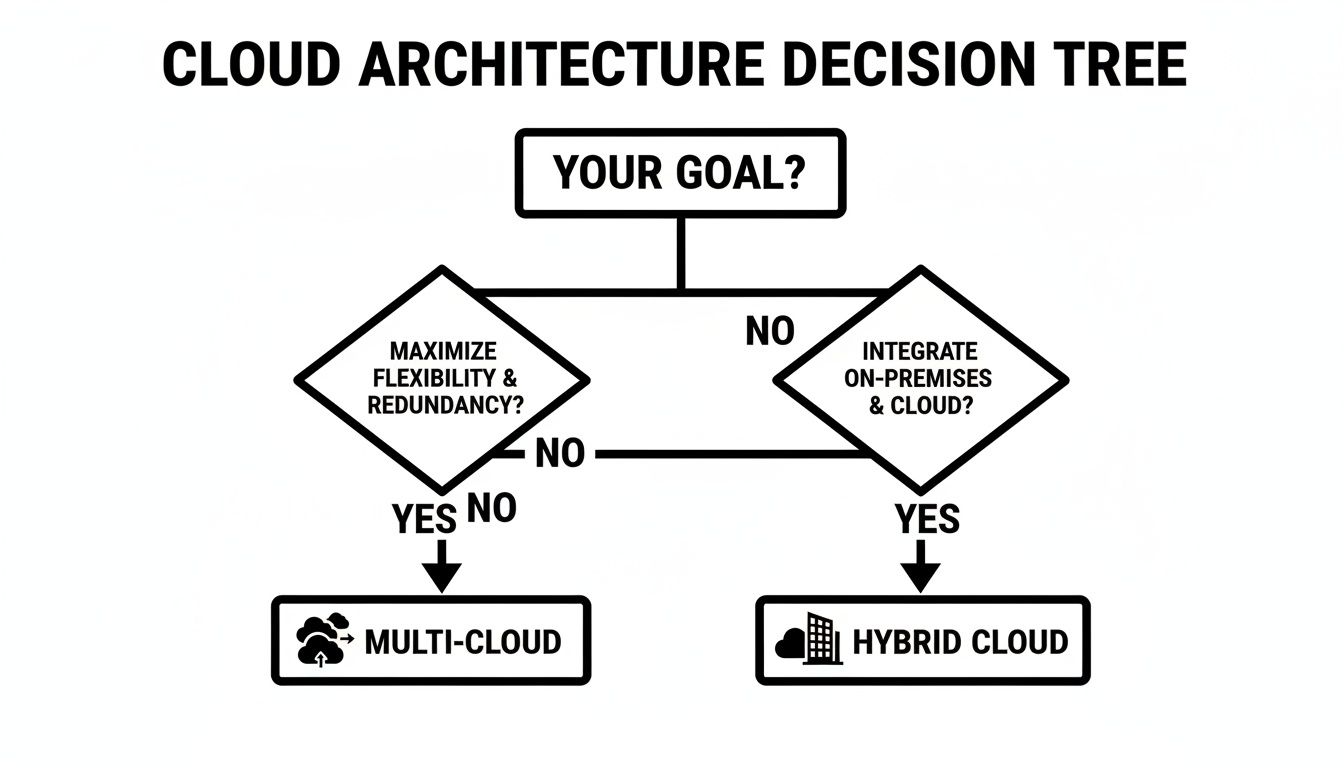
It breaks down the initial choice pretty clearly: if your priority is cherry-picking the best services from each provider and dodging vendor lock-in, multi-cloud is probably where you're headed. But if tight control over sensitive data and making use of your existing hardware is the main game, a hybrid approach is the more natural fit.
Navigating the Cost Management Landscape
Managing costs in a multi-cloud environment is basically a masterclass in FinOps. You're juggling bills from multiple vendors, and each one has its own wacky pricing, billing cycles, and discount models. The biggest headache? Getting a single, coherent view of your total cloud spend. Without specialized tools, trying to track expenses and cut waste across AWS, Azure, and GCP all at once is next to impossible.
On the flip side, hybrid cloud serves up a different kind of financial puzzle. It’s a mix of predictable capital expenses (CapEx) for your on-prem gear and variable operational expenses (OpEx) for whatever you use in the public cloud. While that can bring some stability to your baseline workload costs, it demands sharp capacity planning. Over-invest in your private cloud, and you’ve wasted CapEx on idle servers. Under-provision, and you’ll get hit with expensive, unplanned bursts into the public cloud.
The core financial trade-off is clear: multi-cloud demands sophisticated, continuous spend optimization across variable costs, while hybrid cloud requires disciplined upfront capital planning balanced with ongoing operational expenses.
No matter which path you take, you need a proactive financial strategy. For engineering leaders trying to get this right, understanding cloud migration best practices is key to keeping costs in check from day one. You can explore a detailed guide on the 10 cloud migration best practices for engineering leaders in 2025 to make sure your move is both technically solid and financially smart.
The Security Posture in Each Model
Security is easily one of the heaviest considerations in the multi-cloud vs. hybrid cloud debate. Each path brings its own set of challenges, and both demand specialized expertise you can't afford to fake.
With a multi-cloud architecture, the biggest security challenge is creating and enforcing consistent policies across completely different ecosystems. Each cloud provider has its own identity and access management (IAM) framework, its own security tools, and its own set of compliance certifications. Your security team either has to become fluent in multiple platforms or lean on third-party tools to stitch together a unified security posture, which just adds another layer of complexity.
Key multi-cloud security challenges include:
Inconsistent Security Controls: Trying to apply the same access rules or threat detection standards across different clouds is a constant battle without a good centralized management plane.
Expanded Attack Surface: Every new cloud platform you add increases the number of potential entry points for attackers. It's that simple.
Data Governance Complexity: Keeping track of where your data lives and making sure you’re compliant with rules like GDPR gets a lot harder when that data is scattered across multiple vendors in different parts of the world.
A hybrid cloud model, in contrast, shifts the security focus. Here, the main concern is the perimeter and the connections between your private data center and the public cloud. The real challenge is locking down the network fabric and the data flowing between your on-prem world and the cloud. One little misconfiguration in a VPN, direct connect, or firewall can open up a massive vulnerability.
Analyzing Operational Demands and Team Skills
The cloud model you choose will directly shape the kind of engineering team you need to build. A successful multi-cloud strategy leans heavily on a team of versatile generalists. Your engineers need to be comfortable working across several cloud platforms and skilled with cloud-agnostic tools like Terraform and Kubernetes to bring some operational sanity to the environment. They have to be cross-platform experts.
A high-performing hybrid environment, however, requires deep specialists. You need engineers who are experts in on-premises systems (like VMware or OpenStack) and have deep knowledge of a specific public cloud. On top of that, specialized networking and security skills are completely non-negotiable to manage the complex plumbing between the two worlds. These roles demand a strong platform engineering mindset to maintain a cohesive operational fabric.
The hard truth is that finding people with these specific skill sets is one of the biggest things holding companies back from executing either strategy well. Whether you need adaptable multi-cloud generalists or deep hybrid cloud specialists, the talent gap is very real.
TekRecruiter closes that gap. As a premier technology staffing and AI engineering firm, we connect you with the top 1% of cloud engineers who have the exact skills your chosen architecture demands. We empower you to bring in world-class talent to build, secure, and manage your infrastructure, turning your cloud strategy from a plan on paper into a real competitive advantage.
Choosing the Right Cloud Model for Your Business
Moving from architecture diagrams to the real world is where the multi-cloud vs. hybrid cloud debate really heats up. The right choice isn’t in a textbook; it’s a direct reflection of your company’s unique challenges and strategic goals. To make this tangible, let's walk through two distinct scenarios where one model is the clear winner.
These examples offer a solid framework for figuring out which approach truly aligns with your company's regulatory, performance, and strategic needs.
The Multi-Cloud Use Case: A Global SaaS Company
Picture a fast-growing SaaS company with customers scattered across the globe. Their top priorities are delivering a low-latency user experience, navigating a maze of international data sovereignty laws, and tapping into the best AI/ML services to keep their edge. A multi-cloud strategy is practically tailor-made for this situation.
Their setup might look something like this:
Regional Performance: They deploy their application front-ends on cloud providers with the strongest footprint in key markets. Maybe that’s AWS in North America, Azure in Europe, and Google Cloud in the Asia-Pacific region. This move alone drastically cuts latency and boosts the user experience.
Data Sovereignty: To stay compliant with regulations like GDPR, they can house European user data exclusively within an EU-based data center from one provider, while keeping data from other regions on a completely different provider’s infrastructure.
Best-of-Breed Services: Let's say they want to build a killer recommendation engine. They might use Google Cloud's Vertex AI for its powerful machine learning tools, even if the rest of their core application lives on AWS.
For this SaaS company, avoiding vendor lock-in isn't just a nice-to-have. It’s a core business strategy that fuels their agility and lets them optimize performance anywhere in the world.
The Hybrid Cloud Use Case: A Healthcare Organization
Now, let's pivot to a large healthcare organization. This institution manages highly sensitive protected health information (PHI) and is locked into strict HIPAA compliance. They also have a massive investment in their on-premises data centers. For them, a hybrid cloud model isn’t just an option—it’s a necessity.
Their architecture is built around a completely different set of priorities:
Compliance and Control: All patient records and the core electronic health record (EHR) systems stay on-premises in a private cloud. This gives them direct, physical control over security and data governance—a non-negotiable for meeting HIPAA standards.
Scalable Compute for Innovation: They tap into the public cloud's elastic compute resources to process enormous medical imaging files, like MRIs and CT scans. This allows them to run complex analysis without buying and maintaining ridiculously expensive, specialized hardware on-site.
Modern Patient Engagement: To deliver a reliable and modern digital experience, telehealth platforms and patient portals are hosted in the public cloud, which is perfect for handling fluctuating user traffic.
For this organization, the primary driver isn't agility; it's risk mitigation and regulatory adherence. The hybrid model allows them to innovate with public cloud services while keeping their most critical data securely within their own four walls.
This approach is standard practice in regulated industries. The data backs it up: about 39% of organizations report using a hybrid cloud as part of their core strategy, particularly in sectors where data residency and sovereignty dictate architecture. You can dig deeper into why hybrid cloud is so dominant in these sectors and understand why it’s the go-to for banking, insurance, and government.
Choosing the right model demands a deep understanding of your business's DNA. Whether you're building a global, agile platform or a secure, compliant system, the success of your strategy will hinge entirely on the talent you have executing it.
Building a team with the specialized skills for either multi-cloud or hybrid environments is a serious challenge. TekRecruiter is a technology staffing and AI Engineer firm that helps innovative companies clear this hurdle. We provide access to the top 1% of engineers anywhere, ensuring you have the world-class talent needed to turn your cloud vision into reality.
Building Your Elite Cloud Engineering Team
Your cloud strategy—whether it’s multi-cloud or hybrid—is only as good as the people running it. The most sophisticated architecture on paper means nothing without the right engineers to build, manage, and secure it. This is the part of the cloud decision that gets underestimated the most, yet it's the most critical.

The skills required for each model are fundamentally different. When you pick an architecture, you’re not just making a technical choice; you're committing to building a very specific kind of engineering team.
The Multi-Cloud Generalist
A successful multi-cloud environment is run by a team of versatile engineers—true generalists with broad, cross-platform expertise. These aren’t just AWS experts or Azure specialists; they are fluent in the nuances of multiple public clouds and know how to make them work together.
This team's core game plan has to include:
Broad Public Cloud Knowledge: You need deep, practical experience across AWS, Azure, and GCP to pick and stitch together the best services from each.
Cloud-Agnostic Tooling: Fluency in tools like Terraform for infrastructure-as-code and Kubernetes for container orchestration is non-negotiable. This is the common language that makes disparate environments manageable.
Strong FinOps Chops: The ability to track, analyze, and optimize spending across multiple vendor bills is a must-have skill to keep costs from spiraling out of control.
These "T-shaped" engineers—with deep expertise in one area and wide knowledge across many—are in extremely high demand and incredibly short supply.
The Hybrid Cloud Specialist
In contrast, a high-performing hybrid cloud team is built on deep specialization. The challenge isn't juggling multiple public vendors, it's bridging two completely different worlds: your on-premise infrastructure and a public cloud.
A successful hybrid team needs:
Dual-Environment Mastery: Your engineers need profound expertise in both on-prem systems like VMware and a specific public cloud provider. One without the other won’t work.
Specialized Networking Skills: Deep knowledge of VPNs, direct connections, and software-defined networking is mandatory to build a secure, reliable bridge between your data center and the cloud.
Integrated Security Expertise: The team must be adept at securing the network perimeter and managing data in transit between private and public domains, which is a massive attack surface.
The core difference in talent is breadth versus depth. Multi-cloud demands engineers who can navigate multiple platforms, while hybrid cloud requires specialists who can master the complex integration between two distinct architectures.
To build your elite cloud team, you have to get recruitment right. To get a head start, you can explore the 12 Best AI Tools for Talent Acquisition and see how modern platforms can help you find these scarce skill sets. For more focused guidance, our practical guide to hiring DevOps engineers offers actionable strategies.
The talent gap is the single greatest risk to executing a complex cloud strategy. Navigating the scarcity of these specialized skills is where many organizations falter. TekRecruiter is a technology staffing and AI Engineer firm that bridges this gap, allowing innovative companies to deploy the top 1% of engineers anywhere and turn their cloud vision into a competitive advantage.
Execute Your Cloud Strategy with World-Class Talent
Deciding between multi-cloud and hybrid cloud isn’t the finish line; it’s the starting gun. Your choice, shaped by regulation, cost, performance, and your existing infrastructure, clarifies the technical roadmap. But a roadmap is just a piece of paper without the right team to execute it.
Whether you land on multi-cloud, hybrid, or a sophisticated hybrid multi-cloud setup, your success hinges entirely on the skill of your engineering talent. The single biggest risk to any complex cloud strategy is the talent gap. An architectural plan without the people to build it is a blueprint for failure, plain and simple. It leads to security holes, blown budgets, and stalled innovation.
Bridging the Talent Gap
The skills needed to manage a distributed multi-cloud environment are fundamentally different from those required for a deeply integrated hybrid one. Finding engineers who are not only proficient but are truly in the top tier of their field is a massive undertaking for any company. This is where a strategic talent partner becomes mission-critical.
At TekRecruiter, we bridge that gap. As a premier technology staffing and AI engineering firm, we give you direct access to the top 1% of cloud engineers. These are the elite professionals fluent in AWS, Azure, GCP, and the complex integrations that define modern hybrid environments. We help innovative companies build the scalable, high-performing teams they need to turn a cloud vision into a reality.
The real differentiator in the multi-cloud vs. hybrid cloud debate isn't the technology. It's the team you build to manage it. Investing in top-tier talent is the most direct way to de-risk your cloud initiative and guarantee its success.
Preparing for What's Next in Cloud Engineering
Cloud engineering is constantly advancing, and the skill sets required are becoming more specialized by the day. For CTOs and engineering leaders, the writing is on the wall. Future success will depend on assembling teams skilled in multi-cloud, hybrid, and AI platform engineering—all at the same time.
Mastering Terraform-based IaC, cross-cloud security, FinOps, and MLOps that operate seamlessly across all major platforms will become the new standard. Check out these 2026 cloud predictions to get a sense of just how quickly talent requirements are evolving.
Navigating this requires a partner who gets both the technology and the talent market. If you're looking for outside help, understanding how to find elite DevOps consulting firms is a crucial first step in getting the right skills to support your team.
Don’t let a talent shortage kill your strategic goals. Partner with TekRecruiter to deploy the world-class engineers you need, right when you need them. We provide the expertise that lets you build, manage, and optimize your cloud infrastructure, making sure it’s a powerful engine for growth, not a source of friction.
Got Questions? Let's Clear Things Up.
When you're deep in the weeds comparing multi-cloud and hybrid cloud, some specific questions always seem to pop up. Let's tackle the most common ones I hear from engineering leaders to iron out any lingering confusion.
Can You Just Combine Multi-Cloud and Hybrid Cloud?
Absolutely. In fact, it’s becoming the go-to strategy for a lot of large organizations, often called a “hybrid multi-cloud.”
Think of it this way: a company might have an on-premise data center tightly integrated with AWS for its core applications (that’s the hybrid part). At the same time, they could be tapping into Google Cloud's specialized machine learning services for a specific, data-intensive project.
This approach gives you the ultimate flexibility, but it’s not for the faint of heart. It brings the highest level of management and security complexity, demanding a truly top-tier engineering team to pull it off without creating chaos.
Which Strategy Is Better for Dodging Vendor Lock-In?
If avoiding vendor lock-in is a top priority, multi-cloud is your answer. It’s practically built for that purpose.
By designing your applications to be portable and spreading your workloads across different providers, you keep your options open and maintain serious negotiating leverage. A hybrid cloud helps by keeping some things on-prem, but that public cloud piece often becomes deeply intertwined with a single vendor. Unwinding that kind of dependency down the road can be a massive headache.
The entire philosophy behind multi-cloud is choice. By design, you ensure no single provider holds all the keys to your kingdom, preserving your freedom to pivot and optimize for years to come.
What's the Single Biggest Hurdle in a Multi-Cloud Environment?
Without a doubt, the biggest challenge is wrestling with unified governance, security, and cost management.
Every cloud provider has its own unique set of tools, APIs, and security models. This makes it incredibly difficult to enforce consistent policies across the board or even get a single, clear picture of your spending and performance.
This operational mess is why sophisticated management platforms are essential, along with highly skilled engineers who are fluent in cloud-agnostic tools like Terraform and Kubernetes. Those tools are what let you build a consistent operational fabric that stretches across totally different cloud environments.
Your cloud architecture is only as strong as the team building it. Whether your strategy is multi-cloud, hybrid, or a combination of both, success depends on having elite engineering talent. TekRecruiter is a technology staffing and AI Engineer firm that allows innovative companies to deploy the top 1% of engineers anywhere. Build your world-class cloud team today.
Comments