_edited.png)
A CTOs Guide To Developing In The Cloud For Maximum Impact
Developing in the cloud isn't just a technical decision anymore—it's the engine driving business speed, innovation, and scale. For engineering leaders, it’s a strategic imperative to build better products, faster. This approach completely changes how we create, deploy, and maintain software, moving us away from rigid, self-managed infrastructure to flexible, on-demand services.
The Strategic Shift To Cloud Development

Moving your development to the cloud is about so much more than where you store your code. It's about a total transformation of your entire software delivery lifecycle. You’re fundamentally shifting from massive capital expenditures on hardware to a more fluid, operational spending model on services. This allows your company to react to market demands instantly, not in six months when the new servers finally arrive.
Think of it this way: traditional, on-premise development is like building a factory from scratch. You have to buy the land, pour the foundation, construct the building, and purchase all the heavy machinery before you can produce a single widget. The upfront cost and time are immense. And if you need to scale? You’re looking at another major construction project.
In contrast, developing in the cloud is like having access to a global network of advanced, automated manufacturing plants. You only pay for the production time and capacity you actually use. You can scale up or down in minutes and get immediate access to cutting-edge tech—from serverless computing to AI—without having to build any of it yourself.
Why The Cloud Is A Business Imperative
This pivot from building infrastructure to consuming it gives you a serious competitive edge. It’s not just about saving money on hardware; it's about reallocating your most valuable resource—your engineering talent—away from just maintaining servers and toward creating real customer value. The focus shifts from "keeping the lights on" to innovating and shipping features that drive revenue.
The market has already made its decision. Today, an estimated 72% of global workloads are hosted in the cloud, a clear sign that this is the new standard. As companies move their core services, developer workflows are naturally standardizing around cloud-native tools for CI/CD, managed services, and AI. If you want more context, you can explore more insights about cloud adoption statistics and see just how deeply this trend is reshaping engineering.
Cloud development is the strategic decision to trade the slow, predictable pace of owned infrastructure for the rapid, dynamic capabilities of a global computing platform. It prioritizes speed and agility, allowing teams to experiment, fail fast, and scale successes instantly.
This operational model unlocks a few critical benefits:
Accelerated Innovation: Teams can spin up development and testing environments on demand, dramatically shortening the cycle from a whiteboard idea to a live deployment.
Global Reach: Deploying applications close to your users worldwide becomes a simple configuration change, not a massive capital investment in new data centers.
Enhanced Scalability: Your systems can automatically scale to handle massive traffic spikes and then shrink back down to save costs during quiet periods, ensuring you’re always running efficiently.
Ultimately, mastering cloud development is essential for building a resilient, competitive engineering organization. To make it happen, you need engineers who are more than just great coders. You need experts in cloud architecture, security, and cost optimization. Finding that top-tier talent is often the biggest hurdle.
Choosing Your Cloud Platform And Architecture
So, you’re committed to developing in the cloud. Now comes the hard part: deciding where you’ll build and how you’ll build it. This isn't just about picking a vendor from a list; it’s a strategic choice that will define your team's speed, your product's ability to scale, and how quickly you can innovate for years to come.
Think of it like planning a brand-new city. Your cloud platform—whether it's Amazon Web Services (AWS), Microsoft Azure, or Google Cloud Platform (GCP)—is the land and the core infrastructure. It provides the power grid, the water supply, and the raw building materials. Your application architecture is the city plan itself, the blueprint that dictates how every road, building, and neighborhood connects.
Selecting Your Core Cloud Provider
The public cloud market is dominated by three giants, and each has its own distinct personality and strengths. A feature-by-feature comparison will only get you so far. You need to align their strengths with your business goals.
AWS: The original pioneer, AWS has the most comprehensive and mature ecosystem. It’s often the default for startups and any company that needs the widest array of tools and a massive talent pool to draw from.
Azure: If your company already runs on Microsoft products like Office 365 or Active Directory, Azure is a natural fit. It excels in the enterprise world with powerful hybrid cloud capabilities, making it the go-to for organizations with deep on-premise investments.
GCP: Google’s powerhouse shines in data analytics, machine learning, and container orchestration with Kubernetes. If your business is data-driven or you're building hyper-scalable modern applications, GCP is a serious contender.
For a deeper technical breakdown, this article on Comparing Google Cloud and AWS offers a great perspective that can help clarify which platform’s DNA best matches your roadmap.
To help frame this crucial decision, here’s a high-level look at how these platforms stack up for a CTO.
Cloud Platform Decision Matrix For CTOs
Factor | AWS (Amazon Web Services) | Azure (Microsoft) | GCP (Google Cloud Platform) |
|---|---|---|---|
Enterprise Adoption | Market leader by a significant margin; deep penetration across all industries. The "safe" and established choice. | Stronghold in the enterprise, especially with existing Microsoft customers. The go-to for hybrid cloud strategies. | Gaining traction rapidly, especially in tech-forward and data-intensive industries. Strong among startups. |
Core Strengths | Breadth and depth of services, massive global infrastructure, mature ecosystem, and largest community. | Seamless integration with Microsoft stack (Active Directory, Office 365), robust hybrid cloud solutions, strong PaaS offerings. | Best-in-class data analytics (BigQuery), machine learning (AI Platform), and container management (Kubernetes/GKE). |
Ideal Use Cases | General-purpose workloads, large-scale deployments, startups needing a vast toolkit, applications requiring a wide range of services. | Hybrid cloud environments, organizations heavily invested in Microsoft software, enterprise-grade applications. | Data-intensive applications, AI/ML-driven products, container-native development, global-scale microservices. |
Ultimately, the "best" platform is the one that removes the most friction for your team and aligns with your long-term product vision.
From Monoliths To Microservices
Just as critical as your platform choice is your architectural approach. This is where the city-planning analogy really hits home.
A traditional monolithic architecture is like constructing a single, massive skyscraper that houses everything—apartments, offices, shops, and the power plant. All your code is tangled together in one tightly coupled application. At first, this is simple. It's easy to build and deploy.
But as that skyscraper gets taller, problems emerge. A small change, like fixing the plumbing on the 10th floor, risks flooding the entire building. Scaling becomes an all-or-nothing headache. If the retail stores on the ground floor get swamped with customers, you have to scale the entire skyscraper, which is wildly inefficient.
The modern cloud-native approach is a microservices architecture. Instead of one skyscraper, you design a city full of specialized, interconnected buildings. There’s a separate apartment complex, an office park, and a dedicated power plant. Each building—or service—is developed, deployed, and scaled on its own.
A microservices architecture is all about agility and resilience. It breaks a large application into a collection of small, independent services, where each service handles a specific business function and communicates through well-defined APIs.
This unlocks some huge advantages for teams building in the cloud:
Independent Deployment: Your payments team can push an update to their service without coordinating a massive, high-risk release for the entire application.
Targeted Scalability: If your product catalog service gets slammed during a holiday sale, you can scale just that service, saving a fortune on resources.
Technology Flexibility: The user authentication service can be written in Go, while the recommendation engine can be built in Python. You can use the best tool for every job.
Of course, this "city of services" creates new challenges, like managing network traffic and keeping data consistent across services. If you're navigating these complexities, our guide on the top cloud migration services to watch in 2025 can help.
The market data shows just how big this shift is. In 2025, a staggering 33% of organizations are spending over $12 million a year on public cloud services. That spending is driven by the demands of modern architectures and AI, making it absolutely critical to choose a platform and architecture that you can manage efficiently.
Ultimately, getting this foundational step right requires a clear-eyed view of your business goals, your team's skills, and your product's future.
Mastering The Cloud Native CI/CD Pipeline
Once you’ve settled on a platform and your architecture, the next job is building the engine that actually drives your software delivery. This is your Continuous Integration and Continuous Deployment (CI/CD) pipeline, a concept that completely changes how code gets from a developer’s laptop into a live production environment.
Think of it as the high-tech, automated assembly line for modern software.
Imagine an old-school car factory where every part is built and installed by hand. The whole process is slow, full of potential for human error, and one mistake can bring everything to a grinding halt. A cloud-native CI/CD pipeline is the complete opposite—it’s like a fully automated, robotic assembly plant. Raw code goes in one end, and a finished, quality-tested application rolls out the other with almost no manual intervention.
This automation is the beating heart of a true DevOps culture. To really get this right, you have to understand what DevOps automation entails and how it shifts software delivery from a series of clumsy manual handoffs into one seamless, automated flow. It frees up your engineers from doing the same boring, error-prone tasks over and over, letting them focus on what they were hired to do: build great features.
The Anatomy Of A Cloud CI/CD Pipeline
A solid pipeline is made up of a few key stages, each with a specific job to ensure code gets built, tested, and deployed safely and efficiently. The real goal here is to make releases a non-event—just a routine, predictable part of the day, not a high-stress, all-hands-on-deck emergency.
A typical cloud-native pipeline includes:
Source Control (e.g., Git): This is the single source of truth for all your code. Every single change is tracked, which lets developers collaborate without stepping on each other's toes and roll back to a previous version if something goes wrong.
Build Automation (e.g., Jenkins, GitLab CI): The moment a developer pushes new code, an automated process kicks off to compile it and get it ready for testing. This guarantees consistency and finally kills the "but it works on my machine!" problem.
Containerization (e.g., Docker): Your code gets packaged into a lightweight, portable container. This standardizes the application's entire environment, making sure it runs the exact same way everywhere—from a developer’s local machine all the way to production.
Infrastructure as Code (IaC) (e.g., Terraform, CloudFormation): All of your cloud infrastructure—servers, databases, networks—is defined in code. This makes creating and managing entire environments repeatable, auditable, and easy to scale.
Your decision between a monolith and microservices will have a huge impact on how complex your pipeline needs to be. This decision tree helps visualize how the needs of your application steer that fundamental choice.
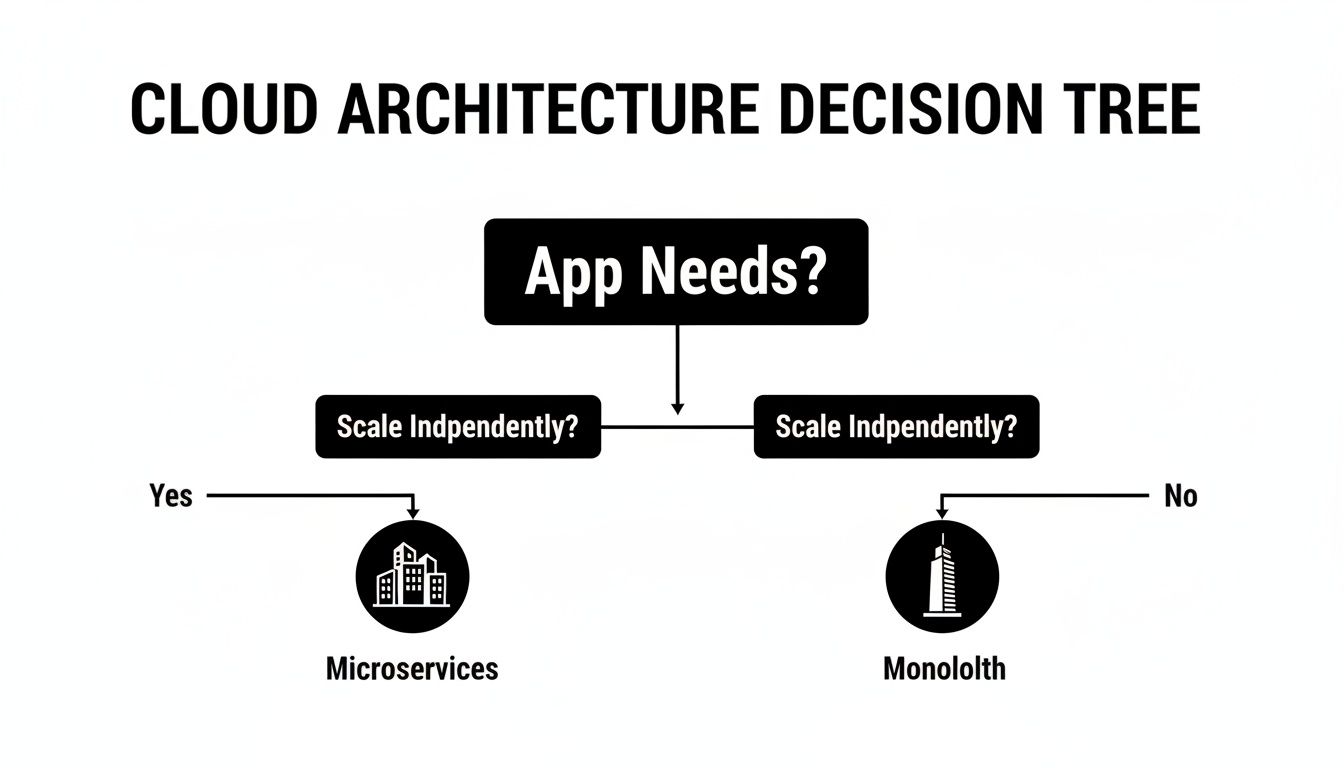
This gets to a core principle: if different parts of your application need to scale independently to be efficient, a microservices path is almost always the better choice. That, in turn, requires a much more sophisticated CI/CD setup to handle lots of small, independent pipelines.
The Cultural Shift To DevOps
A CI/CD pipeline is an incredibly powerful tool, but it’s pretty useless without the right culture to back it up. DevOps is not just a role; it's a mindset that’s built on collaboration, shared responsibility, and a blameless attitude when things break. The old walls between development ("Dev") and operations ("Ops") have to come down.
In a true DevOps culture, the team that builds the software is also responsible for running it in production. This shared ownership creates a powerful feedback loop that drives quality, reliability, and speed.
This cultural change demands a focus on psychological safety, where engineers feel like they can experiment and learn from mistakes without fearing blame. When an issue comes up, the question is "How can we improve the system?", not "Whose fault is this?". The sheer complexity of managing containerized microservices often pushes teams to adopt powerful orchestration tools. You can get more insights from our article on Kubernetes consulting services for seamless cloud-native adoption.
Building this kind of high-velocity engineering organization is one of the biggest challenges for any technology leader. It doesn’t just require the right tools and processes, but also the right people.
Implementing Cloud Governance, Security, And FinOps
Developing in the cloud hands your teams an incredible amount of speed and power. But that power comes with new responsibilities. Without the right guardrails, that agility can quickly devolve into chaos, opening you up to security vulnerabilities and runaway costs.
This is where cloud governance comes in. It’s the framework that lets you innovate safely and sustainably.
Think of it like this: you can give your team a high-performance race car, or you can give them the keys and a map. Governance provides the rules of the road—speed limits, traffic laws, and maintenance schedules—that prevent crashes. It tackles the two biggest concerns for any leader: security and financial management, treating them as two sides of the same coin.
The Shared Responsibility Model In Cloud Security
A classic mistake is assuming your cloud provider handles all the security. The reality is that security is a partnership, defined by the Shared Responsibility Model. Your provider—whether it's AWS, Azure, or GCP—is responsible for the security of the cloud. That means protecting the physical data centers, the hardware, and the core network.
But you are responsible for security in the cloud. This covers everything your team builds and configures on the platform. We’re talking about:
Data Security: Encrypting customer data, both when it's sitting still and when it's moving.
Identity and Access Management (IAM): Making sure only the right people can access specific resources. No exceptions.
Application Security: Writing secure code from the start and defending against common vulnerabilities.
Network Configuration: Properly setting up firewalls and virtual private clouds (VPCs) to control who and what gets in or out.
This model demands a proactive security posture. You have to embed security directly into the development process. This approach, known as DevSecOps, is a cultural shift. It makes security a shared responsibility for the entire engineering team, not just a problem for a siloed team at the end of the line. Using tools for policy as code, teams can automate security checks and compliance rules right inside their CI/CD pipelines, catching issues long before they ever see the light of day in production.
Embracing FinOps For Financial Accountability
Just as security needs a new mindset, so does cost management. The pay-as-you-go nature of the cloud is a massive advantage, but it can also lead to shocking, unpredictable bills. This challenge created FinOps, a cultural practice that brings financial accountability to the cloud's variable spending model.
FinOps isn't about micromanaging every dollar or blocking developers from spinning up resources. It’s about creating visibility and empowering teams to make cost-conscious decisions. It gets engineering, finance, and business teams all aiming for the same goal: squeezing the most business value out of every single dollar spent on the cloud.
FinOps is the practice of bringing a financial management discipline to the cloud, enabling organizations to get the most value from their cloud investments by fostering a culture of cost awareness and accountability.
A few key FinOps practices include:
Cost Visibility and Allocation: Using tagging strategies to pin down exactly which teams, projects, or products are responsible for which cloud costs.
Budgeting and Forecasting: Setting clear budgets and using the cloud provider’s own tools to predict future spending.
Cost Optimization: Automating policies to shut down idle resources, right-size instances, and lock in savings plans.
Balancing Agility With Control
The data on cloud adoption tells a clear story. While a stunning 94% of businesses report security improvements after moving to the cloud, cost management is still a huge headache. Roughly 82% of decision-makers say managing cloud spend is a top concern, a problem that gets worse when you have zero visibility into application-level costs.
These trends prove that while developing in the cloud speeds up delivery, you have to invest in governance, FinOps, and security controls. If you don't, you won't capture the benefits and will instead face unsustainable costs or compliance nightmares. Dive into the latest trends in cloud computing statistics to see just how big this challenge is.
Effective governance is what makes the promise of cloud agility a reality. Without it, you’re just asking for security breaches, budget overruns, and compliance failures that can stop innovation dead in its tracks.
Putting a solid governance framework in place requires specialized expertise in cloud security, policy automation, and FinOps. The trick is finding engineers who can build these guardrails without slowing your team down.
8. Building Your Elite Cloud Engineering Team

Here’s the thing about developing in the cloud: technology is only half the equation. Your platform choice and CI/CD pipeline are just tools. It’s the people who wield them that determine success or failure. For any leader, building a high-performing cloud team in this fiercely competitive market is often the single biggest obstacle you'll face.
Without the right talent, even the most brilliant cloud strategy will stall out. You need more than just generalist software developers. A modern cloud team is a blend of specialists, each bringing a critical perspective to the table.
The Essential Roles On A Modern Cloud Team
To really run a cloud-native ecosystem, you need a roster of specialists. These are the core roles that form the foundation of a team that can build, secure, and optimize applications the right way.
Cloud Architect: This is the visionary who designs the entire cloud environment. They make the big-picture decisions on architecture and services, ensuring the technical strategy actually lines up with what the business needs to achieve.
DevOps Engineer: The builder of your automation engine. This role is all about the CI/CD pipeline, infrastructure as code, and monitoring. Their job is to make deployments fast, reliable, and repeatable.
Cloud Security Engineer: The guardian of your cloud assets. They’re responsible for implementing security controls, managing access, and proactively hunting for vulnerabilities before they become a problem.
FinOps Specialist: The financial steward. This is an emerging but critical role focused entirely on cloud cost management. They make sure you’re getting the most business value out of every dollar you spend on cloud services.
Trying to find individuals with deep expertise in all these areas through traditional hiring is incredibly slow and expensive. The talent market is tight, and top-tier cloud engineers are always in high demand.
A common mistake is trying to hire a single "cloud expert" to do it all. True cloud mastery requires a team of specialists. The domains of architecture, security, automation, and cost are each too deep for one person to truly master.
This hiring bottleneck is forcing leaders to think differently about how they build their teams.
Beyond Traditional Hiring Models
When you can’t find the right people fast enough, you lose momentum. To keep projects from grinding to a halt, savvy leaders are turning to more flexible talent strategies. This means looking beyond your local market and embracing modern ways of sourcing expertise.
Two powerful strategies stand out:
Staff Augmentation: This model lets you embed highly skilled engineers directly into your existing teams to fill immediate skill gaps or for specific projects. You get the expertise you need, right now, without the lengthy process and long-term commitment of a full-time hire.
Nearshore Talent Pools: Tapping into talent hubs in regions like Latin America gives you access to a world-class pool of engineers who are often in a compatible time zone. This approach delivers top-tier skills with significant cost advantages.
These flexible models are essential for any organization that needs to move quickly. If you're struggling to build out your internal capabilities, our guide on how to find elite DevOps consulting firms can give you some valuable insights.
Ultimately, your ability to execute your cloud strategy depends entirely on the strength of your team. In a world where every company is a tech company, the one with the best talent wins.
Accelerate Your Cloud Journey With Elite Talent
The path to building in the cloud is clear. You need the right architecture, automated CI/CD pipelines, and tight governance over security and costs. But none of that matters without the right people to bring it all together.
Your entire cloud strategy rests on one foundation: talent.
Without the right engineers, the best-laid plans and most powerful platforms are just burning money. The biggest bottleneck to cloud innovation isn’t technology—it’s the brutal fight to find and keep engineers with specialized, battle-tested expertise.
The Talent Bottleneck To Cloud Innovation
Modern cloud development is a high-stakes game. This isn't a place for generalists. It demands architects who design for resilience and scale, DevOps specialists who live and breathe automation, and security experts who build defenses, not just react to breaches.
You can't afford to let your team learn on the job when your core business is on the line.
The truth is, the most skilled cloud professionals—the ones who have actually built and scaled systems for years—are in ridiculously high demand. This is the wall most companies hit when they try to speed up their cloud initiatives.
The success of your cloud strategy is directly proportional to the caliber of the engineering talent executing it. Access to the top 1% of cloud engineers is no longer a luxury; it's a strategic necessity for any company serious about winning in its market.
This is where a real talent partner changes the game. Stop wasting time in endless recruiting cycles. You need to bypass the bottleneck and plug directly into the elite expertise required to move forward with confidence.
Deploy The Top 1% Of Engineers Anywhere
At TekRecruiter, we know that building a world-class engineering team is the hardest part of the puzzle. We solve that problem. We connect innovative companies with the top 1% of cloud and AI engineers on the planet.
Our model is built to give you the exact expertise you need, right when you need it. You can learn more about how to leverage staff augmentation best practices for tech teams to fill critical skill gaps without the friction of traditional hiring.
Whether you need to embed a senior cloud architect, build a dedicated nearshore team for a new project, or find elite AI specialists for your next product—we deliver the talent to make it happen. Stop letting hiring challenges dictate your roadmap. Let us help you deploy the world-class engineers you need to win.
You’ve Got Questions, We’ve Got Answers
As engineering leaders start moving development into the cloud, the same practical questions tend to pop up. Let’s tackle some of the most common ones I hear from CTOs and VPs of Engineering.
How Do I Choose The Right Cloud Provider?
Picking between AWS, Azure, and GCP isn't about finding the "best" one on paper. It's about finding the right fit for your business, your team, and your roadmap. Forget the feature-by-feature comparison for a minute and think context.
AWS is the market leader for a reason. It's the safe, default choice with a massive ecosystem and an even bigger talent pool. You’ll never struggle to find engineers who know their way around it.
Azure is a no-brainer for enterprises already deep in the Microsoft world. If your organization runs on Windows Server, Office 365, and Active Directory, the integration is seamless and the learning curve for your team will be much gentler.
GCP has serious engineering cred, especially for anyone building data-heavy applications, doing cutting-edge machine learning, or going all-in on Kubernetes-native architecture. They practically invented it, after all.
Start with your business goals. Are you an enterprise needing hybrid cloud capabilities? Look hard at Azure. Are you building the next big AI product? GCP should be at the top of your list.
What Is The Biggest Mistake In Cloud Migration?
Hands down, the single biggest mistake is the "lift-and-shift." This is where you take your on-prem servers and applications and just drop them onto cloud VMs, expecting magic to happen. It won't.
You end up with all the costs of the cloud but none of the real benefits like auto-scaling, resilience, or serverless functions. It's like buying a Ferrari and only driving it in school zones.
The real goal isn't just to run your applications on the cloud; it's to build them for the cloud. A successful migration means re-architecting your applications to be cloud-native. That’s where you unlock the speed, efficiency, and cost savings you were promised.
How Does Cloud Development Impact Team Structure?
Moving to the cloud is as much a cultural shift as it is a technical one. The old, siloed walls between developers, operations folks, and security teams have to come crashing down.
This new way of working is what we call a DevOps culture. Your teams become cross-functional, taking full ownership of a service from the first line of code all the way to deployment and supporting it in production. It’s a massive shift in responsibility, but it’s the only way to achieve the agility the cloud offers. It also means you'll need to start hiring for new roles like Cloud Architects and FinOps specialists to manage it all.
Navigating the move to the cloud isn't just about technology—it’s about having the right people on your team. TekRecruiter gives you a strategic advantage by connecting you with the top 1% of cloud and AI engineers from around the globe. Whether you need to augment your current team, build out a nearshore delivery center, or bring in specialized AI expertise, we find the experts who can accelerate your cloud journey. As a technology staffing, recruiting, and AI Engineer firm, we allow innovative companies to deploy the top 1% of engineers anywhere. Visit us to see how we build world-class engineering teams at https://www.tekrecruiter.com.
I think cloud development matters most when it leads to fewer workarounds for the people using the system every day. In parks and resorts, that means staff need bookings, finance, maintenance, and guest details connected without jumping between tools. That is why Elite Parks management system stands out to me. It is built around that joined-up way of working, with Microsoft Dynamics 365 behind it, which makes a lot more sense than patching together software that was never made for park operations.