_edited.png)
How to Build High Performing Teams in Tech
Building a high-performing team is about more than just hiring smart people. It’s about creating an environment where talented engineers feel secure enough to challenge ideas, admit mistakes, and take calculated risks. The secret sauce is psychological safety, and it’s what allows a team to become more than the sum of its parts. This foundation is what unlocks genuine collaboration and prevents stagnation.
Cultivating Psychological Safety in Engineering Teams
The real engine of a high-performing team isn't raw talent or a fancy tech stack—it's psychological safety. This gets misunderstood all the time as just being "nice." In reality, it's about creating a culture of intellectual fearlessness where engineers can speak up, question the status quo, and even fail without fearing humiliation or punishment.
Think about a junior developer who spots a potential flaw in a system designed by a principal architect. In a team lacking psychological safety, they stay silent. But in a safe environment, they voice their concern. That conversation uncovers a critical bug before it ever hits production. That’s the difference between a team that just executes and one that truly innovates.
Modeling Vulnerability from the Top
Psychological safety has to start with leadership. When engineering managers and tech leads openly admit their own mistakes or acknowledge what they don't know, they send a powerful message: it’s okay to be imperfect. That simple act of vulnerability dismantles the fear of looking incompetent.
For example, a manager could start a retrospective by saying, "My initial assumption about that user story was wrong, and it led us down a difficult path. Let's talk about how we can adjust our planning process." This immediately sets a tone where failure is just a data point for improvement, not a reason for blame.
The most powerful thing a leader can do to foster psychological safety is to model fallibility. By showing that mistakes are learning opportunities, they give their team permission to take the risks necessary for real breakthroughs.
Defining the Rules of Engagement
Constructive disagreement is the lifeblood of a great team, but it needs clear boundaries to keep it from turning destructive. You have to establish explicit rules for debate to ensure discussions stay focused on ideas, not people.
Attack the problem, not the person. Every discussion should center on the merits of a technical approach, never the person who proposed it.
Encourage questions, not just answers. You have to create space for team members to ask "why" and explore alternatives without feeling like they are challenging authority.
Assume positive intent. Encourage your team to believe their colleagues are acting in good faith. This alone can de-escalate most potential conflicts.
These ground rules transform potentially tense code reviews or architectural debates into productive, collaborative problem-solving sessions. The best leaders know that mastering these soft skills is a non-negotiable part of engineering excellence. For a deeper dive, it's worth reviewing the importance of soft skills and their impact on employee turnover.
The data backs this up, hard. Google's landmark Project Aristotle study found that psychological safety was the single most important predictor of a team's success. Teams that had it saw 19% higher productivity, 31% more innovation, and 27% lower turnover. The research was clear: how a team interacts matters more than who is on it. A culture of safety directly drives measurable business outcomes. You can explore the full findings from Google's research on high-performing teams to see the data for yourself.
Creating this foundation of trust is the first and most crucial step. Ready to find the elite engineers who thrive in this kind of environment? TekRecruiter specializes in sourcing the top 1% of technical talent—individuals who have both the technical chops and the collaborative mindset to build truly high-performing teams. Let us help you find the people who will build your next breakthrough.
Designing Your Team Structure for Maximum Impact
Great engineering teams don’t just happen. They’re designed. While psychological safety provides the cultural fuel, the team’s structure is the engine that turns that potential into real-world results. The right design amplifies output and kills friction, creating a system where your engineers can actually get things done.
Just throwing talented people together and hoping for the best is a classic recipe for confusion, burnout, and missed deadlines. You need a deliberate approach to team structure if you want to build an organization that can ship features, solve gnarly problems, and scale without imploding.
The trick is to align your team’s architecture with your product’s architecture and, most importantly, your company’s goals.
Matching Team Models to Your Mission
There’s no magic bullet here. The "best" team structure is the one that fits your specific context, and choosing the right one means being honest about the trade-offs between autonomy, dependencies, and communication overhead.
Most tech organizations can start with one of three common models:
Feature-Based Teams: These are cross-functional squads that own a specific user-facing feature or product area from concept to deployment. Think of a "Search Team" with its own front-end, back-end, and QA engineers. They have high autonomy and can ship value directly to the customer without waiting on anyone.
Platform Teams: This model is all about enabling other teams to move faster. A platform team builds and maintains the core infrastructure and services that everyone else consumes—things like the CI/CD pipeline, cloud infrastructure, or a shared component library. They abstract away the complexity so feature teams don’t have to worry about it.
Stream-Aligned Teams: Borrowed from the fantastic book Team Topologies, these are similar to feature teams but are aligned with a continuous "stream" of work. This could be a customer journey, a business domain, or a product line. The goal is to create a tight feedback loop and build deep domain expertise over time.
For a deeper dive, our guide on finding the right software development team structure breaks down the pros and cons to help you make a smarter decision.
This flowchart is a great mental model for thinking about the health and potential of your current team setup.

As you can see, true innovation only happens when a team feels safe enough to take calculated risks. The right structure makes that possible.
To help you visualize the options, here's a quick comparison of the most common engineering team structures.
Comparison of Engineering Team Structures
This table breaks down the common models to help you decide which structure best aligns with your product, goals, and company culture.
Team Model | Best For | Key Benefit | Potential Challenge |
|---|---|---|---|
Feature-Based | Product-led companies with distinct user-facing features. | High Autonomy: Teams can ship value independently and quickly. | Can lead to duplicated effort or inconsistent tech stacks without coordination. |
Platform | Organizations needing to standardize core infrastructure and tooling. | Efficiency: Enables other teams by abstracting away complex infrastructure. | Risk of becoming a bottleneck if not managed as an internal product. |
Stream-Aligned | Complex domains where deep business knowledge is critical. | Deep Expertise: Teams build incredible domain knowledge over time. | Requires a clear understanding of business value streams to define team boundaries. |
Functional | Early-stage startups or companies with highly specialized needs. | Technical Excellence: Deep skill development within a single discipline (e.g., front-end). | Creates silos and hand-offs, slowing down feature delivery significantly. |
Choosing a structure isn't a one-time decision. The best leaders are constantly evaluating what's working and are willing to adapt as the company and product evolve.
Managing Cognitive Load for Peak Performance
One of the most overlooked—and most critical—aspects of team design is managing cognitive load. This is the total amount of mental effort an engineer needs to perform their job.
When an engineer's cognitive load is maxed out because they have to understand too many systems, navigate a web of dependencies, or deal with vague processes, their performance plummets. They spend more time trying to figure out how to work than actually working.
Your team's structure should be a tool to reduce cognitive load, not add to it. The entire point is to free up your engineers' brainpower so they can focus on solving customer problems, not navigating your org chart.
An effective structure actively minimizes this burden. It means creating teams with clear boundaries, well-defined APIs for how they interact, and a focused mission. A good platform team, for instance, is a massive cognitive load reducer for every other engineer in the company.
The Power of a Clear Team Charter
Once you've landed on a structure, you need to make it real with a team charter. This isn't just bureaucratic fluff; it's a formal document that outlines the team's purpose, scope, and responsibilities. It’s the single best tool for killing ambiguity.
A solid charter should clearly define:
Mission: A simple, one-sentence explanation of why the team exists.
Scope of Ownership: What specific systems, features, or codebases does this team own? Be explicit.
Key Metrics: How will the team know if it's winning? What are the 2-3 numbers that define success?
Ways of Working: What are the team's core processes, communication norms, and decision-making frameworks?
By writing this down, you give teams genuine autonomy. They know exactly what they own and how they're expected to operate, which is the foundation of any high-performing team.
Sourcing and Onboarding Elite Engineering Talent

Your team’s performance will never outpace the talent you bring through the door. Building a high-performing engineering team doesn't start with the first sprint—it starts with a dead-serious strategy for finding and integrating elite engineers who elevate everyone around them.
Forget reactive hiring. You need a proactive system that hunts for problem-solvers motivated by impact, not just a laundry list of tech specs.
Writing Job Descriptions That Attract the Right People
The best engineers aren’t looking for tasks; they’re looking for challenges. Your job description is the very first signal you send about your culture and the kind of problems you’re solving. Ditch the generic list of technologies and start talking about the why.
Instead of saying, "Must have 5+ years of experience with Python," try this: "You'll use Python to build the machine learning model that predicts supply chain disruptions, saving our customers millions." See the difference? You’re shifting from a boring requirement to a high-impact mission. That’s what gets ambitious thinkers to click "apply."
A job description should be a compelling story about the role, not a sterile checklist. It's your first opportunity to sell top candidates on the mission and the meaningful problems they'll get to tackle.
To find the best, you have to go where they are—and that’s rarely the big job boards. Passive candidates, the ones already employed but open to something better, are your goldmine. Check out our guide on sourcing tech talent who aren't actively job hunting for real strategies to tap into this hidden market.
Designing an Interview Process That Reveals True Potential
Your interview process isn't an interrogation; it's a diagnostic tool. You need to assess three core areas that are non-negotiable for a high-performing team:
Technical Prowess: Move beyond abstract algorithm questions. Give them a practical coding challenge that actually mirrors the work they’ll be doing. A collaborative session on a simplified version of a real problem you’ve faced is infinitely more revealing than a whiteboard puzzle.
Collaboration Skills: Run a system design interview where the candidate pairs up with one of your current engineers. Watch how they communicate. How do they handle feedback? Do they defend their ideas constructively, or do they get defensive?
Growth Mindset: Ask them about a time they failed or a project that went sideways. What you're listening for is self-awareness, ownership, and proof that they learn from mistakes. A candidate who blames everyone else is a massive red flag.
Mastering the Crucial First 90 Days
You landed a great hire. Now the real work begins. A structured onboarding process is the difference between an engineer who’s productive in weeks and one who is still finding their footing months later. With 90% of startups failing, often because they can't build efficient teams quickly, a killer onboarding process becomes a serious competitive advantage.
Those first 90 days are everything for integration and retention. Your plan needs to be dialed in, designed to turn a promising hire into a genuine contributor.
Here’s a simple framework that works:
Week 1 – The First Win: Get them to ship something. Their entire first week should be focused on getting a small, low-risk change into production—a minor bug fix, a documentation update, anything. The goal is to demystify the dev environment, introduce them to the code review process, and give them an immediate sense of accomplishment.
First 30 Days – Mentorship and Learning: Assign a dedicated onboarding buddy who isn’t their manager. This person is their go-to for all the "dumb" questions and helps them navigate the team's unwritten rules. The focus here is on learning the codebase, understanding the product, and building relationships.
Days 31-90 – Contribution and Ownership: By now, the new hire should be taking on small features or well-defined tasks. They should be actively participating in team meetings and starting to bring their own ideas to the table. This is the transition from learning to doing.
For a deeper dive into making new hires feel welcome and getting them up to speed fast, check out these 9 Employee Onboarding Best Practices for 2025.
Sourcing and onboarding are the absolute bedrock of a high-performing team. Getting this right takes a deliberate, thoughtful approach. If you're struggling to find talent that meets these standards, it might be time to bring in a partner.
This is exactly what TekRecruiter does. We help innovative companies deploy the top 1% of engineers, whether you need to augment your team with nearshore talent or find specialists in AI. We handle the sourcing and vetting so you can focus on what you do best: building the future.
Processes That Actually Fuel High Performance
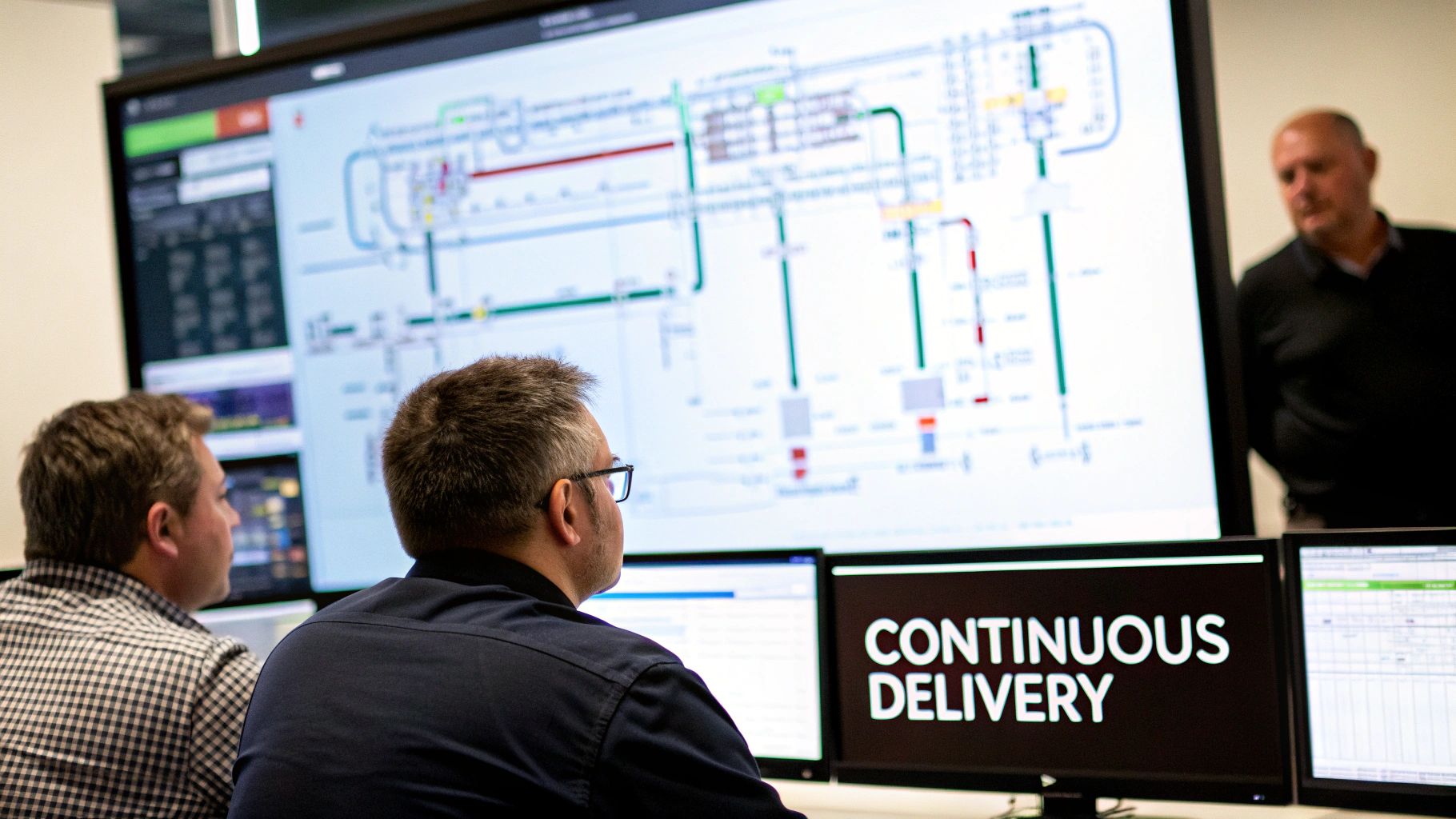
Hiring exceptional talent is only half the battle. To build a team that truly ships, you need an operational engine that empowers engineers to do their best work—not get bogged down by red tape.
Good processes shouldn’t feel restrictive. They should be guardrails that enable speed, safety, and continuous improvement. It's about building a well-oiled machine where the path from an idea to production is as fast and frictionless as possible.
The DevOps Engine: Continuous Integration and Delivery
At the heart of any modern, high-performing engineering team is a rock-solid DevOps culture, anchored by a robust Continuous Integration and Continuous Delivery (CI/CD) pipeline. This isn't just about automation; it’s a fundamental shift in how software gets delivered.
A well-built CI/CD pipeline automates the build, test, and deployment process, turning a historically risky, manual event into a routine, low-stress activity. The impact on team velocity and morale is massive.
When engineers can merge code and see it deployed in minutes, not days, the feedback loop tightens dramatically. This lets teams iterate faster, squash bugs more quickly, and deliver real value to customers on a dime.
Agile That Actually Works
So many organizations go through the motions of agile ceremonies—daily stand-ups, retros—without grasping the why. The result? A string of meetings that feel like a chore instead of a tool for getting better. High-performing teams, on the other hand, adapt these rituals to solve real-world bottlenecks.
Stand-ups for Unblocking: A stand-up is not a status report for a manager. Its only purpose is to identify and remove blockers. The key question isn't, "What did you do yesterday?" It's, "What's stopping you from making progress?"
Retrospectives for Action: A retro that doesn't produce clear, actionable next steps is a waste of everyone's time. Great teams use this meeting to pinpoint one or two specific process improvements to try in the next sprint. For those using structured tools, mastering the best practices in Jira for high-performing teams can make these meetings incredibly effective.
The health of a team's processes has an outsized impact on performance. The best systems are built on trust, communication, and clear decision-making—elements that are crucial for both efficiency and innovation.
Research from McKinsey confirms this, showing that a set of "team health" drivers—with trust and communication at the forefront—can explain up to 76% of the performance difference between low- and high-performing teams. This proves that investing in how a team communicates and makes decisions is a direct investment in its output.
Cultivating a Culture of Code Reviews
A transparent and constructive code review process is one of the most powerful tools in an engineering leader’s arsenal. It's not just about catching bugs; it’s a critical mechanism for sharing knowledge, mentoring junior developers, and upholding quality standards.
A healthy review culture elevates the entire team's skillset. Junior engineers learn best practices from seniors, and seniors get a fresh perspective on their own code. This peer-to-peer feedback loop creates a shared sense of ownership over the codebase and ensures no single engineer becomes a bottleneck. Our guide on agile development best practices to ship faster offers more tips on this.
Putting these processes in place—from automated pipelines to human-centric agile ceremonies—creates an environment where your top talent can really hit their stride. But finding engineers with both the technical chops and the collaborative mindset to thrive in this system is a major challenge.
That’s where TekRecruiter comes in. We specialize in connecting innovative companies with the top 1% of engineers worldwide, including elite nearshore talent. We find the people who don't just write code but actively contribute to building the high-performance culture you need to win.
Let us help you deploy the team that will bring your vision to life.
Driving Engagement Through Growth and Recognition
You worked hard to find and hire elite engineers. Now comes the real challenge: keeping them. If you think a competitive salary is enough, you're already behind. The secret isn't just about the money; it’s about building an environment where your best people see a real future for themselves.
This means creating obvious, tangible paths for growth and fostering a culture where great work never goes unnoticed. When engineers feel like they’re running in place or that their contributions are invisible, they start updating their LinkedIn profiles. This is about the human side of leadership—crafting career development and recognition systems that keep your top talent locked in and fired up for the long haul.
Building Clear and Compelling Career Ladders
One of the fastest ways to lose a great engineer is to make them ask, "So... what's next for me here?" A well-defined career ladder kills that ambiguity before it starts. It’s a transparent roadmap that shows engineers exactly what skills, behaviors, and impact are needed to get to the next level.
This isn’t some HR box-ticking exercise; it’s a critical retention tool. A truly effective ladder needs two distinct, equally respected tracks: one for individual contributors (ICs) and another for managers. This is non-negotiable. It ensures your most brilliant coders don’t feel forced into management simply because it’s the only way to get a promotion and a raise.
Individual Contributor (IC) Track: This path is for the craftspeople. It allows engineers to deepen their technical expertise and expand their influence, moving from Senior to Staff, Principal, and beyond—without ever managing a soul. The focus here is on technical leadership, mentoring others, and wrestling with the gnarliest architectural challenges your company faces.
Manager Track: This path is for engineers who find their energy in leading people, growing talent, and connecting the team’s work to the bigger business picture. The required skills shift to coaching, strategic planning, and mastering cross-functional communication.
When you offer both, you send a powerful message: we value world-class technical mastery just as much as we value world-class people leadership. That’s foundational to a healthy, high-performing engineering culture.
Delivering Feedback That Actually Helps People Grow
Feedback is the fuel for professional growth, but most of it is useless. Vague praise ("Good job this week!") is just as unhelpful as harsh, dead-end criticism. The goal is to give feedback that is specific, actionable, and always focused on behavior, not personality.
Instead of saying, "Your code reviews are too slow," try this: "I've noticed a few PRs have been sitting in your queue for over 24 hours. That’s blocking the team. Can we find a way to carve out some dedicated time for reviews each day to keep things moving?" See the difference? You’ve framed it as a solvable process problem, not a personal failing.
Constructive feedback isn't about pointing out flaws. It's an investment in someone's growth. As a leader, it’s your job to provide the insights and support that help your team members level up.
Creating Recognition Systems That Reward Impact
If you want to keep your team motivated, you have to celebrate the wins. All of them. The big launches and the small breakthroughs. A strong recognition system goes way beyond the annual bonus. It’s about acknowledging the daily grind and the smart plays that push the team forward.
This could be a dedicated #kudos channel in Slack, specific shout-outs in the weekly team meeting, or even small spot bonuses for squashing a particularly nasty bug. The key is to be incredibly specific about what you’re recognizing. Don't just praise the outcome; praise the behavior you want to see more of, like killer collaboration under pressure or proactively jumping on a problem no one else saw. This is how you reinforce the culture you want to build.
This isn't just feel-good stuff; it's tied directly to the bottom line. A massive Gallup meta-analysis found that business units in the top quartile of engagement were 18% more productive in sales and a stunning 23% more profitable. The research also shows that managers who coach frequently and set clear goals drive that performance, yet only 36% of employees say their team even has clear goals. Investing in real engagement delivers real, measurable gains.
Building legendary teams comes down to finding and keeping talent that craves a growth-oriented environment. TekRecruiter connects you with the top 1% of engineers who have the ambition and collaborative spirit to push your organization forward. Let us help you find the people who will build your future.
It All Comes Down to Talent. That's Where We Come In.
Look, you can have the most dialed-in processes and the slickest cultural frameworks on the planet, but they don't mean much without the right people executing them. This is where theory hits the pavement, and honestly, it's where most companies get stuck.
Finding true world-class talent is the one non-negotiable ingredient.
At TekRecruiter, we live in that gap between theory and reality. We don’t just fill roles or send you resumes; we build the kind of high-performing engineering teams that actually move the needle.
Your On-Demand Talent Partner
Whether you’re hunting for a senior engineer with a niche, hard-to-find skillset, scaling fast with an elite nearshore team, or need specialized AI engineers yesterday, we deliver. We connect you with the top 1% of technical talent—the kind of people who are not only brilliant but are also rigorously vetted for the collaborative and problem-solving DNA that defines a high-performer.
Our goal is simple: find the people who will elevate your entire organization.
Building a high-performing team isn't luck; it's a deliberate process. It all starts with sourcing individuals who bring more than just technical chops—they need the collaborative spirit to make the whole team better.
Don't let the talent gap be the thing that holds you back. Stop searching and start building.
Contact TekRecruiter today and let's deploy the engineering talent that will turn your team's potential into undeniable performance.
Burning Questions Answered
Building a truly high-performing engineering team isn't a paint-by-numbers exercise. It's messy, challenging, and full of tough questions. Over the years, I've seen leaders bump into the same walls. Here are the most common questions that land on my desk, along with some straight talk.
What Is the Biggest Mistake Leaders Make When Building a High Performing Team?
Easy. They chase individual "rockstars" and completely ignore team dynamics.
The whole "10x engineer" myth has done more harm than good. A team of brilliant but siloed engineers who can't collaborate will get smoked by a team of good, collaborative engineers every single time. High performance is a team sport, not an individual highlight reel.
It's about how the team gels, communicates, and trusts each other. Focusing on the how of teamwork instead of just the who is the only way to build something that lasts.
How Do You Effectively Measure Engineering Team Performance?
First, throw out vanity metrics like lines of code. They're useless. You need to measure what actually impacts the business.
The gold standard for this is the set of four DORA metrics. They give you a clean, balanced look at both your team's speed and its stability.
Deployment Frequency: How often are you pushing code to production?
Lead Time for Changes: How long does it take from commit to deployment?
Change Failure Rate: What percentage of your deploys blow up in production?
Time to Restore Service: When things do break, how fast can you fix them?
These numbers tell a story. But don't stop there. You need the human context, too. Pair this data with insights from your retrospectives and team health checks to get the full picture.
Measuring what matters is critical. DORA metrics shift the conversation from individual output to team impact, aligning engineering efforts with tangible business results like speed and reliability.
What Is the First Step to Improve an Underperforming Team?
Stop guessing and start listening. Seriously. Before you change a single thing, you have to diagnose the real problem, not the one you think exists.
More often than not, underperformance isn't about a lack of talent or effort. It’s a system problem—unclear goals, process friction, or a culture where no one feels safe enough to speak up.
Run a simple "start, stop, continue" retrospective. It’s an incredibly effective way to get honest feedback directly from the source. Is there a lack of psychological safety? Are roles a total mess? Are there obvious bottlenecks everyone sees but you? Once you know the real issue, you can work with the team to fix it.
Can You Build a High Performing Remote Team?
Absolutely. But you can't just wing it. High performance is built on trust, clarity, and communication—and those things don't happen by accident when you're remote.
You have to be militant about discipline. This means over-communicating context until you feel like a broken record. It means setting crystal-clear rules for tools like Slack. And it means treating documentation like a first-class citizen, not an afterthought.
When you nail this, remote teams often outperform their in-office counterparts. Why? Because the remote environment forces you to be disciplined about the very things that make any team great: clear goals, solid processes, and radical transparency.
Building a high-performing team is a significant challenge, but the single biggest lever you have is the quality of your talent. TekRecruiter is a technology staffing, recruiting, and AI Engineer firm that allows innovative companies to deploy the top 1% of engineers anywhere in the world. Stop letting the talent search slow you down.
Visit https://www.tekrecruiter.com today to find the elite engineers who will build your future.
Comments