_edited.png)
Legacy System Modernization Strategies: Practical Guide to Modern IT
Legacy system modernization isn't just a technical upgrade anymore—it's a core business decision. We're talking about overhauling or replacing those outdated IT systems to tighten up security, boost efficiency, and reclaim your competitive edge.
Why Modernization Is No Longer Optional
Your legacy systems were once the engine of your business. Today, they're the anchor holding you back.
Think of it like a historic building with beautiful architecture but ancient, faulty wiring. It looks impressive from the outside, but internally, it's a massive liability. Sticking with these old systems isn't just about accumulating technical debt; it's about actively accepting business risks that are growing by the day.
The truth is, doing nothing costs you. A lot.
These aging systems become black holes for your budget, sucking up money that should be going toward innovation. The market knows this, which is why legacy system modernization is projected to explode from $24.98 billion in 2025 to $56.87 billion by 2030.
Even with that urgency, a shocking 70% of Fortune 500 companies are still running on software that's over two decades old. That’s a massive vulnerability. For many of these organizations, 80% of their IT budget is spent just keeping the lights on, leaving almost nothing for forward-thinking projects like cloud adoption.
The Real-World Risks of Doing Nothing
Putting off modernization isn't just about dealing with slow performance. You're exposing your business to serious threats that can turn small headaches into full-blown crises.
The longer you wait, the worse it gets.
Mounting Security Vulnerabilities: Old systems are low-hanging fruit for cyberattacks. They often lack modern security protocols and, worse, no longer receive security patches from the vendor.
Compliance and Regulatory Gaps: If you're in finance or healthcare, you know the regulatory landscape is always shifting. Legacy systems often can't keep up with standards like GDPR or HIPAA, opening you up to heavy fines and a damaged reputation.
Soaring Maintenance Costs: The price of supporting obsolete tech skyrockets over time. Finding developers who still know those ancient programming languages? Good luck, and get your checkbook ready. Every dollar spent here is a dollar not spent on new features.
Stifled Innovation and Agility: Legacy platforms don't play well with modern tools, APIs, or cloud services. This hamstring's your ability to react to market changes—a critical skill for any CTO developing in the cloud for maximum impact.
To truly grasp the stakes, you have to see modernization as part of a bigger picture. It's not just an IT project; it's a strategic move essential for survival. This insightful guide to enterprise digital transformation provides excellent context on that larger journey.
At the end of the day, clinging to legacy systems is a losing bet. The real challenge is shifting your company's mindset. Stop seeing modernization as a cost center and start seeing it as an investment in agility, security, and future growth.
Navigating this kind of change demands more than just a solid plan—it requires the right people. If your team has skill gaps in cloud technologies or modern engineering, even the best strategy will fall flat.
TekRecruiter connects you with the top 1% of engineers who live and breathe complex modernization projects. Let us help you deploy the elite team you need to turn your vision into a reality.
Choosing Your Modernization Approach
Picking the right modernization strategy isn’t like choosing from a menu. It's more like a high-stakes renovation project for your company’s digital foundation. Every path comes with its own unique set of costs, timelines, and levels of business disruption. The first step is to get familiar with the core approaches—often called the “6 Rs of Modernization”—so you can make a decision that actually lines up with your strategic goals.
Think of your legacy system as an old, but once-great, house. It's served you well for years, but the foundation is cracking, the wiring is a fire hazard, and it just wasn't built for modern life. You need to make it efficient, functional, and ready for whatever comes next. How you get there is all about the renovation strategy you choose.
Most of the time, the conversation starts when the cost of just keeping the lights on gets too high. This decision tree paints a simple picture of that initial trigger.
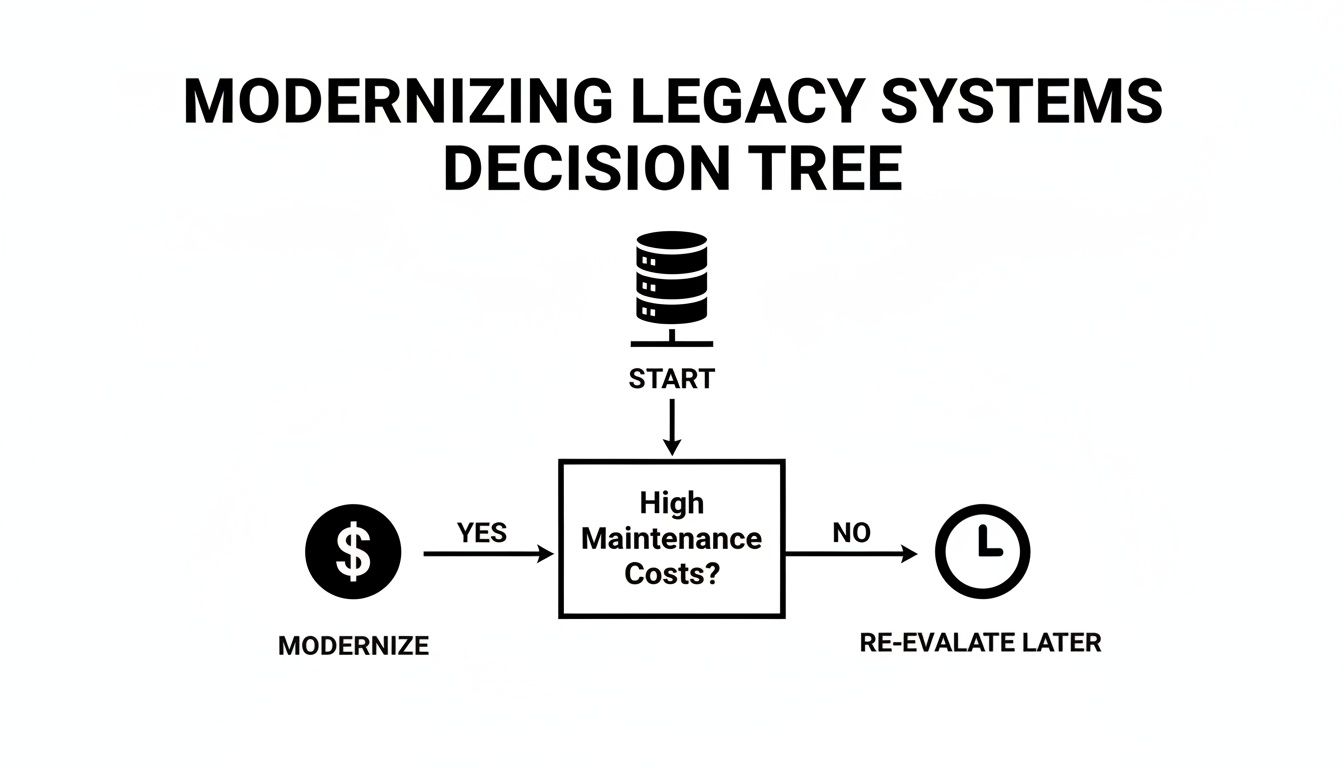
As you can see, soaring maintenance costs usually force your hand. You either modernize proactively or kick the can down the road, which almost always costs more in the long run.
Rehost: The Lift-and-Shift
Rehosting is by far the simplest and fastest option on the table. Think of it like moving all your furniture from the old house into a brand-new apartment building with great amenities. You aren't changing the furniture itself, just its location.
The Analogy: Packing up your belongings and moving to a new home.
The Goal: Get out of your old data center fast and start using cloud infrastructure (IaaS) with almost no code changes.
Best For: Teams on a tight deadline, like a data center contract ending, who plan to come back and optimize the application later.
It’s quick, but rehosting doesn't fix any of the deep-seated problems with your "furniture." Your monolithic architecture and all that technical debt are coming right along with you.
Replatform: The Lift-and-Tinker
Replatforming is one step up from a basic rehost. You’re still moving your furniture to that new apartment, but this time you make a few small upgrades to take better advantage of the new space. Maybe you swap out your self-managed database for a fully managed cloud service.
This lets you tap into some real cloud benefits without committing to a massive overhaul. It takes a few code tweaks, but the payoff is much better than a pure lift-and-shift.
Refactor: The Internal Renovation
Refactoring is like deciding to keep the house but gutting it to rewire the electrical and update all the plumbing. The exterior looks exactly the same to the neighbors, but on the inside, the core infrastructure is now modern, safe, and way more efficient.
With refactoring, you’re not changing what the application does on the outside. You’re only improving its internal structure to clean up code, pay down technical debt, and make the system easier to build on in the future.
This approach demands a bigger investment upfront but pays dividends by boosting performance and security without ever disrupting the user.
Re-Architect: The Major Remodel
Now we're getting into serious construction. Re-architecting is a fundamental structural change. This is like blowing out the walls of your cramped, closed-off kitchen to create a modern, open-concept living space. You’re fundamentally changing the application's architecture, usually by breaking down a monolith into microservices.
This is a high-effort, high-reward move. It unlocks new capabilities and scalability that were simply impossible with the old design. As you weigh this option, it's critical to explore ways of Modernizing Legacy Systems Without The Risk that comes with such a massive undertaking.
Replace: The Complete Demolition
Sometimes, the old house is just a teardown. Replacing means you demolish the old structure and build a brand-new, custom home from the ground up. In software terms, you’re sunsetting the old system entirely and either building or buying a new solution that actually meets today's business needs.
This is the most disruptive and often the priciest option. But it also gives you a completely blank slate to build a solution that’s perfectly aligned with where the business is headed.
The Strangler Fig Pattern: An Incremental Takeover
One of the smartest ways to approach a re-architecture or replacement is with the Strangler Fig Pattern. Picture a new vine growing on an old tree. Over many years, that vine gets stronger and thicker, eventually wrapping around the tree and replacing it completely.
You do the same with your legacy app. You build new features and services around the edges of the old system, slowly redirecting traffic and functionality to them. You keep going until the old system is fully "strangled" and can be safely shut down. This piece-by-piece method dramatically cuts the risk of a chaotic, big-bang migration.
To help you visualize how these strategies stack up, here's a direct comparison across the key factors you'll be weighing: cost, risk, speed, and disruption.
Comparing the 6 Core Modernization Approaches
Strategy | Relative Cost | Risk Level | Time-to-Value | Level of Business Disruption |
|---|---|---|---|---|
Rehost | Very Low | Low | Very Fast | Minimal |
Replatform | Low | Low-Medium | Fast | Low |
Refactor | Medium | Medium | Medium | Low |
Re-architect | High | High | Slow | High |
Replace | Very High | Very High | Very Slow | Very High |
Strangler Fig | Varies | Low-Medium | Incremental | Low (if done right) |
Each path offers a trade-off. A quick-and-cheap rehost won't solve underlying architectural issues, while a full replacement delivers a perfect fit at a high cost and risk. The right choice depends entirely on your specific business context, risk tolerance, and long-term goals.
Finding the right people to pull off any of these complex strategies is often the biggest bottleneck. Whether you need cloud architects for a replatforming job or an entire squad for a ground-up replacement, the skills gap is a real problem. You can get a better sense of how different staffing models work in our guide on staff augmentation vs outsourcing.
Don’t let a talent shortage kill your momentum. TekRecruiter connects you with the top 1% of engineers worldwide, giving you the specialized expertise to execute your modernization roadmap with confidence. We help you build the world-class team your project deserves.
How to Build Your Modernization Roadmap
Choosing how to modernize your legacy systems is a huge strategic bet, not just a technical line item. Get it wrong, and you risk burning through your budget on a strategy that doesn’t actually move the business forward.
A real roadmap isn't a one-size-fits-all template. It's a customized plan that balances what's technically possible with what the business actually needs, all while keeping risk at an acceptable level. The process has to start with a brutally honest look at where you are right now. You can't chart a course to a new destination without knowing your precise starting point.
Start With a Deep Technical Assessment
First things first: you need to quantify the actual state of your legacy application. This isn't about pointing fingers or just calling something "old." It's about getting objective, hard data on its structure, dependencies, and overall health. A proper technical audit is what gives you the ammo to justify any modernization strategy you choose.
Your assessment should zero in on a few key areas:
Code Complexity: Run static analysis tools to get real metrics, like cyclomatic complexity. If the numbers are high, you know the code is a tangled mess that will be tough to understand, maintain, and test. That makes strategies like refactoring or a full re-architecture significantly more difficult.
Technical Debt: You have to identify and actually quantify your tech debt. We're talking outdated libraries, poor architectural choices made years ago, and a glaring lack of automated tests. A mountain of debt often makes incremental approaches a non-starter.
Dependencies: Map out every single internal and external system dependency. A system with a web of undocumented dependencies is a perfect candidate for the Strangler Fig Pattern, which lets you carefully peel them away one by one.
This detailed analysis gives you a clear-eyed view of the technical mountain you're about to climb. For a deeper dive on how to manage the people and resources this requires, check out our guide on mastering project management and resource allocation.
Connect Technical Functions to Business Value
Once you have that technical baseline, the next move is to map every function of the system to a real business outcome. Think about it: a module that handles only 5% of user traffic but generates 40% of your company's revenue has a completely different priority than some high-traffic, low-value feature.
This analysis forces you and your team to ask the hard questions:
Which parts of this system keep our most critical business operations running?
Where is this system creating a bottleneck that stops us from launching new products?
How does the system's performance directly impact our customer satisfaction and churn?
Answering these questions helps you prioritize what to modernize based on strategic importance, not just what's technically broken. It aligns everyone—from the engineers in the trenches to the C-suite—on the why behind the project, ensuring your investment delivers the biggest possible return.
Analyze Your True Risk Exposure
Finally, you need to conduct a thorough risk analysis. Let’s be clear: the "cost of doing nothing" is rarely zero. It's an accumulating liability that gets worse over time. Security vulnerabilities, in particular, represent a massive and growing threat.
In a recent survey, 43% of IT leaders named security as their top concern, with a staggering 62% of organizations still running legacy systems that dramatically increase their cyber risks. The same survey showed that modernization is no longer optional—enhancing security (42%) is now a top priority, right alongside improving performance (48%) and scalability (44%). You can explore more of those findings on legacy software modernization to see just how urgent this is.
Your risk analysis has to be comprehensive, covering:
Security Gaps: Are there known vulnerabilities? Is the system running on unsupported hardware or ancient software versions?
Operational Threats: What’s the real business impact if this system goes down? How resilient is it to failure?
Talent Risk: How hard is it to find—and keep—engineers who actually know how to maintain this legacy codebase?
By combining your technical deep-dive, business value mapping, and risk analysis, you can build a modernization roadmap that actually works. This framework gives you the confidence to pick and choose your battles, maybe rehosting low-risk components while re-architecting the high-value ones. The result is a hybrid approach that is perfectly suited to your organization's unique reality.
Building this roadmap and then actually executing it demands specialized talent. If your team has skill gaps in cloud architecture, data migration, or modern development practices, TekRecruiter can help. We connect innovative companies with the top 1% of engineers needed to de-risk complex modernization projects and guarantee a successful transformation.
Executing Your Plan with Confidence
A great strategy is worthless if the execution falls flat. Once your modernization roadmap is locked in, the focus has to shift from the whiteboard to the real world—turning that high-level plan into a concrete, actionable project. This is where the real work begins, and it demands meticulous planning and a serious commitment to managing risk at every single stage.
Pulling off a complex modernization project isn't a single "go-live" event. It’s a series of carefully choreographed steps designed to keep the business running smoothly while you validate progress piece by piece. One of the smartest ways to do this is with a phased migration.
Instead of a high-stakes, "big bang" cutover, you move the system over bit by bit. This might mean tackling one business function, one user group, or one microservice at a time. This approach lets your team learn as they go, applying lessons from the early phases to make later stages much smoother and far more predictable.
Robust Testing and Rollback Strategies
True confidence in your execution plan comes from knowing you can handle it when things go wrong. And they will. This is where robust testing and a bulletproof rollback plan become absolutely non-negotiable.
Parallel Runs: You run the new system right alongside the old one for a while, feeding both the exact same inputs. This lets you compare the outputs and prove the new system behaves as expected under real-world pressure before you flip the switch on the old one.
Canary Releases: Think of this as sending the "canaries into the coal mine." You roll out the new system to a tiny subset of users first. This lets you monitor performance and get feedback from a small, controlled group, so you can catch issues before they blow up and impact everyone.
No matter how confident you feel, you must have a pre-defined rollback plan. If a critical bug pops up after deployment, you need a documented, tested procedure to revert to the stable legacy system in minutes, not hours.
Conquering Data Migration
Data migration is often the single most painful part of any modernization project. It’s way more than just copying data from point A to point B; it’s a beast of a process that needs its own dedicated strategy. Getting this right is make-or-break.
The whole thing usually breaks down into three key stages:
Data Cleansing: Legacy data is almost always a mess—duplicates, incomplete records, bizarre formatting. Before you even think about moving it, you have to "cleanse" it to make sure only high-quality data makes its way into your shiny new system.
Data Transformation: The data schema in your new system probably looks nothing like the old one. Transformation is all about mapping fields from the old format to the new, ensuring everything lines up perfectly.
Data Validation: After the data is moved, you have to validate its integrity. This means running queries and checks to confirm nothing was lost, corrupted, or scrambled during the transfer.
Building a Modern Architecture for the Future
Your execution plan isn't just about the "now"—it has to lay the foundation for a system that can stay modern. This means embracing modern architectural patterns from day one. Shifting to microservices or cloud-native services is a huge part of this, as it breaks down clunky monoliths into smaller, independent components. For a deeper dive into this, check out our guide on cloud migration best practices for engineering leaders.
Just as critical is implementing a Continuous Integration/Continuous Deployment (CI/CD) pipeline. This is the automation engine that handles your builds, testing, and deployments, letting your team ship new features and fixes fast and reliably. A strong CI/CD pipeline is what will keep your newly modernized system agile and competitive for years to come.
Executing these technical steps requires a team with specialized skills. If your in-house talent doesn't have deep experience in cloud architecture, data engineering, or DevOps, TekRecruiter can help. We connect you with the top 1% of engineers who can de-risk your project and make sure your modernization plan gets executed with precision.
7. Building the Right Team for the Job
Let's be blunt: a complex modernization strategy isn't just a technical challenge—it's a people challenge. You can have the most brilliant roadmap on paper, but it will absolutely crash and burn without the right engineering talent and real organizational buy-in to see it through. Success comes down to assembling a team with the right skills and fostering a culture that embraces change, not one that fights it.
The first real step is getting everyone on board. This means you have to move beyond the technical jargon and clearly communicate the "why" behind this massive effort to everyone from the C-suite to the engineers on the ground. Frame the project in terms of what it means for the business—more agility, better customer experiences, and stronger security. That’s how you build momentum and get everyone pulling in the same direction.
Bridging the Inevitable Skills Gap
Once you've got buy-in, you hit the next wall: the talent gap. Your current team are experts, no doubt—but they’re experts in the legacy system. They probably don't have deep, hands-on experience with modern cloud platforms, microservices architecture, or slick CI/CD pipelines. This reality leaves you with three primary ways to staff your modernization initiative.
Upskilling Existing Teams: Investing in training for your current engineers is a great move. It builds on their invaluable institutional knowledge and boosts morale. The downside? It’s often slow, and you might still lack the senior-level architectural vision needed for the big, hairy decisions.
Hiring Specialized Roles Directly: You could try to hire full-time experts. This gives you dedicated, long-term ownership of the new system. Good luck. The competition for top-tier cloud and DevOps talent is brutal, and lengthy hiring cycles can stall your project before it even starts.
Leveraging Flexible Staffing Models: This is where staff augmentation becomes a powerful hybrid solution. It lets you inject specialized, senior-level expertise exactly when and where you need it, skipping the long-term overhead of permanent hires.
Choosing the right staffing model is a strategic decision that directly impacts your project's risk and speed. The real trick is to find a balance between developing your internal team's capabilities and bringing in external firepower to keep things moving.
De-Risking Your Project with Elite Talent
For a high-stakes modernization, waiting months to hire or upskill just isn't an option. It introduces unacceptable delays and risks that can kill the whole project. A specialized staff augmentation partner gives you immediate access to a pre-vetted pool of elite engineers who have already navigated these kinds of transformations successfully. This approach is a game-changer when you need specific expertise in platforms like AWS, Azure, or GCP.
Instead of spending half a year hunting for a cloud architect or a DevOps specialist, you can have an expert embedded in your team in a matter of weeks. This model doesn't just accelerate your timeline; it facilitates critical knowledge transfer to your existing employees and ensures your project is built on a foundation of proven, real-world best practices from day one.
Modernizing a legacy system is a defining moment. Having the right people in the room is non-negotiable. At TekRecruiter, we specialize in connecting innovative companies with the top 1% of engineers globally. Whether you need to augment your team with a certified cloud expert or deploy a full nearshore team to fast-track your roadmap, we provide the elite talent you need to execute your legacy system modernization with total confidence.
How to Measure Modernization Success
So, how do you prove that multi-million dollar modernization investment was actually worth it? The answer isn't buried in server uptime reports or lower infrastructure bills.
True success is measured by the tangible business value your newly modernized system delivers. To actually prove the ROI of your efforts, you have to move beyond basic IT metrics and start tracking the Key Performance Indicators (KPIs) that the rest of the business actually cares about.
Your goal is to draw a straight line from a technical improvement to a strategic business win. Instead of just reporting that a system is "faster," you need to show how that speed translates into a real competitive advantage and a healthier bottom line. This means shifting your entire perspective from monitoring technical outputs to measuring business outcomes.
Defining Your Business-Centric KPIs
Before you track a single thing, you have to define what success even looks like across the company. The finance team will feel the impact differently than the product team, so your KPIs need to reflect that reality.
And remember, you can't show improvement if you don't know your starting point. The first step is always to establish a clear baseline from your old legacy system.
Financial Impact: This is the most direct measurement. Look at the Total Cost of Ownership (TCO), comparing the old world of maintenance contracts, licensing fees, and clunky infrastructure costs to the new, leaner operational expenses.
Developer Productivity: A modern stack should be a force multiplier for your engineers. Track metrics like Cycle Time (from first commit to production) and Deployment Frequency. If these numbers improve dramatically, it means your team is shipping value to customers faster. Period.
Time-to-Market: How quickly can you get a new feature out the door? A lower time-to-market is a massive competitive edge. It shows the business has become more agile and can finally respond to customer needs at the speed the market demands.
Customer Satisfaction: Your end-users are the ultimate judges. Keep a close eye on metrics like Net Promoter Score (NPS) or Customer Satisfaction (CSAT) scores. A noticeable lift here is hard evidence that the new system is delivering a genuinely better experience.
Post-Migration Governance and Continuous Improvement
Launching your modernized system isn’t the finish line. It’s the starting line for a completely new way of operating.
Post-migration governance is what ensures your investment keeps paying dividends long after the project confetti has settled. This is all about building a culture of continuous improvement, not just babysitting the new status quo.
The real objective of modernization is to create a system that remains agile for years to come. This means implementing robust monitoring, establishing new operational protocols, and fostering a culture where optimization is an ongoing activity, not a one-time event.
Effective governance means setting up comprehensive dashboards that track your KPIs in real-time, letting you spot trends and make decisions based on data, not gut feelings. It also involves creating new, streamlined operational playbooks designed for a modern system. This kind of proactive management is what stops your shiny new platform from slowly decaying into the next generation's legacy problem.
Of course, measuring success and governing a new system requires a team with modern operational skills. If your team is missing key expertise in cloud monitoring, SRE practices, or FinOps to really manage TCO, then finding the right talent becomes critical. TekRecruiter connects you with the top 1% of engineers who specialize in operating and optimizing modern systems, ensuring your investment delivers maximum value for years to come.
Let's Build Your Elite Modernization Team
A brilliant modernization strategy is just a PowerPoint deck without the engineering firepower to make it real. The difference between success and failure almost always comes down to the caliber of the engineers doing the work. A talent gap at this stage isn't a minor hiccup—it's the kind of problem that sinks budgets, blows up timelines, and kills projects.
As a premier technology staffing, recruiting, and AI Engineer firm, TekRecruiter was built to solve this exact problem. We specialize in deploying the top 1% of engineers to the world's most innovative companies. Whether you need a certified AWS architect for a replatforming project, a team of full-stack developers for a ground-up replacement, or seasoned AI engineers to build entirely new capabilities, we can deliver.
Don’t let a skills shortage put your modernization on hold. Give your strategy the world-class engineering team it deserves. Build your elite team with us today.
Comments