Managed Services Advantages: Why Engineering Leaders Choose
Explore the top managed services advantages for engineering teams: cost, speed, quality, scalability, and risk mitigation.

The popular advice says managed services are mainly a way to cut IT costs. That framing is too narrow, and it leads engineering leaders into bad buying decisions. The strongest managed services advantages appear when a hybrid cloud, microservices estate, security program, or third-party SaaS stack has become too complex for a lean internal team to operate consistently.
In short, the five core advantages of managed services are cost predictability, a faster start, consistent quality, lower operational risk and coverage that scales with demand. Each one only appears when the provider owns a clearly defined scope under measurable service levels.
Cost still matters. A recurring fee can make spending easier to plan, and an external team can reduce the burden of recruiting, tooling, and operational coverage. But the better question is whether the service improves delivery quality: fewer dropped handoffs, cleaner incident response, stronger uptime discipline, and less time spent chasing vendors when something breaks.
That distinction matters because the managed services market has moved well beyond niche IT support. One forecast projects growth from USD 430.56 billion in 2026 to USD 704.2 billion by 2031, while another projects USD 847.41 billion by 2033. The market's scale reflects a broad shift toward outsourced, always-on operations across cloud-heavy environments, not a temporary cost-cutting trend. Market analysis on managed services growth and adoption also reports that enterprises represented 66.95% share in one 2025 estimate, while cloud deployment held 52.35% share, reinforcing how closely the model fits modern infrastructure.
My buying rule: outsource operational complexity when it distracts your engineers, but keep product judgment and architectural control close to the people who own the business.
Table of Contents
Why Smart Engineering Leaders Stop Treating Managed Services as a Cost Question - Complexity is the real trigger - Quality beats headcount arithmetic
What Engineering Managed Services Actually Mean - Three models, three accountability patterns
The Core Advantages of Managed Services for Engineering Teams - Five improvements that matter - Five Core Managed Services Advantages at a Glance
Managed Services vs Staff Augmentation vs Direct Hire - Choose based on the accountability you want
Real Engineering Scenarios Where Managed Services Win - Scaling under commercial pressure - Security modernization under an audit deadline
How Uptime SLAs and Response-Time Tiers Translate Into Real Savings - Response time creates the operating difference
Where TekRecruiter Fits in a Managed Services Decision - Turning a scope into delivery velocity
When Managed Services Make Sense and How to Move Forward - A practical boundary test
Why Smart Engineering Leaders Stop Treating Managed Services as a Cost Question
A managed service earns its place when it makes execution more reliable. If the provider only supplies cheaper labor while your managers still assign every task, review every decision, and absorb every escalation, you've bought staff augmentation with extra paperwork.
The difference becomes visible in a hybrid environment. An internal platform team may own Kubernetes, AWS, Azure, observability, CI/CD, identity, and vendor integrations at the same time. Each system can work in isolation while the combined operating model fails at the handoffs. An incident crosses team boundaries, ownership becomes unclear, and senior engineers spend their day coordinating instead of improving the platform.
A capable managed services partner takes responsibility for a defined operating surface. That can include monitoring, maintenance, incident handling, runbooks, release coordination, security controls, and service reporting. The provider should also make the work legible through agreed service levels, escalation rules, and a governance rhythm that lets the CTO see whether reliability is improving.
Complexity is the real trigger
Managed services make the most sense when the work has become operationally important but isn't the company's differentiating product work. Infrastructure maintenance, cloud cost controls, platform reliability, security monitoring, and data pipeline operations often fit this boundary. Product discovery, customer-specific workflow design, and core architectural choices usually don't.
The shift from reactive support to proactive operation is the central advantage. Monitoring and maintenance can identify issues before they become business interruptions, while defined ownership reduces the number of decisions that wait for an already overloaded internal team. For teams working with Kubernetes, a practical resource on GitOps patterns for Kubernetes can help clarify how declarative operations and controlled change management support that model.
Quality beats headcount arithmetic
A fixed monthly model matters because it changes the management conversation. Instead of asking whether another internal hire can absorb the queue, leaders can ask whether the provider is meeting reliability, response, security, and delivery commitments.
That is why the category continues to expand across industries and geographies. The purchase isn't “more people.” It's an operating system for work that must happen consistently, even when internal priorities change.
What Engineering Managed Services Actually Mean
Think of a restaurant during a busy service. Staff augmentation gives you extra line cooks. You still run the kitchen, set the menu, assign stations, inspect every plate, and handle the consequences when dinner goes wrong. A managed service is the full kitchen crew accountable for producing the dish to an agreed standard.
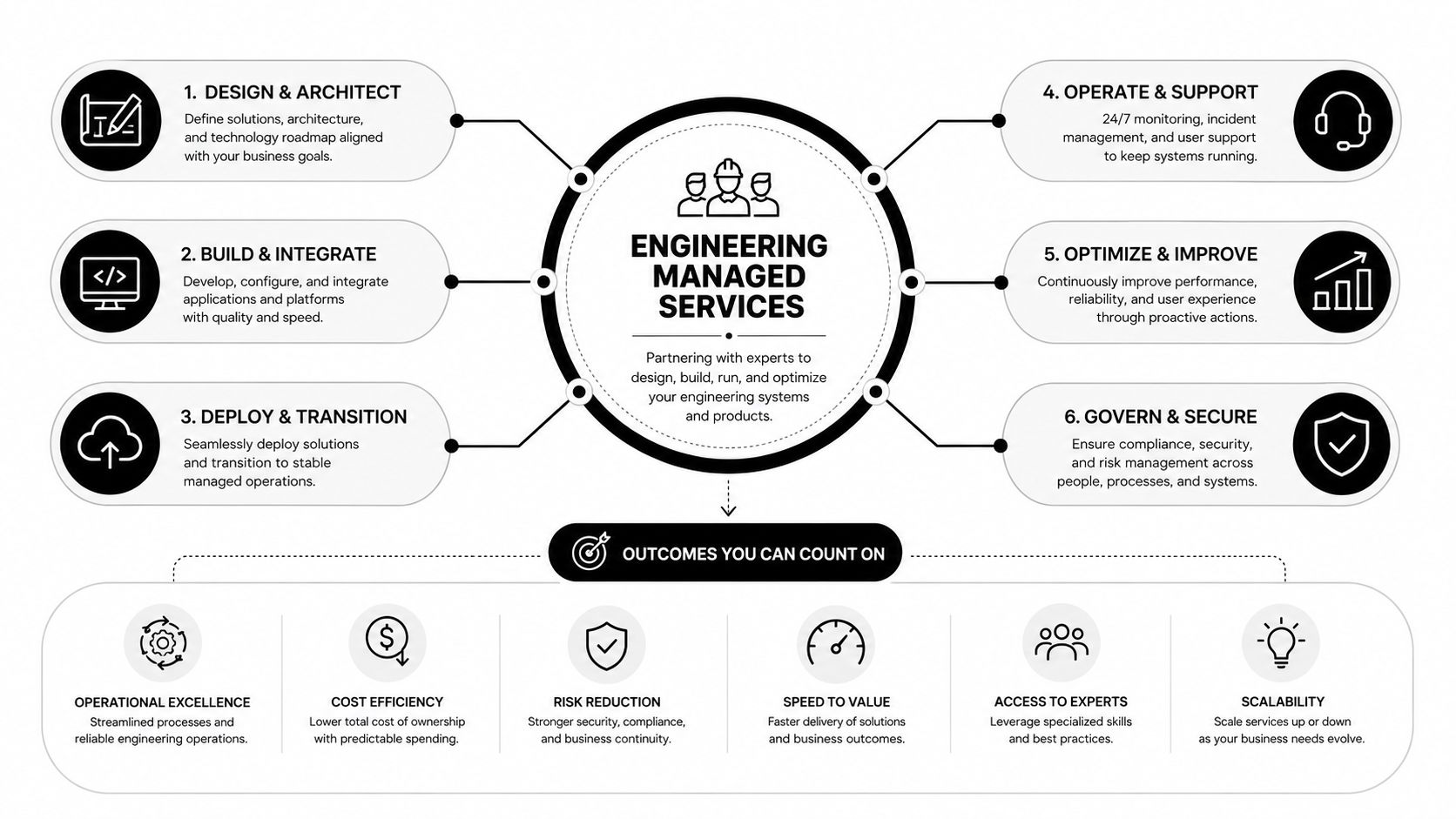
In engineering terms, the provider owns a defined outcome or operating function. The scope might cover cloud infrastructure, platform engineering, security operations, data pipelines, or application maintenance. The agreement should state what the provider monitors, what it maintains, which incidents it handles, how changes are approved, what reports it produces, and how performance is evaluated.
Three models, three accountability patterns
Managed services means the provider manages the work against agreed service levels. You retain strategic control, but the partner owns execution inside the boundary.
Staff augmentation means you add individual engineers to your team. Your managers direct their daily work, your internal leads own the design decisions, and your organization remains accountable when delivery slips. That model is useful when you know exactly which skills are missing and already have the management capacity to use them.
Direct hire gives you permanent capacity and the strongest long-term control. It also makes you responsible for sourcing, screening, onboarding, retention, career development, coverage, and the inevitable gaps between hiring demand and available talent.
The provider's responsibilities should be explicit:
Deliverables: Define the systems, workflows, releases, or operational outcomes included.
Governance: Set weekly operating reviews, monthly service reviews, escalation paths, and decision rights.
Measurement: Track uptime, response times, backlog health, change quality, security findings, and agreed delivery milestones.
Knowledge transfer: Require current runbooks, diagrams, access records, and documented operating procedures.
For a deeper distinction between the commercial models, compare this guide to what managed services means. Teams that operate customer-facing systems can also benefit from practical AI support engineering insights, particularly when they are deciding which repetitive support work belongs inside an automated or managed workflow.
The Core Advantages of Managed Services for Engineering Teams
The managed services advantages are practical when the contract changes how work gets done, not merely who appears in the org chart.
Five improvements that matter
Cost predictability. A recurring monthly structure replaces some variable break-fix spending with a planned operating cost. That makes budgeting easier and reduces the revenue volatility that service providers otherwise face when demand swings. NetSuite's overview of managed services benefits describes this shift from unpredictable support costs toward recurring planning.
Speed. A provider can bring an established delivery process, specialist coverage, and operating tooling to a defined problem without waiting for a complete internal hiring cycle. This is most valuable during a migration or reliability push, when the opportunity cost of delay is higher than the service fee.
Quality. Quality improves when the provider enforces repeatable standards rather than relying on individual heroics. Code review, test expectations, deployment controls, runbooks, and post-incident reviews turn operational knowledge into a system the whole team can follow.
Risk mitigation. Defined SLAs, proactive monitoring, escalation paths, and compliance ownership give leaders a clearer response model. The benefit isn't that failures become impossible. It's that the organization knows who acts, how quickly they acknowledge the issue, and what evidence the service must produce afterward. Industry examples also connect proactive support with faster resolution and fewer unplanned interruptions. AWS value benchmarking material explains how reduced disruption can improve engineering utilization.
Scalability. Demand rarely arrives in neat hiring increments. A managed team can expand coverage for a migration, security program, or platform backlog and then reduce it when the defined work is complete. That avoids forcing the internal organization through a reorganization every time project intensity changes.
Five Core Managed Services Advantages at a Glance
Advantage | Metric Moved | Typical Scenario |
|---|---|---|
Cost predictability | Variable support demand toward recurring operating cost | A platform team replaces emergency work with a defined service package |
Speed | Time from approval to active delivery | A cloud modernization effort starts with an operating pod instead of a long hiring queue |
Quality | Consistency of engineering and operational practice | The provider applies review, testing, runbook, and release standards |
Risk mitigation | Unclear ownership toward documented response and escalation | A security or reliability incident follows an agreed severity path |
Scalability | Fixed internal capacity toward adjustable service coverage | A company adds platform support during a migration and narrows scope afterward |
The strongest buyers measure these changes directly. They don't accept “access to expertise” as the outcome. They ask whether incidents close faster, whether handoffs decrease, whether releases become safer, and whether internal engineers spend more time on product and architecture.
Managed Services vs Staff Augmentation vs Direct Hire
The right model depends on what you need to own. A managed services partner owns an outcome inside a defined boundary. Staff augmentation gives you additional engineers, but your organization keeps the accountability. Direct hire creates durable internal capacity for work you want to control for the long term.
Dimension | Managed Services | Staff Augmentation | Direct Hire |
|---|---|---|---|
Cost predictability | High when scope and service levels are clearly defined | Variable, based on hours, contracts, and management demand | Variable, with recruiting and employment overhead |
Day-to-day control | Shared control, provider manages execution inside scope | Internal team directs daily work | Internal team has direct control |
Speed to first deliverable | Fast for well-defined operational work | Fast when requirements and supervision are ready | Slower because recruiting and ramping take time |
Accountability when something breaks | Provider owns agreed outcomes and escalation duties | Client team remains accountable | Client team remains accountable |
Best-fit use cases | Infrastructure, observability, security operations, data pipelines, and repeatable platform work | Specific skill gaps on a known project | Core IP, product context, architecture, and long-term roadmap ownership |
Choose based on the accountability you want
Managed services win when leadership needs predictable execution more than seat-level control. If the internal team can define the boundary and evaluate the result, the provider can own the operating burden without taking over product strategy.
Staff augmentation wins when the problem is narrow and your managers have room to direct the added engineers. It works well for a known backlog, a temporary language or platform gap, or a project where the client must retain every day-to-day decision. The tradeoff is that the client still carries coordination and delivery risk. This explanation of staff augmentation services provides useful context for that distinction.
Direct hire wins for work that depends on deep institutional knowledge. Core architecture, proprietary algorithms, product discovery, and customer-sensitive decisions should usually stay with permanent employees. Hiring takes longer, but the organization gains durable context and control that an external operating model can't replicate.
The mistake is treating these models as interchangeable. A managed contract won't fix vague ownership, and a new hire won't create an operating process by itself. Start with the work, decide who should be accountable for the outcome, then choose the model.
Real Engineering Scenarios Where Managed Services Win
A mid-market SaaS company moving from a single-cloud setup to a hybrid AWS and Azure footprint has a clear managed services use case. Its internal architects should decide the target design and migration priorities. The managed team can own the migration runbook, environment preparation, cutover coordination, observability, and post-cutover service objectives. The result is a defined transition with operational ownership after launch, not a handoff that ends when the new environment goes live.
The internal team remains responsible for product behavior and architectural tradeoffs. The provider handles the repeatable work required to move systems safely and keep them observable. That division lets the company modernize without asking its product engineers to become full-time infrastructure operators.
Scaling under commercial pressure
A Series B startup can face sudden enterprise demand while its hiring budget remains fixed. Its product and engineering leaders need to protect the roadmap, but the platform must support a much larger workload and stronger operational coverage.
A managed platform pod can take on infrastructure automation, deployment pipelines, monitoring, capacity planning, and incident procedures. The startup's permanent engineers retain product direction and customer context. The managed partner supplies an operating capability that can expand for the growth period and then narrow when the platform stabilizes.
Security modernization under an audit deadline
A regulated fintech modernizing identity and access management, security information and event management, and vulnerability management also benefits from outcome-based ownership. The internal security leader defines control requirements and approves risk decisions. The managed security team implements tooling, tunes alerts, maintains workflows, documents evidence, and manages the operational queue.
The value comes from completing a measurable body of work under a deadline. A collection of contractors may provide skill, but someone inside the fintech still has to coordinate the program, define procedures, and verify that the controls remain operational. A managed service can absorb that execution burden when the scope and acceptance criteria are explicit.
The pattern is consistent: managed services win when the scope is defined, the outcome is measurable, and leadership needs predictable execution more than additional headcount.
They don't automatically win in early product discovery or ambiguous transformation programs. Those efforts require context, judgment, and frequent changes in direction. The best boundary separates decisions that require company-specific knowledge from operations that require disciplined repetition.
How Uptime SLAs and Response-Time Tiers Translate Into Real Savings
SLA economics only work when the assumptions are visible. Start with the uptime commitment, identify which systems it covers, and calculate the business exposure of downtime using your own revenue and workload data. Don't claim savings from an SLA until finance and engineering agree on the value of the protected service.
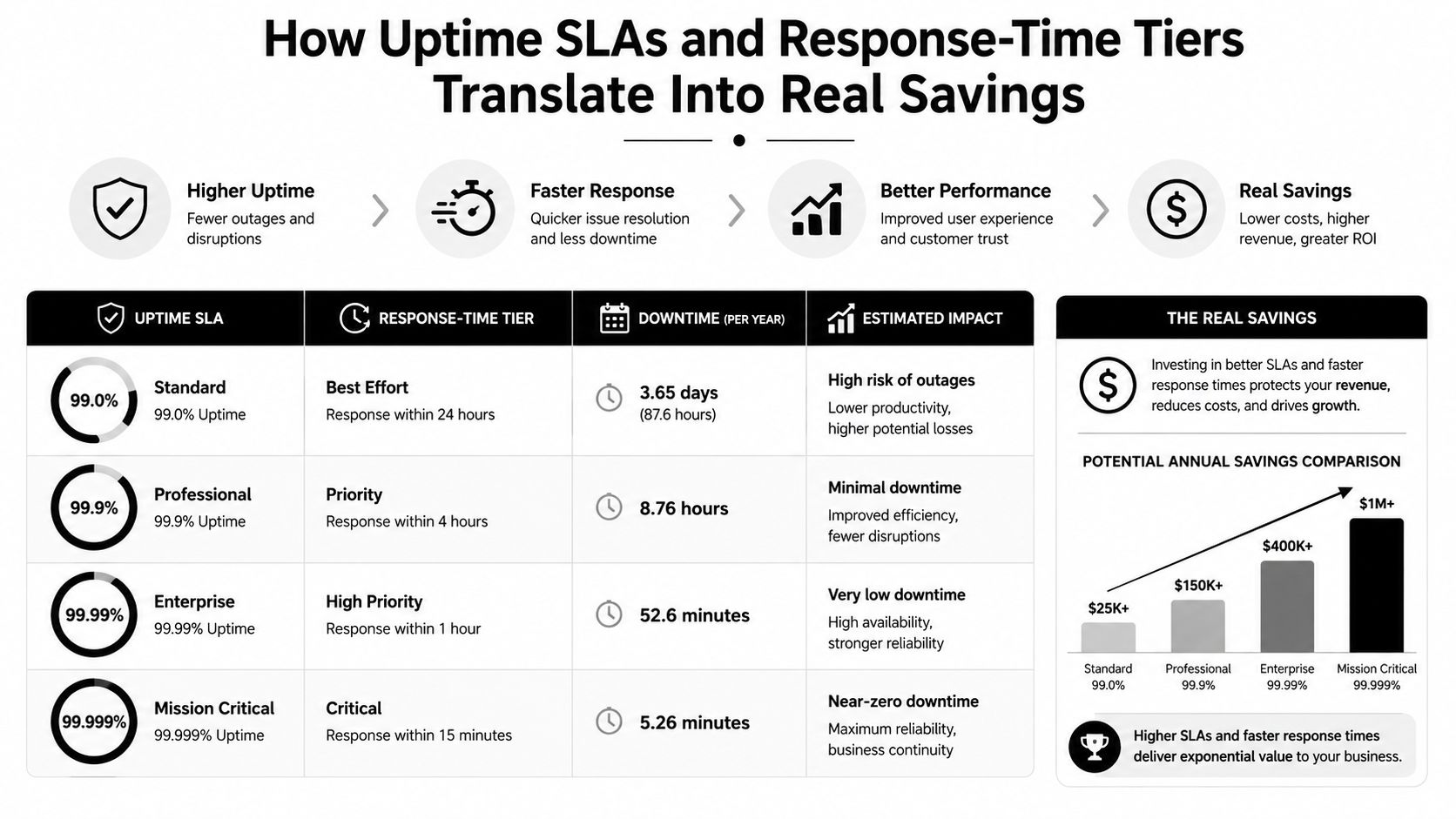
The published downtime equivalents are useful for setting the baseline. 99.9% uptime allows about 8.76 hours of downtime per year, while 99.99% allows roughly 52.56 minutes, and 99.999% is treated in some SLA guides as under 5.26 minutes. These figures come from managed IT service-level agreement guidance. They don't tell you what an outage costs. They show how much availability the contract promises.
Response time creates the operating difference
Response tiers define mobilization, not resolution. Common SLA guidance describes critical incidents with acknowledgement targets of 15 to 30 minutes, high-priority issues at 1 to 2 hours, medium-priority issues at 4 hours, and low-priority requests at 8 business hours or the next business day. Industry SLA expectations provide those severity-based ranges.
For a revenue-critical system, the economic question is straightforward. Take the system's hourly business exposure, multiply it by avoidable downtime, then compare that risk with the managed contract's recurring fee. A faster P1 acknowledgement can prevent escalation, reduce idle engineering time, and bring the right specialist into the incident before a small fault becomes a prolonged outage.
Use incident management guidance to define severity, ownership, communications, and post-incident learning before negotiating the SLA. If planned maintenance is a recurring source of disruption, review practices that can reduce AWS maintenance disruption as part of the operating design.
The ROI isn't the uptime percentage alone. It's a more predictable incident cost, with fewer surprise escalations and a fixed line item finance can plan against.
Where TekRecruiter Fits in a Managed Services Decision
Careful screening matters because managed services fail when the provider matches résumés to keywords instead of matching engineers to the actual operating problem. TekRecruiter holds deep technical conversations with candidates, so the screening process can examine architecture experience, cloud operations, platform practices, security work, and the candidate's ability to operate within delivery constraints.
TekRecruiter’s specializations map to common managed-service scopes, including cloud and systems engineering, DevOps and platform engineering, data engineering, cybersecurity engineering, software engineering, and AI engineering. It uses the same depth to vet a managed service provider, checking the team the provider names for your scope, how it would structure the work, and whether the stack it proposes is one you can hire for later. When a client needs engineers on its own migration or platform team instead, TekRecruiter recruits them from an extensive network.
Turning a scope into delivery velocity
A credible engagement starts with a technical scope, not a generic request for “developers.” The client should define the systems in scope, existing documentation, success measures, escalation rules, and the decisions that remain internal. The supplier then maps those requirements to an engineering pod and establishes a delivery cadence.
The first month should make the operating model visible. The team inventories services and dependencies, validates access, reviews monitoring and deployment workflows, identifies immediate risks, and produces an agreed backlog. It should also establish the reporting baseline for uptime, response handling, change quality, and completed work.
That cadence connects talent supply to the SLA economics. A technically screened engineer isn't valuable merely because they can start. They're valuable when they can operate the relevant environment, follow the agreed process, document decisions, and contribute to an outcome the client can measure.
For organizations evaluating the broader model, outsourced engineering services can clarify how external delivery teams fit alongside permanent engineering leadership. The important test is still operational: can the provider take ownership without forcing the client to recreate the management layer it hoped to remove?
When Managed Services Make Sense and How to Move Forward
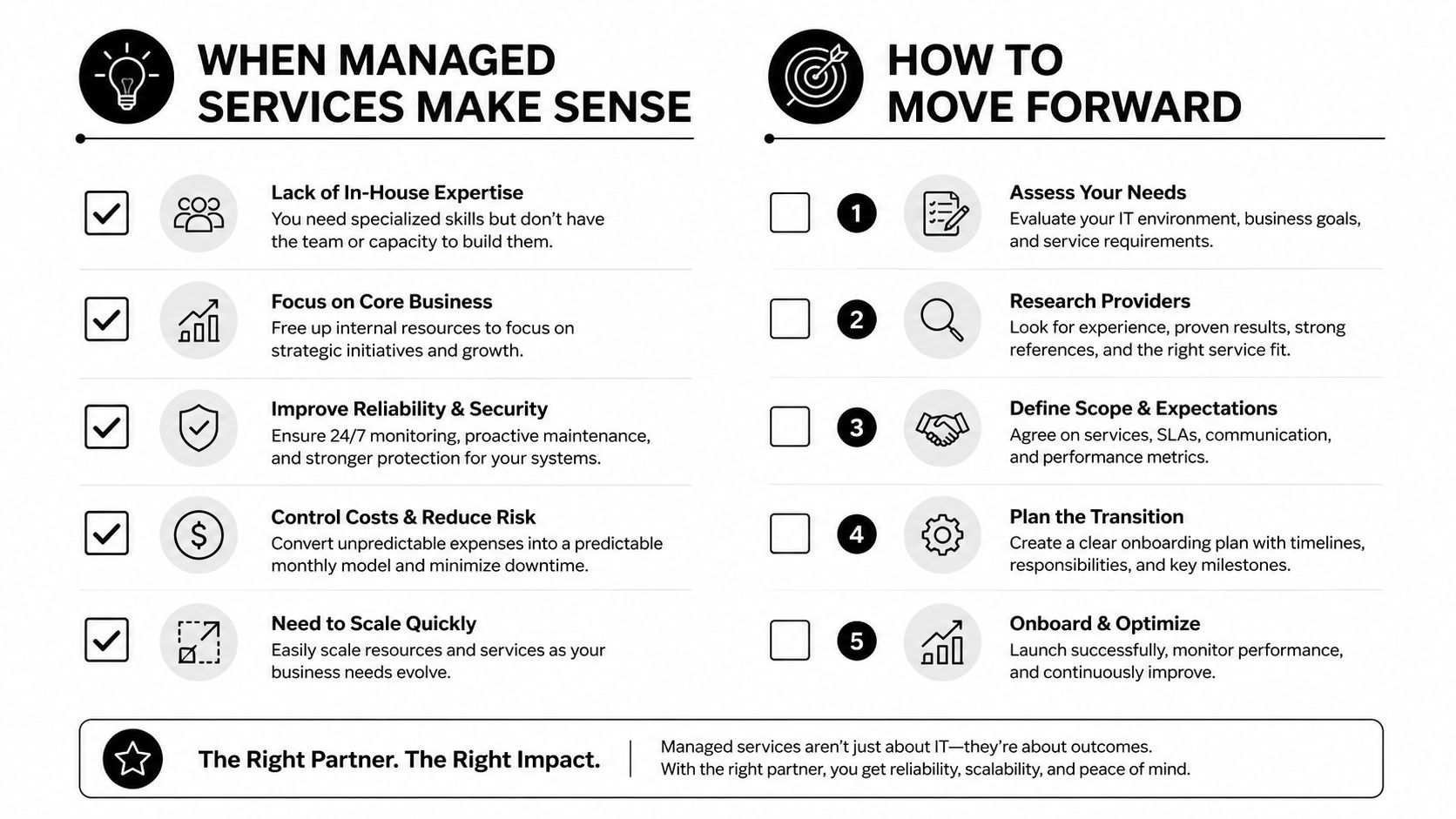
Outsource work that is well-defined, repeatable, and outcome-bound. Infrastructure management, observability, security tooling, data pipelines, CI/CD modernization, and routine platform operations are strong candidates because the provider can measure performance without owning the company's product strategy.
Keep work in-house when it depends on deep customer context or irreversible product judgment. Early discovery, core architecture decisions, proprietary IP, product prioritization, and sensitive domain workflows belong with the internal team. You can use an external partner to supply specialist capability, but don't outsource the decisions that define why the company exists.
A practical boundary test
Ask five questions before signing:
Can we define the result: Is success observable through service levels, completed milestones, reliability measures, or security evidence?
Can the provider operate independently: Will the team have the access, documentation, and authority required to act?
Can we separate strategy from execution: Does the client retain product and architecture decisions while the provider owns the operating work?
Can we govern the relationship: Are review meetings, escalation paths, reporting, and change controls explicit?
Can we exit cleanly: Does the agreement require documentation, knowledge transfer, and a practical transition path?
If the answers are weak, don't hide the problem inside a managed-services contract. Fix the scope first.
A low-risk evaluation should begin with a scoping call, a written technical brief, and a one-week pilot pod focused on a contained outcome. Add a defined exit clause, clear acceptance criteria, and a review at the end of the pilot. That approach tests execution quality before either side commits to a larger operating model.
The strongest managed services advantage isn't lower headcount. It's higher delivery quality under operational complexity, with accountability clear enough that engineering leaders can focus on product, architecture, and growth.
 Ron SmithPresident & Lead RecruiterTekRecruiter