_edited.png)
Your Cloud Engineer Career Path from Junior to Architect
A cloud engineer's career isn't a straight ladder—it's more like a sprawling tech tree with multiple paths to success. You might start out as a Junior Cloud Engineer, get your hands dirty, and eventually level up to a Senior Cloud Engineer. From there, you can branch out into highly specialized roles like Cloud Architect or step into leadership.
This is a journey of constant learning, where hands-on experience with the big three—AWS, Azure, and GCP—is the name of the game.
Mapping Your Journey in the Cloud
Think of your career not as a rigid checklist, but as a map with different territories to explore. This guide is your compass, showing you the entire landscape—from your first day deploying services to the moment you're designing entire cloud ecosystems from scratch.
At its heart, a cloud engineer is like a digital city planner. You’re the one designing, building, and maintaining the fundamental infrastructure—the servers, networks, and databases—that modern businesses run on. It’s a role that sits at the very core of a company's operations, which is why it's such a rewarding and high-growth field.
The Core Progression
Most careers in cloud follow a pretty logical sequence, with each stage building on the skills of the last. You’ll start by mastering the fundamentals, then slowly take on more and more strategic responsibility. It's a natural progression that builds both the deep technical know-how and the high-level vision you need to succeed in senior roles.
This flowchart gives you a bird's-eye view of that vertical climb, showing how responsibilities expand as you move from Junior to Senior and eventually to an Architect role.
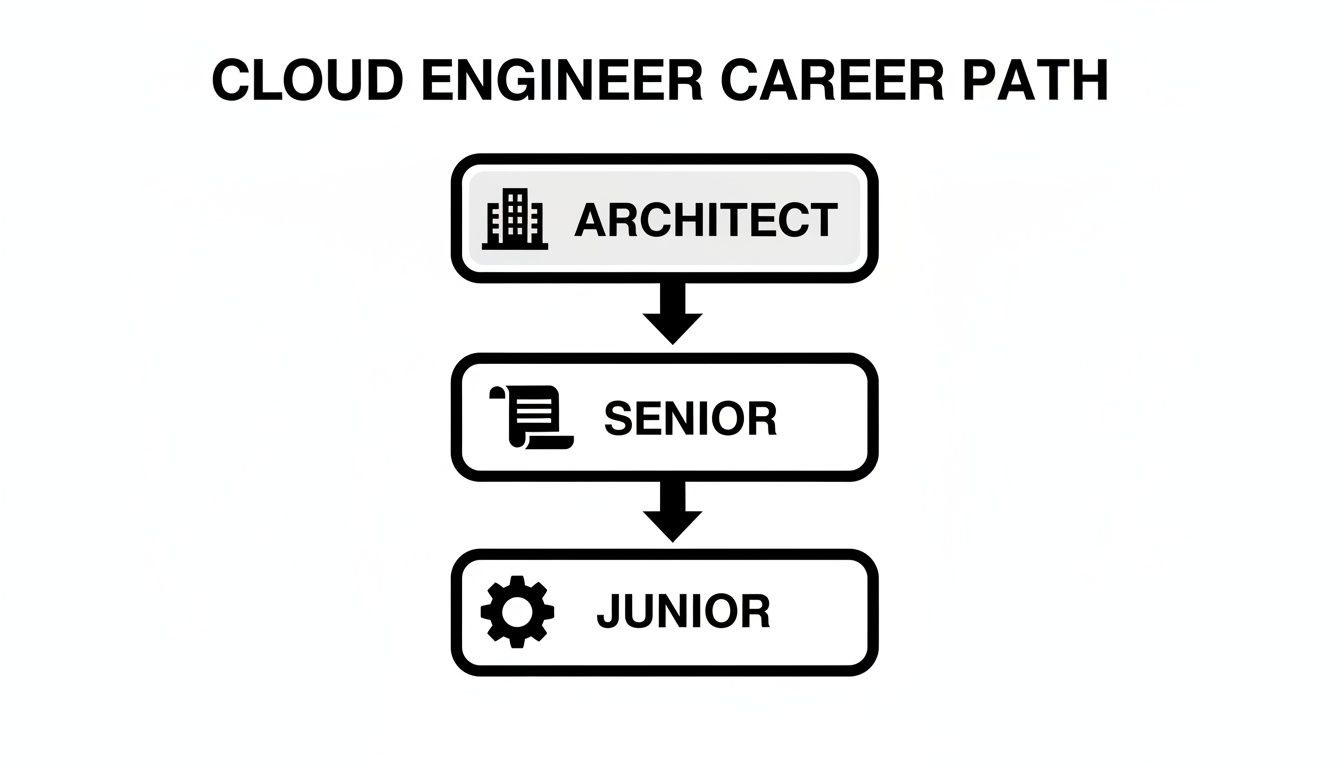
As you can see, the foundational skills you build as a junior engineer directly feed into the complex design and strategy work you'll do as an architect. It’s all about growing your impact over time.
To plan your journey effectively, you need to know what's out there. Digging into the different career opportunities in the cloud is a great way to see the variety of paths you can take. And with nearly 45,000 cloud engineer jobs currently posted, the demand for sharp professionals is undeniable.
The real leap in a cloud engineer's career happens when you go from executing tasks to influencing strategy—from building what you're told to build, to defining what should be built.
For CTOs and hiring managers, understanding this path is crucial for building a team that can scale. If you want a deeper dive, check out our guide on developing in the cloud for maximum impact.
Cloud Engineer Career Path At a Glance
To make this progression even clearer, here’s a quick summary table breaking down what to expect at each stage of your cloud engineering career.
Career Stage | Typical Experience | Core Responsibilities | Key Skills Focus |
|---|---|---|---|
Junior Cloud Engineer | 0-2 years | Implementing, monitoring, and maintaining cloud infrastructure under supervision. Manages basic cloud services and handles troubleshooting. | Foundational cloud services (compute, storage, networking), scripting (Bash, Python), basic IaC (Terraform, CloudFormation). |
Senior Cloud Engineer | 3-6 years | Designing and deploying scalable, secure, and resilient cloud solutions. Automating infrastructure and mentoring junior engineers. | Advanced IaC, CI/CD pipelines, containerization (Docker, Kubernetes), cost optimization, and security best practices. |
Cloud Architect | 7+ years | High-level system design and strategic planning. Defining cloud architecture, governance, and technology roadmaps. | Multi-cloud strategy, enterprise architecture, stakeholder communication, business acumen, and deep technical leadership. |
Principal / Lead Engineer | 8+ years | Driving technical excellence across multiple teams. Setting engineering standards and solving the most complex technical challenges. | System design at scale, cross-functional leadership, R&D on emerging technologies, and mentoring senior engineers. |
This table provides a roadmap, but remember that every journey is unique. The key is to keep learning, stay curious, and continuously build on your hands-on experience. The following sections will break down each of these stages in more detail, helping you chart a clear course for your own success.
The Foundational Stages from Junior to Senior Engineer
Your cloud career starts with mastering the fundamentals, then slowly taking on more strategic ownership. Think of it like learning to cook: first, you follow recipes to the letter. Then you start improvising. Eventually, you’re creating entirely new dishes from scratch.
That arc from execution to innovation is exactly what defines the journey from a junior to a senior engineer. Each stage builds on the last, turning tactical skills into a strategic vision. It’s a rewarding climb where your impact grows with every single level you hit.

The Junior Cloud Engineer: Your Starting Point
As a Junior Cloud Engineer, your job is to learn and execute. This is where you get your hands dirty with the absolute building blocks of the cloud. You’ll spend most of your time working with core services like AWS EC2, Azure VMs, or GCP Compute Engine.
Your tasks are usually well-defined and closely supervised. You might be asked to write a Python script for backups, configure a security group to allow specific traffic, or deploy a pre-written Infrastructure as Code (IaC) template. Your world is all about mastering the "how."
A Junior Engineer's success is measured by their ability to reliably execute assigned tasks and quickly learn the core cloud toolset. It's about building a solid technical foundation, one successful deployment at a time.
This phase is all about building the muscle memory and foundational knowledge that will support the rest of your career.
The Mid-Level Engineer: Bridging Execution and Design
The move to Mid-Level Cloud Engineer is a real shift—you’re going from just executing tasks to actively solving problems. You’re not just following the recipe anymore; you’re starting to understand why certain ingredients are used. Your responsibilities grow from simple deployments to troubleshooting complex issues and optimizing existing systems.
Instead of just running a script, you might be asked to figure out why an application is running slow, then propose and implement a fix. You'll start thinking about cost optimization and analyzing which cloud services are the most efficient for a particular job.
Your focus areas at this stage really sharpen:
Troubleshooting: You become the go-to person for diagnosing production issues that stump the junior members of the team.
Optimization: You analyze system performance and spending, making recommendations to improve efficiency and cut costs.
Mentorship: You start informally guiding junior engineers, sharing what you know and helping them get past technical hurdles.
At this level, you’ve earned enough trust to work more independently and even start contributing to the design of smaller-scale solutions.
The Senior Cloud Engineer: Architecting the Future
When you hit the Senior Cloud Engineer level, your focus moves from fixing today's problems to preventing tomorrow's. You’re now a strategic leader, responsible for designing the resilient, scalable, and secure systems the business depends on. Your perspective shifts from "how do I build this?" to "what should we build, and why?"
A senior engineer doesn't just deploy a database; they design a multi-region disaster recovery plan that guarantees 99.99% uptime. They don't just write automation scripts; they build entire CI/CD pipelines that let the whole development team ship code faster and more reliably.
This is a strategic leadership role, and it comes with some heavy responsibilities:
System Architecture: You design complex, large-scale cloud environments, making the big calls on technology stacks and architectural patterns.
Technical Influence: You set the technical direction for projects, establishing best practices and standards that the rest of the team follows.
Mentoring and Leadership: You formally mentor mid-level and junior engineers, playing a vital role in their professional growth and upskilling the entire team.
Your success is no longer about your individual output. It's measured by the success of the systems you design and the team you help elevate. This journey from junior to senior is a core part of the cloud engineer career path, and it sets the stage for even more advanced specializations.
Finding engineers who can actually grow through these stages is a huge challenge for most companies. For leaders looking to build teams with this kind of potential, TekRecruiter connects you with the top 1% of global talent. We help you deploy elite engineers who can drive your cloud strategy forward, from foundational execution to architectural leadership.
Choosing Your Advanced Career Track
Once you hit the senior level, the cloud engineer career path stops looking like a straight ladder. It branches out into a network of exciting, high-impact specializations. This is your chance to match your deep technical skills with what genuinely interests you and chart a course toward real mastery.
Picking a track isn't just about learning new tools; it’s about deciding what kind of problems you want to spend the next phase of your career solving. Do you want to build the internal superhighways that all the other developers drive on? Or would you rather be the guardian protecting the digital city from every possible threat?

Cloud Platform and Site Reliability Engineering
Imagine your organization's developers are world-class chefs. A Platform Engineer is the one who designs and builds their perfect kitchen—a standardized, automated environment where they can create incredible applications without ever thinking about the plumbing or electricity. You build the internal platforms that make everyone else’s job easier.
This path is a natural fit for engineers who love automation, infrastructure as code, and thinking about system design. Your focus will be on creating self-service tools and clean, repeatable workflows.
Right alongside this is Site Reliability Engineering (SRE). If platform engineering is about building the kitchen, SRE is about making sure it can handle an insane dinner rush without a single hiccup. SREs apply software engineering principles to operations problems, with a laser focus on reliability, performance, and scale. Their goal is to automate away toil and make systems so bulletproof they practically run themselves.
"A Platform Engineer builds the paved road for developers to follow. An SRE makes sure that road can handle infinite traffic at lightning speed with zero potholes."
To really kill it in this track, you’ll need to go deep on specific tech:
Container Orchestration: Mastery of Kubernetes is non-negotiable. You’ll be designing, building, and maintaining complex clusters that are the backbone of the company.
Advanced IaC: You need to move past basic templates. Think modular, reusable infrastructure components built with tools like Terraform or Pulumi.
Observability: You have to be an expert in monitoring, logging, and tracing with tools like Prometheus, Grafana, and Datadog to see problems before they even happen.
Cloud Security Engineering and DevSecOps
In this specialization, you’re the guardian of the cloud. A Cloud Security Engineer is responsible for weaving security into every single stage of the development lifecycle—a practice known as DevSecOps. Your job isn’t to be a gatekeeper who just says "no." You're a partner who shows teams how to build securely from the ground up.
This path is perfect for anyone with a meticulous, analytical mind who enjoys thinking like an attacker to build tougher defenses. You’ll spend your days automating security checks, running threat models, and being the first responder when an incident occurs.
The skills here are highly specialized:
Identity and Access Management (IAM): You need an expert-level grasp of cloud IAM policies, roles, and best practices to enforce the principle of least privilege—no exceptions.
Threat Modeling: This is the ability to look at a system architecture diagram and spot potential vulnerabilities before a single line of code is written.
Security Automation: Using scripts and tools to automate compliance checks, vulnerability scanning, and security policy enforcement right inside the CI/CD pipeline.
Understanding the subtle differences between cloud models is also critical here. For a closer look at the kinds of architectures you'll be tasked with securing, our guide on the key differences between multi-cloud and hybrid cloud offers some essential context.
Cloud Data and ML Engineering
If data is the new oil, then Cloud Data and ML Engineers are the ones building the refineries and the pipelines. This track is all about designing and managing the massive infrastructure needed to support data analytics and machine learning. You aren’t usually the data scientist building the models, but you’re the one who builds the rock-solid platform that makes their work possible.
This specialization is a great fit for engineers fascinated by the power of data and who want to work at the intersection of infrastructure and AI. You'll be building out robust data lakes, creating efficient ETL pipelines, and deploying machine learning models at a massive scale.
To succeed here, you need to master a unique blend of skills:
Cloud Data Services: Deep, hands-on knowledge of services like Google BigQuery, AWS Redshift, or Azure Synapse is absolutely fundamental.
Data Pipeline Orchestration: You’ll need expertise with tools like Apache Airflow or cloud-native solutions like AWS Glue to manage incredibly complex data workflows.
ML Operations (MLOps): This means understanding how to build infrastructure that supports the entire machine learning lifecycle—from training and deployment to ongoing monitoring—using platforms like SageMaker or Vertex AI.
Each of these advanced tracks offers a compelling and lucrative future. The right choice really comes down to what gets you excited: building platforms, defending systems, or powering insights.
No matter which path you take, the demand for elite talent is fierce. For companies looking to build world-class teams in these advanced fields, TekRecruiter connects you with the top 1% of engineers globally, ensuring you have the expertise you need to drive your mission forward.
Understanding Your Earning Potential
Let’s talk money. A career in cloud engineering isn’t just about solving cool technical puzzles—it’s also one of the most financially rewarding paths in tech. The salary jumps from a junior to a senior role are significant, and understanding these numbers helps you set real, ambitious goals for your career.
We'll break down what you can actually expect to earn at each level, from your first gig to a high-level architect role. This isn’t just about the base salary; it’s about seeing the full picture of how your earnings grow as your skills stack up.

From Junior to Senior: A Look at the Numbers
The salary growth in cloud engineering is seriously impressive. Market data shows a clear and steep climb as you gain experience. For example, an entry-level engineer might start out around $91,409 a year, but that number doesn’t stay put for long. Once you hit the mid-level with 2-5 years under your belt, you’re often looking at a range between $115,000 and $148,000.
The real money comes with expertise. Senior engineers with over five years of experience can easily clear $185,000. If you’re in a major tech hub like San Francisco or New York, those figures can skyrocket, with top professionals pulling in between $173,000 and $237,000. The DevOps track shows a similar trend; you can check out the numbers in our guide to a senior DevOps engineer's salary in 2024.
The average cloud engineer salary in the United States hovers between $129,464 and $131,500 annually, but treat that as a starting point. Your experience, specialization, and where you live will heavily influence what you actually take home.
These figures paint a clear picture: continuous learning and skill building directly translate into a bigger paycheck.
Beyond the Base Salary: Total Compensation
While a six-figure salary is great, it’s only one piece of the puzzle. Top tech companies are in a constant battle for elite cloud talent, and they sweeten the deal with comprehensive compensation packages that go way beyond your monthly paycheck. These extra perks can dramatically boost your overall earnings.
To really know your worth, you have to look at the whole package. Common components include:
Performance Bonuses: Annual or quarterly bonuses tied to your work and company success can add a serious chunk to your yearly income.
Stock Options (RSUs): Restricted Stock Units are a game-changer. They give you equity in the company, so you have a direct stake in its growth.
Retirement Matching: A solid 401(k) match is basically free money for your future. It’s a form of deferred compensation that builds long-term wealth.
Health and Wellness Benefits: Premium health insurance, wellness stipends, and other benefits reduce your out-of-pocket costs, which is just as good as cash.
It’s crucial to learn how to calculate total compensation by adding up all these benefits and bonuses. Looking at an offer through this lens gives you a much more accurate idea of what a company is truly investing in you.
For companies, a competitive package is how you attract and keep the best engineers. For engineers, understanding it is how you maximize your financial rewards.
At TekRecruiter, we specialize in connecting top-tier engineers with companies that offer competitive total compensation. Whether you’re looking for a role that reflects your true value or trying to hire the top 1% of cloud talent, we can help you hit your goals.
How Geography and Platform Expertise Shape Your Salary
Your experience level gets you in the game, but two other factors really dictate your earning potential as a cloud engineer: where you live and which cloud platforms you’ve mastered. Nailing these down is how you maximize your paycheck, whether you’re an engineer plotting your next move or a leader building a global team.
Location isn't just about the cost of living; it's about the raw supply and demand for specialized talent. It’s no surprise that a senior cloud engineer in a tech hub like San Francisco will pull in a much higher salary than someone with the exact same skillset in a smaller market. This gap creates a massive strategic advantage for companies willing to think globally.
The Global Salary Landscape
Compensation for cloud talent is all over the map, creating some interesting opportunities for engineers and employers alike. The market varies wildly depending on where you are. For instance, Switzerland leads the pack with an average annual salary of $176,800, with Germany not far behind at $142,784.
Back in the United States, major tech hubs set a high bar—California averages $155,000, and Washington hits $151,000. But then you look at Eastern Europe, and you see highly skilled talent with much lower salary expectations. A cloud architect in Poland might make around $69,552, and in Romania, it’s about $66,800. If you want to dive deeper, this cloud architect salary guide is a great resource.
This isn’t just a data point; it’s a strategic lever. For companies, it’s a clear signal of the power of nearshore delivery from talent hubs in Latin America and Europe.
Your physical location—or the location of your talent—can be one of the biggest factors in your financial strategy. For an engineer, it might mean a life-changing salary. For a company, it can mean a more sustainable, scalable team.
Let's take a look at how some of these markets compare side-by-side.
Global Cloud Engineer Salary Comparison
The table below breaks down the average annual salaries for cloud engineers across several key global markets. It really puts into perspective the financial opportunities available when companies look beyond their local talent pool and embrace nearshore or offshore team building.
Country/Region | Average Annual Salary (USD) |
|---|---|
Switzerland | $176,800 |
Germany | $142,784 |
United States (California) | $155,000 |
United States (Washington) | $151,000 |
Poland | $69,552 |
Romania | $66,800 |
As you can see, the difference is stark. A company can build a world-class team in a region like Eastern Europe for a fraction of the cost of hiring in a top-tier U.S. tech hub, without sacrificing quality. This is the core principle behind building effective nearshore teams.
How Platform Specialization Impacts Your Paycheck
The second major dial on your salary is the cloud platform you specialize in. While skills on any of the major clouds are valuable, the market definitely plays favorites. The "big three"—Amazon Web Services (AWS), Microsoft Azure, and Google Cloud Platform (GCP)—all have their own unique salary dynamics.
AWS has been the undisputed market leader for years, which means there’s a massive talent pool. But as Azure and GCP continue to win over big enterprise clients, specialists on those platforms can often demand higher pay simply because there are fewer of them to go around.
Here’s a quick look at how things generally shake out:
AWS Engineers: You'll find a ton of opportunities thanks to market dominance, but also more competition.
Azure Engineers: Incredibly valuable in the corporate world, especially in companies already deep in the Microsoft ecosystem. They often command very strong salaries.
GCP Engineers: A smaller, more niche talent pool, but highly prized, particularly for roles focused on data, analytics, and machine learning.
But the real money? It's often with the engineers who know how to play well with all of them.
The Multi-Cloud Premium
Smart companies are terrified of vendor lock-in. They’re building multi-cloud strategies to cherry-pick the best services from each provider, creating an explosion in demand for engineers who can bridge these different worlds.
Think about it. An engineer who can build a data pipeline on GCP, hook it into an application running on Azure, and manage all the security using AWS IAM is a force multiplier. They are exceptionally valuable.
This ability to operate across different cloud ecosystems is a massive career differentiator. Professionals with proven multi-cloud skills can demand the highest salaries because they give their organizations ultimate flexibility and resilience. They’re the ones building modern, interconnected cloud architectures, making them a top-tier asset for any company that’s serious about technology.
Navigating the complexities of global talent and specialized skills is a significant challenge for hiring managers. At TekRecruiter, we connect innovative companies with the top 1% of cloud engineers from anywhere in the world. Whether you need an AWS expert in the US or a cost-effective nearshore team with multi-cloud skills, we provide the elite talent to accelerate your roadmap.
Gaining the Right Skills and Certifications
Knowing the career map is one thing, but you can’t finish the race without the right engine. To really move up the cloud engineer career path, you need a powerful mix of validated knowledge and battle-tested experience. Certifications prove you know the theory; hands-on projects show you can actually build something that works.
Think of certifications as your official license to operate heavy cloud machinery. They’re a clear signal to hiring managers that you’ve put in the time to master a specific platform’s services and best practices. For anyone just starting out or looking to specialize, they are one of the fastest ways to get your resume to the top of the pile.
Charting Your Certification Journey
The "big three" cloud providers—AWS, Azure, and GCP—all lay out a tiered certification path that mirrors your career growth. You'll typically start with a foundational exam to get your bearings, move to an associate-level cert to prove you can build, and then aim for professional or specialty certs once you've honed your expertise.
Foundational Level: This is your starting block. Certs like the AWS Certified Cloud Practitioner or Azure Fundamentals (AZ-900) confirm you've got the basics down. They're perfect for building confidence and a solid knowledge base before you dive deeper.
Associate Level: This is where you prove you can do more than just talk the talk. The AWS Certified Solutions Architect – Associate or Microsoft Certified: Azure Administrator Associate are heavy hitters and often a baseline requirement for mid-level roles. They show you can design and implement real-world solutions.
Professional and Specialty Levels: These are the expert-tier credentials that separate the pros from the crowd. Earning a Google Professional Cloud Architect or an AWS Certified DevOps Engineer – Professional certification shows you have deep technical expertise and can tackle complex, large-scale challenges. For a detailed roadmap, check out our guide to the GCP certification path.
Beyond the Badge: The Power of Hands-On Experience
Certifications might get you in the door, but hands-on experience is what lands you the job and helps you keep it. Theory is great, but it's useless if you can't apply it. True expertise is forged in the fires of building, breaking, and fixing things in a live environment. This is where you graduate from knowing the "what" to truly understanding the "why."
A certification proves you can pass the test. A portfolio of personal projects proves you can solve the problem. Hiring managers value both, but they hire for the latter.
Getting this experience is easier now than ever. All the major cloud providers offer generous free tiers, giving you a personal sandbox to experiment in without breaking the bank. Start with something simple, like deploying a static website, and then work your way up to more ambitious projects.
Build a Personal Project: Create a serverless API, build a CI/CD pipeline for a small app, or set up a containerized environment with Docker and Kubernetes. The goal is to build something tangible.
Contribute to Open Source: Find an open-source project that relies on cloud infrastructure and jump in. It's a fantastic way to learn from seasoned engineers and start building your professional network at the same time.
Document Everything: Create a GitHub repository for your projects. Write clean, clear documentation explaining your architectural choices. This becomes your living, breathing resume.
The platform you choose to master can also make a big difference in your paycheck. While multi-cloud expertise often fetches the highest salaries, averaging between $145,000 and $160,000, individual platform specialists do very well. Recent cloud engineer salary data shows that while AWS engineers see a median of $140,000, Microsoft Azure specialists average $162,000 in base pay. Google Cloud professionals can hit a base salary of $164,000, often with significant additional compensation on top.
This balanced approach—pairing validated knowledge from certifications with a strong portfolio of real-world projects—is the single most effective way to accelerate your career as a cloud engineer.
For engineering leaders, building a team with this critical blend of certified knowledge and practical skill is a huge challenge. TekRecruiter specializes in connecting innovative companies with the top 1% of engineers who have this exact mix of expertise. Let us help you find the elite talent you need to drive your cloud initiatives forward.
Build Your Elite Cloud Team with TekRecruiter
Navigating the cloud engineer career path is one thing. Building the world-class team that executes your vision is a whole different beast.
As a leader, you're fighting a war on multiple fronts: intense salary competition, the constant hunt for niche skills, and the pressure to scale without breaking the bank or your engineering culture. This is where a real talent partner stops being a luxury and becomes a necessity.
TekRecruiter helps you sidestep those hurdles by plugging you directly into the top 1% of engineers from around the world. We get that finding the right expertise isn't just about filling a role—it's about fueling your technical roadmap and hitting your business goals.
Stop searching and start building. The right talent partner doesn't just fill seats—they accelerate your vision and give you a decisive competitive advantage in the market.
Whether you're looking to advance your own cloud career or build an unstoppable engineering team, the right partner makes all the difference. As a leading technology staffing, recruiting, and AI Engineer firm, TekRecruiter specializes in helping innovative companies deploy the top 1% of engineers, anywhere in the world.
Ready to build the future? Learn how we connect you with the top 1% of global engineering talent.
Comments