_edited.png)
Your Guide to the GCP Certification Path
A solid GCP certification path isn't just a training checklist—it's a strategic move that directly impacts how fast you build, how secure your products are, and whether you can truly innovate. For any engineering leader, putting your team through certification is about swapping out a generic toolkit for a specialized, up-to-date one designed for Google Cloud. It’s how you turn a team of generalists into a crew of certified experts.
Why a GCP Certification Path Matters for Your Team

Imagine trying to build a high-performance engine with a basic wrench set from a hardware store. Sure, you might get it done eventually, but it's going to be slow, clunky, and you'll probably strip a few bolts along the way. A strategic GCP certification path gives your team the specialized, high-precision tools they need to master Google’s powerful services.
This shifts certification from being just an individual trophy on a LinkedIn profile to a core part of your business strategy. It's about creating a common language and a shared standard of excellence across the entire engineering org.
The Business Impact of Certified Expertise
When your team gets formally trained and their skills are validated, the ripple effects go far beyond one person's resume. Certified professionals just work faster. They make fewer mistakes, and they build solutions that are more secure and cost-effective right from the get-go.
That expertise shows up in real business results:
Faster Project Delivery: Certified engineers already know GCP best practices. That means less time fumbling around in the dark troubleshooting and more time actually shipping valuable features.
Hardened Security Posture: Proper training in things like Identity and Access Management (IAM), network security, and data protection closes the door on the simple misconfigurations that lead to breaches.
True Innovation: A deep knowledge of advanced tools like BigQuery and Vertex AI is what allows your team to stop just managing infrastructure and start building genuinely groundbreaking products.
For leaders, this isn't just about upskilling. It's about building a competitive edge and a future-proof engineering team that can tackle any cloud challenge with confidence.
Quantifying the Value of Certification
The demand for people with proven GCP skills is undeniable, and the salaries reflect it. Professionals who follow a GCP certification path often see their earnings jump by an impressive $8,500 on average compared to their non-certified peers. That financial bump highlights just how much the market needs experts who can navigate GCP's environment, which itself is seeing a blistering 35% annual market growth.
Understanding this value is key to a modern skills-based hiring approach. Certifications act as a clear, objective benchmark of a candidate’s abilities, making it easier to cut through the noise and hire top-tier talent. If this is on your mind, you might find our guide on how to build high-performing teams in tech useful.
Whether you need to bring in certified specialists to augment your current team or hire permanent GCP experts, TekRecruiter can help. As a technology staffing and AI Engineer firm, we connect innovative companies with the top 1% of engineers, helping you build the elite team you need to win.
Starting with the Foundational Cloud Digital Leader
Every great journey needs a starting point. In the world of GCP, that first step is often the Cloud Digital Leader certification. Think of it less as a technical deep dive and more as the essential 'Rosetta Stone' for your entire organization. Its whole purpose is to create a shared language around the business value of the cloud.
This foundational exam is intentionally designed to be accessible. It skips the hands-on coding and command-line experience, focusing instead on the strategic ‘why’ behind moving to the cloud. The goal is simple: get everyone, from project managers to C-suite executives, speaking the same language as the engineering team.
Who Is This Certification For?
The audience for the Cloud Digital Leader is incredibly broad, which is exactly what makes it such a powerful starting block in any GCP certification path. It's built for anyone who influences technology decisions but doesn't necessarily get their hands dirty with the implementation.
That includes roles like:
Business Leaders and Executives: So they can finally connect cloud investments to tangible business outcomes and real innovation.
Project and Program Managers: To help them better scope, plan, and actually communicate about cloud-based projects without getting lost in jargon.
Sales and Marketing Professionals: To give them the vocabulary to articulate the benefits of cloud-powered products to customers convincingly.
Newcomers to the Cloud: To provide a solid, high-level map of the landscape before they dive into more technical, specialized certifications.
When you empower this diverse group, you break down the silos. Suddenly, technology discussions aren't just for the engineers anymore. Everyone can contribute meaningfully to strategic conversations about what’s next.
What You Actually Learn
The curriculum is all about core cloud concepts and how they apply in a business context. It’s designed to demystify the cloud by connecting the tech to real-world value.
A key takeaway is understanding how specific Google Cloud products and services solve common business challenges. It’s less about how to configure a virtual machine and more about why a company would choose cloud infrastructure for scalability in the first place.
You'll cover the fundamentals, like the financial shift of moving from CapEx to OpEx, the basics of what data analytics can do, and the massive potential of machine learning. The goal is to build a conceptual framework, not technical mastery. For leaders planning a migration, these fundamentals are non-negotiable. Our guide on 10 cloud migration best practices for engineering leaders in 2025 dives deeper into that process.
By establishing this common ground, you ensure your technical and non-technical teams are rowing in the same direction. That alignment makes every cloud project that follows smoother, faster, and far more impactful.
Finding professionals who have both this strategic business view and deep technical skill is tough. At TekRecruiter, we specialize in identifying and placing those rare individuals. As a premier technology staffing and AI Engineer firm, we connect innovative companies with the top 1% of engineers, ensuring your team has the talent to turn that shared vision into reality.
Mastering the Essentials with the Associate Cloud Engineer
If the foundational Cloud Digital Leader is about knowing the "why" of Google Cloud, the Associate Cloud Engineer (ACE) is all about mastering the "how." This is the real-deal, hands-on certification for anyone who actually builds and manages things in the cloud.
Think of it this way: the ACE is your practical driver's license for GCP. It proves you can do more than just read the map—you can get behind the wheel, navigate the services, and get the job done.
This cert blows past high-level concepts and gets straight into the day-to-day grind of a cloud engineer. It’s built to confirm you have the core skills to deploy applications, monitor operations, and manage enterprise-level solutions. For anyone serious about a GCP career, this is the most critical next step on their gcp certification path.
From Theory to Practice: A Real-World Scenario
Let's make this real. Imagine your company needs to launch a new containerized web app that has to handle totally unpredictable traffic spikes. An ACE-certified pro doesn't just talk about solutions; they get their hands dirty and execute.
Here’s what their workflow would look like, step by step:
Build a Secure Foundation: First, they’d set up a Virtual Private Cloud (VPC) network. This isn't just clicking a button; it's about defining firewall rules to control traffic and carving out the right subnets. You create a secure, isolated sandbox for your application right from the start.
Lock Down Access Control: Next up is Identity and Access Management (IAM). Instead of handing out admin keys to everyone, they’d apply the principle of least privilege. This means giving specific service accounts and users only the access they need to do their jobs. Nothing more.
Deploy the Application: With the groundwork laid, they’d turn to Google Kubernetes Engine (GKE), the go-to for running containerized apps. A certified ACE knows exactly how to spin up a GKE cluster, write the deployment files, and get the application live and accessible behind a load balancer. If your team is diving into this world, our guide on Kubernetes consulting services for seamless cloud-native adoption offers some valuable context.
Monitor and Maintain: Once the app is live, the job isn't done. They would immediately set up monitoring and logging using Cloud Operations (what used to be called Stackdriver). This means building dashboards to track performance, setting up alerts for potential issues, and ensuring the app stays healthy.
This isn't just a random list of tasks. It’s a complete demonstration of competence. The ACE exam is packed with scenario-based questions that test whether you can connect these dots to solve actual business problems.
Why ACE is a Must-Have for Engineering Teams
For any CTO or engineering manager, the Associate Cloud Engineer certification is a powerful signal. It’s tangible proof that a team member has the crucial, everyday skills needed to build, manage, and scale solutions on GCP without constant hand-holding.
Hiring or upskilling engineers to the ACE level dramatically cuts down the risk of common—and expensive—mistakes like security holes or out-of-control cloud bills.
When you see ACE on a resume, you know that person can be trusted with core cloud infrastructure. They've proven they can operate within GCP's best practices, which translates directly to more reliable, secure, and cost-effective projects.
This certification marks a huge milestone. It separates the people who know about GCP from the people who can actually build on GCP. It confirms an engineer has moved beyond theory and can start contributing to real projects from day one.
Getting ACE-certified also builds the hands-on muscle memory needed to tackle more complex architectural, data, or security challenges down the road. It perfectly sets someone up for the Professional-level certs. For any company that’s serious about Google Cloud, building a team with a strong ACE foundation isn't just a good idea—it's absolutely essential.
Finding engineers with this validated, hands-on skill set is how you accelerate your cloud initiatives. At TekRecruiter, we specialize in identifying these proven professionals. As a technology staffing and AI Engineer firm, we allow innovative companies to deploy the top 1% of engineers anywhere, ensuring your team has the ACE-level talent needed to execute flawlessly.
Mapping Professional Certifications to Career Goals
Once an engineer nails the fundamentals with the Associate Cloud Engineer certification, their GCP certification path starts to look like a branching tree. This is the point where broad knowledge gives way to deep specialization, forging distinct career trajectories.
Moving up to a professional-level cert is like a musician finally choosing their primary instrument. It’s a deliberate commitment to mastering a specific domain, the kind of expertise needed to solve complex, high-stakes business problems.
Instead of just giving you a laundry list of options, it’s much more useful to think of these advanced certifications as clear-cut pathways. Each one aligns directly with a specific career track, validating the exact skills that engineering leaders hunt for when filling senior roles. For an engineer, this choice is a strategic career move. For a hiring manager, understanding these paths is the secret to building a truly capable, well-rounded team.
This diagram perfectly illustrates how you build from a solid foundation up to specialized mastery within the GCP ecosystem.
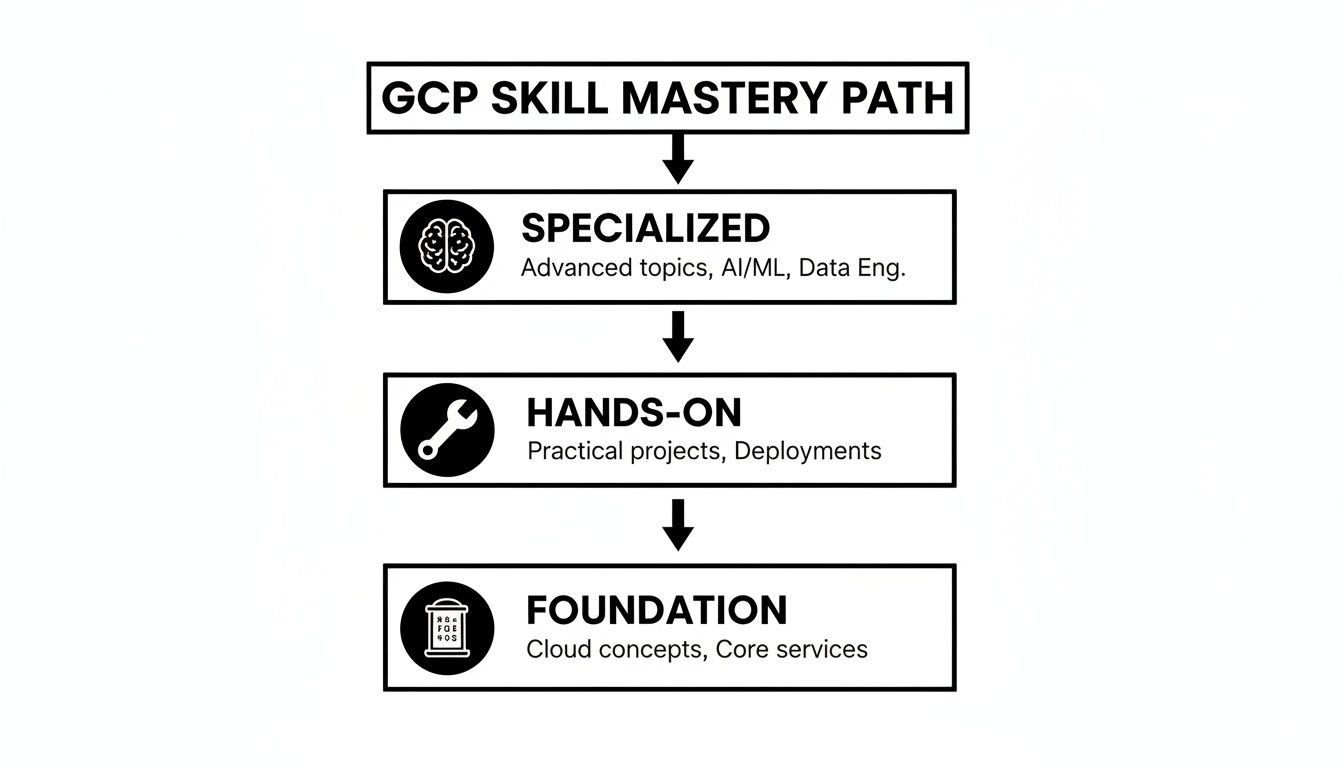
As you can see, it all starts with the foundational concepts, moves into the practical core skills, and culminates in specialized expertise—the highest level of proficiency.
The Architect Path
The Professional Cloud Architect certification is easily one of the most respected credentials in the entire cloud industry. This isn't about tweaking individual services; it’s about designing entire cloud solutions that are robust, secure, and scalable enough to meet ambitious business goals. An architect thinks in blueprints, not just lines of code.
These are the people answering the big questions: How do we design a multi-region, disaster-resilient system from the ground up? How do we migrate a clunky legacy application to a modern microservices architecture on GKE? What’s the most cost-effective way to manage and analyze petabytes of incoming data? This certification is proof that someone can design, plan, and oversee a cloud solution architecture from concept to reality.
The Data Path
In a world running on data, the Data Path is where you'll find many of the most in-demand and high-paying roles. This track is all about mastering the entire data lifecycle—from ingestion and processing all the way to analysis and machine learning.
The two key certifications here are:
Professional Data Engineer: This person builds and maintains the data processing systems. They are the masters of services like BigQuery, Dataflow, and Pub/Sub, architecting the data pipelines that turn raw, messy data into actionable intelligence.
Professional Machine Learning Engineer: This role pushes things even further, focusing on designing, building, and productionizing ML models. They live in tools like Vertex AI, using GCP’s powerful platform to train, deploy, and manage machine learning systems at scale.
The GCP journey is especially lucrative for data and AI specialists. The Professional Data Engineer certification, for example, is linked to average salaries between $118,974 and $148,082. That’s a highly valuable niche in a market that’s projected to rocket from $676.29 billion in 2024 to an incredible $2,291.59 billion by 2032.
The Security And Networking Paths
For any organization where security and network reliability are mission-critical, having specialized experts isn't a luxury—it's a necessity.
Professional Cloud Security Engineer: This is the expert who configures the defenses and ensures everything stays compliant. They master GCP's security tools, implement rock-solid policies, manage identity and access, and protect data across the entire organization.
Professional Cloud Network Engineer: This role is all about designing, implementing, and managing network architectures in GCP. They are the go-to experts on VPCs, interconnects, load balancing, and network security—the digital plumbing that keeps everything running smoothly and safely.
These professional certifications are far more than just badges for a LinkedIn profile. They send a clear signal to hiring managers that a candidate has the deep, scenario-based knowledge needed to handle complex, real-world cloud challenges.
To help you see the differences more clearly, we’ve put together a table breaking down each path. It maps out the target audience, the skills being validated, and what you can expect in terms of salary, giving both engineers and hiring managers a clear guide. Our own research into high-paying tech jobs in demand roles for 2024 consistently shows just how valuable these specializations are in the current market.
GCP Professional Certification Paths and Job Roles
This table offers a detailed comparison of key Professional GCP certifications, outlining the target audience, primary skills validated, and typical salary ranges to help align credentials with career goals and hiring needs.
Certification | Ideal For (Job Role) | Core Skills Validated | Average Salary Range |
|---|---|---|---|
Professional Cloud Architect | Cloud Architects, Solutions Designers, Senior Cloud Engineers | Designing for security and compliance, analyzing and optimizing technical and business processes, managing implementations, ensuring solution reliability. | $125,000 - $175,000+ |
Professional Data Engineer | Data Engineers, Data Architects, Business Intelligence Professionals | Building and maintaining data structures and databases, designing data processing systems, analyzing data and enabling machine learning. | $118,000 - $165,000+ |
Professional Cloud Security Engineer | Security Engineers, Security Analysts, Cloud Operations Specialists | Configuring access within a cloud solution environment, managing security operations, ensuring data protection, enforcing organizational policies. | $120,000 - $170,000+ |
Professional Cloud Network Engineer | Network Engineers, Cloud Network Architects, Systems Administrators | Designing and implementing VPCs, configuring network services, implementing hybrid connectivity, managing network operations and security. | $120,000 - $160,000+ |
This breakdown makes it easy to see how each certification targets a specific, high-value skill set. For companies, having a team with a diverse mix of these professional certifications means you're equipped to tackle just about any challenge Google Cloud can help solve.
Building Your Certification Study Plan

Knowing the map of the GCP certification path is one thing; successfully navigating the terrain is another. The bridge between your ambition and the certification itself is a solid, realistic study plan. It’s what turns the big goal into a series of small, manageable wins.
This isn’t about just passively watching videos or skimming documentation until your eyes glaze over. It's about building a structured approach that forces you to get your hands dirty with real-world application. A good plan ensures you’re not just memorizing facts for a test, but building genuine, durable skills that make you a better engineer.
Laying the Groundwork: A Four-Step Approach
The first—and most critical—step is building a realistic schedule. A well-paced plan is your best defense against burnout and the fastest way to build real confidence. Think of it like a blueprint for a building: you need a solid plan before you even think about laying the first brick.
Here’s a simple checklist to get you started:
Define Your Timeline: Get real about your existing commitments. For an Associate exam, a focused learner could aim for 6-8 weeks. For a Professional certification, that timeline easily stretches to 3-4 months or more, especially if you're newer to the concepts.
Block Out Your Calendar: Schedule non-negotiable study blocks and stick to them. Consistency is everything. Two focused hours every other day will beat an eight-hour cram session on Sunday, every single time.
Set Weekly Milestones: Break down the official exam guide into weekly chunks. For the Associate Cloud Engineer, Week 1 could be "Setting up a cloud solution environment," while Week 2 is "Planning and configuring a cloud solution."
Identify Your Resources: Pick a small number of high-quality materials. One of the biggest mistakes I see people make is trying to use every course, book, and video out there. It just leads to getting completely overwhelmed.
Choosing High-Impact Study Resources
Not all study materials are created equal. The best ones are those that force you to stop watching and start doing. Your study plan should revolve around hands-on practice, not just theory.
Prioritize resources that demand practical application:
Google Cloud Skills Boost: This is Google's own turf. It's a mix of courses and hands-on labs designed to align perfectly with the certification objectives. Start here.
Hands-on Labs (Qwiklabs): These are timed, real-world scenarios in a live GCP environment. Honestly, completing labs is the single best way to build the muscle memory you'll need for the exam's performance-based questions.
Quality Practice Exams: Use these as diagnostic tools, not just memorization drills. A good practice exam doesn’t just tell you that you’re wrong; it explains why the right answer is correct, helping you spot your knowledge gaps.
A common pitfall is spending 80% of study time on videos and only 20% on labs. Flip that ratio. True competence is built by doing, not just watching.
From Associate to Professional: Leveling Up Your Plan
The game changes when you move from an Associate to a Professional exam. It’s no longer just about knowing what a service does; it's about knowing why you'd choose it over another to solve a complex, messy business problem. Your study plan has to reflect that jump in complexity.
For a Professional certification like the Cloud Architect:
Extend Your Timeline: Give yourself more runway. You’re aiming for a much deeper level of understanding, and that takes time.
Focus on Case Studies: Google publishes official case studies for its Professional exams. Your job is to deconstruct them. Understand the business needs, the technical constraints, and the architectural trade-offs.
Go Beyond the Docs: Start reading the Google Cloud Architecture Framework documents and official whitepapers. These resources explain the "why" behind best practices, which is exactly what the Professional exams are designed to test.
Ultimately, your GCP certification path study plan is your personal roadmap. It should push you but not break you. It needs structure, but also the flexibility to adapt. The real goal isn't just to pass an exam, but to walk into that testing center confident you can solve real-world problems.
Of course, if your goal is to build a team of certified experts without that ramp-up time, TekRecruiter can help. As a technology staffing and AI Engineer firm, we connect innovative companies with the top 1% of pre-vetted engineers who have already mastered these skills, ready to deploy anywhere.
Got Questions About the GCP Path? We've Got Answers.
People always have practical questions when navigating the GCP certification ladder, whether they're mapping out their own career or building a team. Let's clear up a few of the most common ones.
Which GCP Certification Should I Start With?
That really boils down to your background and what you want to achieve.
If you’re new to the cloud entirely or you're in a role that touches tech—like sales, marketing, or project management—the Cloud Digital Leader is your perfect on-ramp. It’s all about the business value of the cloud, no hands-on keyboard skills required.
But if you're coming from a technical background and your goal is a hands-on engineering job, start with the Associate Cloud Engineer. It’s the practical, foundational cert that proves you can actually build and manage things on GCP.
How Long Do GCP Certifications Last?
All Google Cloud certifications are valid for two years, period.
When that two-year mark approaches, you’ll need to recertify by passing the latest version of the exam. This isn't just a hoop to jump through; it’s Google’s way of making sure your skills are sharp and relevant as their platform continues to evolve.
Are There Prerequisites for the Professional Certifications?
Officially, no. You could technically walk in and sit for a Professional exam without any other certs to your name.
But let’s be real—that’s a bad idea. Google strongly recommends having at least three years of industry experience, including one solid year of hands-on work with GCP. The Professional exams are brutal, scenario-based tests of deep, practical knowledge. Experience isn’t just recommended; it’s pretty much essential for passing. The Associate Cloud Engineer is the smartest stepping stone you can take.
Mapping out a GCP certification path is a fantastic way to build skills, but assembling a whole team of certified experts takes time you might not have. When you need elite GCP talent right now, TekRecruiter is your answer. We’re a technology staffing and AI Engineer firm that connects innovative companies with the top 1% of engineers, anywhere in the world. Let's build your elite cloud team together.
Comments