Hire Dedicated Software Developers A CTOs Playbook For Elite Teams
Learn how to hire dedicated software developers with this CTOs playbook. Master sourcing, vetting, and retaining elite engineers for your global team.

Are you struggling to scale your engineering team fast enough? The right move might be to hire dedicated software developers. This isn't just a stop-gap; it's a strategic model that gives you access to specialized, pre-vetted talent ready to plug directly into your team. It's how you bypass the slow, expensive grind of traditional hiring and actually accelerate your product launches.
Why Smart CTOs Now Prioritize Dedicated Developers
In the race to innovate, speed and expertise are everything. I've seen countless CTOs and engineering leaders get bogged down by traditional, sluggish in-house hiring cycles. They're now shifting to a more agile approach: hiring dedicated software developers.
This isn't about filling empty seats. It’s a strategic pivot to build a resilient, high-performing engineering team that can adapt to market demands instantly.
The real advantage is gaining immediate access to specialized skills—think AI, machine learning, and cloud engineering—that are often scarce or prohibitively expensive to find locally. Instead of burning months searching for a single senior engineer, you can onboard an entire team of vetted experts who are ready to contribute from day one.
The Strategic Edge of a Dedicated Team
When you hire a dedicated software team, you're getting more than just extra hands on keyboards. You’re acquiring a strategic asset.
Accelerated Time-to-Market: You get to sidestep those lengthy recruitment cycles and immediately inject momentum back into your product roadmap.
Access to Elite Global Talent: Tap into a worldwide pool of engineers, bringing diverse perspectives and genuinely top-tier skills to your projects.
Cost-Effective Scalability: Build a powerhouse team without the heavy overhead of salaries, benefits, and office space that come with full-time employees. Getting a handle on metrics like your overall recruitment cost per hire is key to making smart financial decisions here.
This shift is a direct response to the insane global demand for tech talent. The global software developer population is expected to hit 28.7 million by 2024, a jump of 3.2 million since 2020. That number alone shows the relentless competition you're up against, making the dedicated team model a practical necessity, not just a luxury.
To make the right call, you need to see how the different models stack up.
Engagement Model Comparison: Dedicated Team vs Freelancer vs In-House
Here’s a quick breakdown to help you decide which hiring model best fits your project needs, budget, and long-term goals.
Attribute | Dedicated Team | Freelancer | In-House Team |
|---|---|---|---|
Commitment | Long-term, fully integrated | Short-term, project-based | Long-term, full-time employee |
Cost | Moderate, predictable monthly cost | Variable, often hourly/project-based | High, includes salary, benefits, overhead |
Integration | High; becomes part of your team | Low; typically works independently | Highest; fully part of company culture |
Scalability | High; easy to scale up or down | Moderate; depends on availability | Low; slow and expensive to scale |
Management | Shared responsibility with vendor | You manage directly | You manage directly |
Best For | Long-term projects, core product dev | Specific tasks, short-term needs | Core business functions, long-term strategy |
Each model has its place, but for sustained product development and scaling, the dedicated team often hits the sweet spot.
A dedicated team model offers the perfect balance—the control and integration of an in-house team with the flexibility and cost-efficiency of outsourcing. It’s about building a long-term partnership focused exclusively on your success.
Ultimately, this model can transform your engineering department from a cost center into a powerful engine for growth. It gives you the agility to scale up for a critical launch or down after a major release, ensuring your resources are always aligned with your most important business goals.
Ready to build a world-class engineering team without the traditional hiring headaches? TekRecruiter connects you with the top 1% of vetted software developers from premier global talent hubs. Let's build your elite team today.
Finding And Vetting Elite Global Talent
If you want to hire dedicated developers who will actually move the needle on your roadmap, you can’t just post on the usual job boards and hope for the best. The top 1% of engineers aren't scrolling through those listings. They’re found in specialized networks, thriving nearshore tech hubs, and through partners who live and breathe the global talent market.
It’s a mindset shift from reactive hiring to proactive, strategic sourcing.
The goal is simple: find developers who bring not just technical firepower but also slot neatly into your time zone and work culture. This is where smart engineering leaders are winning with nearshore talent.
Exploring High-Value Nearshore Hubs
Nearshore hubs in Latin America are the sweet spot—offering a potent mix of skill, cultural affinity, and logistical ease. They give you a real advantage over traditional offshore locations by cutting down communication friction and maximizing the hours your teams can actually collaborate.
Latin America (Brazil & Argentina): These are absolute tech powerhouses with a deep and growing bench of senior developers. The time-zone overlap with U.S. companies is a huge win, making real-time collaboration feel effortless. Culturally, you’ll find a strong alignment with North American work ethics, where proactive communication and problem-solving are the norm.
Even with some recent hiring slowdowns, the software development field is on track for a massive 17% growth between 2023 and 2033. While the Bay Area still dominates with 32% of global AI engineering jobs, these nearshore hubs are catching up fast. In fact, Brazil now makes up 27.8% of 2024 hires in the region, offering incredible cost savings of 40-60% compared to U.S. rates.
The diagram below maps out the strategic forks in the road leaders face when building out their teams.
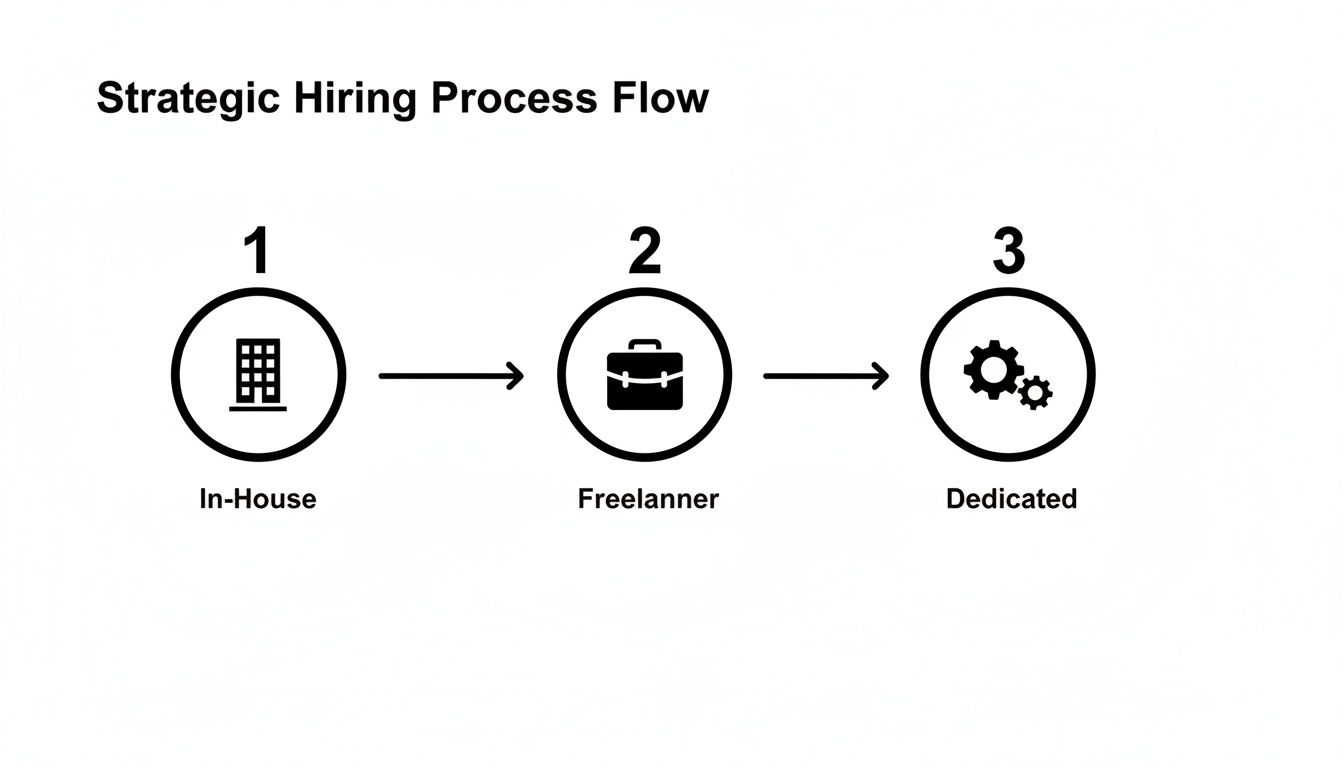
As you can see, opting for a dedicated team isn’t just about filling a seat. It's a strategic move that gives you the deep integration of an in-house hire with the flexibility you’d normally expect from a freelancer.
Designing a Vetting Process That Works
Okay, so you've found some promising talent pools. Now the real work begins. A tough, multi-stage vetting process is non-negotiable if you want to land elite developers—not just someone with a polished resume.
Your process has to test for three things: technical mastery, problem-solving chops, and cultural contribution.
1. The Initial Screen (Go Beyond the Resume) The first call shouldn't be a skills checklist. This is your shot to feel out their passion, communication style, and whether they’re genuinely fired up about your company's mission. Ask them about their toughest projects and what they learned when things went sideways.
2. The Technical Assessment (Use Real-World Challenges) Ditch the abstract brain teasers. The best technical tests mimic the actual work they’ll be doing. A live coding session centered on a simplified version of a real problem your team recently tackled is brutally effective. It tests their coding skills, sure, but it also shows you how they think under pressure and talk through their approach.
3. The Cultural Interview (See How They Collaborate) This is the final gate. Will they actually thrive in your team's dynamics? This isn't about hiring clones; it's about finding people who share your core values around collaboration, feedback, and ownership.
A killer question to ask here is: "Tell me about a time you disagreed with a teammate on a technical approach. How did you handle it, and what was the outcome?" Their answer tells you everything you need to know about their ego, communication style, and whether they put the project's success first.
By pairing strategic sourcing in high-potential nearshore hubs with a bulletproof vetting process, you can consistently hire dedicated developers who become long-term, invaluable members of your team. For a deeper dive into managing these teams, check out our guide on practical strategies for global engineering teams.
Structuring Contracts And Protecting Your IP
You’ve found the right engineers. Now it’s time to formalize the partnership. When you hire dedicated software developers across borders, you’re not just signing a contract—you’re building a legal and operational shield around your most valuable asset: your intellectual property. A thoughtfully structured agreement is the bedrock of a secure and successful engagement.
This all starts with a rock-solid Statement of Work (SOW). Don’t think of this as a simple task list. Your SOW is the definitive playbook for the project. It needs to clearly spell out deliverables, project milestones, and firm timelines. It should also map out your communication protocols—what’s the expected response time? What channels do you use for daily stand-ups versus formal reporting?

Ambiguity is your worst enemy here. A detailed SOW is your best defense against scope creep, mismatched expectations, and any disagreements that might pop up down the line.
Choosing The Right Pricing Model
Hand-in-hand with the SOW, picking the right pricing model is essential for keeping your budget predictable and everyone aligned. Different models are built for different kinds of projects, so you need to understand the trade-offs. You can dive deeper into the differences in our guide to staff augmentation vs outsourcing models.
To help you decide, think of it this way: are your project's needs more like building a bridge with a fixed blueprint, or navigating an ocean with a map that's still being drawn? This framework breaks it down.
Pricing Model Decision Framework
This table can help you select the optimal pricing model by comparing key characteristics against your project requirements.
Model | Best For | Pros | Cons |
|---|---|---|---|
Fixed Price | Well-defined, short-term projects with clear deliverables (e.g., an MVP build). | Predictable budget and timeline. Minimal financial risk. | Inflexible; changes often require costly contract renegotiations. |
Time & Materials | Long-term, evolving projects where scope and requirements may change. | High flexibility to adapt and pivot. Pay only for work done. | Budget can be less predictable. Requires close monitoring. |
Retainer | Ongoing development, support, and maintenance needs requiring consistent availability. | Guarantees developer availability. Fosters a long-term partnership. | You pay for the time, even if it’s not fully used every month. |
For most dedicated team setups, a Time & Materials or retainer model gives you the best mix of flexibility and commitment. It lets the team adapt right alongside your product as the vision evolves.
Fortifying Your Intellectual Property
Let’s be blunt: protecting your IP is non-negotiable. Your code, trade secrets, and proprietary data are the lifeblood of your business. Your legal agreements have to be airtight.
These are the legal tools you can’t skip:
Non-Disclosure Agreement (NDA): This is your first line of defense. Get a strong NDA signed before you share anything sensitive. It legally binds developers to keep your project details, business strategies, and proprietary code under lock and key.
Invention Assignment Agreement: This is absolutely critical. This clause ensures that every line of code, every design, and any other IP created by the developer during the engagement legally belongs to your company—not them and not their agency.
Your contract must explicitly state that all work product is "work for hire" and that all rights, titles, and interests are transferred to your company upon creation. Without this, you could face devastating ownership disputes down the road.
When you're working with dedicated software developers, getting this right is paramount. It’s always smart to consult an experienced Intellectual Property Licensing Lawyer to ensure your trademarks, patents, software, and data are properly shielded.
Implementing Essential Cybersecurity Measures
Legal agreements are just one piece of the puzzle. You also need to enforce robust technical and operational security measures. This ensures your remote team is a secure asset, not a potential liability.
Start by implementing strict access controls based on the principle of least privilege. Developers should only have access to the systems and data they absolutely need to do their jobs. Nothing more. Audit these permissions regularly, especially when roles or projects shift.
Next, mandate the use of multi-factor authentication (MFA) across every critical system, from your code repository to Slack. This single step can block 99.9% of account compromise attacks. Finally, provide ongoing secure coding training to arm your team against the latest threats and reinforce best practices for building resilient software.
Navigating contracts and IP can feel like a minefield, but it doesn’t have to slow you down. At TekRecruiter, we build these best practices directly into our process. We find the vetted, trusted engineers, and your counsel can apply these practices to the agreement. Let us handle the details so you can get back to building.
Integrating Your New Developers Into The Team
The contracts are signed, the talent is vetted, and the legal groundwork is solid. So, you’re done, right? Not even close.
The real work of turning a great hire into a high-performing, long-term team member has just begun. When you hire dedicated software developers, those first 30 days are everything. A seamless integration process is what transforms a skilled individual coder into an indispensable part of your core team.
Your goal isn't just to get them pushing code. It's to build a deep sense of belonging and psychological safety from day one—that's the real foundation for collaboration and innovation. A structured onboarding plan is your roadmap for making sure your new developers feel connected, valued, and ready to make an impact immediately.

Building a Bulletproof 30-Day Onboarding Plan
A great onboarding experience is a careful balance of technical necessities and cultural immersion. Don't just hand them a checklist of tasks. Think of this as a phased journey designed to build momentum and confidence.
Week 1: Foundations and Connections The first week is all about the welcome and the setup. Your primary goal is to remove friction and make them feel like they’ve absolutely landed in the right place.
Painless Tech Setup: Get all their access sorted before day one. Think code repos, project management tools like Jira or Asana, and all communication platforms. A smooth, frustration-free setup shows you respect their time and are ready for them.
Human Connections: Schedule a series of brief, informal one-on-one video calls with key team members. Go beyond their immediate project squad; introduce them to people in product, design, or even sales. This helps them build a mental map of the company and see where they fit into the bigger picture.
Assign a Buddy: This is non-negotiable. Pair them with a seasoned team member who can be their go-to guide for everything from coding standards to the unwritten rules of your team’s Slack channels. It provides an immediate, trusted point of contact for all the "silly" questions they might be hesitant to ask in a group setting.
Week 2: Codebase and Context Okay, time to get into the weeds. Start with a comprehensive codebase walkthrough led by a senior engineer. The focus shouldn't just be on what the code does, but why it was built that way. Share the history, the trade-offs that were made, and the long-term architectural vision.
This is also the perfect moment to assign their first small, low-risk task. A well-documented bug fix or a minor feature enhancement is ideal. It lets them get their hands dirty, navigate the deployment pipeline, and most importantly, score an early win. That first merged pull request is a massive confidence booster.
Launching a Pilot Project To Validate Chemistry
Even with the most thorough vetting process, nothing confirms a great fit like a real-world project. A pilot project is your low-risk, high-reward strategy to validate both technical chops and team chemistry under real-world pressure.
This isn't another test; it's the first real chapter of their journey with you. The ideal pilot is a self-contained feature or module that can realistically be completed within two to four weeks. It needs to be complex enough to be a genuine challenge, but not so mission-critical that a hiccup would derail your entire roadmap.
During the pilot, pay close attention to their communication patterns. Do they ask clarifying questions proactively? How do they handle feedback in code reviews? This is where you see if their collaborative style truly meshes with your team's DNA.
Cultivating Belonging And Trust For The Long Haul
Integration doesn't stop after 30 days. Building lasting trust with a distributed team requires continuous, intentional effort. Often, it's the small, consistent actions that make the biggest difference.
Dedicated Channels: Create a specific Slack or Teams channel for your new developers to connect with each other and their buddies. This carves out an informal space for questions, shared learning, and a bit of camaraderie.
Structured Check-ins: Establish a clear rhythm of daily stand-ups and weekly one-on-ones. These aren't just for status updates; they are crucial for unblocking issues and reinforcing that their voice is heard and valued.
Public Recognition: When they ship their first feature or solve a particularly nasty bug, celebrate it publicly. A simple shout-out in a team channel goes a long way in reinforcing their value and motivating everyone.
Seamlessly integrating remote talent is a core competency for modern engineering leaders. For more insights, explore our playbook for managing distributed teams effectively.
At TekRecruiter, we know that finding top-tier talent is only half the battle. Our entire model is built on deploying the top 1% of engineers who aren't just technically brilliant but are primed for seamless, rapid integration. Let us help you build an elite team that feels cohesive from day one.
Measuring Performance And Driving Long-Term Retention
Once your dedicated developers are integrated, the game shifts from onboarding to outcomes. How do you actually know if this move is paying off? Real measurement goes way beyond vanity metrics like lines of code or tickets closed. It’s about gauging genuine impact and building a relationship that lasts.
The trick is to define Key Performance Indicators (KPIs) that tie directly back to business value and engineering excellence. It's easy to track fluff, but that tells you nothing about the health of your project or the effectiveness of your team. You need to focus on what truly moves the needle.
Defining KPIs That Actually Matter
For a true picture of performance, you need a balanced view that covers quality, speed, and business alignment. This isn't just about shipping features fast; it's about shipping the right features well.
Code Quality: This is your foundation. Are you creating assets or future headaches? Track metrics like bug density (bugs per feature) and the code review participation rate. A high-quality codebase is what lets you move faster later.
Development Velocity: This is all about workflow efficiency. Use metrics like cycle time (from first commit to deployment) to see how quickly your team can deliver value. Consistently low cycle times mean you have an efficient, unblocked team that’s humming along.
Business Impact: This is the ultimate report card. Connect engineering efforts to bottom-line goals. This could be feature adoption rates, improvements in system uptime, or direct contributions to revenue or user growth.
The best engineering teams I've seen are the ones deeply connected to the "why." When a developer understands how their code actually impacts a customer or a core business metric, their sense of ownership goes through the roof.
Focusing on these outcome-driven KPIs creates a culture where performance is measured by tangible results, not just activity. It gives your dedicated developers a clear picture of what success looks like and how they fit into it.
Fostering Growth Through Continuous Feedback
Let’s be honest: annual performance reviews are a relic. For a dynamic, distributed team, a culture of continuous feedback is the only way to drive both performance and growth. This means creating frequent, lightweight opportunities for communication that feel constructive, not critical.
Set up a rhythm of weekly one-on-ones and post-sprint retrospectives. These forums create a safe space to talk about wins, roadblocks, and what could be better next time. The goal is to make feedback a normal, healthy part of the weekly routine. It helps engineers grow their skills and feel far more connected to the team’s mission.
Proven Retention Strategies for Distributed Teams
Keeping top engineering talent is one of the biggest fights any leader faces today. The market has shifted dramatically, with over 50% of open roles now targeting senior-plus engineers. This isn't a fluke. It's driven by explosive growth in specialized sectors like Investment Banking (+91% hiring increase) and Industrial Automation (+73%), where advanced AI and cloud skills are non-negotiable.
This intense competition makes retaining the elite talent you’ve worked so hard to find more critical than ever. You can see more on these software engineer job market trends here.
Here are the strategies that actually work for keeping dedicated developers engaged for the long haul:
Invest in Their Growth: Give them a budget for courses, certifications, and conferences. When you support their career, not just the current project, they notice.
Offer Competitive Compensation: This is table stakes. Regularly benchmark salaries and benefits against the global market to make sure you’re not falling behind.
Promote a Healthy Work-Life Balance: Burnout is real. Encourage your developers to actually disconnect. Respect their local holidays and working hours to build a sustainable, long-term relationship.
Recognize and Reward Contributions: Publicly acknowledge great work. Recognition is a powerful motivator that reinforces the right behaviors and makes your team members feel genuinely valued.
At TekRecruiter, our entire model is built for these long-term partnerships. We don’t just find you developers; we connect you with the top 1% of engineers who are driven by impact and growth. Let us help you build a high-performing team that stays, delivers, and becomes a core part of your success for years to come.
Ready to Build Your Elite Engineering Team?
You now have the playbook. You know what it takes to find, vet, and retain world-class developers. The principles are clear, from protecting your IP to building a culture that keeps top talent engaged.
But knowing the plays and executing them under pressure are two different things. The real challenge is turning all this knowledge into a high-performing team that ships incredible products.
That’s where we come in. TekRecruiter brings this playbook to life. We handle the gritty, complex work of global sourcing and vetting so you can stay focused on what you do best: building your business.
Your Direct Path to the Top 1%
We specialize in quality-first staff augmentation, direct hiring, and nearshore staffing for companies that refuse to settle for second best.
We give you a direct line to the top 1% of engineers from nearshore hubs in Latin America. This means you get elite talent, perfectly aligned with your time zone, who are ready to hit the ground running.
We don't just find individuals. We recruit battle-tested engineers who can form cohesive teams ready to accelerate your roadmap from day one.
Choosing the right partner changes everything. It's the difference between simply filling a role and gaining a genuine competitive advantage. If you want to see exactly how we deliver on this promise, check out our insights on finding talented and affordable software engineers and making it a reality.
Don't let the friction of global hiring slow you down. Let's build the elite engineering team you need to win.
Common Questions, Answered
When you're thinking about hiring a dedicated software team, a few key questions always pop up. Here are the straight answers I give to CTOs and engineering leaders who are ready to make a move.
What's The Real Cost Difference Between Nearshore And Onshore Developers?
Honestly, the numbers are significant. Hiring from a top-tier nearshore hub like Latin America usually saves you 40% to 60% compared to a senior developer in a major U.S. city.
This isn't about getting cheaper, lower-quality work. It's about smart economics. You're tapping into a global talent market with a lower cost of living and operational overhead. That financial edge means you can stretch your budget to hire two, maybe even three, elite engineers for the price of one U.S.-based developer. All without sacrificing skill or the time-zone alignment that's critical for real collaboration.
How Do You Actually Ensure Seamless Communication With A Remote Team?
Great communication isn't just about having the right tools; it’s a deliberate mix of technology, process, and culture. The strongest teams run on a shared tech stack—think Slack and Jira—daily video stand-ups, and most importantly, major overlap in working hours. That last part is the built-in advantage of a nearshore model.
The secret sauce isn't the software, though. It's the mindset. Great teams drill down on clear documentation and foster a culture of proactive updates. When you get that right, the physical distance just melts away, and it feels like your team is right down the hall.
How Fast Can We Actually Hire And Onboard A Dedicated Developer?
This is where the model really shines. Traditional in-house hiring is a grind—it can easily take months to find and onboard the right person. A dedicated team approach is built for speed.
Because the best partners maintain a bench of pre-vetted, top-tier talent, you can often see a shortlist of qualified and interested candidates quickly.
From the moment you say "go" to a developer pushing their first commit, the whole process can be wrapped up in as little as two to four weeks. That kind of speed means you can scale your team exactly when the business needs it, without the frustrating delays that kill momentum.
Ready to skip the hiring headaches and get direct access to elite, pre-vetted engineers? As a technology staffing and recruiting firm, TekRecruiter allows innovative companies like yours to deploy the top 1% of engineers anywhere in the world. We handle the process so you can focus on building the future. Let's build your elite team today.
 Ron SmithPresident & Lead RecruiterTekRecruiter