A Guide to IT Outsourcing Development for Scalable Teams
Discover how IT outsourcing development helps you access elite global talent, accelerate project timelines, and build a scalable engineering team.
Not long ago, "IT outsourcing" was just a buzzword for cutting costs. Today, it’s a completely different ballgame. Smart businesses now see outsourcing development as a strategic weapon for tapping into elite global talent, crushing project timelines, and landing specialized skills that are nearly impossible to find at home. It’s no longer just a line item in the budget—it’s a core driver of your competitive advantage.
IT outsourcing development means hiring an outside company to build, run or support part of your technology. It works through one of three engagement models: staff augmentation, managed services or project-based outsourcing.
Why IT Outsourcing Development Is Your New Competitive Edge

Think about building a championship-winning race car. You wouldn't mine the ore or forge the steel for the engine yourself. Of course not. You’d go straight to the best automotive engineers in the world.
That’s exactly what modern IT outsourcing is. It’s not about offloading grunt work to the lowest bidder anymore. It’s a calculated move to build a faster, smarter, and more powerful technology engine for your entire business.
This shift is fundamentally changing how companies think about growth. VPs of Engineering and CTOs I talk to now see outsourcing as a non-negotiable business accelerator. And the numbers back it up. The global IT services outsourcing market is on a trajectory to hit an eye-watering USD 1,345.48 billion by 2034.
What’s driving this explosion? The priorities have flipped. A staggering 42% of tech leaders now prioritize access to top talent above all else, including cost savings. If you want to see the raw data, check out the full market research on these outsourcing trends.
Tapping Into a Global Talent Pool
The single biggest win with IT outsourcing is instant access to a worldwide pool of specialized experts. Let’s be real: local hiring markets are often a nightmare—fiercely competitive, slow, and expensive, especially for high-demand roles.
Outsourcing lets you sidestep those headaches entirely and connect directly with seasoned professionals in critical fields:
Artificial Intelligence and Machine Learning: Find the data scientists and AI engineers you need to build intelligent systems now, not after a year-long recruiting slog.
Cloud Computing and DevOps: Bring on certified AWS, Azure, or GCP experts who can optimize your infrastructure and streamline deployments from day one.
Legacy System Modernization: Partner with developers who have battle-tested experience migrating complex, mission-critical systems to modern architectures without breaking a sweat.
This isn't just about filling seats. It’s about giving startups the firepower to scale an MVP at lightning speed. It’s how large enterprises tackle massive modernization projects without derailing their internal teams. You get the right expertise, right when you need it.
By partnering with external experts, companies can focus on their core business objectives while highly skilled teams handle the technical execution. This division of labor is a powerful recipe for innovation and market leadership.
Picking the right way to work with an IT outsourcing partner is just as critical as picking the partner itself. The structure of that relationship—what we call the engagement model—directly shapes your control, flexibility, and, ultimately, your project's success. This isn't a one-size-fits-all deal; the right model is all about your specific goals.
Think of it like renovating a house. Do you just need an expert electrician to wire a new room while you direct the project? Or do you need a general contractor to handle the entire kitchen remodel, from design to the final touches? Your answer completely changes the approach.
It's the same in software development. Each engagement model is built for a different purpose. Let's break down the three main options to figure out which one fits you best.
Staff Augmentation: Extending Your Team
Staff augmentation is the most straightforward model. It’s about embedding specialized engineers directly into your existing team. You manage their day-to-day work, they slot into your workflows, and they become a part of your company culture.
This is the perfect move when you already have solid project management in-house but are missing a key skill or just need more hands on deck for a short period. For instance, if your team needs two senior AI engineers to push a new feature over the finish line, staff augmentation gets you that exact talent without the long-term overhead of hiring. You get the expertise you need, right now, while keeping full control.
Managed Services: Offloading a Function
Managed services is a completely different animal. Instead of adding individual people, you're handing off an entire business function to a partner. This could be anything from managing your cloud infrastructure and security to taking over all your quality assurance testing.
The key idea here is shifting responsibility. The vendor becomes accountable for delivering specific outcomes and hitting pre-defined Service Level Agreements (SLAs). A company might hire a managed services provider to guarantee 99.9% uptime for their AWS environment. This frees up their internal team to stop worrying about infrastructure and focus on building the core product.
This model shifts your focus from managing people to managing results. Your partner takes complete ownership of an operational area, letting your team concentrate on the strategic work that actually grows the business.
Project-Based Outsourcing: End-to-End Delivery
Finally, there’s project-based outsourcing. This is when you hand over an entire, well-defined project from start to finish. You lay out the scope, requirements, and deadlines, and the outsourcing partner takes it from there, delivering the final product.
This model is ideal when you have a clear vision for a project but don’t have the internal team or specific expertise to build it. A classic example is a startup that needs a Minimum Viable Product (MVP) built from the ground up. With a project-based model, they can get a fully functional app delivered without having to assemble an in-house development team first.
To get a deeper look at how these models stack up, check out our detailed guide comparing staff augmentation vs outsourcing.
Comparing IT Outsourcing Engagement Models
To help you decide, here’s a side-by-side comparison of the models based on what matters most: your project needs, budget, and how much control you want to keep.
Factor | Staff Augmentation | Managed Services | Project-Based |
|---|---|---|---|
Control | High (You manage the talent directly) | Medium (You manage outcomes, not people) | Low (You define scope, vendor executes) |
Flexibility | High (Easy to scale team up or down) | Medium (Defined by SLA and contract terms) | Low (Changes often require a scope revision) |
Best For | Filling skill gaps; short-term needs | Offloading entire functions (e.g., IT support) | Well-defined projects with a clear endpoint |
Cost Structure | Time & Materials (Pay per hour/day) | Fixed Monthly Fee (Predictable cost) | Fixed Price (Pay for the entire project) |
Management | Your internal project manager | Vendor's manager + your oversight | Vendor's project manager |
Each model has its place. The trick is aligning the model's strengths with your business's immediate needs and long-term vision.
Whether you need to add a few elite engineers to your roster or hire a whole AI team, TekRecruiter has you covered. We connect innovative companies with the top 1% of global engineers, giving you the flexibility and expertise to succeed with any engagement model you choose.
Onshore, Nearshore, and Offshore Outsourcing Compared
Picking a partner for IT development isn't just about their tech stack; it’s about their ZIP code. And that decision goes way beyond a line on a map—it’s a strategic choice that directly impacts communication, collaboration, and whether your project actually succeeds.
The three main flavors are onshore, nearshore, and offshore. Each comes with its own set of very real trade-offs.
This decision tree helps frame the conversation. Are you trying to plug a specific skill gap on your current team, offload an entire function, or build something totally new from scratch? Your answer points you to the right model.
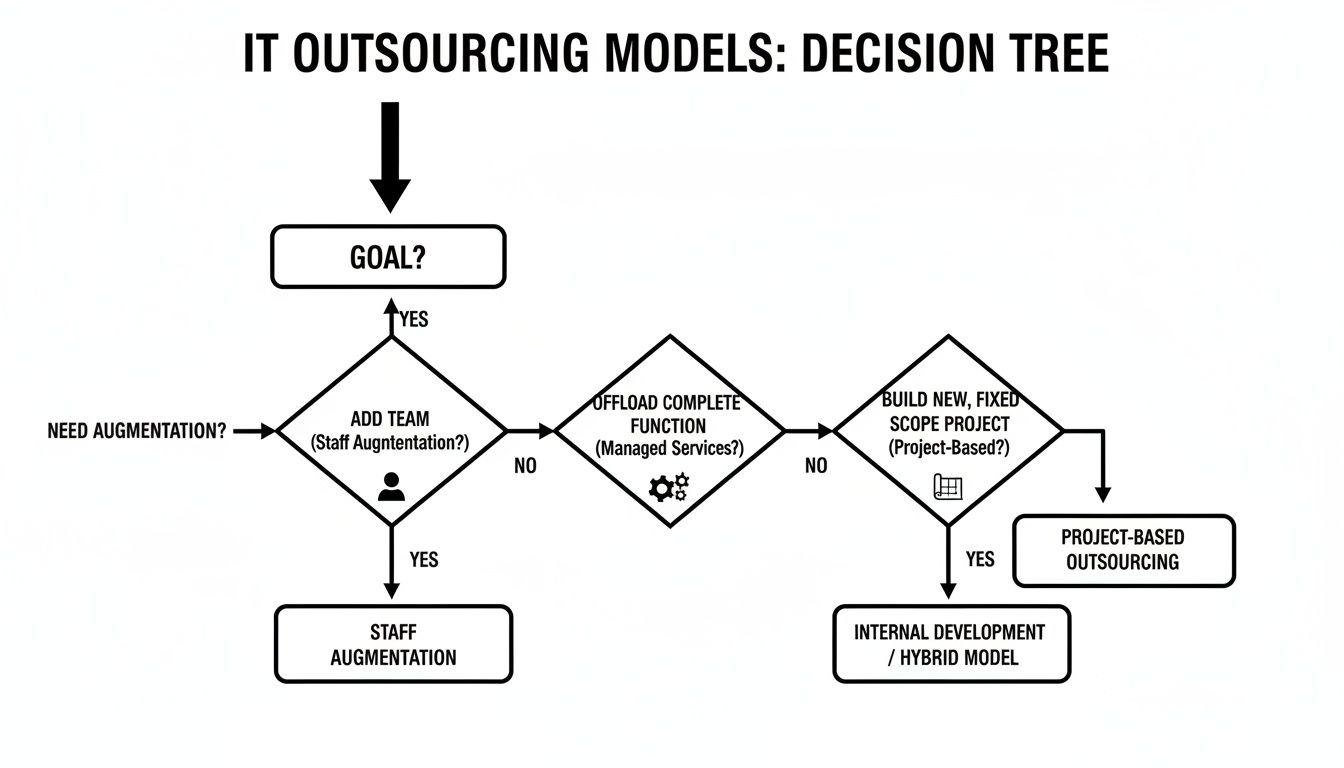
As you can see, the core goal—augmenting your team, managing a function, or delivering a project—is the real starting line for figuring out the best engagement and location model for your business.
Understanding the Geographic Models
The names themselves give you a pretty good hint.
Onshore means you're partnering with a company inside your own country. This gives you perfect cultural alignment and zero time zone headaches, but it almost always comes with the highest price tag.
Offshore development sends the work to a firm in a distant country, like India or the Philippines. This route usually offers the biggest cost savings, but you have to wrestle with massive time zone gaps and cultural nuances that can bog down real-time work.
Nearshore is the sweet spot in the middle. This model pairs you with partners in neighboring countries that share similar time zones, like a U.S. company working with a team in Latin America. It’s a compelling blend of cost-effectiveness and smooth collaboration.
The Rise of Nearshore and Hybrid Models
The market is clearly tilting toward this more balanced approach. North America currently dominates the global IT outsourcing market, holding a massive 38% share. But with brutal talent shortages pushing companies to outsource over a third of their IT tasks, everyone is looking for smarter, more efficient ways to get work done.
This has lit a fire under nearshore and hybrid solutions. While traditional off-site delivery still holds a 56.70% market share, hybrid models are the fastest-growing segment, expanding at a 15.40% CAGR.
For fast-moving Agile and DevOps teams, time zone alignment isn't a "nice-to-have"—it's a non-negotiable. Nearshore teams can jump into daily stand-ups and solve problems in real time, killing the frustrating "overnight" communication delays that plague offshore models.
This sync-up is mission-critical for projects that depend on quick feedback and rapid iteration, especially complex AI implementations. For a much deeper dive into these location strategies, check out our definitive tech guide on nearshore vs. offshore.
At TekRecruiter, we specialize in connecting you with the top 1% of engineers from elite nearshore hubs. We handle the vetting, including how clearly each engineer communicates, so your team avoids communication gaps and cultural missteps. You get the best of both worlds: world-class talent at a fraction of the cost, all working in real time with your team.
How to Select the Right Development Partner
Picking a partner for your IT outsourcing development is the single most important decision you'll make. Get it right, and they become a seamless extension of your team, pushing innovation and driving growth. Get it wrong, and you're staring down the barrel of missed deadlines, bloated budgets, and endless frustration.
Your goal isn't just to find a vendor; it's to find a strategic ally. Technical chops are just the ticket to the game. A real partnership is built on something much deeper: cultural alignment, transparent communication, and a shared vision for what you're building together. That means you have to look far beyond a polished portfolio.
Beyond the Code: Vetting Essential Qualities
It’s easy to judge a team's technical skills. What's harder—and far more important—are the intangible qualities that make or break a collaboration. You need a team that thinks strategically, not one that just takes orders and cranks out code.
Keep an eye out for evidence of these critical traits:
Cultural Fit: Do their team's values and work style actually mesh with yours? If there’s a mismatch, you'll feel it in everything from daily stand-ups to high-pressure crunch times.
Communication Protocols: How do they talk? Look for established routines, clear points of contact, and a rock-solid commitment to transparency, especially when things go wrong.
Security and Compliance: Don't skip this. A crucial step is running a thorough third party risk assessment to see if their security posture is up to snuff. Ask about certifications like SOC 2 or ISO 27001—these aren't just acronyms; they prove a serious commitment to protecting data.
The best partners don't just build what you ask for; they challenge your assumptions and offer better solutions. They act as strategic advisors, leveraging their expertise to help you build a real, long-term competitive advantage.
Critical Questions to Ask Potential Partners
To really figure out if a potential partner is the right one, you have to ask pointed questions that cut through the sales pitch. Their answers will tell you everything you need to know about their processes, problem-solving skills, and how they truly see the partnership.
Use this checklist to guide your conversations:
How do you handle scope creep and changes in project requirements? Their answer reveals just how agile and adaptable they really are.
What is your knowledge transfer and documentation process? This is non-negotiable. You can't be left in the dark holding a black box of code when the project ends.
Can you share case studies of projects similar to ours in complexity and scale? This is where the rubber meets the road. It validates their experience far better than a simple list of skills.
How do you ensure code quality and maintainability over the long term? You're listening for words like code reviews, automated testing, and clear coding standards.
Choosing the right partner comes down to building a foundation of trust and shared goals. When you find that team that gets your vision and genuinely enhances your capabilities, you’re not just outsourcing tasks—you're setting the stage for your next big win.
Ready to find a partner that acts as an extension of your team? We find and vet the best IT outsourcing company for the work, and you contract with that company directly, so your IT outsourcing development starts with the right supplier. See how MSP & Outsourcing Search works.
Managing Contracts, Security, and Project Governance

Once you’ve shaken hands with the right partner, the real work begins. A successful IT outsourcing development relationship isn’t built on good intentions; it’s built on a rock-solid foundation of clear contracts, tight security, and transparent project governance. This is where you move from strategy to execution, turning a promising partnership into a predictable, high-performing engine for your business.
A vague contract is just a recipe for disaster. Think of your agreement as the precise blueprint for the engagement, leaving zero room for interpretation. This document is your single source of truth, defining everything from deliverables to how you'll handle disagreements.
Building an Ironclad Contract
The heart of your contract needs a few non-negotiable components. These are the elements that ensure both sides are perfectly aligned on expectations and responsibilities from day one.
Statement of Work (SOW): This needs to detail the specific tasks, deliverables, timelines, and project milestones. Be ruthless with the details.
Service Level Agreements (SLAs): These are the measurable metrics that define what success actually looks like—think system uptime, ticket response times, or bug-fix resolutions.
Intellectual Property (IP) Clause: Clearly state that your company owns 100% of the code, designs, and other IP created during the project. This is non-negotiable.
A strong contract acts as your project's constitution. It protects your interests, clarifies responsibilities, and provides a clear framework for measuring success, ensuring the partnership starts on solid legal and operational ground.
Prioritizing Security and Governance
In any outsourcing engagement, security can't be an afterthought. Protecting your data and systems is everything. You have to establish crystal-clear protocols for data handling, access control, and compliance with regulations like GDPR or CCPA. A great way to bake security in from the start is to implement a modern shift left security approach.
Effective governance is what keeps the project from going off the rails. This means setting up a regular communication rhythm—think daily stand-ups, weekly check-ins, and maybe a monthly steering committee meeting. You’ll also want to define Key Performance Indicators (KPIs) to monitor progress without emotion or guesswork. Having a plan for when things go wrong is just as crucial. For more on that, check out our article on mastering software project risk management for on-time delivery.
The Future of IT Outsourcing and Global Talent
The ground is shifting under the world of IT outsourcing. Forget everything you thought you knew. The game isn't just about finding cheaper developers anymore. It's evolved.
Two massive forces are reshaping how smart companies build their global engineering teams: the explosion of AI as a core business weapon and the rise of elite, specialized talent hubs across the world. The conversation has moved past pure cost-cutting and is now laser-focused on strategic value, innovation, and collaboration that just works. Companies are waking up to the fact that the right partner does more than just follow orders—they can future-proof your entire tech roadmap.
AI as a Force Multiplier
Let's get one thing straight: AI isn't just another skill you outsource. It's becoming the engine of the outsourcing process itself. AI-powered tools are now writing code, automating tedious testing, and running project management with an intelligence that dramatically shrinks development cycles.
This means the best partners aren't just the ones who can find you AI engineers. The real game-changers are the ones who have already baked AI into their own operations. They use it to work faster, smarter, and predict risks before they become disasters. This dual role makes AI a true force multiplier.
The most forward-thinking companies aren't just asking, "Can you build AI for us?" They're asking, "How do you use AI to build everything better?" This symbiotic relationship between AI talent and AI-driven process is the new gold standard.
The Shift to Value-Driven Talent Hubs
At the same time, the map of global talent is being redrawn. While cost is still part of the equation, the primary focus has pivoted to specialized expertise and real-time, timezone-aligned collaboration. This has ignited the rise of nearshore talent hubs in places like Latin America and Eastern Europe, turning them into epicenters for in-demand skills like AI, cloud engineering, and cybersecurity.
This isn't a small trend; it's reshaping the entire market. While 76% of businesses already outsource IT functions, the new emphasis is on cultural fit and a shared drive for innovation. This strategic pivot is fueling explosive growth, with the global IT outsourcing market expected to rocket from USD 807.91 billion in 2025 to USD 1,219.31 billion by 2030. You can explore the top IT outsourcing trends to see just how fast things are moving.
 Ron SmithPresident & Lead RecruiterTekRecruiter