_edited.png)
Hire dedicated development team: A proven path to delivering results
When you hire a dedicated development team, you’re not just outsourcing tasks. You're bringing on a group of external professionals who integrate directly into your workflow, working exclusively on your projects. Think of them as an extension of your in-house staff, but without the traditional hiring overhead.
This model is all about long-term stability and building deep product knowledge, a world away from the short-term, fire-and-forget nature of project outsourcing.
Why Smart Scaling Starts with a Dedicated Team
Are you struggling to find specialized talent? Trying to get a handle on development costs while the pressure to ship faster never lets up? You're not alone. The demand on CTOs and engineering leaders to deliver more with less is relentless.
Hiring a dedicated development team has gone from a simple cost-cutting tactic to a core strategy for real, sustainable growth. It's how you get a competitive edge when the market won't wait.
This isn't just theory. This approach is the answer to the biggest headaches in tech leadership today. Picture a fintech startup launching critical features months ahead of schedule, completely outmaneuvering the established players. Or an enterprise finally tackling that massive cloud migration without pulling its core team off their day-to-day mission. These are the real-world results I’ve seen happen.
From Bottleneck to Breakthrough
The traditional hiring process is a known bottleneck. It's slow, it's expensive, and it stalls innovation right when you need to be moving fastest. A dedicated team flips that script, turning the challenge of scaling into a strategic advantage. You can move quickly and deliberately.
Don't just take my word for it. A recent Gartner report showed that 78% of businesses are planning to increase their use of external development resources. The market is clearly shifting in this direction.
This isn't some fleeting trend. The global IT outsourcing market is on track to hit an insane $1,318.28 billion by 2033. This is the new standard for building and scaling tech teams effectively.
The real win here isn't just filling seats. It’s about building a cohesive unit that takes genuine ownership of your product vision. That ownership translates directly into higher quality code, proactive problem-solving, and a true partnership—not just a vendor relationship.
The process is straightforward: you identify a challenge, implement a strategic team solution, and drive measurable growth.
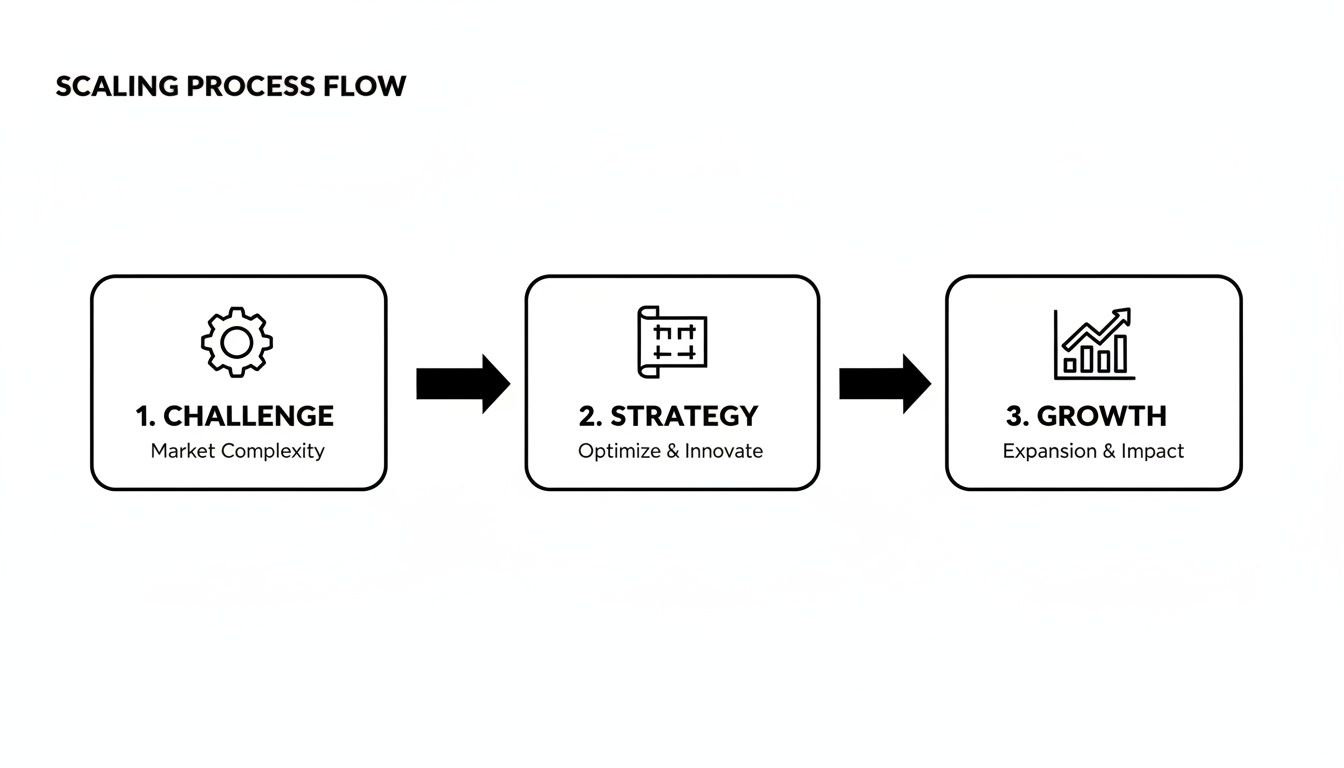
This model isn't just about adding headcount; it's a deliberate process for turning roadblocks into growth opportunities. If you’re looking at different ways to augment your team, you can also explore the benefits of staff augmentation to boost growth.
At its core, a dedicated team gives you:
Access to a global talent pool: You can find those niche skills in AI, cloud, or cybersecurity that are nearly impossible to find locally.
Predictable costs: You operate on a fixed monthly cost, which makes budgeting and financial planning ridiculously simple.
Enhanced focus: Your in-house team is freed up to concentrate on the core business logic and strategic priorities that only they can handle.
Ready to build a high-performing team without the endless cycle of traditional recruiting? TekRecruiter connects you with the top 1% of engineers on the planet. Let's talk about building your elite team.
Defining Your Mission Before You Build Your Team
Hiring a team without a clear mission is like setting sail without a map. It’s a rookie mistake I’ve seen sink otherwise promising projects. Before you even think about interviewing candidates or comparing pricing models, you need to build a rock-solid business case.
This initial planning phase is the single most important predictor of success. Jumping straight into hiring is a recipe for scope creep, budget overruns, and a final product that just misses the mark. Instead, you need to start by articulating exactly what you need to achieve. That clarity will guide every single decision that follows.

Mapping Your Project Scope and Goals
First, get granular. Vague objectives like "build a new mobile app" are useless. What specific problems will this solve for your customers? What are the absolute core features required for a successful MVP? What does success look like in six months? A year?
A practical way to do this is to force-rank your features into two buckets: must-haves and nice-to-haves. It sounds simple, but this exercise forces real prioritization and helps define a realistic initial scope.
Must-Haves: These are the non-negotiables. For an e-commerce app, this is user authentication, a product catalog, and a secure checkout. The product is dead on arrival without them.
Nice-to-Haves: These add value but can wait for phase two. Think of things like a recommendation engine or a customer loyalty program.
Making this distinction is critical because it directly dictates the skills you need on day one. If your must-haves involve heavy data processing, you need a senior data engineer immediately. But if AI-powered recommendations are a future goal, you can hold off on that specialized hire.
Determining the Right Team Size and Structure
With a clear scope in hand, you can start to map out the team. Do you just need a couple of specialists to augment your current crew, or are you building a full squad from scratch for a long-term project? A small, targeted initiative might only require two senior backend engineers and a QA specialist to punch through a specific part of your roadmap.
On the other hand, a brand-new product build demands a more complete team. You're typically looking at a mix of frontend and backend devs, a QA engineer, a UI/UX designer, and a project manager to keep the train on the tracks. For a deeper dive, check out our guide on finding the right software development team structure.
Your technical requirements document becomes your North Star here. It should detail the desired architecture, tech stack (e.g., React, Node.js, AWS), and any specific third-party integrations. A well-defined technical plan kills ambiguity and ensures any potential partner can line up a team with precisely the right expertise.
Calculating the True Cost of Ownership
Finally, you have to sell this to the business. That means moving beyond the monthly rate for a dedicated team and presenting a realistic Total Cost of Ownership (TCO) analysis. This isn't just about showing you've done your homework; it's about demonstrating you understand the real business impact.
Your TCO needs to account for all the "hidden" costs of traditional hiring that you're strategically avoiding:
Recruitment Overhead: The cost of job postings, recruiter fees, and the sheer number of hours your own team burns screening and interviewing. This can easily eat up 20-30% of a new hire's first-year salary.
Benefits and Equipment: All the associated costs for healthcare, retirement plans, office space, and hardware add up fast.
Opportunity Cost: This is the big one. How much revenue are you losing because of project delays while you hunt for scarce local talent?
When you present a clear TCO that contrasts these factors with the predictable, all-inclusive cost of a dedicated team, the conversation changes. It’s no longer about an expense; it’s a strategic investment in speed and efficiency.
With a defined mission, a sharp scope, and a compelling business case, you are finally ready to find a partner who can actually deliver. At TekRecruiter, we specialize in connecting companies with that top 1% of global engineering talent—the kind of elite teams that can execute on your vision.
How to Find and Vet a Truly Elite Development Partner
Finding the right partner to help you hire a dedicated development team is a whole lot more involved than a quick Google search. The market is absolutely flooded with vendors, but I’ve found that only a tiny fraction can deliver the kind of elite engineering talent that actually moves the needle.
Your real goal here is to find a partner with a transparent, proven process for sourcing and qualifying top-tier professionals. Forget the generic freelance platforms—that's often a race to the bottom on price and rarely gets you the cohesive, high-performing team you need for a serious project.
Instead, you need to focus your efforts on channels known for quality.

Sourcing Channels for Top-Tier Talent
I’ve learned you can’t just rely on one source. A multi-channel approach is the only way to go, mixing different types of providers to find the perfect fit for your specific tech stack and culture.
Specialized Recruiting Firms: Partners like TekRecruiter don’t just post jobs; they build and maintain curated networks of pre-vetted engineers. They’ve invested years in these relationships, giving you a direct line to talent that isn't even looking at job boards.
Curated Talent Platforms: Some platforms are solid, but you have to look for the ones with a truly rigorous, multi-stage vetting process. A key signal? They publicize their acceptance rates. A low number—think under 5%—is a good sign they’re serious about quality control.
Peer Recommendations: This is often the best signal you can get. Tap into your professional network. Ask other CTOs or VPs of Engineering who they’ve worked with and, more importantly, who they'd work with again. A strong referral from a trusted peer is gold. For more on this, check out these practical strategies for hiring remote developers.
Once you have a shortlist of potential partners, the real work begins. This is where you cut through the sales pitch and see if they can actually deliver.
The Battle-Tested Vetting Checklist
An elite partner will have well-defined, battle-tested processes. Your job is to poke and prod those processes with sharp, specific questions. Don’t just ask, "How many developers do you have?" Dig into the how—the mechanics of how they build and maintain their talent pool.
Before you even start, it's a good idea to ground your own expectations. Using a practical guide to technical feasibility assessment can help you frame what you need so you can better evaluate if their capabilities truly align.
Here are the critical areas I always investigate:
1. Their Technical Assessment Process
How do they really know their engineers are any good? If you get a vague answer here, it’s a massive red flag.
Are they just using automated coding tests, or do they conduct live pairing sessions and system design interviews? The latter tells you so much more.
Who is doing the assessing? It needs to be senior engineers who can accurately gauge a candidate's depth, not just a recruiter checking boxes.
Ask if they can share anonymized examples of technical challenges or their scoring rubrics. Transparency is key.
2. Communication and Cultural Alignment
Technical skill is only half the battle. I've seen projects derailed faster by poor communication than by buggy code. A developer who can't collaborate effectively is a liability.
How do they screen for soft skills? Ask about their methods for testing proactive communication, problem-solving, and a sense of ownership.
What’s their process for matching a candidate to your company’s specific values and work cadence?
Try this question: "How do you ensure your team members contribute to our engineering culture, not just the codebase?"
3. Support and Replacement Policies
Let's be realistic: even with the best vetting, not every placement is a home run. A great partner plans for this and has a clear, fair process for handling underperformance.
What is the trial period for new team members?
If a developer isn't meeting expectations, what’s the protocol for giving feedback and, if it comes to it, finding a replacement?
Ask them directly: "Walk me through your exact process for replacing an underperforming developer." Their answer will tell you everything you need to know about their commitment to your success.
A partner’s value isn’t just in finding talent; it’s in de-risking the entire process. Their ability to swiftly and smoothly replace a mismatched developer is a critical service that protects your project's momentum and your budget.
Finding the right partner is the single most important step in this entire journey. At TekRecruiter, we connect companies with the top 1% of global engineers. Our rigorous vetting process is designed to cover every angle—technical excellence, communication skills, and cultural fit—to make sure we provide talent that can start delivering value from day one.
Understanding Contracts and Pricing Models
Alright, you've found a team that looks promising. Now comes the part that makes or breaks the entire relationship: the contract and pricing model. Get this right, and you’re setting the foundation for a transparent, successful partnership. Get it wrong, and you’re signing up for budget nightmares and mismatched expectations.
Choosing how you’ll hire a dedicated development team isn't just a financial decision—it’s about matching the engagement model to the reality of your project. The structure you agree on dictates everything from flexibility and budget predictability to how you manage the team day-to-day. It’s the rulebook for your entire engagement.
Decoding Common Pricing Models
While you’ll see some hybrid approaches, most deals boil down to one of three models. Each serves a very different purpose, and knowing the difference is your first line of defense against a costly mistake.
If you want to go deeper into how these structures compare, check out our guide on staff augmentation vs outsourcing models.
Here are the main options you’ll encounter:
Time & Materials (T&M): This is your go-to for agility. You pay for the actual hours the team puts in, which is perfect for projects where the scope is guaranteed to change. If you're building a new product and need the freedom to pivot without constantly renegotiating the contract, T&M is your best friend.
Fixed Price: This model works best for small, tightly-defined projects where the scope is set in stone. It gives you absolute budget predictability, which is great. The downside? Rigidity. Any change, no matter how tiny, means a change order and almost always more cost.
Dedicated Team Model: For long-term, complex projects, this is the gold standard. You pay a set monthly fee for each team member, covering their salary, benefits, and the provider’s overhead. It's the best of both worlds: you get the cost predictability of a fixed model but the flexibility to direct the team as your priorities evolve.
The Dedicated Team model is the single most effective way to build a true extension of your in-house team. It gives you the stability of full-time talent with the operational ease of outsourcing. It’s a powerful engine for continuous product development.
To make the choice clearer, here’s how these models stack up against each other.
Engagement Model Comparison
Model | Best For | Pros | Cons |
|---|---|---|---|
Time & Materials | Agile, evolving projects where scope is not fully defined. | High flexibility; pay only for work done; easy to pivot. | Budget can be unpredictable; requires close monitoring. |
Fixed Price | Small, well-defined projects with clear deliverables. | Predictable budget; minimal financial risk. | Inflexible; any change requires renegotiation; risk of quality cuts. |
Dedicated Team | Long-term, complex projects needing continuous development. | Predictable costs; high flexibility; deep team integration. | Higher upfront commitment; best for ongoing needs. |
Each model has its place. Your job is to honestly assess your project's needs—scope certainty, budget constraints, and desired flexibility—and pick the one that aligns, not the one that just seems cheapest on paper.
Critical Clauses to Scrutinize in Your Contract
Your Master Service Agreement (MSA) and Statement of Work (SOW) aren't just paperwork; they are the legal backbone of this partnership. Before you sign anything, your legal counsel needs to comb through every single line.
Pay extra attention to these three areas:
Intellectual Property (IP) Rights This is a deal-breaker. The contract must state, without any ambiguity, that 100% of the code, designs, and all work product created by the team for you belongs to you. If there's any fuzzy language here, walk away.
Data Security and Confidentiality The agreement has to spell out the provider's security protocols. If you need compliance with GDPR, CCPA, or HIPAA, it needs to be in writing. This should also include a rock-solid Non-Disclosure Agreement (NDA) that covers both the vendor and every individual developer.
Termination and Transition Policies What if things go south? The contract must have a clear "termination for convenience" clause that outlines the notice period. Just as important, it needs to detail the handoff process to ensure you get all your code, documentation, and knowledge back smoothly.
Breaking Down the Cost Structure
You need to know exactly what’s baked into that monthly rate. The cost differences are significant. A mid-sized team of 4-6 developers might cost you $45,000-$90,000 per month in the US. In contrast, you could find a comparable team in Asia for $16,000-$36,000—a 40-70% savings.
The savings get even more dramatic for specialized talent. An AI/ML squad that runs $170,000-$250,000 in the US can be sourced for $55,000-$90,000 in top offshore hubs.
Navigating these financial and legal waters is complex, but it's the most important step in building a secure, transparent, and high-performing team.
At TekRecruiter, we build our partnerships on total transparency. We help you assemble elite engineering teams with clear, fair agreements that protect your IP and align with your business goals, so you can deploy the top 1% of global talent with confidence.
Integrating Your New Team for Maximum Impact
The contract is signed and your new dedicated development team is ready to go. It's easy to mark this as "mission accomplished," but the truth is, the most critical part of the journey is just getting started. How you bring these new engineers into the fold will determine whether they become a genuine extension of your team or just another siloed vendor.
A successful integration isn’t about a one-day orientation and a welcome packet. It's a deliberate, structured process designed to immerse them in your company’s tech stack, product vision, and engineering culture. The goal is to get them contributing real business value from day one, not spending weeks trying to figure out how things work.

Crafting a Robust Onboarding Plan
Nothing kills momentum faster than a disorganized onboarding. Your plan should be a detailed roadmap covering every single touchpoint for the first few weeks. Think of it as setting the stage for long-term success, making sure every developer knows exactly what’s expected and has the tools to deliver.
This plan has to be comprehensive, hitting both the technical setup and the cultural immersion. Considering a great onboarding experience can boost new hire retention by 82%, this initial investment pays for itself almost immediately.
Here’s what a solid plan looks like in practice:
Painless Environment Setup: Provide crystal-clear, step-by-step docs for setting up local dev environments, getting repository access, and connecting to staging servers. Pre-configuring their accounts in Jira, Slack, and your CI/CD tools is a non-negotiable.
Product Vision & Roadmap Deep Dive: Get your product manager to walk the new team through the product’s history, who it’s for, and where it’s headed over the next six to twelve months. They absolutely need to understand the why behind the what.
Codebase & Architecture Tour: A senior in-house engineer should lead a detailed walkthrough of the codebase. This is where you explain key architectural decisions, common patterns, and any "gotchas" they need to watch out for. This single step will shave weeks off their learning curve.
Mandatory Pair Programming: For their first few tickets, assign each new developer to pair with an existing team member. It's hands-down the most effective way to transfer tribal knowledge, clarify unwritten rules, and build real human connections.
Fostering Cross-Functional Collaboration
When you hire a dedicated development team—especially a nearshore one—you can't just leave communication to chance. You need an intentional strategy that blends the right tools with structured human interaction. Dropping them into a Slack channel and hoping for the best isn't a strategy; it’s a recipe for confusion.
The key is to create multiple, overlapping communication channels that serve different purposes, from quick async check-ins to real-time, deep-dive problem-solving sessions. This creates a resilient communication fabric that keeps everyone in sync, no matter where they are.
A daily stand-up on a video call is essential for tracking progress and unblocking issues. But for bigger architectural discussions, you might need a separate, longer weekly meeting. This mix of synchronous and asynchronous communication respects everyone's time while making sure critical information never gets lost.
Your goal is to make the remote team feel just as present and integrated as your local engineers. This means deliberately including them in everything from sprint planning and retrospectives to virtual "water cooler" chats. True integration happens when they feel like colleagues, not contractors.
Establishing Meaningful Performance Metrics
You need to know if your new team is actually moving the needle. That means tracking more than just story points or lines of code. The best metrics focus on outcomes, not just output. They tell you if you’re building the right thing, building it well, and shipping it efficiently.
Start with just a few key performance indicators (KPIs) that directly map to engineering health and product momentum. Ditch the vanity metrics and zero in on what truly matters for the business.
Here are a few high-impact KPIs to get you started:
Code Cycle Time: How long does it take from the first commit to that code being live in production? A short cycle time is a powerful indicator of an efficient, agile development process.
Deployment Frequency: How often are you shipping? High-performing teams deploy constantly, which enables faster feedback loops and quicker value delivery to customers.
Defect Removal Efficiency (DRE): This metric calculates the percentage of bugs found before a release versus those found by users after a release. A high DRE points to a strong QA process and a real commitment to quality.
Team Velocity: While it can be gamed, tracking the number of story points completed per sprint gives you a decent measure of the team's predictable output. It’s crucial for forecasting and roadmap planning.
By defining these metrics from the start, you create a transparent framework for what success looks like. It enables you to have objective, data-driven conversations about performance and make smart adjustments to keep the team firing on all cylinders.
Navigating the complexities of onboarding and managing a remote team requires experience. TekRecruiter doesn't just find talent; we build high-performing teams. We specialize in deploying the top 1% of engineers and providing the U.S.-based project management needed to ensure they integrate seamlessly and deliver maximum impact for innovative companies like yours.
Build Your Elite Engineering Team with TekRecruiter
Let's be honest. Navigating the tech world today means you're constantly fighting talent shortages, unpredictable costs, and the headache of getting new people up to speed. To win, you don't need another vendor filling seats—you need a strategic partner who understands the trenches.
At TekRecruiter, we solve these exact problems. We give innovative companies a direct line to the top 1% of engineers in the world.
Our model is built for speed and precision, connecting you with elite engineers from talent-rich hubs in Latin America and Europe. That includes the highly sought-after AI specialists that are nearly impossible to find and vet on your own. This isn't about just finding bodies; it’s about strategically scaling your team without the usual bottlenecks. For a look at how this plays out in the real world, check out these tech recruiting use cases.
A Partnership Built on Technical Excellence
All our teams are managed by experienced U.S. project leaders, which means communication is seamless and there’s no cultural friction. As certified partners with Salesforce, AWS, Azure, and GCP, we’re not just sending you resumes. We deliver proven technical excellence that drives your projects to the finish line.
A true partner doesn't just find people. They build cohesive, high-performing units that take ownership of your goals. Our model is designed to create a seamless extension of your existing organization, embedding talent that contributes from day one.
Whether you need to augment your current staff, make direct permanent hires, or build an entire AI solution from the ground up, our focus is singular: building the high-performing dedicated team you need to win.
Ready to stop searching and start building? Let's talk. Connect with TekRecruiter today and deploy your elite engineering team.
Common Questions from Engineering Leaders
Deciding to bring on a dedicated development team is a big move. It’s natural to have questions about how it all works in practice. As someone who has navigated this process countless times with CTOs and VPs of Engineering, I've found a few questions come up again and again.
Here are the straight answers.
What’s the Real Difference: Staff Augmentation vs. Dedicated Team?
Think of staff augmentation as a tactical hire. You have a gap—maybe you need a single DevOps engineer for a six-month project—and you bring someone in to fill that specific seat. You manage them directly, they slot into your existing sprints, and when the project’s over, the engagement ends. It's a great way to temporarily plug a hole.
A dedicated team is a whole different ballgame. This is a long-term, strategic partnership. Your partner builds a complete, self-sufficient squad for you—developers, QA, a PM, the works. This team doesn't just fill gaps; they take ownership of an entire product or feature, functioning as a true extension of your own engineering org. They’re in it for the long haul, deeply embedded in your roadmap and goals.
How Can You Guarantee Quality and a Good Cultural Fit With a Remote Team?
This is where the quality of your partner really shows. You can't just look at resumes. Top-tier partners go way deeper, with multi-stage technical vetting that includes live coding sessions and complex system design challenges. That’s how you find out if an engineer really knows their stuff.
But technical chops are only half the battle.
The best partners screen aggressively for soft skills—things like proactive communication, a bias for action, and a real sense of ownership. A key step I always insist on is having your own tech leads conduct the final interviews. They're the ones who can truly gauge the chemistry and see if someone will click with your existing team.
Finally, a solid, structured onboarding that immerses the new members in your company’s culture and workflows is non-negotiable. It's what turns a group of talented individuals into a cohesive, high-performing team.
Who Actually Owns the IP Created by My Dedicated Team?
You do. Full stop.
In any legitimate partnership, the client—that’s you—retains 100% of the intellectual property. This isn't just the source code; it's everything created for your project, from designs and documentation to any other work product.
This needs to be spelled out, crystal clear, in your Master Service Agreement (MSA). Any reputable partner will have a non-negotiable clause stating this. If there’s any ambiguity here, it’s a massive red flag. Always, always have your own legal counsel review this part of the contract before you sign anything.
Ready to stop searching and start building? As a leading technology staffing, recruiting, and AI engineering firm, TekRecruiter allows innovative companies to deploy the top 1% of engineers anywhere in the world. We build elite teams that integrate seamlessly, delivering the technical excellence and strategic value you need to succeed. Deploy your next team with confidence by visiting us at https://www.tekrecruiter.com.
Comments