A Guide to Scrum Methodology in Software Development
Explore the scrum methodology in software development. This guide covers the roles, events, and artifacts that help elite teams deliver value faster.


Ever tried to build something complex with a single, massive blueprint? One tiny mistake, and you’re back to square one. It’s a nightmare.
Now, imagine building it piece by piece, testing each component as you go. That’s the entire philosophy behind Scrum in software development. It’s less of a rigid process and more of a flexible framework designed to help teams navigate uncertainty and deliver real value, step by step.
Why Scrum Dominates Modern Software Development
Instead of getting locked into long-term plans that rarely survive contact with reality, Scrum operates on an adaptive cycle of transparency, inspection, and adaptation. For engineering leaders, this is more than just a workflow—it’s a strategic pivot. It means faster delivery, better products, and teams that are genuinely engaged in their work. It’s built for a world where change is the only constant.
And its popularity isn't just talk. Scrum has become the undisputed leader in the Agile world, with adoption rates that speak for themselves. The 16th State of Agile Report found that a massive 87% of organizations using Agile frameworks now lean on Scrum. That's a huge leap from the 58% reported in earlier surveys, proving it’s not a trend; it’s a standard.
The Core Idea Behind Scrum
At its heart, Scrum is about one thing: breaking down massive, complex problems into small, manageable chunks of work. Teams operate in short, time-boxed cycles called "Sprints" to produce a potentially shippable piece of the product.
This isn’t just about moving faster. This iterative loop allows for constant feedback and course correction—a radical departure from the old "waterfall" model where you couldn’t start the next phase until the previous one was perfectly complete. If you want to dig deeper into how these modern approaches stack up, check out our guide on Agile vs. DevOps for modern engineering leaders.
The real goal of Scrum isn’t just building software faster. It's about building the right software by staying tightly aligned with what stakeholders actually need and what the market demands. It’s all about delivering tangible value, Sprint after Sprint.
For leaders in software development, this approach delivers some serious wins:
Increased Adaptability: When requirements change (and they always do), the team can pivot without derailing the entire project.
Faster Time-to-Market: Shipping functional product increments every Sprint means customers see value sooner and more often.
Enhanced Team Morale: Scrum empowers developers. It fosters autonomy, collaboration, and a real sense of shared ownership that you just don't get from top-down management.
Improved Product Quality: With continuous testing and feedback loops baked into the process, bugs get caught and fixed early, not right before a major launch.
Building a team that thrives in this kind of environment takes a specific kind of talent. If you need to find the top 1% of engineers who are wired for this adaptive, high-performance way of working, TekRecruiter can connect you with the exact expertise needed to make your software goals a reality.
The Pillars and Values Driving Scrum Teams
If you want to truly master the scrum methodology in software development, you have to look past the ceremonies and roles. The real engine driving Scrum is its foundational mindset, which is built on three pillars of empiricism: transparency, inspection, and adaptation.
Think of these pillars as a continuous feedback loop. They’re designed to keep your projects grounded in reality and tightly aligned with what the business actually needs.
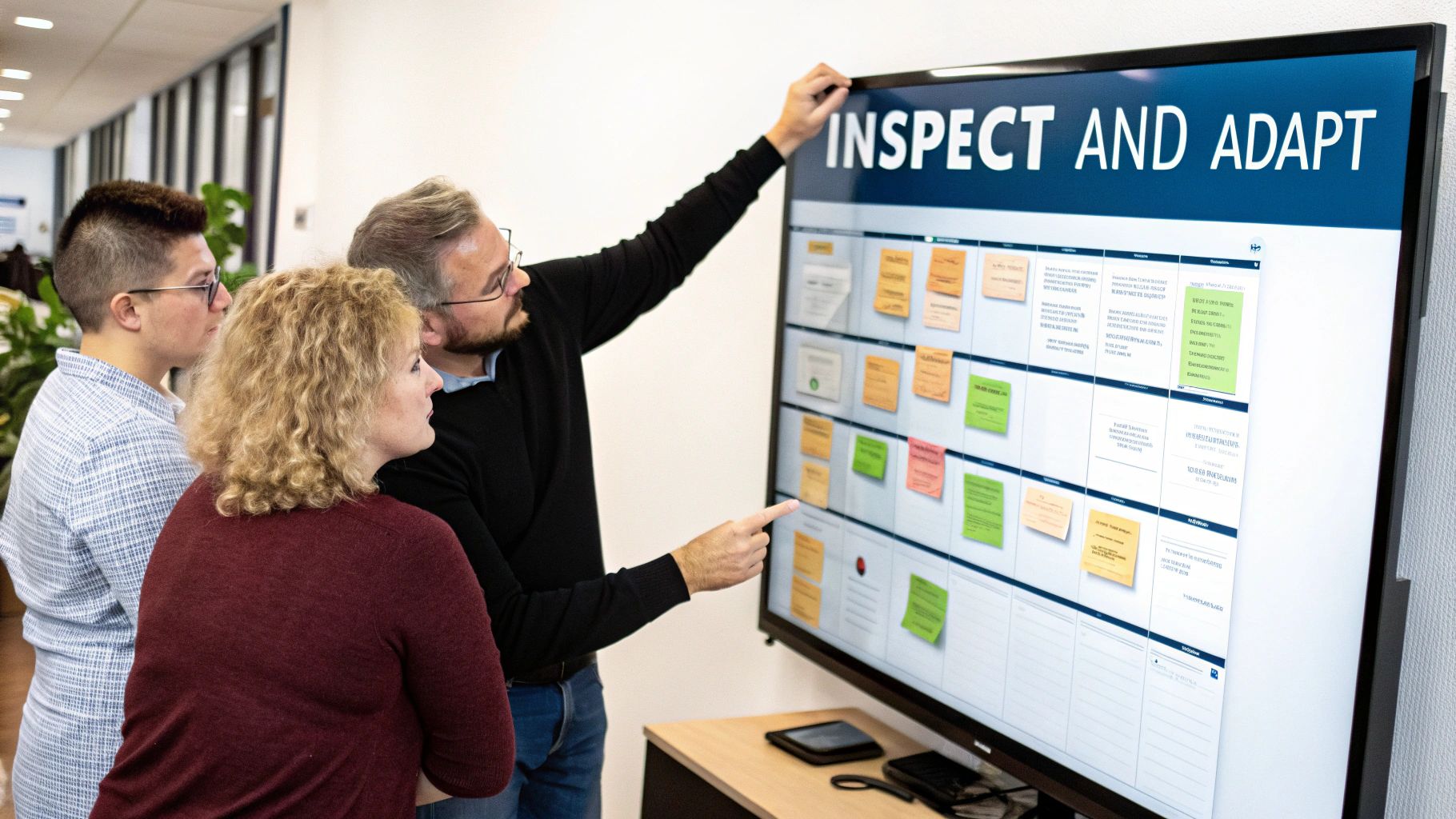
This isn’t just abstract theory; it's a practical system for cutting through complexity. Let's say your team is building a new mobile banking app. Here’s how each pillar comes into play:
Transparency: Everyone—from the newest developer to the most senior stakeholder—sees the exact same picture of the project's status. A public Jira board becomes the single source of truth, showing what’s in progress, what's done, and what’s up next. No hidden tasks, no surprise roadblocks.
Inspection: The team and its stakeholders constantly check progress against the Sprint Goal to catch any deviations before they become major problems. The Sprint Review is a perfect example. The team demos working software, gets direct feedback, and makes sure the project hasn't drifted off course.
Adaptation: When an inspection reveals something isn't working—whether it's a process bottleneck or a technical approach—the team has to adjust. The Sprint Retrospective makes this possible, creating a dedicated space for the team to talk openly about what went well, what didn't, and how to get better in the next Sprint.
The Five Core Scrum Values
Holding these pillars up are five core values that define a team's culture and daily behavior. This is the human element that makes the whole framework click. It creates the psychological safety engineers need to innovate and solve genuinely tough problems.
These values aren't just feel-good ideals. They are tangible behaviors that turn a group of individuals into a high-performing, cohesive unit capable of shipping exceptional products.
Each value has a direct impact on a team’s success:
Commitment: Team members don't just get assigned work; they personally commit to achieving the team's goals. This creates a deep sense of ownership and drives everyone to find the best path forward, together.
Courage: The team feels safe enough to tackle difficult problems, voice concerns, and challenge the status quo without fear of blame. This is what it takes to address messy technical debt or question a feature's real value.
Focus: By zeroing in on the Sprint Goal, the team pushes aside distractions and makes real progress on the most important work. It’s how every Sprint delivers something meaningful.
Openness: Everyone agrees to be completely transparent about their work and the challenges they’re facing. This raw honesty builds trust and helps the team smash through obstacles.
Respect: Team members see each other as capable, independent professionals. This foundation allows for healthy conflict, diverse opinions, and true collaboration.
Living these principles is a massive part of our 10 agile development best practices to ship faster in 2025.
Finding engineers who not only have the right technical chops but also live and breathe these values is what separates good teams from great ones. At TekRecruiter, we specialize in finding that top 1% of talent—the engineers who thrive in collaborative, high-performance Scrum environments. Let us help you find the people you need to build a truly effective agile team.
Understanding The Key Scrum Team Roles
A high-performing Scrum team isn't just a random group of smart people. It's a small, tight-knit unit built around three distinct roles, each with crystal-clear accountabilities. Forget traditional hierarchies and managers—a Scrum team is self-managing and cross-functional, meaning it has all the skills baked right in to deliver value every single Sprint. This structure is the engine of the scrum methodology in software development.
Think of it like a high-performance racing team. You have the driver, who knows the track inside and out and sets the race strategy. Then there's the pit crew chief, whose job is to make sure the car and the team operate flawlessly. Finally, you have the engineers who build and maintain the machine itself. Each role is non-negotiable, and they have to work in perfect sync to even have a shot at winning.
And this isn't just theory. The data shows that projects run with Agile methods like Scrum hit a 75% success rate—a huge jump from the 56% average for old-school project management. If you want to dig into how this framework gets results, you can discover more insights about these project management statistics.
To understand how this all works in practice, let's break down the three core roles.
The Product Owner: The Chief Value Officer
The Product Owner is the strategic brain of the operation, obsessed with one thing: maximizing the value of whatever the team is building. They are the voice of the customer, the stakeholders, and the business, all rolled into one. Their core job is to own and prioritize the Product Backlog.
This isn't a passive role where you just collect feature requests. A great Product Owner is a decisive leader who owns the "what" and the "why." They paint a compelling picture of the product's future and make sure every single piece of work the team picks up gets them closer to that vision.
The Product Owner is accountable for effective Product Backlog management. This means clearly expressing what needs to be done, ordering those items to best hit the goals, and making sure the backlog is transparent and understood by everyone.
On any given day, you might find them:
Talking to Stakeholders: Constantly checking in with customers and internal leaders to make sure the team is still solving the right problems.
Refining the Backlog: Working side-by-side with the Developers to get backlog items ready for upcoming Sprints, making sure they're clear and well-understood.
Setting the Product Goal: Defining the long-term objective that gives the team a north star to aim for.
The Scrum Master: The Team Coach
The Scrum Master is a true servant-leader, focused entirely on the team and the process. Their main job is to help everyone—both on the team and in the wider organization—understand and live by Scrum's principles. They're a coach, a facilitator, and an obstacle-remover.
Think of the Scrum Master as the oil in the engine. They aren't driving the car or building its parts, but they make damn sure everything runs smoothly and without friction. They shield the team from outside noise and hunt down any roadblocks that get in the way of progress.
A Scrum Master’s key functions involve:
Coaching the Team: Guiding them toward genuine self-management and cross-functionality.
Facilitating Scrum Events: Making sure all the ceremonies happen, are productive, and stay within their time limits.
Removing Impediments: Actively clearing any hurdles that are slowing the team down.
The Developers: The Delivery Powerhouse
The Developers are the experts who do the actual work of building a usable piece of the product every Sprint. This isn't just for coders. The "Developers" role includes anyone needed to get the job done—QA engineers, UX designers, architects, you name it. They are the ones who turn ideas into reality.
Developers are responsible for creating a plan for the Sprint (the Sprint Backlog), baking in quality by sticking to a Definition of Done, and adjusting their plan daily to hit the Sprint Goal. They are the masters of the "how." Our guide on defining roles in Agile software development dives deeper into how to structure these teams for success.
These three roles are distinct, but they aren't silos. They form a self-correcting system of checks and balances. To help clarify how they fit together, here’s a quick breakdown of their core accountabilities.
Scrum Team Roles and Core Accountabilities
Role | Primary Focus | Key Responsibilities | Interacts With |
|---|---|---|---|
Product Owner | Value & Vision | - Owns & prioritizes the Product Backlog- Defines the Product Goal & Sprint Goals- Is the voice of the customer & stakeholders | - Stakeholders- The Scrum Team- Customers |
Scrum Master | Process & People | - Coaches the team on Scrum practices- Facilitates all Scrum events- Removes impediments blocking the team | - The Scrum Team- The Product Owner- The wider organization |
Developers | Delivery & Quality | - Creates the Sprint Backlog & the Increment- Ensures quality via the Definition of Done- Adapts the plan daily to meet the Sprint Goal | - The Product Owner- The Scrum Master- Each other |
Together, these roles create the perfect blend of strategy, process, and execution needed to turn a big vision into tangible, high-quality software.
Finding the right people to fill these specialized roles is everything. TekRecruiter connects innovative companies with the top 1% of engineers, Scrum Masters, and Product Owners who thrive in these collaborative environments, allowing you to build elite teams anywhere in the world.
The Rhythm of Development: Scrum Events and S Sprints
If you think of Scrum as the operating system for your development team, then Sprints and their related events are the clock cycle—the steady, predictable pulse that keeps everything moving forward.
The Sprint is the core of this rhythm. It's a short, time-boxed period, usually lasting between one to four weeks, where the team focuses entirely on building a "Done," usable, and potentially shippable piece of the product. No distractions, no shifting priorities. Just pure focus.
Within every single Sprint, a sequence of five specific events unfolds. These aren't just more meetings to fill up your calendar; they are deliberate opportunities for the team to inspect their work, adapt their plan, and genuinely get better at what they do. This structure is what turns the chaos of software development into a manageable, value-driven process.
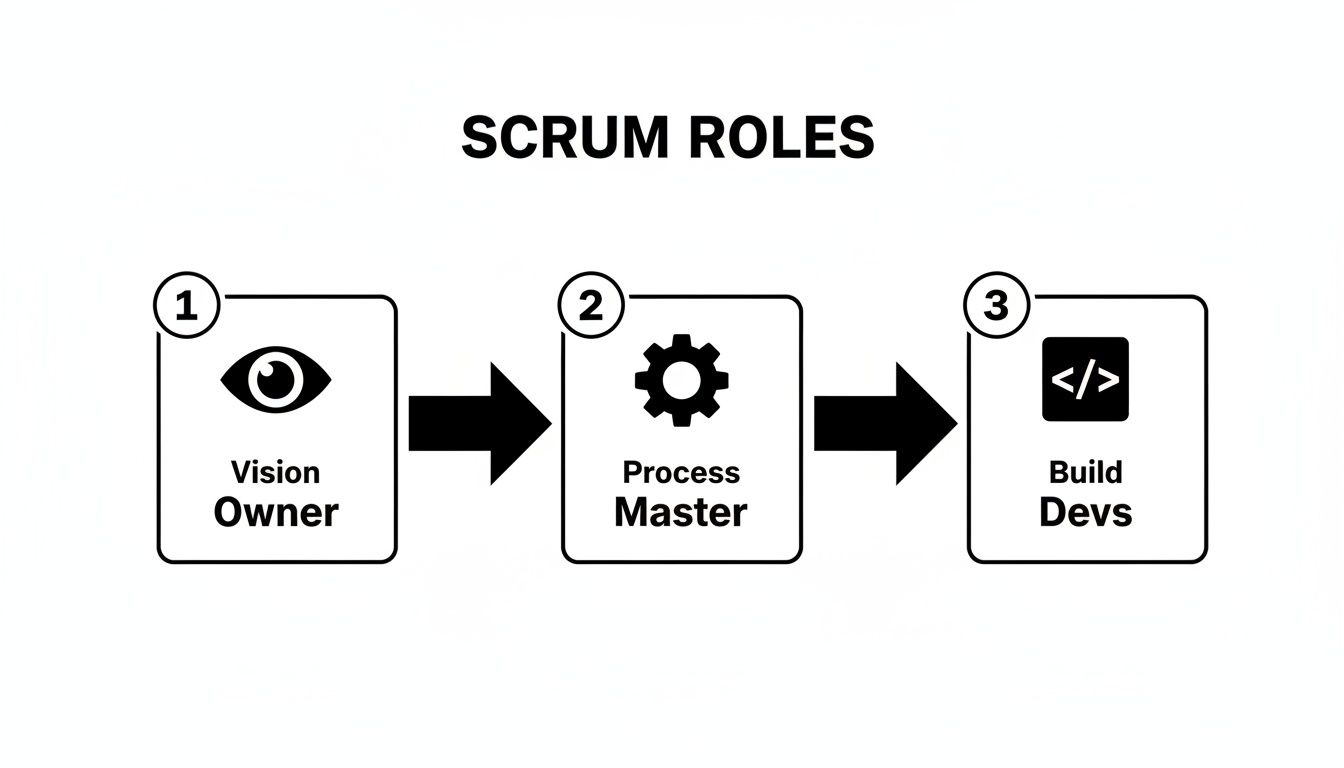
This simple flow shows how responsibility is shared. The Product Owner sets the "what," the Scrum Master perfects the "how," and the Developers bring it all to life.
Sprint Planning: Kicking Things Off
Every Sprint starts with Sprint Planning. This is a working session where the entire Scrum Team gets together to figure out two things: what can we deliver in this next Sprint, and how are we going to get it done?
This isn't a top-down mandate. The Product Owner comes to the table with the highest-priority items from the Product Backlog and proposes an overarching Sprint Goal. The Developers then assess this work and forecast what they can realistically pull into the Sprint. It’s a negotiation that ends in a shared commitment.
A great Sprint Planning session produces a clear Sprint Goal—the "why" behind the work—and a Sprint Backlog, which is the team's game plan for achieving it. That clarity is everything.
The Daily Scrum: The 15-Minute Sync
Next up is the Daily Scrum, a quick, 15-minute huddle for the Developers. The point is to sync up, check progress against the Sprint Goal, and make a plan for the next 24 hours.
Let's be clear: this is not a status report for managers. It's for the team, by the team.
To keep it focused, many teams use three simple questions as a guide:
What did I do yesterday to help us meet the Sprint Goal?
What will I do today to help us meet the Sprint Goal?
Are there any roadblocks in my way?
This daily check-in fosters intense alignment and kills the need for a bunch of other meetings. Blockers get surfaced and dealt with immediately, so momentum never stalls.
The Sprint Review: Showcasing The Work
When the Sprint ends, the team holds a Sprint Review. Think of it as a casual demo day, not a stuffy presentation. The Scrum Team shows the actual working software they built—the Increment—to key stakeholders.
This is all about getting real, honest feedback. Stakeholders get to see and touch the new functionality, and their input directly shapes what the team prioritizes next. It’s a powerful feedback loop that ensures the product is always evolving in the right direction.
The Sprint Retrospective: Getting Better Every Time
The very last event is the Sprint Retrospective. This is where the team turns the mirror on itself. It's a dedicated time to reflect on how the last Sprint went—the good, the bad, and the ugly—across people, processes, and tools.
The team talks through what worked well and what got in their way. From that conversation, they create a concrete plan for one or two improvements to implement in the next Sprint. This relentless focus on getting better is what separates good Scrum teams from great ones.
Building a team that can truly master this rhythm takes a unique kind of talent. A firm like TekRecruiter helps innovative companies deploy the top 1% of engineers who thrive in the structured, high-performance world of Scrum.
Making Work Visible with Scrum Artifacts
How do you track anything in a system that throws out traditional Gantt charts and rigid project plans? The secret is in the scrum methodology in software development. It relies on three powerful tools, or artifacts, built specifically to maximize transparency and keep everyone on the same page.
Think of these artifacts not as static documents, but as living, breathing representations of the work, the plan, and the actual value being created. They give the Scrum Team and stakeholders the hard data they need to inspect progress and adapt on the fly, making sure every conversation is grounded in reality, not guesswork.

The Product Backlog
The Product Backlog is the single source of truth for everything the product needs. It's a dynamic, prioritized list of all features, fixes, requirements, and enhancements that will go into the product down the road. The Product Owner owns this artifact—they're accountable for its contents, its order, and making sure everyone can see it.
To really get a handle on defining clear requirements, it helps to see real-world examples of user stories. Just remember, this list is never truly "done." It's constantly evolving as the product finds its place in the market.
The Sprint Backlog
If the Product Backlog is the long-term roadmap, the Sprint Backlog is the GPS for the current Sprint. It's made up of the Sprint Goal (the why), the specific Product Backlog items chosen for the Sprint (the what), and a tangible plan for getting it all done (the how).
This is an artifact built by Developers, for Developers. It provides a highly visible, real-time picture of the work they plan to accomplish during the Sprint, and it's updated constantly as they learn more.
The Increment and the Definition of Done
The Increment is what you get at the end of a Sprint. It’s the sum of all the Product Backlog items completed during that Sprint, added to the value of all the work from previous Sprints. For an Increment to be truly finished, it has to be "Done."
And "Done" isn't just a casual term; it means the work is in a usable state and meets the Scrum Team’s Definition of Done.
The Definition of Done is a formal description of the state of the Increment when it meets the quality measures required for the product. It's the secret ingredient that ensures quality and predictability, giving leaders confidence that what’s "done" is truly ready to ship.
This shared understanding is non-negotiable. It ensures everyone is working toward the same quality standard, which is critical for preventing misunderstandings and cutting down on technical debt.
The global adoption of these practices is undeniable. As of December 1, 2025, over 1.14 million Professional Scrum certifications have been issued worldwide, with 739,509 of those being for the Professional Scrum Master I (PSM I) credential alone. This massive talent pool proves just how deeply embedded Scrum is in modern software development.
Mastering these artifacts is fundamental to building a team that performs at a high level. At TekRecruiter, we connect innovative companies with the top 1% of engineers who are experts in these practices, allowing you to deploy world-class talent anywhere to accelerate your product delivery.
Build an Elite Engineering Team with Scrum
Knowing the principles of Scrum in software development is one thing. Actually building a world-class team to execute it is how you win. The Scrum framework, when done right, naturally creates an environment of autonomy, mastery, and purpose—the exact conditions that attract and keep the best engineers. That kind of culture is a serious competitive advantage.
The whole point of Scrum is collaboration and iteration, which makes it perfect for plugging in specialized talent. It doesn't matter if you're bringing in a contractor with niche skills, making a critical full-time hire, or deploying a team of elite AI engineers for a heavy-duty project. The framework gives them a clear structure to start delivering value almost immediately.
Attracting the Top 1%
Top-tier engineers don’t want to be micromanaged; they want to make an impact. Scrum hands them ownership over how they tackle complex problems within a Sprint, and that's a game-changer. This creates a level of engagement and accountability that old-school, top-down management just can't touch.
The goal isn’t to build a team that just follows a process. You want a team that owns the outcome. That feeling of collective ownership is the signature of an elite engineering organization, and it’s a direct result of well-implemented Scrum.
To really help a team like that flourish, you need to clear the runway for them. Think about creating streamlined operations and reduced DevOps overhead. When you get rid of the operational friction, your developers can lock in on what they do best: building incredible products that move the needle for the business.
Staffing for Scrum Success
Putting together a team that thrives in a Scrum environment takes more than just coding skills. You need a specific mindset. The best people for the job aren't just developers; they're collaborative problem-solvers who genuinely value transparency and are always looking for ways to improve.
When building out your team, a few key roles are non-negotiable:
Certified Scrum Masters who can coach the team, protect the process, and keep things running smoothly.
Agile Product Owners who have a crystal-clear vision and know how to manage a backlog like a pro.
Elite Developers who have a proven history of shipping high-quality, working software.
We've got a deeper dive into the specific traits to look for in our guide on how to build high-performing teams in tech. At the end of the day, your Scrum implementation is only as good as the people running it.
At TekRecruiter, we specialize in connecting innovative companies with the top 1% of technical talent—the kind of people who are wired to excel in a Scrum framework. If you’re ready to build a team that can accelerate your delivery from day one, let's talk. We provide the exact expertise you need to make your software development goals a reality.
Frequently Asked Questions About Scrum
Even with a solid grasp of the roles, events, and artifacts, plenty of questions pop up when you start putting the scrum methodology in software development into practice. Here are some of the most common ones I hear from leaders and teams, along with some straight answers.
How Is Scrum Different from Agile?
This is a classic. Think of Agile as a philosophy—a mindset for building software. It's like deciding to "eat healthy." The Agile Manifesto gives you the core values and principles, like valuing people over processes and responding to change over following a rigid plan.
Scrum, on the other hand, is a specific framework that brings that philosophy to life. It’s a recipe. If Agile is "eating healthy," Scrum is the Mediterranean diet—a concrete plan with specific rules (roles, events, artifacts) you follow to achieve that goal.
So, all Scrum is Agile, but not all Agile is Scrum. Agile is the why; Scrum is one of the most popular ways of doing the how.
Can Scrum Work for Non-Software Projects?
Absolutely. While Scrum got its start in the software world, its core framework for tackling complex problems is incredibly versatile. I’ve seen it work wonders in marketing, scientific research, product design, and even HR departments.
The real test is whether the project involves complexity and uncertainty where you need to learn as you go. If you can break the work down into valuable chunks and empower a team to deliver them, Scrum can be a game-changer in just about any industry.
The magic of Scrum is its empirical nature. It gives teams a structure to navigate the unknown, learn from real feedback, and consistently deliver value—whether the product is a piece of code or a new marketing campaign.
What Are the Biggest Challenges When Implementing Scrum?
The toughest hurdles are almost always about people and culture, not the process itself. The biggest killer is a lack of real buy-in from the top. This happens when leadership says they support Scrum but won't change the things that undermine it, like fixed-scope contracts or inflexible annual roadmaps.
Role confusion is another huge one. You often see Product Owners who don't actually have the authority to make decisions, or Scrum Masters who are treated like old-school project managers, chasing down status updates.
Finally, a weak "Definition of Done" can cripple a team. Without a shared, high standard for what "finished" means, you end up with a mountain of technical debt and low-quality work. Getting past these issues takes serious commitment to the Scrum values, from the C-suite all the way down.
How Do You Measure Success in a Scrum Project?
Success in Scrum isn't about how many tasks you checked off or how many lines of code you wrote. It’s measured by one thing: the consistent delivery of value. The whole point is to ship working, valuable software that moves the business forward.
To see if you’re actually doing that, you have to focus on outcomes, not just output.
Stakeholder Satisfaction: Are the people paying for and using the product actually happy with what they're getting?
Time-to-Market: How fast can you get a great idea into the hands of a real user?
Team Velocity: Is the team’s output becoming more stable and predictable? (This is for forecasting, not for performance reviews.)
Team Morale: Is the team healthy, collaborative, and working at a pace they can sustain without burning out?
When you nail it, you get delighted customers, a high-performing team that loves their work, and a product that consistently wins in the market.
Mastering the scrum methodology in software development is a powerful first step, but executing it requires elite talent. As a premier technology staffing, recruiting, and AI Engineer firm, TekRecruiter allows innovative companies to deploy the top 1% of engineers anywhere. If you're ready to build a high-performing team that can turn your vision into reality, contact TekRecruiter today.