Top Engineering Recruiting Firms: 7 Best Picks for 2026
Compare 7 top engineering recruiting firms by specialty, hiring model, vetting, and pricing, plus a buyer's checklist for choosing the right partner in 2026.
Why do senior engineering searches stall after the first round of résumés? The problem usually isn't a lack of applicants. It's a mismatch between the firm's sourcing reach, its understanding of the technical work, and the hiring model your company needs.
The right recruiting partner influences speed, candidate quality, assessment depth, and whether you should make a permanent hire at all. That matters in a market where specialized engineering talent remains scarce. Bain found that 73% of engineering and R&D companies reported talent gaps, while engineers at engineering companies were leaving at approximately 16% to 17%. Bain's engineering talent analysis puts the pressure in context.
This list compares TekRecruiter, TEKsystems, Kforce, Motion Recruitment, Insight Global, Actalent, and Randstad Technologies on the same five decision points: specialty depth, engagement model, vetting method, pricing signal, and best-fit client. It's designed for shortlisting, not browsing. If your process needs work before you add another vendor, start with this guide to streamlining the recruitment process.
1. TekRecruiter
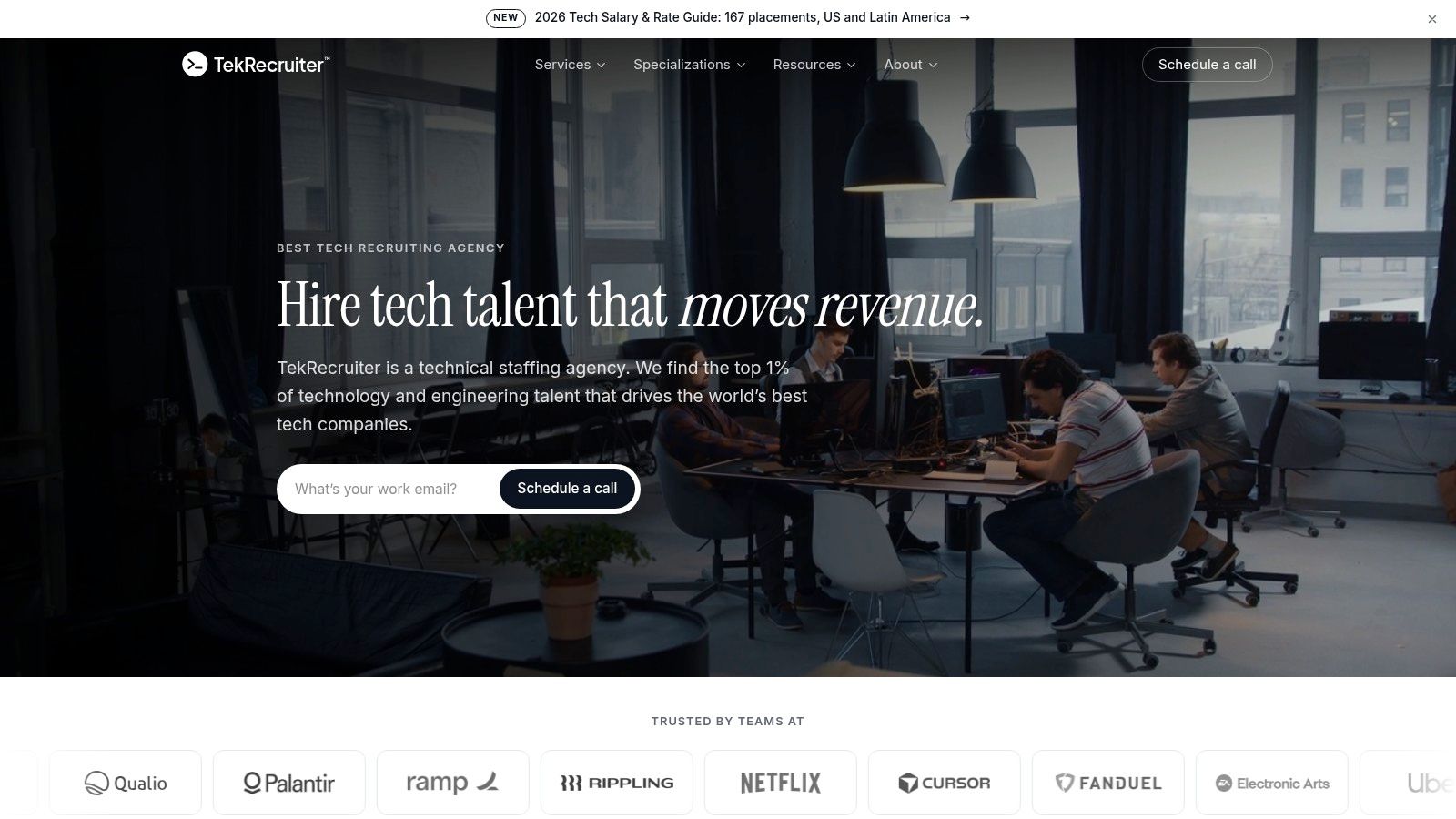
TekRecruiter is the strongest fit here when technical depth matters as much as sourcing speed. Founded by former software engineer Ron Smith, the firm was built around a straightforward objection to conventional tech staffing: recruiters shouldn't present engineers they can't meaningfully discuss.
Its model combines an AI-native operating system for sourcing, pipeline management, screening, and matching with recruiter-led conversations. Those conversations focus on how a candidate built a system, why specific decisions were made, what the system did for the business, and what the candidate personally owned. That approach is more useful than matching résumé keywords to a job description.
The firm's engineering coverage includes software, AI, AI platform, forward-deployed engineering, DevOps, SRE, cloud infrastructure, data, SDET, cybersecurity, hardware, robotics, and quantitative engineering. It also recruits technology leadership, product, go-to-market engineering, and technical account roles. Clients can use direct hire, contract-to-hire, staff augmentation, nearshore recruiting, executive search, or supplier sourcing.
Five decision points
- Specialty depth: Best for engineering-led SaaS, AI, cloud, security, data, and platform organizations that need recruiters to understand technical ownership rather than just tools.
- Engagement model: Direct hire includes a 90-day placement guarantee. Contract-to-hire has no conversion restrictions. Staff augmentation can begin in as little as three days, while nearshore support provides English-speaking Latin American engineers working in compatible time zones.
- Vetting method: Peer-to-peer technical conversations, work-history validation, and assessment of HEART traits, meaning high agency, execution, accountability, resourcefulness, and transparency.
- Pricing signal: Outcome-based and contingent, with no upfront retainers or maintenance fees. That reduces initial commitment, but it may cost more per hire than internal recruiting for companies with established high-volume talent teams.
- Best-fit client: CTOs, VPs of Engineering, talent leaders, startups, scale-ups, and enterprise teams with difficult technical searches or urgent capacity gaps.
Practical rule: Ask for evidence that a submitted engineer can explain architecture, operational ownership, trade-offs, and business impact. A polished interview alone isn't enough.
TekRecruiter reports 167 tech and engineering placements in 2026 to date, and its plan materials state that 92% of submitted candidates are interviewed. Those figures are company-reported, so buyers should ask how the firm defines a submission, placement, and interview before comparing them with another supplier.
The main trade-off is focus. TekRecruiter isn't the right choice for broad corporate hiring outside technology and engineering. For buyers who want an engineer-first partner, its engineering staffing firm approach is more differentiated than a generalist database model.
Learn more at TekRecruiter.
2. TEKsystems
Need engineers across locations, disciplines, or hiring models? TEKsystems is built for that operating reality. Its coverage includes software, data and AI, cloud, cybersecurity, infrastructure, and program delivery. Clients can use contract staffing for an immediate gap, contract-to-hire to assess fit over time, or direct placement for permanent roles.
The firm's distinctive capability is program scale. TEKsystems can assemble managed teams and outcome-based programs when the problem involves delivery capacity, not one vacant requisition. That suits enterprise transformation, infrastructure modernization, and work requiring several technical disciplines.
The buying decision comes down to five points:
- Specialty depth: Broad coverage across enterprise technology. Actual depth varies by local account team and the recruiter assigned to the search, so ask who has handled comparable roles.
- Engagement model: Contract, contract-to-hire, direct hire, managed teams, and program-level solutions.
- Vetting method: Recruiters handle initial screening, skills alignment, and candidate management, with analytics supporting the process. For architecture or production roles, confirm who tests technical judgment and how.
- Pricing signal: Contract billing, conversion terms, and direct-hire fees are proposal-driven. Existing enterprise or MSP arrangements may simplify procurement, while client policies can affect conversion timing.
- Best-fit client: Large companies and established technology organizations that need geographic reach, recurring capacity, or a managed staffing program.
Scale helps when several engineers must be hired across offices or the supplier already understands procurement requirements. The trade-off is account consistency. One local team may provide close technical guidance, while another may operate more transactionally.
Before a vendor call, request the assigned delivery team, examples of comparable searches, the technical-screening owner, conversion terms, and the escalation path. The brand provides reach; the named team determines execution and candidate experience.
Review TEKsystems' capabilities at TEKsystems.
3. Kforce
Which hiring model fits Kforce best? Companies with recurring technology needs, defined processes, and procurement requirements usually get the clearest value from its approach.
Kforce focuses on technology and finance and accounting, with technology coverage spanning application development, data, cloud, support, and related roles. Clients can use contract, contract-to-hire, or direct-hire arrangements through the same provider.
Its enterprise and MSP experience can reduce administrative friction. A hiring manager may want a candidate quickly, while vendor management still requires rate approvals, compliance checks, onboarding, and documented workflows. Kforce is accustomed to that environment.
The comparison is clearest across five buyer questions:
- Specialty depth: Kforce is strong in common technology categories, though it is broader than a boutique engineering search firm. Give the team extra scrutiny when a role combines a rare stack with specialized domain experience.
- Engagement model: Contract, contract-to-hire, and direct hire are available, allowing clients to adjust the hiring path as requirements change.
- Vetting method: Recruiter qualification and role matching anchor the process. For senior engineering searches, ask whether a technical specialist or hiring manager joins the screening stage and how technical judgment is tested.
- Pricing signal: Direct-hire contingency fees, contract rates, and conversion provisions vary by requisition. Get each term in writing before candidate submissions begin.
- Best-fit client: Enterprise and mid-market companies hiring recognizable technology roles repeatedly, especially when MSP or procurement experience affects speed.
Kforce fits a defined hiring process better than a highly bespoke search for a rare architect, research-heavy engineer, or emerging technology specialist. A single provider can simplify vendor management across application, data, and cloud hiring, while one unusually senior platform search deserves a closer review of the assigned team's technical screening.
Before the vendor call, ask who will run delivery, who owns technical assessment, how conversion works, and which comparable searches that team has completed. The brand provides reach, but the named team determines execution.
Explore the technology practice at Kforce.
4. Motion Recruitment
How well does Motion Recruitment fit a search shaped by location, technical discipline, and delivery needs? Its teams combine technology specialization with local recruiting networks, which can improve response times when qualified candidates cluster in established U.S. technology hubs.
Motion can support more than a single permanent hire. Its options include contract, contract-to-hire, direct hire, consulting, Agile and DevSecOps work, and SOW-based project delivery. That range helps a company choose between adding one engineer, building a temporary team, or assigning a defined workstream to an external delivery group.
The trade-off is geographic. Local market knowledge may strengthen a concentrated search, while remote, rural, international, or multi-location hiring may require proof that the assigned team can deliver beyond its strongest hubs.
Use the first vendor call to test five points:
- Specialty depth: Discipline-focused recruiting across technology roles, supported by local market knowledge. Ask for recent searches involving the exact stack, seniority, and domain.
- Engagement model: Staffing, consulting, and SOW delivery. Confirm who manages the work, how scope changes are handled, and whether a project can shift from delivery support to individual hiring.
- Vetting method: Recruiter qualification shaped by technical discipline and market familiarity. Ask how the team evaluates production ownership, architectural judgment, and communication with the hiring manager.
- Pricing signal: Contingent fees and contract billing require a custom proposal. Use salary guides and market data to set a realistic compensation range, then document fees, conversion terms, and project costs.
- Best-fit client: Technology companies hiring in established U.S. hubs that may need both individual contributors and consulting support.
Motion is a stronger candidate when location is part of the search strategy, not just an administrative detail. A broad technology label alone does not establish niche expertise, so request the names and experience of the account team handling the role.
Review the firm's current services at Motion Recruitment.
5. Insight Global
Can one recruiting partner support both an individual hire and a larger delivery need? Insight Global is positioned for that combination, with coverage across application development, cloud, AI and data, enterprise IT operations, cybersecurity, DevOps and SRE, QA and SDET, plus applied engineering disciplines.
That range matters when a vacancy sits inside a broader execution problem. An infrastructure modernization effort might require engineers under the client's management, a managed team, or an external group accountable for a defined workstream. Insight Global offers each of those paths, including individual professionals, convertible teams, and scoped project delivery.
The trade-off is consistency. A large provider can bring substantial resources, but the assigned team still determines the day-to-day experience. Set service levels, communication cadence, candidate ownership, and replacement procedures before submissions begin.
Use the first vendor call to test five decision points:
- Specialty depth: Broad IT and engineering coverage, with support for specialized and security-conscious environments. Ask for recent searches matching the role's stack, seniority, and operating context.
- Engagement model: Individual staffing, convertible teams, managed services, and SOW projects. Confirm who manages delivery and how scope changes are approved.
- Vetting method: Role-specific recruiter screening and delivery-team qualification. Establish who owns technical interviews, candidate feedback, escalation, and hiring-manager communication.
- Pricing signal: Managed and SOW work is custom quoted. Contract and direct-hire terms vary by role, engagement, and client requirements, so document rates, conversion terms, and replacement coverage.
- Best-fit client: Organizations that need talent acquisition and delivery support for cross-functional technology programs.
Define the handoff before the first submission. Confirm who owns sourcing, technical screening, scheduling, feedback, rate negotiation, and replacement coverage.
Insight Global fits hiring managers who need flexibility without immediately building a full internal team. For one highly specialized permanent engineer, compare the assigned technical group with a narrower search firm. For broader software developer staffing agency options, then review Insight Global's technology and engineering services.
6. Actalent
Actalent stands out when an engineering search crosses physical products, industrial systems, and scientific work. Its coverage includes mechanical, electrical, systems and software, manufacturing, utilities, transmission and distribution, laboratory, and related technical roles.
That mix changes the screening problem. A recruiter may need to assess design-for-manufacturing experience, electrical systems work, validation environments, regulatory requirements, and collaboration between engineering and laboratory teams. A software-focused search provider may cover Kubernetes or Python well, yet offer less discipline-specific support for those requirements.
Start with the work itself, not the title. Share the product stage, design tools, regulatory environment, manufacturing setting, and which skills candidates can learn after joining. This helps the recruiting team distinguish a genuine match from someone whose résumé only uses similar terminology.
Actalent's main trade-off is breadth. It can support several engineering disciplines, but local delivery may determine the quality of the experience. Ask who will run the search, who screens candidates technically, and whether the proposed team has recruited for comparable products or operating conditions. Request references from similar teams before committing.
For a vendor call, clarify five points:
- Specialty depth: Strong coverage across mechanical, electrical, manufacturing, systems, and adjacent scientific roles. Ask for recent examples in your discipline.
- Engagement model: Customized staffing and project support, shaped around the discipline and program. Confirm how changes in scope or headcount are handled.
- Vetting method: Engineering and science-focused recruiter qualification. Identify the technical background of the screeners and the assessment steps.
- Pricing signal: Contract work is generally hourly, while direct hire is contingent. Confirm rates, conversion terms, and replacement coverage.
- Best-fit client: Industrial, hardware, aerospace-adjacent, utilities, manufacturing, laboratory, and multidisciplinary engineering organizations.
For expanding teams, team augmentation services can help compare permanent hiring with temporary capacity or a blended model. Review Actalent for its engineering and science capabilities.
7. Randstad Technologies
Need coordinated hiring across several engineering roles or locations? Randstad Technologies is designed for that operating model. Its coverage includes software development, data and AI, cloud, DevOps and SRE, desktop support, and enterprise technology. It also offers MSP, RPO, managed services, and analytics-supported workforce planning.
The trade-off is structure. Larger employers can use market analysis, salary insight, job-description support, reporting, and program coordination alongside recruiting delivery. A single niche search may receive less attention than it would from a specialist agency, so confirm the delivery team before signing.
Assess the firm on five points:
- Specialty depth: Broad technology coverage with specialist sub-teams. Ask for recent searches using your stack, especially if the role involves unusual systems or tools.
- Engagement model: Permanent and contract recruiting, MSP and RPO programs, managed services, and outsourced workforce support. Clarify which services are included and how scope changes are handled.
- Vetting method: A process-led qualification approach supported by analytics and workforce research. Require a defined technical assessment plan for senior engineering roles.
- Pricing signal: Fees and program terms are set through a proposal based on the required services. Compare the full scope with a specialist agency's contingency fee, including reporting, coordination, and supplier management.
- Best-fit client: Enterprise employers managing many roles, locations, suppliers, or workforce categories.
Ask who will own the account, who screens candidates, and whether the proposed team has filled comparable engineering positions. Randstad's infrastructure can bring consistency, but the brand alone does not confirm specialist depth.
Read our comparison of staffing companies in the US, then use Randstad Technologies when governance, reporting, and workforce coordination matter as much as individual candidate sourcing.
Top 7 Engineering Recruiting Firms Comparison
| Vendor | Implementation Complexity 🔄 | Resource Requirements ⚡ | Expected Outcomes ⭐📊 | Ideal Use Cases 💡 | Key Advantages |
|---|---|---|---|---|---|
| TekRecruiter | Low–Moderate: engineer-led, fast process; typical shortlist ≈1 week | Modest client engagement; outcome-contingent fees; AI + peer screening; high outreach (~3,000 contacts/role) | High-quality senior hires; 92% interview rate; 98% contract-to-hire; 65% placement-offer; 167 placements (2026 YTD) | Hard-to-fill senior engineering, SaaS, AI, cloud roles; rapid hires and technical vetting | Engineer-led + AI screening; rapid predictable shortlists; flexible engagement models; DEI-certified |
| TEKsystems | Moderate–High: enterprise onboarding for managed programs | Significant: national scale, analytics, procurement integration for large programs | Broad candidate reach; scalable team delivery; consistent enterprise fills | Large-scale hiring, managed teams, MSP programs, Fortune 500 engagements | Unmatched scale and breadth; analytics-backed lifecycle management; multiple engagement paths |
| Kforce | Low–Moderate: straightforward delivery model for core tech roles | Standard: national recruiting infrastructure; enterprise procurement familiarity | Reliable volume hiring and steady fill rates for mainstream tech roles | Volume hiring in apps/data/cloud/support; organizations needing consistent supply | Consistent tech focus; speeds onboarding via enterprise/MSP experience |
| Motion Recruitment | Low: hyper-specialized, market-aligned teams; hands-on consulting | Moderate: strong local networks in major metros; proposal-based pricing | Fast fills for in-demand specialist roles in key metros | Specialized vertical searches, team builds, Agile/DevSecOps consulting | Hyper-specialization; deep local pipelines; flexible staffing + SOW delivery |
| Insight Global | Moderate–High: can assemble managed/convertible teams and scoped projects | Significant: delivery capacity for teams, multi-domain coverage | Provides talent plus delivery capacity; suitable for scoped SOWs and managed teams | When talent and delivery capacity are required (managed teams, projects) | Breadth across IT/engineering; ability to combine staffing with delivery; security-cleared experience |
| Actalent | Moderate: multidisciplinary engineering and project staffing | Moderate–High: access to mechanical/electrical/systems, lab/science pools | Strong placements for industrial, hardware, and multidisciplinary engineering teams | Industrial/hardware/manufacturing, utilities/T&D, and lab/science roles | Deep coverage of physical engineering disciplines; combined engineering + scientific talent |
| Randstad Technologies | High: MSP/RPO and enterprise program implementation | High: analytics, workforce research, program management for scale | Mature processes and scalable multi-location hiring; consultative workforce insights | Complex multi-role or multi-location hiring; enterprise MSP/RPO programs | Global HR scale; analytics-backed consultative resources; stability for large programs |
Choose the Firm That Matches Your Hiring Model
The best engineering recruiting firm depends less on brand size than on the problem behind the requisition. Direct hire fits a permanent capability gap, especially when the role owns architecture, product direction, or long-term team leadership. Contract-to-hire works when you need to evaluate collaboration and delivery in your environment before making the employment decision. Staff augmentation fits urgent capacity under your leadership. Managed services or SOW delivery fits a defined outcome where the supplier owns more of the team and execution.
Start by writing down the failure you need the partner to prevent. Is your internal team missing passive candidates? Are hiring managers unable to assess technical depth? Do you need engineers in a different geography? Is procurement slowing down an otherwise urgent project? A firm that solves the wrong problem will add activity without improving the hire.
The market explains why this choice matters. The U.S. Bureau of Labor Statistics projects about 174,800 openings per year through 2035 across architecture and engineering occupations, including growth and replacement needs. The BLS occupational outlook shows that recruiting demand includes both expansion and the replacement of experienced professionals.
Shortlist two or three firms whose specialty matches your stack and hiring model. Then make each one answer the same questions:
- Technical screening: Who validates architecture, production ownership, trade-offs, and business impact?
- Candidate evidence: Can the firm explain what the candidate built and operated, not just list technologies?
- Timeline: When should you expect the first qualified candidates, and what assumptions make that timeline realistic?
- Commercial terms: What are the direct-hire guarantee, contract-to-hire conversion rules, hourly terms, and replacement provisions?
- Operating cadence: Who owns feedback, how quickly are candidates updated, and how will withdrawals or duplicate submissions be handled?
- Measurement: Which metrics will be reported, such as qualified submissions, interview conversion, withdrawal reasons, and time spent per screened candidate?
AI can improve sourcing and administrative throughput, but adoption alone isn't a quality signal. LinkedIn's 2025 recruiting research found that 37% of organizations were actively integrating or experimenting with generative AI, up from 27% the prior year, across 23 countries. LinkedIn's Future of Recruiting research supports a practical conclusion: ask what the tools improve and where human judgment remains mandatory.
The final decision should reflect the cost of delay, the scarcity of the skill, the risk of a poor technical match, and your team's ability to run the process internally. The right partner won't just send more résumés. It will help you choose a workable hiring model, present evidence about candidate capability, and keep qualified engineers engaged until the decision is made.
TekRecruiter combines engineer-led recruiting, AI-native sourcing, peer-to-peer technical screening, direct hire, contract-to-hire, staff augmentation, nearshore engineering, and executive search. If you're comparing top engineering recruiting firms for a difficult technical role or a fast team build, TekRecruiter can help you choose the engagement model and candidate profile that fit your business.
 Ron SmithPresident & Lead RecruiterTekRecruiter