Architecture Interview Questions: Expert Guide 2026
Master your hiring with top architecture interview questions. Get expert guidance for evaluating system design, scalability, and security in senior engineers.
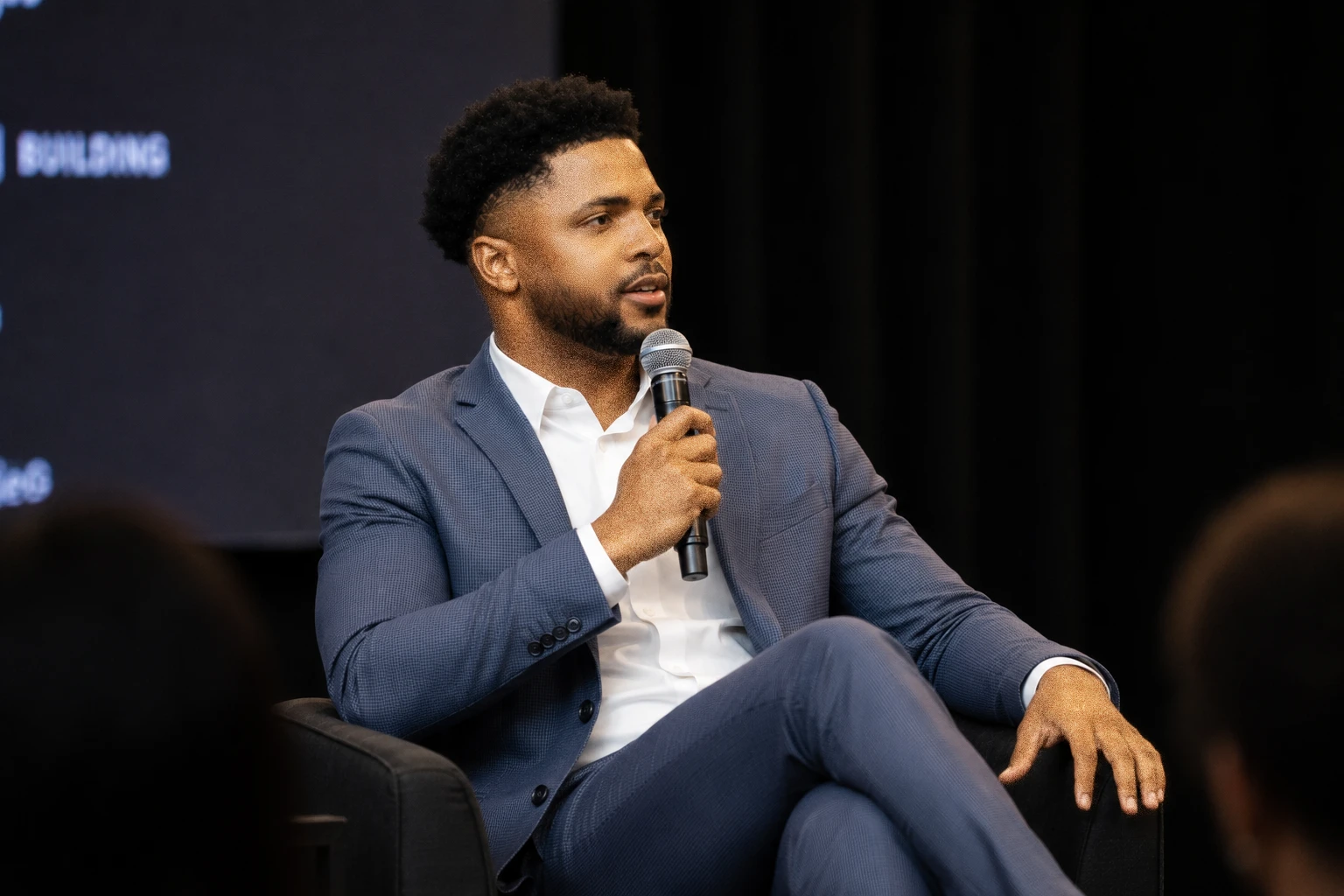

Stop asking broken architecture interview questions. The old approach, generic puzzles, abstract whiteboard prompts, and “tell me about a tough project” questions, doesn't predict who can design, defend, and evolve systems under pressure. Strong architecture interview questions force candidates to clarify requirements, estimate scale, choose trade-offs, and stress test a design inside a real interview window, the same kind of milestone-based structure used in modern system design rounds (system design interview framework). If you want a sharper benchmark, stop grading for vocabulary and start grading for judgment.
That's the point of this guide. It gives hiring managers ten high-signal architecture interview questions, plus the follow-up probes, scoring standards, and answer patterns that separate senior thinking from junior answers. It also borrows the right lesson from a startup interview preparation guide, good interviews reveal how a candidate thinks when the problem is messy, not how many buzzwords they can recite.
Table of Contents
1. Design a Scalable Microservices Architecture - What to listen for - Follow-up probes that separate senior from junior
2. System Design for High Availability and Disaster Recovery - What strong answers sound like - Follow-up probes
3. Database Architecture and Scaling Strategies - What to listen for - Follow-up probes
4. API Design and Version Management - What senior candidates cover - Follow-up probes
5. Cloud Architecture and Multi-Cloud Strategy - What to listen for - Follow-up probes
6. Real-Time Data Processing and Event Streaming - What strong answers contain - Follow-up probes
7. Security Architecture and Zero Trust Implementation - What to listen for - Follow-up probes
8. Load Balancing and Traffic Management - What senior answers include - Follow-up probes
9. Observability, Monitoring, and Incident Response - What to listen for - Follow-up probes
10. Capacity Planning and Cost Optimization - What to listen for - Follow-up probes
10-Topic Architecture Interview Comparison
Find Your Next Architect with Engineers Who Understand Architecture
1. Design a Scalable Microservices Architecture
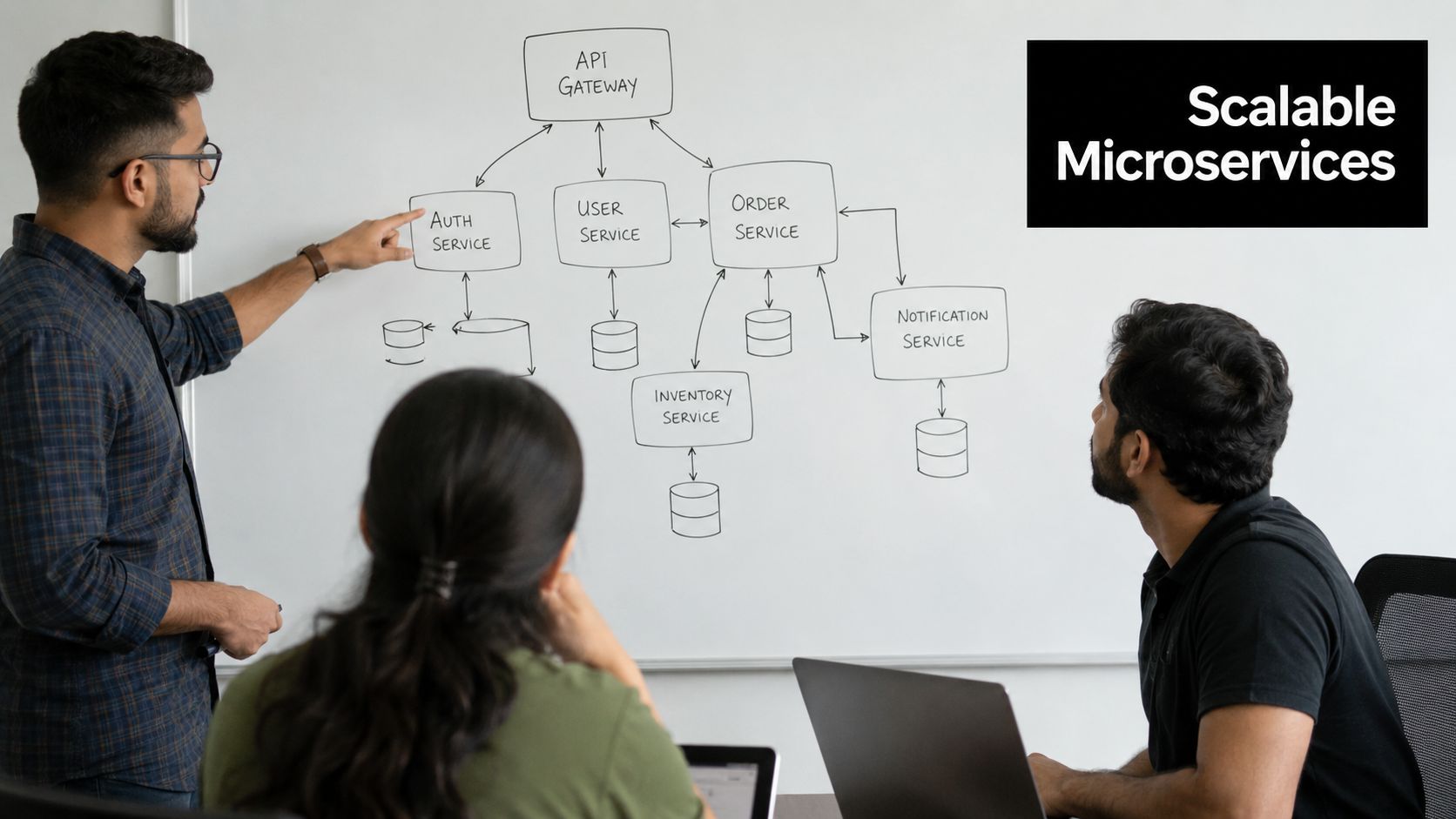
The weak answer starts with a tool list. The strong answer starts with business domains, service boundaries, and the operational cost of splitting too early. A good candidate explains how they would decompose a system into independently deployable services, then defend that choice with communication patterns, data ownership, and the overhead that comes with each new boundary.
Engineering leadership sounds like this. A strong candidate walks through service boundaries, synchronous versus asynchronous calls, failure isolation, and the way cross-service feature work creates coordination costs. If they say “microservices” before they justify the need, they are skipping the hard part.
What to listen for
A senior answer should include these moves:
Clear domain boundaries: The candidate uses domain-driven thinking instead of splitting by technical layer.
Failure-aware communication: They mention circuit breakers, fallback paths, and tracing.
Data ownership discipline: They explain which service owns which data and how consistency works across boundaries.
Migration realism: They do not pretend a greenfield rewrite is the default. They discuss a path from monolith to services when that is safer.
Modern architecture interviews are timed, milestone-based exercises. The interviewer should expect the candidate to move through clarifying requirements, data and API design, high-level architecture, and stress testing within a standard 45 to 60 minute interview window, with the interview structure and trade-offs laid out in interview structure and trade-offs. That timing matters because weak candidates spend it naming technologies instead of defending decisions.
Scoring rule: Give full credit only if the candidate can justify why microservices are worth the operational complexity. If they cannot defend the trade-off, they do not really know how to design one.
Follow-up probes that separate senior from junior
Ask, “Where would you start with a monolith, and when would you split it?” Ask, “How do you prevent distributed transactions from becoming a liability?” Ask, “What happens when one service gets hot and starts to dominate latency?” A junior candidate lists Kafka or Kubernetes by name. A senior candidate explains how consumer lag and pod eviction would affect the deployment schedule.
If the answer stays generic, push harder. Ask them to name one service boundary they would absolutely not split, and why. That question shows whether they understand the product or just the pattern.
For a practical cloud-native example of how teams frame service boundaries and deployment concerns, review cloud-native architecture guidance.
2. System Design for High Availability and Disaster Recovery
Candidates who haven't operated systems through real outages often conflate high availability with disaster recovery. That confusion is a red flag, because the two problems demand different designs and different trade-offs.
A strong answer starts with business impact. The candidate should define recovery time objectives and recovery point objectives before talking about regions, replicas, or failover. If they jump straight to active-active architecture without explaining the workload, they are designing for elegance, not continuity.
Use this item to test whether the candidate can tie technical design to business continuity. A serious answer covers redundancy, automated failover, backup restoration, and the difference between surviving an outage and surviving data loss. The discussion should also show they know how to test disaster recovery, not just diagram it.
For a practical internal benchmark, review TekRecruiter's disaster recovery planning resource while calibrating what good failure planning sounds like in a hiring loop.
What strong answers sound like
A senior candidate talks in operational terms:
RTO and RPO first: They define the business tolerance before selecting mechanisms.
No manual heroics: They prefer automated health checks and failover paths.
Multi-region realism: They know when geographic distribution matters and when it just adds cost.
Graceful degradation: They preserve core user flows instead of forcing total outage behavior.
The best interviewers keep the probe anchored to recovery behavior, not architecture theater. That means asking whether the candidate can distinguish an availability problem from a data-loss problem, then listening for how they would verify each one under pressure. Use the architecture interview framework as a baseline for that style of questioning, but keep the discussion on failure handling and operational judgment.
A candidate who cannot explain what breaks first under failure does not understand resilience. They understand diagrams.
Follow-up probes
Ask, “What would you test quarterly versus annually?” Ask, “Which part of your recovery plan depends on people being awake?” Ask, “What do you do if your primary region is alive but corrupt?” Those questions force the candidate to move from theoretical redundancy to actual recovery behavior.
The junior answer names backups. The senior answer explains data restoration sequencing, failover verification, and what the organization can tolerate losing. That difference tells you whether the candidate has ever owned a real outage.
3. Database Architecture and Scaling Strategies
Good database answers are never about favorite technologies. They're about access patterns, consistency, and the shape of growth. If a candidate starts by saying “I'd use PostgreSQL” or “I'd use NoSQL,” they're telling you almost nothing.
A strong answer begins with workload analysis. What's being written, what's being read, which queries dominate, what needs to stay strongly consistent, and where can eventual consistency work? That's the level at which database design becomes architecture, not tool selection.
You want candidates who can explain partitioning, sharding, replication, caching, and read/write separation without turning the answer into a vendor pitch. They should also be able to discuss how to migrate data before scale becomes a crisis. If they wait until the system is already overloaded, they've missed the strategic window.
For a useful comparison point on storage trade-offs, see this vector database comparison for startups, especially if the role touches modern retrieval or AI-adjacent data systems.
What to listen for
A senior candidate should be able to reason through:
Access patterns before schema: They choose the database after they understand reads, writes, and query shape.
Sharding strategy: They know why consistent hashing reduces rebalancing pain.
Read scaling: They use replicas and caching where it makes sense.
Migration planning: They have a plan for cutover, backfill, and rollback.
Consistency trade-offs: They can explain where CAP trade-offs matter to the product.
The best answers don't stop at the database. They describe how storage fits into the wider flow from ingestion to serving, which is how strong data architecture answers are often evaluated in practice (source to serving pattern).
Follow-up probes
Ask, “What changes first when write volume doubles?” Ask, “How do you keep a hot partition from melting the system?” Ask, “Where would you accept stale reads, and where wouldn't you?” Those questions expose whether the candidate thinks in operational realities or just architecture vocabulary.
A junior answer tries to sound clever. A senior answer tells you which access path dominates and what breaks when that path gets too expensive. That's the standard that matters.
4. API Design and Version Management
API design is where architecture gets exposed to customers. The question is not whether a candidate can name endpoints. The true test is whether they can change contracts without breaking clients, splitting backend logic, or locking the platform into old behavior.
A senior candidate should discuss request and response shape, authentication, rate limiting, deprecation policy, and versioning discipline. They should also know when REST fits the problem and when GraphQL, webhooks, or async flows are the better answer. If they only talk about endpoint naming, they are staying at the surface. A useful baseline for REST is TekRecruiter's REST architecture resource, which helps separate fundamental fluency from real design judgment.
Use this question to check whether the candidate designs for what comes after launch. Good API designers treat every contract as a support burden, every breaking change as a customer problem, and every undocumented field as a liability. Version strategy and documentation belong in the architecture, not in a separate cleanup task.
What senior candidates cover
A solid response usually includes:
Long-term compatibility: They protect existing clients while adding new behavior.
Versioning discipline: They can explain semantic versioning and deprecation timelines.
Infrastructure-level control: They know when version handling belongs at the gateway or edge.
Developer experience: They consider SDKs, examples, and clear docs.
Event-based alternatives: They know when webhooks solve the wrong synchronous problem.
A strong answer also shows how the candidate reasons through contract evolution inside a standard interview flow, from requirements to interface design to trade-off analysis.
Practical rule: If a candidate cannot explain how they would support old and new clients at the same time, they are not ready to own an API platform.
Follow-up probes
Ask, “How do you retire an old version without surprising partners?” Ask, “What do you do when one client insists on a field that everyone else no longer uses?” Ask, “Where do you enforce auth, at the edge or inside the service?” Those follow-ups quickly separate platform thinking from endpoint coding.
Junior responses focus on endpoint paths. Senior responses frame versioning as a business commitment, every deprecated field becomes a support ticket, and every undocumented contract becomes a liability. That is the standard to hold.
5. Cloud Architecture and Multi-Cloud Strategy
This question exposes whether a candidate can think beyond individual services and reason about operating models. Cloud architecture isn't just “move it to AWS.” It's portability, automation, cost control, and the practical limits of vendor choice.
A strong candidate talks through deployment models, regional design, serverless versus containers, and the reasons a team might choose hybrid or multi-cloud. They should also know that portability comes from disciplined infrastructure and application design, not wishful thinking. If they present multi-cloud as an automatic good, they're overstating the benefit.
The best answers cover infrastructure-as-code, release automation, data residency, and cost visibility. They also acknowledge that migration choices depend on constraints, not ideology. Sometimes portability matters. Sometimes operational simplicity matters more.
A useful reality check comes from this cloud exam and architecture reflection, which reinforces a simple truth, scenario-based cloud work rewards comprehension over memorization.
What to listen for
A senior answer should include:
Infrastructure as code from day one: They don't hand-wave repeatability.
Cost awareness: They know cloud bills are design inputs, not post-launch surprises.
Portability with intent: They discuss what moves and what stays coupled.
Hybrid reasoning: They explain why some workloads remain on-prem or in a controlled environment.
Operational discipline: They automate deployment and monitoring as part of the design.
This question also maps well to the industry shift toward cross-functional architecture interviews, where the candidate's ability to explain execution and constraints matters as much as the diagram itself (role fit and delivery risk).
Follow-up probes
Ask, “What would make you reject multi-cloud?” Ask, “What's the first thing you'd automate in a cloud migration?” Ask, “Which part of the system would you keep intentionally boring?” The best candidates answer with trade-offs, not slogans.
The junior answer says “use cloud.” The senior answer explains governance, portability, and why the platform exists in the first place. That's the bar.
6. Real-Time Data Processing and Event Streaming
This section separates people who have only used streaming tools from people who can design them under real pressure. Real-time systems force trade-offs across throughput, latency, ordering, failure handling, and replay, and weak candidates dodge those trade-offs.
Strong candidates can explain why a workload belongs in streaming rather than batch. They should talk about message brokers, event schemas, consumer lag, exactly-once semantics, and how to handle late-arriving or out-of-order data. If they gloss over state management, they are not ready for the operational side of streaming.
Event systems are not just pipes. They are stateful, failure-prone, evolving architectures that need monitoring and versioning from the start. A candidate who has worked in data-intensive environments should be able to explain the consequences of a bad event shape, a broken consumer, or a schema change that lands too early.
For a concrete reference point, here is a relevant video on event-driven architecture concepts.
What strong answers contain
A senior answer usually includes:
Broker selection by constraint: Throughput, durability, and latency drive the choice.
Idempotency: They design consumers to survive retries cleanly.
Latency visibility: They monitor end-to-end delay, not just queue depth.
Late data handling: They explain windows, replays, and correction logic.
Schema evolution: They use a registry or equivalent discipline.
A good answer also shows the candidate understands how architecture interviews now reward explicit constraint handling, scale, latency, availability, and capacity reasoning before component selection (interview framework and quantitative reasoning).
Design the consumer for replay on day one. If you wait until the first incident, you have already lost control of the system.
Follow-up probes
Ask, “How do you make a payment or fraud event safe to process twice?” Ask, “What happens if a consumer falls behind for two hours?” Ask, “How do you recover when a schema changes but old events still exist?” Those probes expose whether the candidate can design for real operation, not ideal flow.
A candidate who has only operated Kafka can list topics and partitions. A candidate who has owned production streaming explains idempotency keys, consumer group rebalancing, and what happens when schema registry is down during a deploy. That is the standard.
7. Security Architecture and Zero Trust Implementation
Security questions separate serious architects from people who think security is someone else's job. If a candidate treats it as a compliance add-on, they're not ready to design modern systems.
A strong answer begins with threat modeling and attack surface reduction. Then it moves into identity, encryption, secrets management, auditing, and service-to-service trust. Zero trust should not be a slogan in the response. It should be a concrete design approach that includes mutual authentication, narrow permissions, and logging that helps investigations.
You also want to hear how the candidate balances security with operability. Security that blocks deployment, hides failures, or centralizes every decision into a manual bottleneck is weak security. Mature architects design controls that teams can use.
For an external security governance angle, DataLunix's cyber security governance analysis is a useful companion reference when reviewing how candidates talk about control, risk, and accountability.
What to listen for
The strongest answers include:
Threat modeling early: They don't wait for implementation to think about attackers.
Secrets handling: They can explain hardware security modules or equivalent controls for sensitive material.
Zero trust service mesh behavior: They mention mutual TLS between internal services.
Centralized detection: They route logs into a SIEM or equivalent response layer.
Auditability: They know security reviews need evidence, not assumptions.
This question also overlaps with the published architecture interview guidance that explicitly asks candidates how they ensure a building project meets code, which shows that architecture interviews often test regulatory thinking and constraint handling together (code compliance in interviews).
Follow-up probes
Ask, “What's your first move if a secret leaks?” Ask, “Where do you terminate trust between services?” Ask, “How do you prove to auditors that the design is compliant?” A junior candidate will talk about firewalls and passwords. A senior candidate will talk about identity boundaries, evidence, and response paths.
If they can't explain the attack path, they can't defend the architecture. Simple as that.
8. Load Balancing and Traffic Management
This question tells you whether the candidate can keep a system alive under uneven demand. Load balancing isn't a box to check, it's a design discipline that affects latency, resilience, and user experience.
A strong candidate should explain how they distribute traffic, handle unhealthy instances, and prevent cascading failure. They need to understand the difference between round robin, consistent hashing, sticky sessions, and global balancing across regions. They should also know when retries help and when they amplify the problem.
The key is traffic behavior under stress. What happens when a deploy goes bad, a region is slow, or a backend starts to degrade? Good architects design the traffic layer so the system degrades gracefully instead of collapsing all at once. That includes circuit breakers, health checks, connection draining, and backoff logic.
What senior answers include
Traffic-aware balancing: They choose algorithms based on statefulness and workload shape.
Accurate health checks: They don't confuse process liveness with application readiness.
Retry discipline: They understand exponential backoff and retry storms.
Overload behavior: They design graceful degradation instead of sudden failure.
Latency monitoring: They watch the balancing layer itself, not just the app behind it.
This is another area where the architecture interview's timed structure matters, because strong candidates should be able to justify load-balancing choices, then stress-test them against failure modes within a single interview loop (system design timing and stress testing).
Follow-up probes
Ask, “What happens during a rolling deploy?” Ask, “How do you avoid sticky sessions breaking your scale-out story?” Ask, “When do retries make things worse?” These questions reveal whether the candidate has real operational instincts.
A junior answer says “put a load balancer in front.” A senior answer explains traffic control, state, and failure isolation. That's the difference between a diagram and an architecture.
9. Observability, Monitoring, and Incident Response
If a candidate can't design observability, they can't own production. Systems fail in ways no one predicted, and the only way teams recover quickly is if the architecture exposes the right signals.
A strong candidate talks about logs, metrics, and traces as a connected system, not three separate chores. They should explain correlation IDs, meaningful alerting, and how they'd tie monitoring to service-level objectives that matter to the business. If they optimize for infrastructure charts alone, they're missing the point.
This is also a useful place to test incident maturity. Ask how they'd detect an issue, triage it, assign ownership, and keep the blast radius contained. A senior candidate should know that incident response begins in design, not after the page goes off.
For a direct incident-management reference, use TekRecruiter's incident management resource when framing what operational readiness sounds like in interview answers.

What to listen for
A senior answer should include:
Instrumentation by design: Observability starts before launch.
Correlation across services: They use IDs or equivalent tracing discipline.
Actionable alerts: They avoid noisy alarms that nobody trusts.
Business-aligned SLOs: They measure what customers feel, not just server health.
Response automation: They automate the predictable parts of incident handling.
This fits the broader architecture interview pattern where modern guides emphasize the shift from opinion-based discussion to repeatable engineering method, including stress testing and bottleneck identification (system design evolution).
If a candidate says “we'd add monitoring later,” they're telling you they've never been the one on call.
Follow-up probes
Ask, “What alert would wake you up at 2 a.m.?” Ask, “How do you know if the customer is affected before support tickets arrive?” Ask, “What's the first dashboard you open during an incident?” The best candidates answer with operational clarity, not generic tooling.
The junior answer is tool names. The senior answer is about visibility, ownership, and recovery speed. That's the standard.
10. Capacity Planning and Cost Optimization
This question reveals whether a candidate can design systems that scale economically, not just technically. Plenty of people can add capacity. Far fewer can forecast it, control waste, and keep performance stable while costs stay sane.
A strong answer starts with growth modeling and traffic patterns. Then it moves into auto-scaling, reserved capacity, spot usage, and right-sizing. The candidate should explain how cost review becomes part of architecture review, not a finance surprise after launch.
The best answers connect performance with spend. They know when a workload needs steady baseline capacity and when burst capacity makes sense. They also understand that under-provisioning and over-provisioning are both architecture failures, just different ones.
What to listen for
Look for these signals:
Metrics-driven capacity planning: They forecast from actual usage patterns.
Mixed capacity strategy: They combine baseline reservation with variable capacity when appropriate.
Continuous tuning: They don't treat cost optimization as a one-time cleanup.
Operational guardrails: They include cost checks in review gates.
Efficiency awareness: They look for waste in infrastructure and utilization.
This is a good place to test whether the candidate can think like a platform owner, not just a feature builder. The cloud and system design material behind modern interviews consistently pushes candidates to estimate scale with concrete numbers and then defend component choice under constraints (quantitative design expectations).
Follow-up probes
Ask, “What tells you you're over-provisioned?” Ask, “Which parts of the system should scale on time, not just load?” Ask, “How do you stop cost optimization from hurting reliability?” A senior candidate will answer with trade-offs. A junior candidate will talk about discounts.
The best architects know that cost is a design dimension. If they don't treat it that way, they're not ready to own the platform.
10-Topic Architecture Interview Comparison
Architecture Topic | 🔄 Complexity (implementation) | ⚡ Resource needs | ⭐ Expected outcomes (quality) | 📊 Ideal use cases | 💡 Key advantages / Tips |
|---|---|---|---|---|---|
Design a Scalable Microservices Architecture | High, service decomposition, distributed coordination, operational overhead | High, container orchestration, CI/CD, monitoring, cross-team effort | ⭐⭐⭐⭐, independent scaling, resilience, faster team velocity | Large, modular applications with many teams and rapid feature churn | 💡 Enables independent scaling; start with DDD and design for failure |
System Design for High Availability and Disaster Recovery | High, geo‑redundancy, automated failover, continuous testing | High, multi‑region infra, replication, backup systems, cost of redundancy | ⭐⭐⭐⭐, strong continuity, low RTO/RPO when properly implemented | Mission‑critical services, financial/healthcare, SLA-bound systems | 💡 Define RTO/RPO, automate failover, run regular DR tests |
Database Architecture and Scaling Strategies | Medium‑High, sharding, replication, consistency trade‑offs, migrations | Medium‑High, DB clusters, caching layers, storage and ops expertise | ⭐⭐⭐⭐, high throughput and scalable storage with tuned trade‑offs | Large datasets, high read/write workloads, analytics platforms | 💡 Choose DB by access patterns; use consistent hashing and caching |
API Design and Version Management | Medium, contract/version governance, auth, backward compatibility | Medium, API gateways, docs, SDKs, governance tooling | ⭐⭐⭐, stable evolvable interfaces and improved developer experience | Public APIs, multi‑client ecosystems, evolving mobile/web clients | 💡 Use semantic versioning, clear deprecation timelines and SDKs |
Cloud Architecture and Multi-Cloud Strategy | Medium‑High, portability, governance, automation challenges | Medium‑High, IaC, cloud services, cost management, cross‑cloud tooling | ⭐⭐⭐⭐, elasticity, global reach, optimized TCO if managed well | Migrations, global apps, hybrid/multi‑cloud resilience requirements | 💡 Use IaC from day one, monitor costs and design for portability |
Real-Time Data Processing and Event Streaming | High, stateful processing, windowing, exactly‑once semantics | High, broker clusters (Kafka), stream processors, storage for state | ⭐⭐⭐⭐, low‑latency insights, scalable event pipelines | Real‑time analytics, fraud detection, personalization, telemetry | 💡 Pick broker by throughput/latency needs; design idempotent consumers |
Security Architecture and Zero Trust Implementation | High, IAM, threat modeling, encryption, policy enforcement | High, IAM/HSMs, centralized logging, compliance tooling, ops | ⭐⭐⭐⭐, reduced attack surface and stronger compliance posture | Regulated industries, sensitive data platforms, enterprise environments | 💡 Embed threat modeling early; enforce mutual TLS and centralize logs |
Load Balancing and Traffic Management | Medium, algorithms, session handling, global routing complexity | Medium, LB infrastructure, health checks, DNS and CDN integration | ⭐⭐⭐, improved availability and reduced tail latency under load | High‑traffic web services, global deployments, maintenance windows | 💡 Use circuit breakers, consistent hashing for stateful routing, monitor LB metrics |
Observability, Monitoring, and Incident Response | Medium, instrumentation, correlation across services, alerting design | Medium‑High, telemetry storage, APM/SIEM tools, on‑call staffing | ⭐⭐⭐⭐, faster detection/resolution and better operational visibility | Production systems at scale, SRE/ops‑driven organizations | 💡 Instrument early, define SLOs/SLIs, keep alerts actionable |
Capacity Planning and Cost Optimization | Medium, forecasting, autoscaling policies, trade‑offs vs reliability | Medium, monitoring/analytics, reserved/spot management, cost tools | ⭐⭐⭐, reduced costs with maintained performance when tuned | Cost‑sensitive ops, seasonal/variable traffic, growth planning | 💡 Use metrics‑driven right‑sizing; combine reserved baseline + spot for variable capacity |
Find Your Next Architect with Engineers Who Understand Architecture
Asking the right questions is only half the battle. The other half is having interviewers and recruiters who can recognize a real architectural mind when they see one. TekRecruiter uses an engineer-to-engineer model, which means technical conversations drive the hiring process instead of surface-level screening, and that matters when you're hiring for roles that demand judgment, systems thinking, and execution discipline.
If you hire architects, platform engineers, cloud engineers, or AI engineers, your interview process should measure more than confidence. It should test whether a candidate can reason through ambiguity, defend trade-offs, and translate design into delivery. TekRecruiter works across software engineering, AI engineering, DevOps, SRE, platform engineering, cloud and systems engineering, data engineering, cybersecurity engineering, Salesforce engineering, and ERP engineering, so the talent conversation stays tied to the actual technical work.
That fit matters for leaders running architecture-heavy hiring loops. CTOs, VPs of Engineering, IT Directors, Program Managers, startup founders, and talent leaders all need the same thing, a reliable way to evaluate technical depth without wasting cycles on the wrong candidates. TekRecruiter's direct hire, staff augmentation, on-demand, and managed services options give teams different ways to add that capability without changing the quality bar.
If your interview loop is already struggling with generic questions, fix the hiring signal before you scale the team. Start by aligning on the questions in this guide, then use TekRecruiter when you want engineers who can evaluate architecture the way engineers do.
TekRecruiter helps companies hire engineers who can handle architecture interviews with real technical depth, not rehearsed buzzwords. If you're building a cloud, platform, data, or AI team and want a staffing partner that understands the difference between a polished answer and a senior one, visit TekRecruiter and start the conversation.