Direct Hire Process: A Practical Guide for Engineering Teams
Run a faster, fairer direct hire process for engineering roles. Covers sourcing, screening, interview loops, offers, onboarding, KPIs, and pitfalls.

The popular advice is to source harder and move faster. That advice misses the failure point in engineering hiring. Most direct hire searches don't collapse because the team can't find enough resumes. They collapse because qualified candidates lose interest, interviewers collect redundant signals, hiring managers change the bar mid-process, and finance appears after the candidate has already received a verbal promise.
A strong direct hire process is a controlled funnel. One accountable team owns the requisition from intake through signed offer and onboarding handoff. The team defines the technical bar before sourcing, puts an engineer in the first serious screen, limits the interview loop, and measures conversion between stages instead of celebrating application volume.
That discipline matters because technical hiring already takes longer than business hiring. Independent recruiting benchmarks report a median time to first fill of 76 days for technical roles versus 56 days for business roles, with average time to hire at about 48 days for technical roles versus 38 days for business roles. The same benchmark reports that 75% of technical roles close within 57 days, a useful reminder that specialized hiring needs tighter execution, not wishful speed claims. (Ashby's recruiting benchmarks)
This guide lays out the operating model: ownership, decision rights, sourcing, engineer-led screening, interview design, offers, onboarding, and the KPI dashboard that exposes funnel drift. The contrarian thesis is simple: one credible 45-minute technical conversation beats three recruiters submitting 200 untagged resumes.
Table of Contents
What the Direct Hire Process Really Is - Optimize conversion, not application volume
Stakeholders, Roles, and Decision Rights - Assign decisions before they become disputes
Sourcing and Screening Engineers That Convert - The engineer screen is the filter
Designing the Interview Loop - Build a rubric that forces evidence
Offers, Negotiation, and Closing
Onboarding Handoff and Time-to-Productivity - Make the first month operational
KPIs, Pitfalls, and Where TekRecruiter Fits - Audit the failure modes
What the Direct Hire Process Really Is
Direct hire means the candidate joins the hiring company as a permanent employee. A staffing partner may identify and qualify the person, but the employer owns the employment relationship, final decision, and long-term outcome. That separates direct hire from contract staffing, where the staffing firm employs the worker, and contract-to-hire, where both sides assess a temporary arrangement before deciding whether to convert it.
A direct hire process is an end-to-end accountability model requiring someone to own every stage from intake through onboarding handoff. That owner coordinates role calibration, sourcing, screening quality, interview scheduling, the hiring decision, offer, references, and handoff. Responsibility can be distributed, but ownership cannot. Otherwise, candidates receive fragmented communication and interviewers lose context.
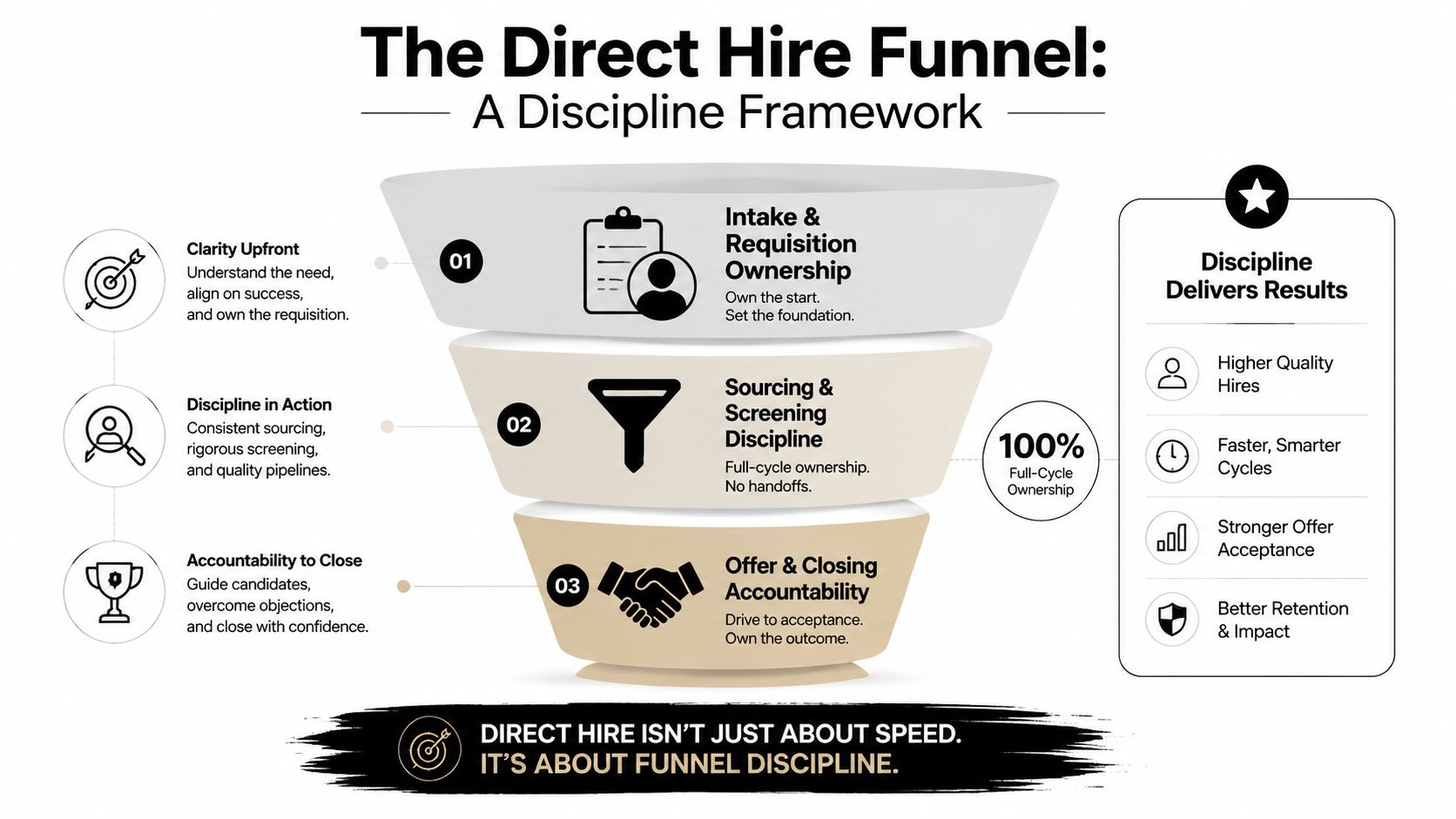
Optimize conversion, not application volume
Published recruiting funnel benchmarks report average applicant-to-hire conversion at about 3.7%, with best-in-class pipelines near 7.5% and bottom-quartile pipelines around 1.5%. The sharpest attrition often occurs between interview and offer, where only about 20% to 35% of candidates progress. (EasyHire's recruiting funnel analytics)
Use those stages to find waste. Tighten the intake brief before sourcing so poorly matched candidates stay out of the funnel. Put an engineer in the first technical screen, then use a defined rubric to test technical depth before consuming panel capacity. Timebox feedback and decisions. A larger pipeline cannot compensate for slow, inconsistent evaluation.
Public-sector hiring shows the same principle. The U.S. Office of Personnel Management describes Direct-Hire Authority as an exception that lets agencies hire qualified applicants without competitive rating and ranking, veterans' preference, or “rule of three” procedures when there is a critical hiring need or severe candidate shortage. Agencies must support a request with evidence such as applications, qualified candidates, offers, declinations, hires, and performance problems. (Office of Personnel Management guidance on Direct-Hire Authority)
Targeted market research can also sharpen a role brief. A company hiring for adjacent leadership talent might review a current Web3 marketing director position to compare scope, language, and expectations before writing its own requirements.
Practical rule: Name the person who owns the funnel from approved requisition to accepted offer. If nobody has that responsibility, the process will drift.
Stakeholders, Roles, and Decision Rights
Engineering hiring gets slow when everyone participates but nobody decides. Give each stakeholder a defined role before the first candidate enters the process. A RACI-style map works well, provided the organization uses it to clarify authority rather than create another meeting.
Stakeholder | Primary Role | Owns | Consults On |
|---|---|---|---|
Hiring manager | Business and team owner | Role scope, selection, offer strategy | Level, compensation, team fit |
Recruiting lead | Funnel operator | Pipeline health, candidate communication, scheduling | Sourcing profile, process design |
Technical interview panel | Technical signal producers | Assigned technical assessments | Rubric calibration |
Hiring committee or bar raiser | Quality control | Exceptions, level disputes, final calibration | Evidence from every interviewer |
HR business partner | People and policy advisor | Policy alignment and employment process | Level, compensation, accommodations |
Finance approver | Headcount and budget control | Approved budget and compensation envelope | Business case and package |
Candidate experience owner | Process continuity | Communication, logistics, accessibility | Timing, concerns, feedback |
Assign decisions before they become disputes
The hiring manager requests headcount and remains accountable for the hiring decision. Finance must approve the budget before sourcing begins, not after a candidate has accepted a verbal range. Recruiting owns pipeline health and scheduling, but it shouldn't redefine the technical bar to make the funnel look healthier.
Engineers own the technical evaluation. They should define what competent performance looks like, write the rubric, and explain which evidence supports a hire. They don't own compensation approval or unilateral leveling. A panel that recommends hiring above the approved level has created an exception, not a final decision.
The recruiter or candidate experience owner should keep the candidate informed and preserve context between conversations. The hiring manager owns the relationship at decisive moments, especially when the candidate has competing options or needs clarity about the work.
Use hiring manager training resources to reinforce these boundaries, then publish the decision map beside the requisition. One-line rules prevent most drift:
Headcount: No sourcing starts until finance approves the role and range.
Technical bar: No interviewer changes the rubric during an active loop.
Level: No verbal offer goes out until the level and package are confirmed.
Exception: Any above-level recommendation goes to the designated committee.
Communication: The candidate never has to ask twice for the next step.
The point isn't bureaucracy. It's preventing late-stage reversals that damage trust and force the team to restart.
Sourcing and Screening Engineers That Convert
A larger pipeline does not fix weak hiring decisions. For technical roles, conversion improves when the team controls funnel quality from the first conversation, assigns technical evaluation to engineers, and removes candidates who lack relevant evidence before consuming senior interview time.
Source through careers sites, referrals, outbound recruiting, GitHub, Stack Overflow, conference networks, and specialist talent communities. These channels produce different levels of intent, context, and technical evidence, so measure them separately rather than treating every applicant as equivalent.
Referrals often include useful context about the person and the team. Outbound recruiting can reach engineers who are not actively applying, but the message must explain why the problem, scope, or environment merits a response. Public technical work can show how someone thinks, while a repository or forum profile still cannot replace a conversation about ownership and trade-offs. Conference relationships and talent communities should remain active networks, not emergency lists.
Write the sourcing brief around evidence:
Recent ownership: What did the engineer personally design, ship, operate, or repair?
Technical judgment: Which trade-offs did they make, and what changed afterward?
Operating context: Did they work within reliability, scale, compliance, or delivery constraints?
Role motivation: Why does this problem, team, and environment fit now?
The funnel should reward qualified conversations, not application volume. A low applicant-to-hire conversion rate means adding more applications can increase review work without improving hiring outcomes. As noted earlier, the team should fix qualification and follow-through before expanding the top of the funnel.
The engineer screen is the filter
Put an engineer in the first serious conversation. A 30 to 45-minute screen with an engineer should examine recent project depth, system design intuition, debugging habits, and the candidate's explanation of technical trade-offs. The interviewer is not recreating the full loop. The decision is narrower: does the candidate show enough relevant signal to justify several hours of senior engineering time?
Strong candidates can explain what they owned without hiding behind team language. They can describe a failed approach, identify constraints, and explain why a simpler design might have worked better. Weak signals include vague impact, little recent shipping activity, and an unwillingness to discuss trade-offs.
Keep the screen conversational. Trivia and automated tests often measure test-taking rather than engineering judgment. Respectful qualification produces better signal and protects candidate time.
Channel | Avg Response Rate | Screen Pass-Through | Time-to-First-Response |
|---|---|---|---|
Careers site | Not established in the provided benchmarks | Track by role | Track from application |
Employee referrals | Not established in the provided benchmarks | Track by role | Track from referral |
Sourced outbound | Not established in the provided benchmarks | Track by role | Track from outreach |
Technical communities | Not established in the provided benchmarks | Track by role | Track from introduction |
Conference networks | Not established in the provided benchmarks | Track by role | Track from contact |
Use a documented candidate sourcing strategy to tag every source and compare qualified-conversation conversion, not response activity alone. Timebox the funnel, keep the technical bar fixed, and let technical evidence from your engineers determine who advances. The strongest channel is the one that produces candidates your engineers can assess quickly and consistently.
Designing the Interview Loop
The interview loop should answer distinct questions in a deliberate order. If two interviewers test the same skill, one of them is probably wasting the candidate's time and the team's capacity.
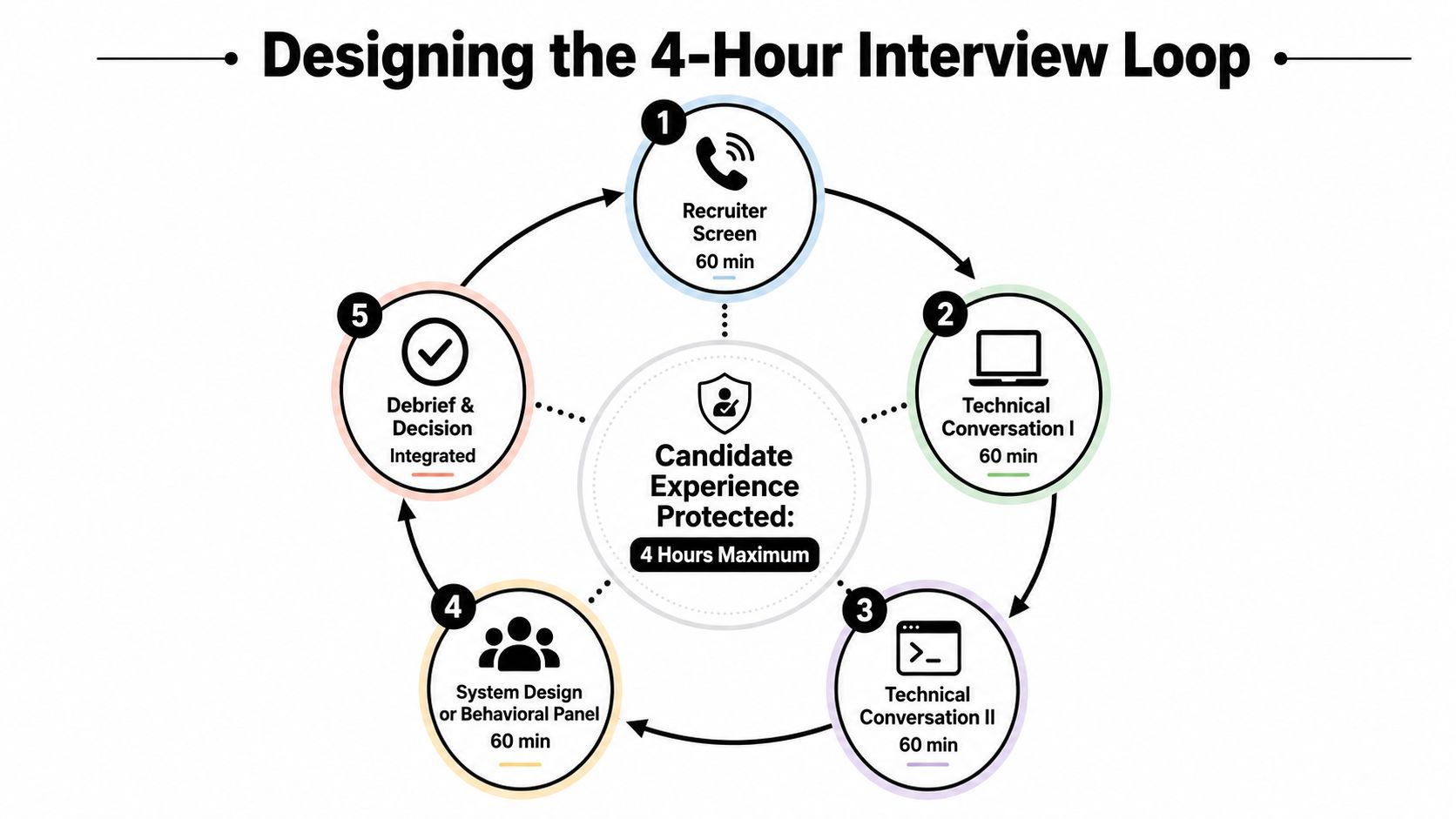
The model below uses five stages and keeps the candidate experience to a four-hour maximum. That limit is a design constraint, not a promise that every role needs the same questions.
Recruiter screen, 60 minutes. Confirm scope, motivation, logistics, compensation alignment, and communication expectations. The recruiter should not pretend to assess architecture depth.
Technical conversation I, 60 minutes. Use a paired-debugging or coding discussion to observe fluency, decomposition, testing instincts, and how the candidate responds to new information.
Technical conversation II, 60 minutes. Explore a recent project in depth. Ask what the candidate owned, which alternatives they rejected, and what they would change now.
System design or behavioral panel, 60 minutes. Test abstraction, prioritization, collaboration, and the ability to make decisions across boundaries.
Debrief and decision, integrated. Interviewers submit scorecards before the debrief, then a senior engineer resolves conflicting evidence without substituting personal preference for the rubric.
Build a rubric that forces evidence
Use a four-point scale for each competency. Define the difference between insufficient evidence, developing capability, strong evidence, and exceptional evidence before interviews begin. Interviewers should record observed behavior and technical reasoning, not impressions such as “great culture fit.”
A paired-debugging session reveals how the engineer investigates a problem. An architecture discussion surfaces abstraction depth and constraint handling. A cross-functional conversation reveals whether the candidate can explain risk and negotiate scope with people who don't share the same technical vocabulary. Those signals are different, so the panel should stay different.
Senior-engineering rule: A debrief should compare evidence against the role rubric, not candidates against the interviewer's favorite career path.
Share only the context that prevents redundant questioning. Interviewers need the role level, competencies, prior stage outcomes where appropriate, and areas they own. They don't need a group narrative that primes them to confirm an earlier opinion. Submit every scorecard within 24 hours, then make the decision the same day while the evidence is fresh.
Staggering can help candidates recover between technical conversations, but don't create idle gaps that suggest internal disorder. The recruiting lead should publish the full schedule, identify the purpose of each session, and name the decision owner. If the team can't explain what signal a panel produces, remove that panel.
The accompanying walkthrough reinforces the value of an intentional loop rather than a collection of disconnected interviews.
Offers, Negotiation, and Closing
Offer design and negotiation are separate jobs. Design establishes the level, compensation band, start window, and internal approval. Negotiation determines which approved levers best match the candidate's priorities. Mixing those conversations creates avoidable confusion and makes the recruiter sound as if the company is inventing terms in real time.
Prepare the package before the verbal call. Anchor it to the approved role and level, then identify the available levers, such as base compensation, equity refresh, signing support, or relocation assistance. Rank them according to the candidate's motivation. A candidate optimizing for ownership may value equity clarity. Someone facing a move may care more about timing or relocation support.
The hiring manager should deliver the business case for the role. The recruiter should explain process, paperwork, and next steps. Both should use the same written package.
Candidate Signal | First Lever to Flex | Second Lever to Flex | Watch-Out |
|---|---|---|---|
Scope and ownership driven | Equity refresh | Level clarity | Don't promise authority the role lacks |
Cash-flow focused | Base compensation | Signing support | Preserve internal equity |
Location constrained | Relocation support | Start-date flexibility | Confirm policy before promising |
Uncertain about the team | Manager conversation | Role or project detail | Don't buy commitment with money alone |
Competing offer | Approved total package | Decision-maker access | Avoid reactive exceptions |
A 72-hour verbal deadline creates a decision point without turning the process into a threat. Offer a written extension option when the candidate needs one, and document the reason. If the team removes one component, rebalance the total package before presenting the change. Candidates remember inconsistency more than they remember polished language.
When a candidate ghosts, send two value-add follow-ups within a week. Each message should answer a likely concern, share a concrete detail about the work, or invite the hiring manager into the conversation. If silence continues, close the loop professionally and walk away. An open requisition is cheaper than a desperate hire.
Before the candidate countersigns, confirm references, the start window, reporting line, and the first-week plan. Then send the written agreement immediately after the verbal acceptance. Momentum survives paperwork when every person knows the next action.
Onboarding Handoff and Time-to-Productivity
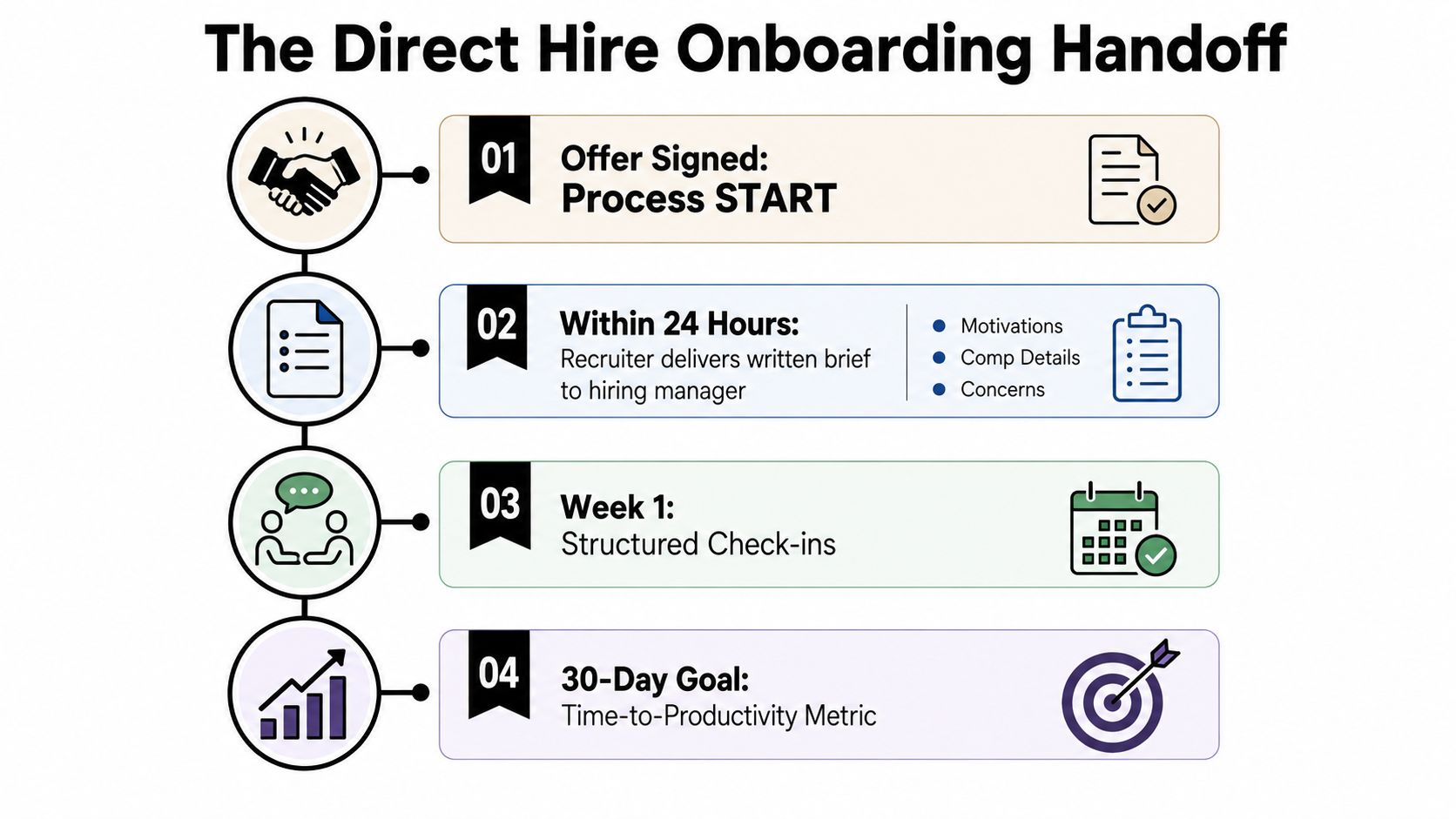
The signed offer is the start of the handoff, not the finish line. A candidate who receives silence after accepting has already learned that the company's internal coordination is weak. The recruiter should deliver a written brief to the hiring manager within 24 hours, covering motivations, compensation details, concerns, expected pushback, and any agreed accommodations.
The hiring manager owns the next phase. Draft the 30-60-90 plan before Day 1, choose a team buddy, and give that buddy the same relevant context. The plan should identify the systems to learn, relationships to build, decisions the new engineer can make, and the first meaningful contribution. Avoid assigning vague “ramp-up” work with no definition of success.
Make the first month operational
Use a simple service-level checklist:
Equipment and access: Laptop, accounts, repositories, environments, and documentation are ready by Day -3.
Manager connection: The first one-on-one is scheduled for Day 1.
Team integration: The buddy has a clear role and the team knows how to include the new engineer.
First artifact: The engineer owns a scoped pull request or design document by Week 2.
Formal review: A structured 30-day check-in mirrors the interview rubric and tests whether the role matched the promise.
Pre-boarding should answer practical questions before they become anxiety. Send a written first-week schedule, a welcome video from the team, and instructions for access or equipment. The hiring manager should also explain what won't be expected immediately. Clarity gives a new engineer room to learn without interpreting every unanswered question as a warning sign.
A useful onboarding best-practices guide can support the checklist, but ownership stays inside the hiring team. Recruiting transfers context. The manager turns context into work. The buddy turns work into belonging.
Handoff standard: If the new hire has to reconstruct the role's promises from scattered messages, the direct hire process ended badly even if the offer was accepted.
KPIs, Pitfalls, and Where TekRecruiter Fits
A direct hire dashboard should show where candidates disappear, not just how many requisitions closed. Track time-to-fill, time in each stage, pass-through rates by interview stage, offer-acceptance rate, 90-day retention, and quality of hire against six-month performance. Review the metrics by role family and level so a difficult engineering search doesn't get hidden inside an all-company average.
Time-to-fill needs careful interpretation. Recent benchmark reporting places median time-to-fill for non-executive roles at about 39 calendar days, while broader U.S. and global benchmarks commonly sit in the 42 to 45-day range. The same reporting cautions that time-to-fill includes requisition approval and posting delays, so leaders should separate approval time, screen-to-interview lag, and offer-acceptance latency. (Consultadd's hiring benchmarks and fixes)
KPI | Target Band | Red Flag |
|---|---|---|
Time-to-fill | Defined by role and level | Approval or evaluation stages drift without an owner |
Time in stage | Published internal service level | Candidates wait for feedback or scheduling |
Stage pass-through | Calibrated to the written rubric | One interviewer rejects nearly everyone |
Offer acceptance | Reviewed by role and source | Candidates decline for repeated, known reasons |
90-day retention | Reviewed by cohort | New hires leave before the first formal review |
Quality of hire | Compared with six-month performance | Interview scores don't predict manager assessment |
Audit the failure modes
Vague role scorecards create inconsistent screens. Unstructured debriefs reward confidence and recency instead of evidence. Manager-driven loops skip calibration. Counteroffer panic produces exceptions that damage internal equity. A weak onboarding handoff turns an accepted offer into a cold first week.
Use a one-page audit in the ATS or team wiki:
Role: Scope, level, competencies, compensation approval, decision owner.
Sourcing: Channels, source tags, technical screen owner, response workflow.
Interview: Distinct signal for every stage, four-point rubric, scorecard deadline.
Decision: Senior tiebreaker, same-day debrief, documented exception path.
Offer: Approved package, motivation levers, deadline, extension process.
Handoff: Written brief, equipment readiness, buddy, first artifact, 30-day review.
Outcome: Acceptance, retention, and performance reviewed after hire.
When internal recruiters can't sustain engineer-led screens and disciplined loops, external support should strengthen the funnel rather than flood it. TekRecruiter provides technology staffing and recruiting services, including direct-hire support for permanent technology employees, with recruiting built on technical conversations instead of relying only on generic tests or quizzes. Treat that model as a capacity extension: your hiring manager still owns the bar and selection, while a specialized partner can help identify, qualify, coordinate, and maintain candidate momentum.
The right question isn't whether your company needs more sourcing. Ask where qualified engineers leave the funnel, who owns that failure, and what evidence will change the process.
 Ron SmithPresident & Lead RecruiterTekRecruiter