Outsourced Development Team: A Complete Guide for 2026
Learn about outsourced development team costs, engagement models, and how to hire the right partner. A complete guide for 2026.


Your roadmap is approved, customers are waiting, and the internal engineering team is already committed to production support, cloud migration, and the next release. Hiring permanently may take too long, while handing an entire product to an unfamiliar vendor creates risks you can't easily reverse. The key decision isn't whether external engineering can help. It's whether the team structure, operating rhythm, and accountability model fit the work.
An outsourced development team can provide specialized capability, flexible capacity, and delivery momentum without requiring permanent headcount. It can also create expensive coordination problems when leaders select on rate cards alone. The useful question is structural: what kind of external team can contribute without making your internal organization slower?
The Hidden Operating Model Behind Scalable Engineering Teams
A CTO often reaches the same uncomfortable point. The product roadmap keeps expanding, but internal capacity stays flat. The platform team is pulled into reliability work, product engineers are supporting legacy customers, and every new initiative competes with commitments already made. Adding more meetings won't solve the constraint.
An external team can change that equation, but only if leadership treats it as an operating model rather than a temporary staffing patch. The right team can own a defined stream of work, add scarce expertise, or operate alongside internal engineers during a period of intense delivery. The wrong team adds tickets without reducing the decision burden on internal leaders.
This model has moved far beyond occasional cost cutting. One major industry estimate values the software development outsourcing market at $564.22 billion in 2025 and projects $618.38 billion in 2026, with a possible $977.04 billion by 2031. The same estimate implies approximately 9.6% annual growth. Those figures place outsourced engineering within the mainstream infrastructure of global product delivery, not at the edge of the technology labor market. (Mordor Intelligence software development outsourcing market estimate)
Capacity is only one part of the decision
Leaders use external teams for several distinct reasons:
- Specialized capability: Bring in engineers with experience in cloud infrastructure, QA automation, data platforms, cybersecurity, or modernization work that the internal team can't cover immediately.
- Flexible throughput: Add delivery capacity for a major initiative without committing to permanent headcount before the roadmap is proven.
- Independent focus: Give a dedicated group responsibility for a platform, product stream, or migration while internal leaders protect core operations.
- Market access: Work with talent in regions where the required skills are available and working-hour overlap is practical.
Enterprise adoption reinforces this shift. A widely cited benchmark reports that 90% of Fortune 500 companies outsource at least some software development, often through staff augmentation or dedicated external teams. (Net Solutions software development outsourcing statistics) That pattern matters because large companies generally don't outsource only to find the lowest hourly rate. They use external capacity to access expertise, accelerate modernization, and adjust delivery capacity around strategic programs.
Practical rule: An external team should remove a constraint from your operating system. If it only adds people while your managers still make every technical and delivery decision, you've bought capacity without buying leverage.
The strongest engagements make ownership visible. Internal leaders retain product direction, business context, and architectural authority where those responsibilities belong. The external group owns the work assigned to it, participates in the same delivery cadence, documents decisions, and raises risks before they become executive surprises.
What an Outsourced Development Team Actually Is
An outsourced development team is a group of engineers supplied by an external partner and organized to deliver software work for your business. The engineers aren't your employees, but the work becomes part of your delivery system. Depending on the contract, the partner may manage recruiting, payroll, team leadership, delivery processes, or an entire functional outcome.
That definition separates a real team from a list of available contractors. Individual freelancers can be useful for tightly bounded tasks, but they usually don't provide coordinated product, engineering, QA, DevOps, and delivery coverage. A traditional IT services agency may deliver a project under its own process and then leave. An outsourced team should operate as a deliberate extension of your organization, with clear interfaces for priorities, code review, security, and acceptance.
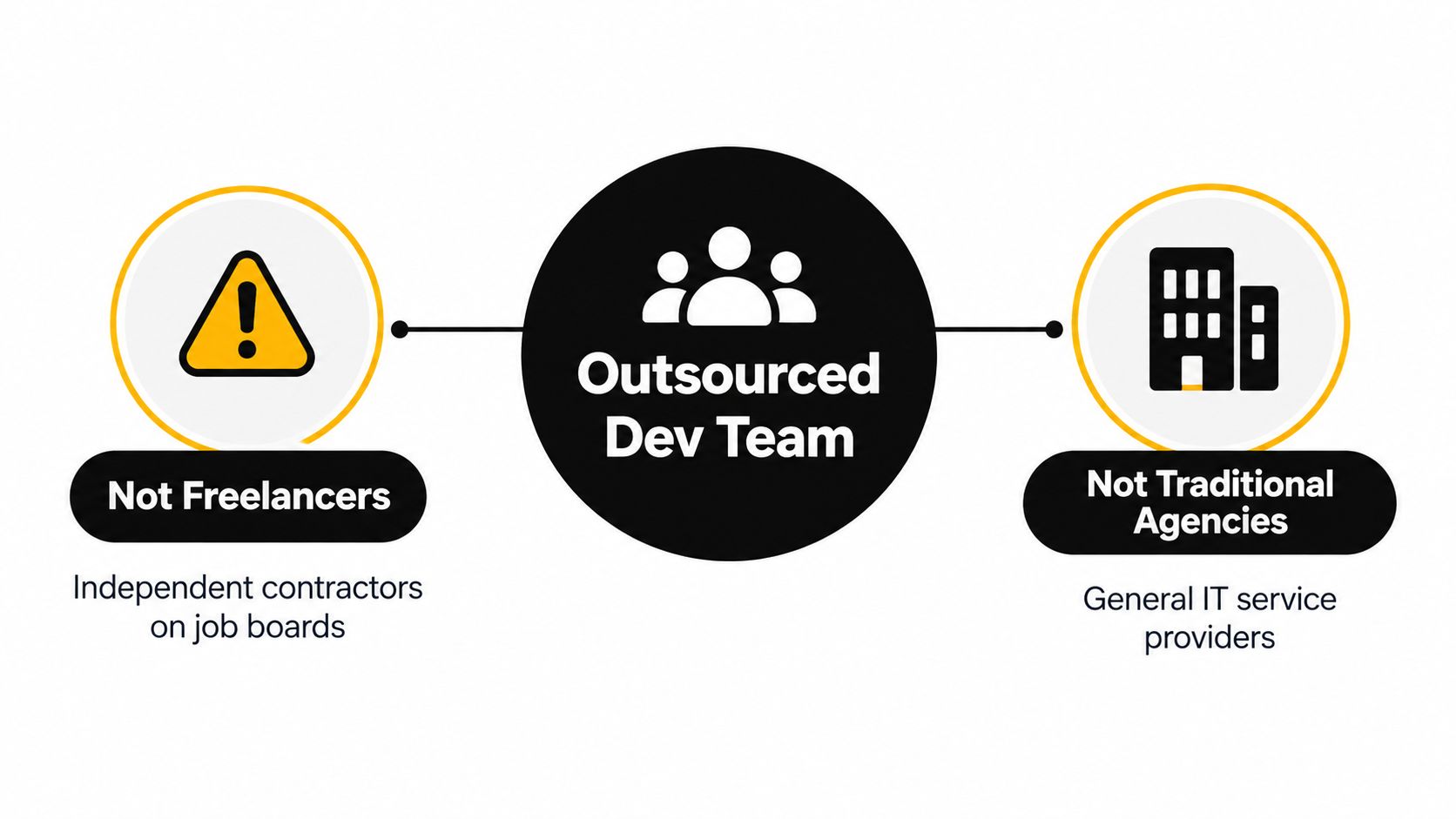
The distinction shows up in daily work
A mature external team has more than engineering talent. It has a delivery shape. You should be able to identify who owns technical decisions, how work enters the backlog, who reviews pull requests, how quality is measured, and what happens when requirements change.
The practical differences are straightforward:
| Model | What you receive | Typical risk |
|---|---|---|
| Individual freelancers | Independent contributors for specific tasks | You coordinate the people, quality, and continuity |
| Traditional IT agency | A vendor-led project or service | The vendor may optimize for contractual completion rather than product outcomes |
| Outsourced development team | Coordinated engineering capacity integrated with your priorities | You still need clear ownership, governance, and communication |
The market's scale supports treating this as mature delivery infrastructure. Estimates place software outsourcing at $544.22 billion in 2024, with a projection of $888.69 billion by 2033 and a 5.6% CAGR during 2026 to 2033. (Outsource Accelerator software outsourcing market overview) Another estimate places the market at $555.03 billion in 2024 and projects $897.9 billion by 2032, with a 5.49% CAGR during 2026 to 2032. (SkyQuest software outsourcing market report) The estimates differ in methodology, but they point to the same conclusion. External software delivery is a large, established commercial category.
Integration matters more than the label
Application development accounts for 44.2% of software outsourcing market share in one industry estimate, indicating that external teams are heavily involved in building applications, not just maintaining existing systems. (Dataintelo global software outsourcing market report) That makes integration especially important. New application work requires constant decisions about user behavior, architecture, testing, observability, and release readiness.
Before signing, define the interfaces:
- Product interface: Who sets priorities and approves trade-offs?
- Technical interface: Who owns architecture, standards, and review?
- Delivery interface: Who runs planning, demos, risk tracking, and retrospectives?
- Knowledge interface: Where do decisions, runbooks, and system context live?
- Commercial interface: What counts as included work, changed scope, and acceptance?
If those interfaces remain vague, the partner becomes a queue of labor. If they're explicit, the outsourced development team can become a dependable extension of your engineering organization.
Comparing Staff Augmentation, Dedicated Teams, and Managed Services
The three common models solve different problems. Treating them as interchangeable staffing packages is a mistake because each assigns control, accountability, and management work differently.
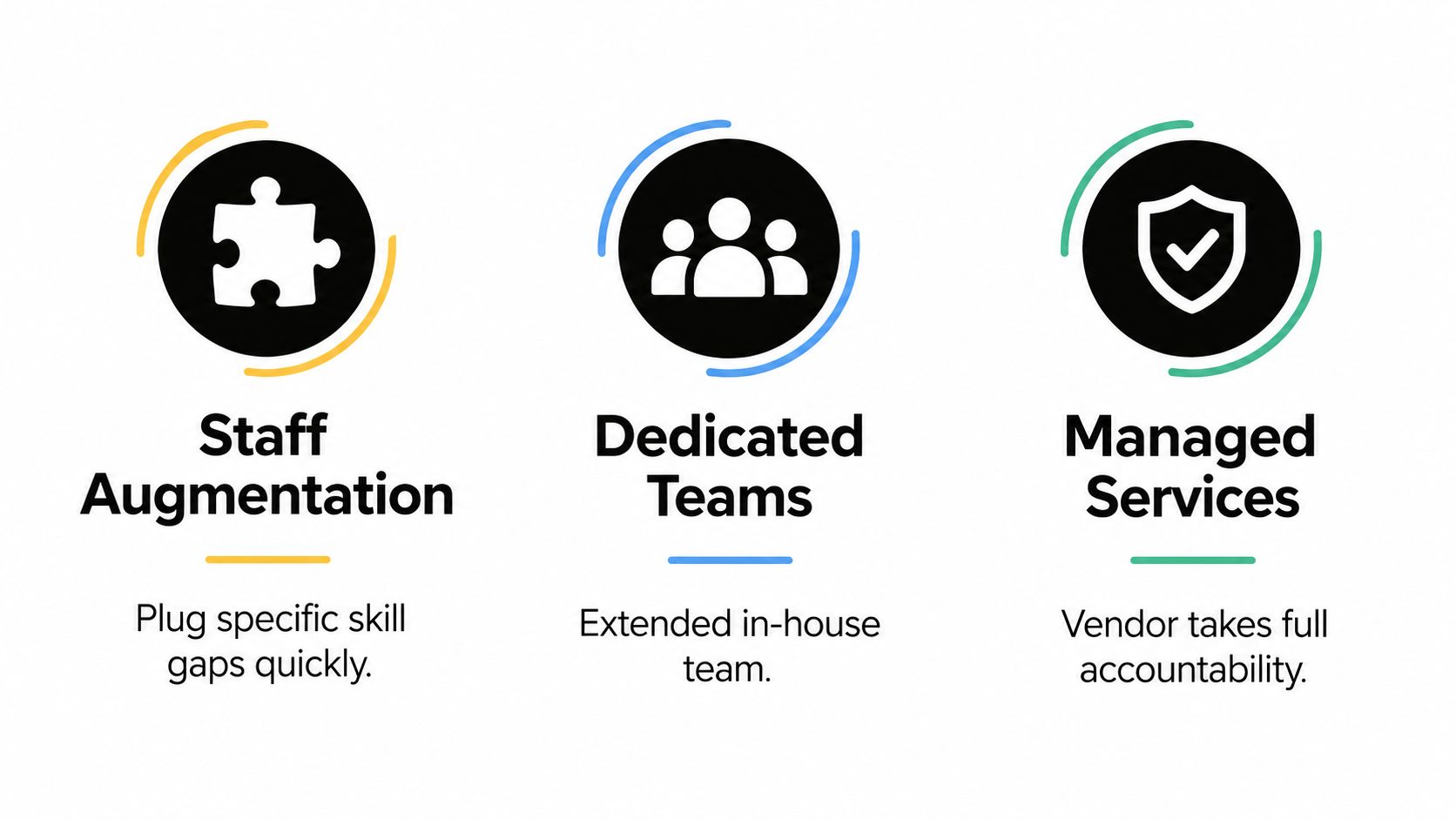
| Engagement model | Best fit | Control | Integration speed | Internal management load |
|---|---|---|---|---|
| Staff Augmentation | A specific skill or capacity gap inside an existing team | High | Fast when roles are clear | High |
| Dedicated Teams | A substantial roadmap stream requiring a coordinated pod | Shared | Fast after onboarding | Moderate |
| Managed Services | A functional area or outcome that needs vendor accountability | Lower day-to-day control | Depends on scope and operating agreement | Lower day-to-day, higher governance |
Staff augmentation
Staff augmentation works when your internal organization already owns the product and can direct additional engineers. An external developer joins your ceremonies, follows your branching and review practices, and works under your technical leadership. This model is useful for a short-term need, such as adding a DevOps engineer during a cloud migration or adding QA capacity before a major release.
The trade-off is management responsibility. Your leads still need to assign work, review output, resolve ambiguity, and protect team cohesion. The model is a strong fit when you need augmenting your IT team and already have the leadership capacity to absorb another contributor.
Dedicated teams
A dedicated team is a coordinated unit assembled around your roadmap. You set strategic priorities and business context, while the partner typically helps manage delivery cadence, team composition, and day-to-day engineering operations. This model suits a platform build, product expansion, or modernization program where scope will evolve as the team learns.
The benefit is continuity. You aren't merely buying isolated hours. You're creating a stable group with shared context and complementary roles. The cost is that you must invest in onboarding, decision access, and regular product feedback. A dedicated team can't compensate for an absent product owner or an executive sponsor who changes direction without communicating why.
Managed services
Managed services move accountability further toward the partner. Instead of directing individual engineers, you define the service, performance expectations, boundaries, security requirements, and business outcomes. The provider manages more of the process and may own an entire capability such as application support, testing, infrastructure operations, or a defined product function.
This model reduces daily coordination but increases the importance of the agreement. You need measurable acceptance criteria, escalation paths, access rules, reporting expectations, and a clear definition of what the provider controls. For a deeper comparison of the leadership trade-offs, see managed services versus staff augmentation.
A simple decision rule works well:
- Choose staff augmentation when an internal team has direction but lacks hands or a specific skill.
- Choose a dedicated team when an initiative needs a stable, cross-functional unit.
- Choose managed services when you want a partner to own an operational or delivery outcome.
This video offers another perspective on how the models differ in practice.
The cheapest model on paper can be the most expensive in management time. Pick the structure that matches where decisions should live.
Beyond the Hourly Rate Understanding True Total Cost
Procurement often begins with one question: “What is the hourly rate?” That question is easy to answer and frequently leads buyers toward the wrong team.
The billable rate is only one component of total cost. You also pay with engineering leadership time, product clarification, code review, onboarding, environment access, security review, handoffs, rework, and contract administration. A low rate can become expensive when every requirement requires a meeting and every change triggers a negotiation.
Recent outsourcing guidance specifically identifies ramp-up time, change requests, handover effort, and out-of-scope negotiations as costs that headline rates often omit. (X-Team analysis of software outsourcing challenges) Those costs are not theoretical. They appear when a vendor lacks domain context, when documentation is incomplete, or when the contract rewards narrow compliance instead of useful outcomes.
Build the cost model around friction
Before comparing proposals, estimate the management work your organization will provide:
- Onboarding effort: Time spent explaining architecture, customers, workflows, repositories, and release procedures.
- Decision latency: Delays caused when questions cross team boundaries or time zones.
- Review burden: Internal engineering time required to inspect code, test behavior, and correct standards violations.
- Knowledge transfer: Documentation and pairing needed to prevent dependency on one external engineer.
- Scope administration: Time spent determining whether a request is included, changed, or billable.
- Transition exposure: Cost and risk when the engagement ends or team composition changes.
A proposal with a higher rate may still have a lower total cost if the team arrives with the right skills, communicates clearly, documents decisions, and works within your existing toolchain. Conversely, a low-cost team that needs extensive supervision can consume the exact leadership capacity you were trying to protect.
The relevant question isn't “What does each engineer cost per hour?” It's “How much internal attention does this team require to produce acceptable software?”
Use a written cost model before contract negotiations. Include the internal product owner, engineering manager, security lead, and finance partner. If nobody can explain who absorbs coordination work, the quote isn't complete. A practical framework for building that estimate is available in this guide to software development cost estimation.
Why Nearshore Is Outperforming Offshore Delivery
Geography affects engineering performance through working hours, not only through labor rates. A team that can discuss a product decision while your team is still online creates a shorter feedback loop than a team that receives the question after your workday ends.
One industry estimate reports that offshore delivery represented 51.85% of market share in 2025, while nearshore delivery is projected to grow at a 13.95% CAGR between 2026 and 2031. (Verified Market Research software outsourcing market report) The figures describe different parts of the delivery market, but they highlight an important shift. Offshore remains substantial, while nearshore models are expanding because organizations increasingly value working-hour alignment.
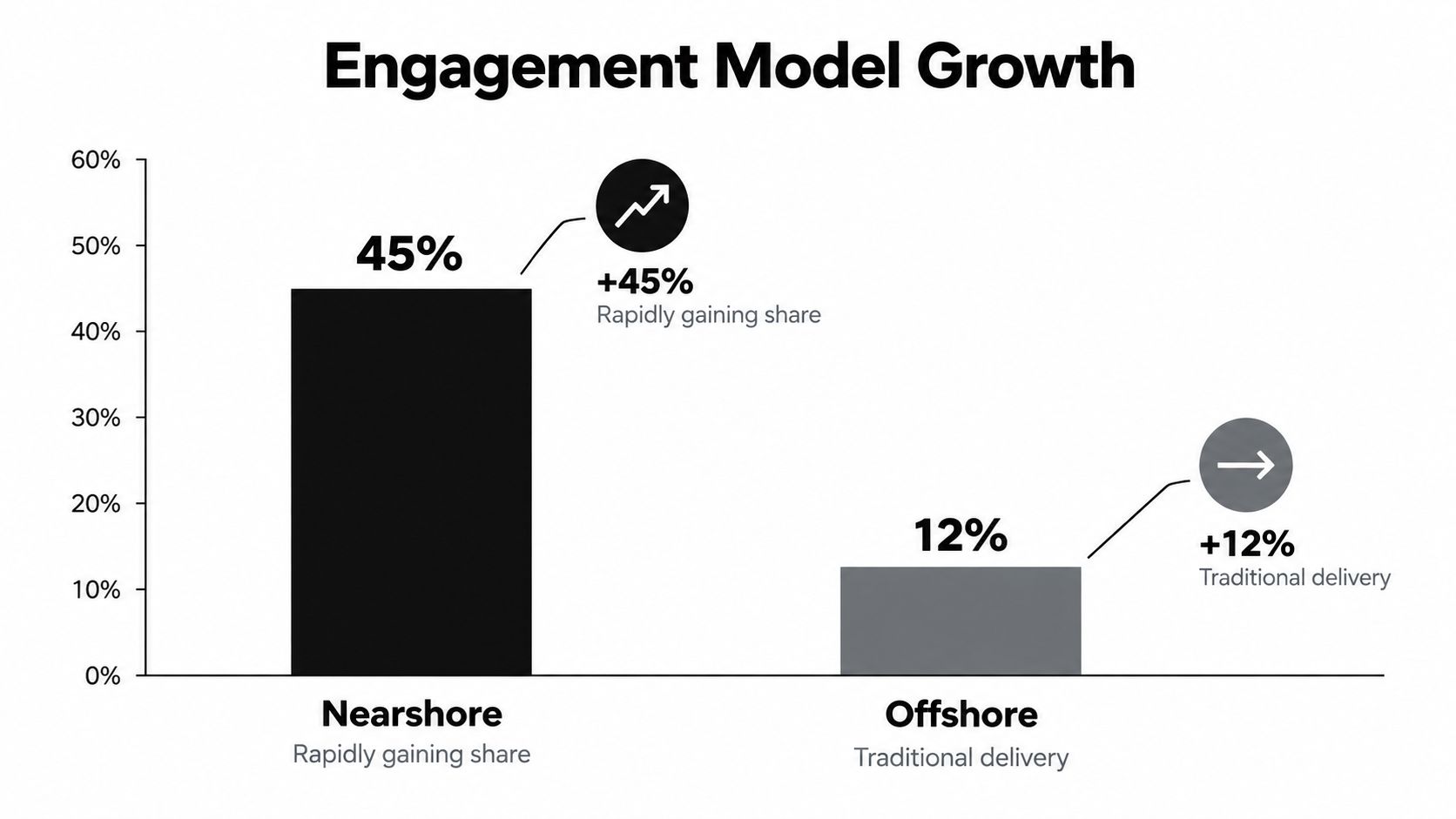
Temporal distance changes the delivery loop
Nearshore doesn't automatically mean better. A poorly managed nearby team can still miss requirements, ship weak code, or create security exposure. The advantage is structural. Teams that overlap in working hours can resolve ambiguity while the decision still has context.
A 2026 study of global software development found statistically significant advantages for nearshore outsourcing in overall success, project-management effort, schedule adherence, quality, and communication problems. The study used a survey of 80 respondents and interviews with 6 practitioners. (Rose Talent Solutions discussion of dedicated nearshore developer teams) The finding supports a practical CTO observation: time-zone alignment is a performance variable, not a lifestyle preference.
When a product manager can answer an engineer's question during the same working window, the team spends less time preserving incomplete assumptions. When a staff engineer can review a design before implementation begins, defects are less likely to travel deep into the sprint. When a production issue appears, overlapping hours make escalation and diagnosis more direct.
What to test before choosing nearshore
Ask a potential partner to show how the teams work:
- Working-hour overlap: Which hours are guaranteed for collaboration, reviews, and incident response?
- Decision ownership: Who can make a technical decision when your internal lead is unavailable?
- Communication habits: Which discussions happen synchronously, and which must be documented?
- Team continuity: How does the partner preserve context when an engineer changes?
- Escalation coverage: Who responds when the problem crosses the normal development schedule?
Nearshore is most valuable when your product depends on iteration, design feedback, and frequent coordination. If the work is strictly isolated and fully specified, geographic alignment matters less. For a broader comparison of the models, see offshoring versus nearshoring.
How to Choose the Right Model for Your Roadmap
Start with the problem you're trying to remove, not the vendor category.
- You have internal leadership and need a few specific capabilities: Use staff augmentation. Assign the external engineers to an existing team with a named manager and clear acceptance standards.
- You have a substantial initiative that needs a stable unit: Use a dedicated team. Give it a product owner, technical context, backlog access, and authority to manage execution.
- You want an external party to own a defined function: Consider managed services. Define outcomes, service boundaries, reporting, security, and escalation before work starts.
Then test the transition rather than launching at full scale. Begin with a limited workstream that exposes the partner's communication, code quality, documentation, and ability to handle ambiguity. Keep the initial scope meaningful enough to reveal delivery behavior, but bounded enough that your organization can recover if the fit is poor.

Before kickoff, document the repository structure, environments, quality gates, communication channels, approval rights, and definition of done. Schedule recurring planning, demonstrations, risk reviews, and retrospectives. Your first objective isn't maximum velocity. It's shared operating context.
Get Elite Engineering Talent Without the Resume Mill
The partner selection problem often starts before the outsourcing contract. Staffing firms can produce a large volume of resumes while leaving your technical team to determine whether candidates can design, build, debug, and ship.
That process fails when recruiters screen for keywords instead of engineering judgment. A strong outsourced development team needs people who can work through incomplete requirements, explain trade-offs, collaborate across functions, and take ownership after deployment. Those traits rarely appear in a resume summary.
TekRecruiter uses an engineer-to-engineer recruiting model for engineering, product, and Go-to-Market roles. Its recruiters work with technical context and support direct hire, staff augmentation, on-demand, and nearshore talent options. For teams building their own sourcing infrastructure, a recruiting and sourcing API can also support structured talent workflows.
Evaluate the person and the operating fit
Your selection process should test more than framework familiarity:
- Technical reasoning: Ask the candidate to explain an architectural decision, including the alternatives rejected.
- Delivery ownership: Explore how they respond when a release is blocked by unclear requirements or unstable infrastructure.
- Communication quality: Test whether they can make complex issues clear to product, security, and executive stakeholders.
- Team behavior: Look for people who document context, invite review, and raise risks early.
- Role alignment: Match the candidate to the engagement model. A self-directed technical lead may thrive in a dedicated pod, while a specialist may be more effective inside an existing team.
For a more detailed hiring process, see the ten pillars of a best-practice recruitment process for elite engineers. The principle is simple: don't outsource your judgment. Require the partner to show how it evaluates technical ability, communication, ownership, and continuity before you give it responsibility for your roadmap.
TekRecruiter helps companies build outsourced, nearshore, augmented, and permanent engineering teams across software, AI, cloud, DevOps, data, QA, product, and Go-to-Market functions. Visit TekRecruiter to discuss the delivery model and technical talent your roadmap requires.