How to Hire Fintech Developers: Roles, Tests and Steps
Learn how to hire fintech developers in 2026: define the role, test payment and domain skills, score candidates and close the offer.
Your payments team has had a developer role open for months, but there's still no credible shortlist. The recruiter wants more keywords, the engineering manager wants stronger candidates, and the CTO needs someone who can own production without putting customer funds at risk.
The way out isn't a longer stack checklist. Knowing how to hire fintech developers starts with deciding what a mistake would cost, which knowledge the engineer needs immediately, and what evidence would justify giving them production responsibility.
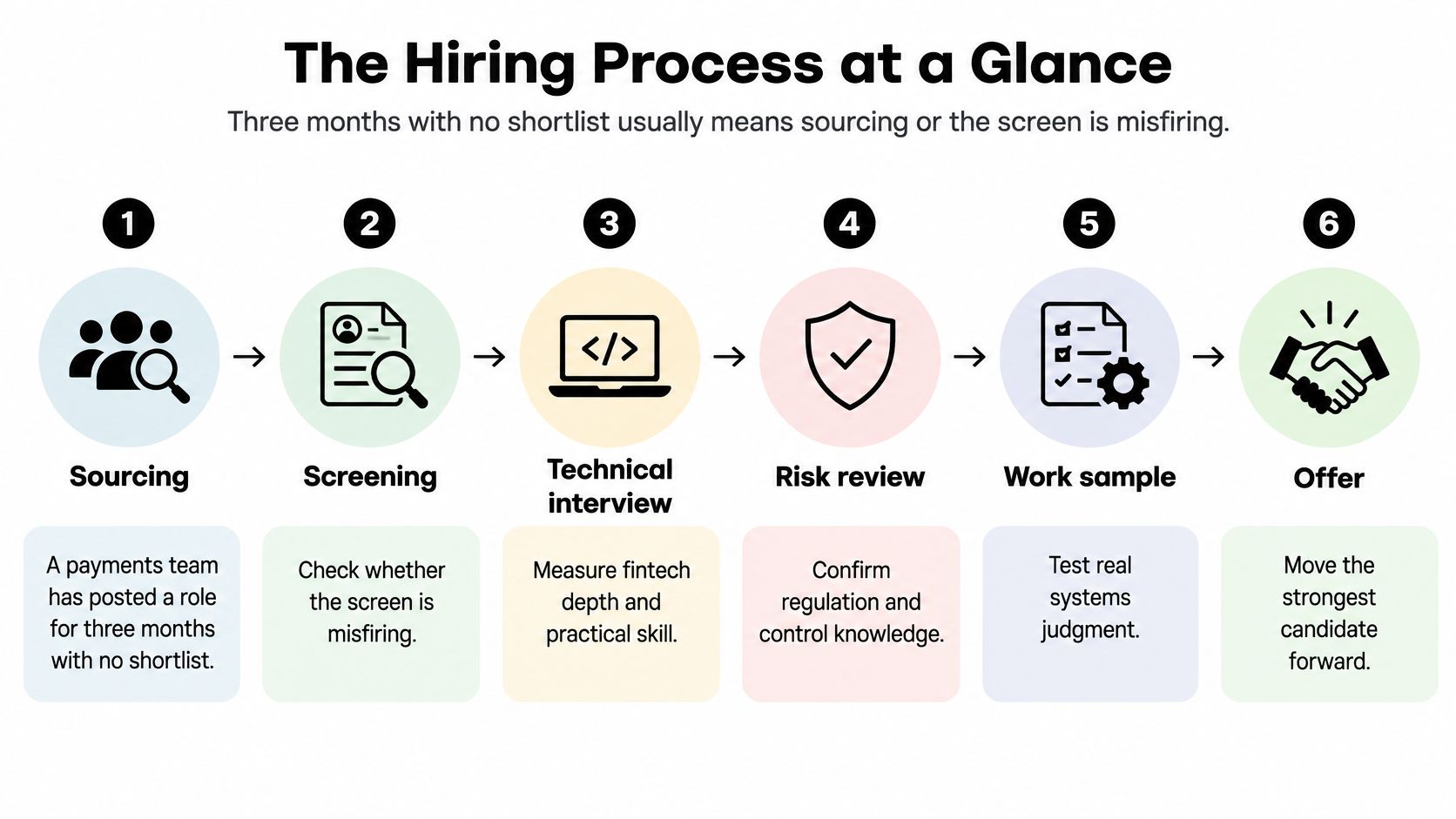
The Hiring Process at a Glance
A stalled search usually warrants checking sourcing and screening before adding interviews. If suitable people aren't entering the pipeline, another technical round won't help. If weak fits keep reaching engineers, the recruiter needs a sharper screen.
Use the following as a proposed operating schedule, not a market benchmark. Reserve panel availability before outreach begins, and overlap sourcing with screening rather than waiting for a complete shortlist.
Assign an owner to every decision
Fintech developer hiring stages, duration and owner
| Stage | What Happens | Typical Duration | Owner |
|---|---|---|---|
| Role definition | Agree capabilities, domain, hiring model and salary band | Allocate 1 week | Hiring manager and CTO |
| Sourcing and outreach | Referrals, fintech engineering communities and agencies | Allocate 2 to 4 weeks, overlapping interviews | Recruiter or talent lead |
| Screening call | Confirm domain exposure, work authorization and salary expectations | Schedule 30 to 45 minutes | Recruiter |
| Work sample | Candidate works through a realistic failure scenario | Cap at 2 to 3 hours | Senior engineer |
| Panel interviews | Architecture, security judgment and communication | Schedule 2 rounds of 60 to 90 minutes | Interview panel |
| Offer and checks | Offer, references and checks required for regulated roles | Reserve 1 to 2 weeks | Hiring manager and HR |
For planning, you could target four to seven weeks for a common role, with a six-to-ten-week contingency for a scarce payments or data profile. Treat those as internal targets to validate against actual candidate availability, not promised hiring times. Specialist sourcing may require changing the location, compensation or scope.
The workflow below is a useful overview. Keep ownership explicit even when your team changes the order of assessments.
Diagnose the handoff that's failing
Ask the recruiter to record why candidates exit: compensation, location, missing capabilities, assessment burden or an accepted competing offer. Review those reasons rather than treating every rejection as a sourcing problem.
For the administrative handoffs, Cyndra's guide to streamline sourcing through offer provides a starting point for deciding what to automate. Scheduling and reminders are reasonable candidates. Technical judgment still needs a named human owner.
Pipeline rule: Fix sourcing when suitable candidates don't reach the screen. Fix screening when engineers repeatedly spend panel time discovering basic mismatches.
Close the loop with candidates promptly. An unresolved panel disagreement is an internal decision problem, not a reason to leave someone waiting.
Map Each Fintech Role to Its Risk and Hiring Model
Failure cost changes the hiring model more than the programming language does. Use this role map as a starting assessment, then adjust it for your product, jurisdiction and production responsibilities.
Fintech role archetypes by risk and hiring model
| Role Archetype | Failure Cost | Regulatory Specificity | Talent Scarcity | Suggested Hiring Model |
|---|---|---|---|---|
| Payments and ledger engineer | High | High | High | Direct hire with a domain interview |
| Platform and API engineer | High | Medium | Medium | Direct hire or contract-to-hire |
| Test automation engineer | Medium | Low | Low | Staff augmentation or nearshore |
| Data and AI platform engineer | Medium | High | Very high | Direct hire at a premium, or contract-to-hire if scarce |
| Regulatory reporting engineer | High | Very high | High | Local direct hire |
| Product feature engineer | Medium | Low | Medium | Nearshore or staff augmentation |
Discuss these ratings with engineering, operations and compliance before approving the requisition.

The World Economic Forum's 2025 Future of Jobs Report identifies FinTech Engineers among the roles projected to grow fastest through 2030. That supports defining durable capabilities, including financial reasoning and learning capacity, rather than recruiting only for today's framework.
Scarcity also differs by specialty: the Quess financial-services hiring report identifies a 42% supply gap in AI, data and analytics and a 38% gap in platform engineering. Don't assume a familiar title means an accessible talent pool.
Choose where context must stay
Use direct hire when the engineer will accumulate institutional knowledge and own consequential decisions. Payments ownership and regulatory reporting fit this pattern, although local hiring should follow genuine market-context or location requirements, not habit.
Contract-to-hire works when both sides need to validate an evolving role. It doesn't remove the need for supervision, and conversion terms belong in the agreement before work begins.
Nearshore and staff augmentation suit bounded work with documented interfaces, test coverage and an internal technical owner. Test automation and product features are good candidates. A feature that changes account balances, however, deserves a higher risk classification than its title suggests.
For another perspective on delivery scope, use our fintech software development guide. We give neutral stack advice backed by hiring-market data, and tell clients how deep the talent pool is for a supplier's proposed technology before they commit.
Use the video as a discussion prompt alongside the role map.
Source for the responsibility
Referrals and fintech engineering communities suit context-heavy permanent searches. Agencies can help identify augmentation capacity and distributed teams. Fetchin's guide to understanding talent intelligence systems offers context for organizing that search around capabilities rather than titles.
Also assess collaboration intensity: who must answer this engineer's questions, and when? A distributed-systems specialist may be stronger on ledger reliability than someone with a narrow fintech résumé, while regulatory reporting requires regulatory fluency.
If correcting a wrong hire's decision would require a regulator or customer conversation, I'd start with direct hire and explicit internal ownership.
Test Domain Knowledge Alongside Core Engineering Skills
A fintech developer needs sound engineering fundamentals and enough domain understanding to recognize an unsafe assumption. Don't treat either as a substitute for the other.
Test production debugging, distributed systems, API contracts, cloud permissions, data architecture and secure handling of financial information. Ask candidates to connect those skills: how does a database transaction interact with an external provider call, and what happens when only one succeeds?
Domain concepts and sample questions for fintech interviews
| Domain | Concepts to Probe | Sample Candidate Question |
|---|---|---|
| Payments | Authorization, settlement, chargebacks, idempotency | How would you retry a card capture after a timeout without charging the customer twice? |
| Lending | Underwriting data, credit decisioning, repayment schedules | How would you recalculate a repayment schedule after a partial payment? |
| Banking and ledgers | Double-entry bookkeeping, balances, reconciliation | How would you detect a ledger mismatch between two systems? |
| Trading and markets | Latency, order matching, market data feeds | What fails first when a market data feed lags behind the order book? |
| Insurance | Claims workflows, policy versioning, actuarial inputs | How would you version a policy that changes in the middle of its term? |
| Compliance and AML | KYC data, transaction monitoring, audit trails | What evidence would an auditor need about a flagged transaction? |
Listen for process understanding
For lending, a weak answer jumps straight to recalculating interest. A stronger candidate asks how payments are allocated, which contractual rules apply, and whether the schedule must preserve its previous version.
For insurance, listen for effective dates and the distinction between correcting stored data and changing contractual coverage. For trading, the candidate should investigate stale inputs and execution safeguards rather than assuming every delay is a throughput problem.
The same distinction applies to compliance. Listing know-your-customer providers isn't enough. A useful answer identifies the decision record, supporting evidence, reviewer actions and access history needed to explain a flagged transaction.
A candidate who explains a balance change clearly, including what happens when it fails, gives you more useful evidence than someone who lists frameworks.
Separate readiness from learning capacity
A lending engineer who hasn't built your audit workflow may still be a good hire. Look for questions about who approves changes, which records must remain available, and how operations resolves exceptions.
Write the domain question before the interview. Afterward, record whether the answer demonstrated process understanding, vocabulary alone, or a knowledge gap the team can realistically teach.
Don't expect candidates to infer undocumented business rules. Give everyone the same clarifications, and assess whether they revise their approach when new information appears. Your shortlist should contain people who can explain a payment or balance concept to a non-specialist without hiding the uncertainty.
Score Candidates with a Weighted Interview Scorecard
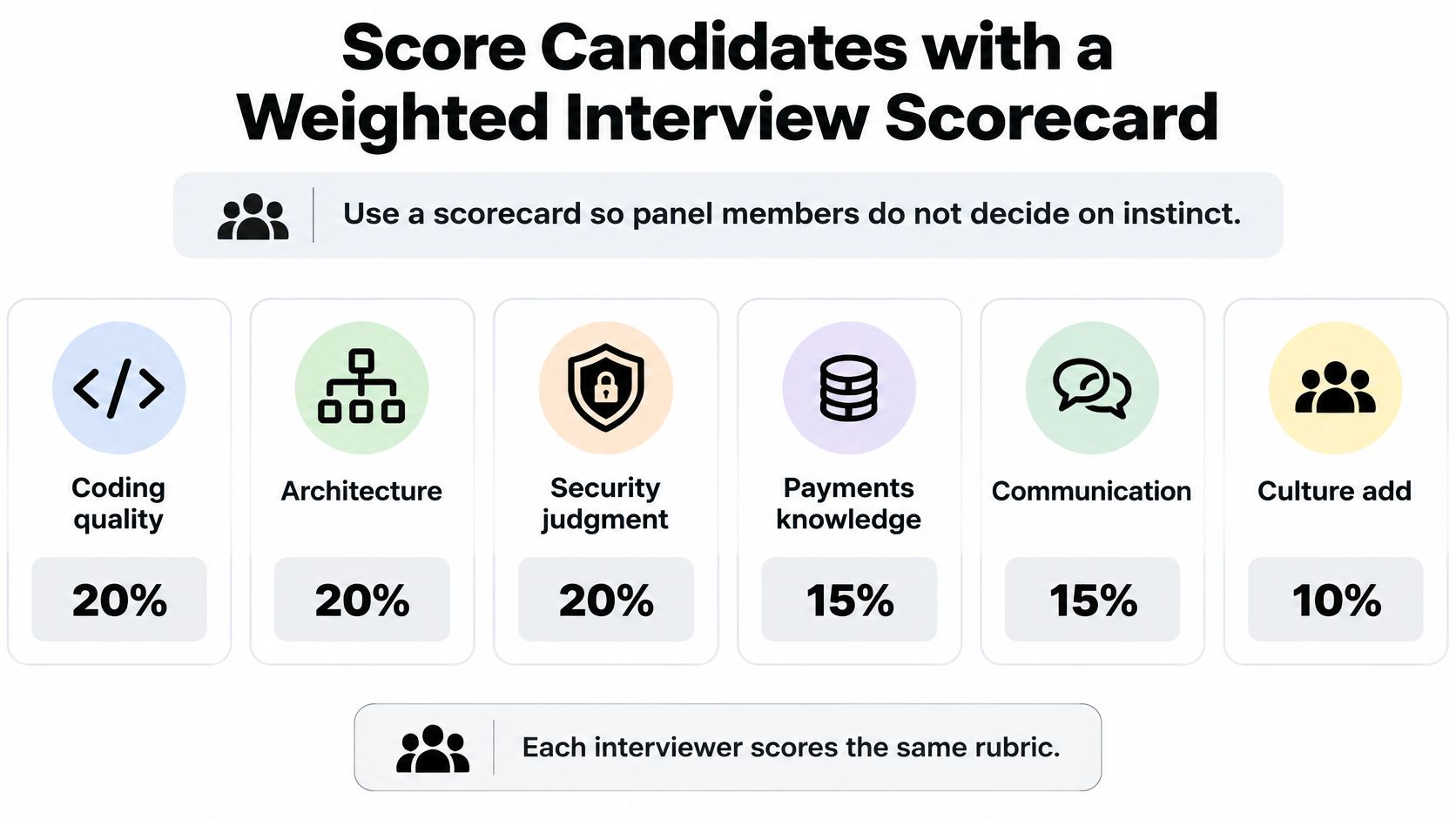
Use fixed criteria so the panel can compare evidence rather than confidence, familiarity or presentation style. The following weights are a recommended rubric, not an industry benchmark.
Fintech developer interview scorecard
| Criterion | Weight | Strong Signal | Red Flag |
|---|---|---|---|
| Coding quality | 20% | Clear, tested code with explicit error handling | Passes tests but ignores edge cases |
| Architecture | 20% | Explains trade-offs and partial failure modes | Describes only the happy path |
| Security judgment | 20% | Names access control, secrets and data-handling risks | Treats security as a later step |
| Analytical thinking | 15% | Reasons about data quality and fraud signals | Guesses without checking the data |
| Domain learning | 15% | Asks how the regulated workflow actually runs | Assumes the domain works like e-commerce |
| Communication | 10% | Explains decisions to non-engineers with business impact | Uses jargon without consequences |
The World Economic Forum's 2025 report identifies analytical thinking as the most sought-after core skill, considered essential by seven out of 10 surveyed companies in 2025. Give candidates room to demonstrate that reasoning, not just recall terminology.
Make the scoring independent
Adopt a five-point scale with written anchors: unsafe, needs substantial support, independently competent, strong, and exceptional. Require interviewers to submit evidence before discussing the candidate.
For this rubric, I'd require at least three out of five in architecture and security, with nothing below two. Those are recommended decision gates. A high weighted average shouldn't erase an unsafe access-control decision.
The visual below reinforces consistent evaluation; use the table above as the governing rubric for this hiring loop.
Ask for decisions and consequences
Have candidates walk through a system they built. Ask why they chose the design, what alternatives they rejected, what failed, and what they personally changed. Respect confidentiality: a candidate can explain technical reasoning without revealing customer information or proprietary architecture.
Our recruiters use peer-to-peer technical conversations rather than keyword matching. The same principle belongs in your structured interview process: probe explanations, distinguish personal contributions from team achievements, and document observable evidence.
- Coding evidence: Note whether the candidate handles malformed inputs and meaningful error states.
- Security evidence: Record which risks they identified without prompting.
- Learning evidence: Capture questions about your actual workflows, not prior familiarity with your product.
When panel members disagree, compare their notes against the anchors. Don't add another interview unless you can name the unresolved question and explain how the extra assessment will answer it.
How to Run a Failed Payment Work Sample
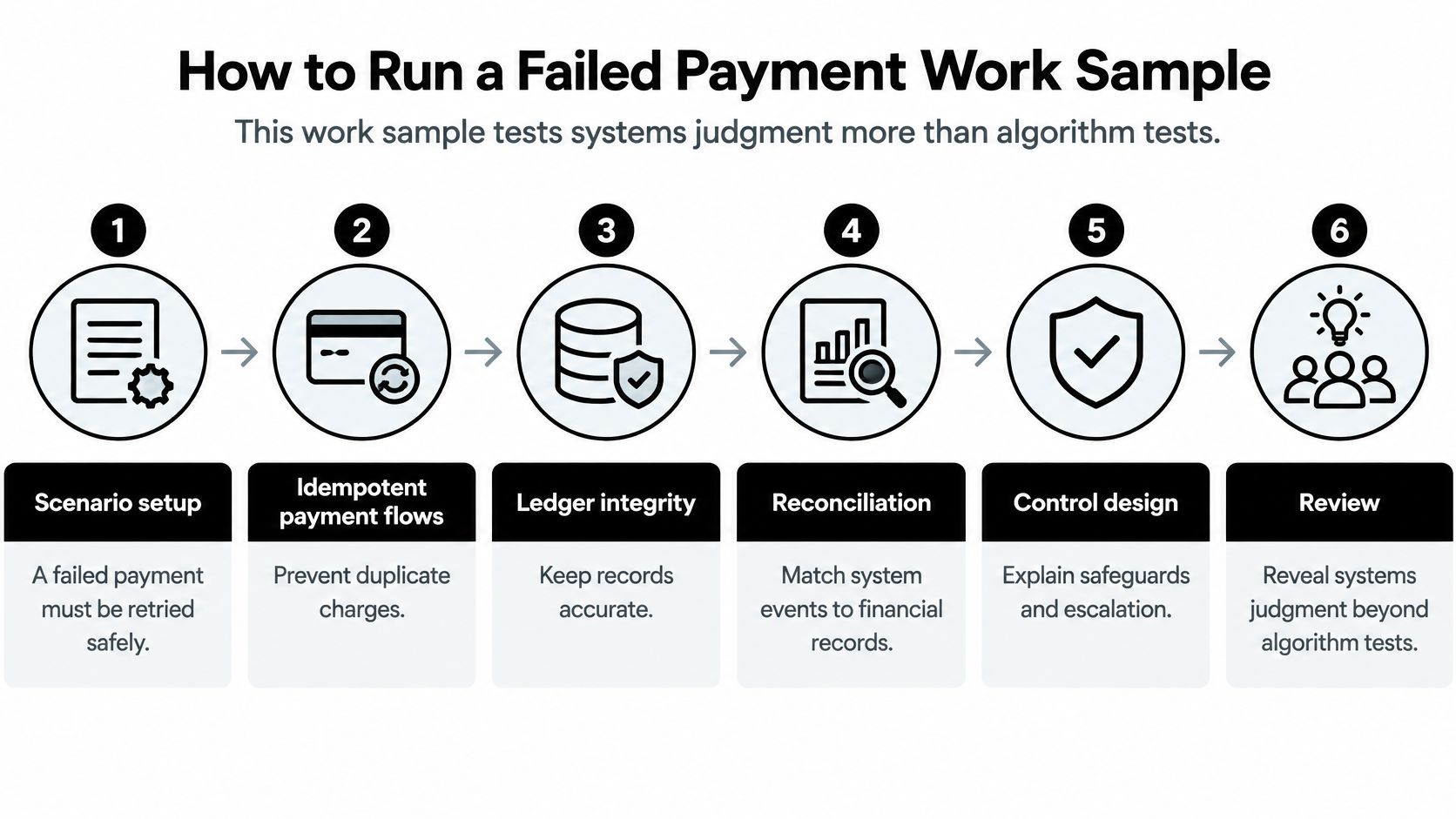
A failed-payment exercise tests whether candidates can investigate uncertainty without creating another financial error. It integrates engineering, operations and control design in a way an isolated algorithm problem doesn't.
The JAR Solutions discussion of fintech technology and talent provides context for evaluating combined technology, risk and governance capabilities. For hiring, turn those capabilities into observable decisions.
Use this flow to organize the assessment, then give candidates a written brief with clear deliverables.
Give the symptom, not the diagnosis
Present an ambiguous failure. Say a card capture timed out. The processor shows a successful charge, but the application doesn't show the corresponding completed payment. Don't reveal whether the cause was a lost response, delayed event or failed database write. Giving away the cause removes the investigation.
Provide read-only synthetic logs and a ledger extract, with request identifiers, event timestamps and transaction states. Include enough evidence to distinguish plausible explanations, but don't use customer records or production credentials. Everyone should receive the same material.
Ask for a bounded investigation plan. As a proposed exercise constraint, give the candidate fifteen minutes to identify a likely cause and explain how they'd confirm it. Look for correlation across records and a clear separation between evidence, assumptions and unanswered questions.
Ask for a safe retry design and reconciliation proposal. A strong idempotency key represents the business operation, survives retries and rejects incompatible payload reuse. The reconciliation job should compare independent records, flag unresolved differences and route exceptions to an owner rather than rewriting balances.
Request an incident note for a non-technical manager. Set a two-paragraph deliverable covering confirmed business impact, remaining uncertainty, containment and the proposed customer action. The candidate shouldn't promise a refund or retry before establishing what happened to the funds.
Review the implementation, investigation and note against the scorecard. Ask what evidence a control owner or auditor could inspect: transaction lineage, authorization records, reconciliation results and documented remediation. Naming a control isn't the same as showing that it operated.
Keep the assessment fair
Cap the proposed exercise at two to three hours and state the expected depth. Pseudocode is appropriate for a reconciliation design if production-quality implementation would exceed that cap.
Assessment safeguard: Test the candidate's judgment, not their willingness to donate an evening to your backlog.
Publish your compensation policy for take-home work and pay for work beyond your stated uncompensated limit. Offer reasonable assessment accommodations and disclose whether coding assistants are permitted.
Our guide to programming assessments can help frame the evaluation. Keep the scoring focused on evidence: safe actions, explicit assumptions, traceable records and understandable communication.
Make the Offer and Choose Your Hiring Route
Make the decision from the evidence you collected. Don't replace the scorecard with a final discussion about who felt most senior.
Among candidates who meet the gates, prefer stronger security and architecture judgment when those capabilities govern the role's failure cost. Someone with less niche experience can be the better choice if the remaining domain gap is teachable and the team has capacity to teach it.
Confirm the engagement before negotiating
Recheck whether you need a permanent owner, a contractor who may convert, or additional execution capacity under your management. Our comparison of direct hire versus staffing agencies helps separate the employment decision from the sourcing decision.
Budget against the actual scarcity of the role, not a generic backend title. For a scarce data and AI platform engineer, be prepared to raise the band or reduce the scope. Don't promise specialist ownership while budgeting for a broadly supervised generalist.
If an outside partner is involved, bring a concise decision pack:
- Technical scope: Stack, business domain, expected deliverables and production responsibilities.
- Commercial boundaries: Budget, timeline, engagement model, contract terms and intellectual-property requirements.
- Operating constraints: Security requirements, location, working overlap and approval authority.
Our first step is a 20-minute call to learn those requirements. If the work is better assigned to a company, we find and vet software development agencies, AI engineering and consulting firms, cloud and cybersecurity MSPs, and QA firms.
Recruiters may also use prospecting systems to win clients. The dreach guide to AI-powered client acquisition for recruiters addresses that commercial workflow, which is separate from proving a candidate's technical suitability. Judge a partner by its assessment evidence, not its outreach volume.
Finish the checks and define ownership
Before finalizing the offer, use a role-specific checklist with HR and compliance:
- Employment eligibility: Confirm right to work for the intended employment arrangement.
- References: As an internal policy, seek two references, including a former manager where possible.
- Required checks: Have compliance identify applicable checks for the jurisdiction and role, especially access to customer funds.
- Written conditions: Document the start date, outstanding conditions, access requirements and security obligations.
Ask the former manager how the candidate handled an incident: what they communicated, whether they escalated promptly, and how they followed through. Avoid asking for confidential incident details.
Set 30-, 60- and 90-day reviews as your onboarding checkpoints, with explicit evidence of increasing production ownership. Start with understanding the system and controls, progress to supervised changes, and grant broader responsibility only when the engineer demonstrates readiness.
Post the role this week using the capabilities, failure scenario and decision criteria you've defined. A clear, bounded role is more useful than a perfect job description that never reaches candidates.
TekRecruiter helps you recruit permanent engineers, add contractors under your leadership, or find a vetted delivery firm when the work needs a team. Bring your fintech scope, stack, budget and security requirements to TekRecruiter, and book a 20-minute call to choose a hiring route that fits the responsibility.
 Ron SmithPresident & Lead RecruiterTekRecruiter