What Does a VP of Engineering Do in a Tech Company
What does a VP of Engineering do day to day? See how the role covers strategy, delivery, hiring, and partnership with product and executives.
A VP of Engineering turns company and product goals into a technical plan the team can actually ship. Then they build the people, standards, and delivery habits that keep that plan honest.
If you're a founder or CTO trying to explain the seat in a hiring meeting, that one sentence is your answer.
What a VP of Engineering Actually Owns

Think of the role like an air-traffic lead. They don't fly every plane themselves.
Instead they set the routes, staff the tower, and decide what has to land this quarter.
That distinction matters because people confuse the title with senior coder who manages. It isn't that.
The VP owns a system, not a keyboard. Five jobs define the work:
- Technical strategy — the architecture principles and platform bets the team builds on
- Team leadership — managers who coach well and engineers who stick around
- Reliable delivery — a clear rhythm for planning, risk review, and honest status
- Hiring — role design, a high bar, and a pipeline that actually fills roles
- Partnership with product and executive leaders on scope, sequencing, and cost
The Five Jobs of a VP of Engineering
Here is the quick way to explain all five in an interview:
| Job | What the VP Owns | Main Partners | Sign It Is Working |
|---|---|---|---|
| Technical strategy | Architecture principles and platform bets | CTO, staff engineers | Decisions age well and get reused |
| Team leadership | Managers, culture, and growth paths | Engineering managers, HR | Strong people stay and get promoted |
| Reliable delivery | Planning rhythm and risk review | Product, program leads | Roadmaps land close to commitments |
| Hiring | Role design and the interview bar | Recruiters, executives | Offers close and perform |
| Executive partnership | Delivery risk and cost of delay | CEO, CFO, product | No surprises at the board level |
Read that last column closely. That is how you judge the hire.
The tradeoffs are where the job gets real. Picture a quarter where a promised feature slips so reliability work can land.
Why? Because incidents were eating the team's week. That is not a lack of hustle.
It is the VP making a deliberate call: a stable system ships more value over a year than a rushed feature does.
A VP of Engineering makes the organization able to ship the company's promises again next quarter, not only this one.
If that is the gap you're feeling, this is the seat you need. The next question is how it differs from a CTO and an engineering manager, and that is where most confusion lives.
Most of the confusion around the VP of Engineering comes from the roles right next to it. The title lives between the CTO on top and engineering managers underneath, and they’re solving very different problems.
A CTO is usually making the long-term technology bet. What stack do we build on, what do we avoid, and how do we explain those choices to customers, partners, and investors.
The VP of Engineering owns the system that turns that bet into shipped software. Hiring pace, delivery cadence, how managers grow, where the quality bar sits — that whole operating layer.
An engineering manager works much closer to the ground. They coach a single team and protect a piece of the roadmap, typically across the next one or two quarters.
The Architect, The Contractor, And The Crew Lead
Construction is the easiest way I’ve found to explain it:
- The architect (CTO) decides what should be built and why it matters
- The general contractor (VP) lines up crews, budget, and schedule so it actually gets finished
- The crew lead (engineering manager) runs one crew and keeps their wall straight and on spec
One decides, one coordinates, one builds. All three matter, none are interchangeable.
CTO, VP of Engineering, and Engineering Manager
Put side by side, the difference is really about focus, time horizon, and what “good” looks like for each seat.
| Role | Primary Focus | Time Horizon | People Scope | Success Looks Like |
|---|---|---|---|---|
| CTO | Technology bets and external voice | 2 to 5 years | Staff-level influence | The right bets, made early |
| VP of Engineering | The system that ships the bets | 2 to 6 quarters | Whole org, 30 to 300+ | Predictable delivery and strong managers |
| Engineering Manager | One team's growth and slice of roadmap | 1 to 2 quarters | 5 to 10 people | A healthy, shipping team |
Read it left to right and the handoff gets clear. The CTO chooses direction, the VP builds a repeatable way to move that way, and managers keep the day-to-day motion healthy.
When One Person Holds Both Seats
In an early startup, the founding CTO often does both jobs. They set the architecture and run standups, hiring, and releases at the same time.
It works — until it doesn’t. Once you have several teams, a real manager layer, and a roadmap no single person can hold in their head, that combo starts to crack.
If the open problem is the next technical bet, hire a CTO voice. If the open problem is a team that cannot ship that bet twice, hire a VP.
For founders, that’s usually the fastest hiring test.
In practice, search firms treat these as related but separate hires. TekRecruiter's leadership specializations, for example, cover CTO, VP and Head of Engineering, Head of Infrastructure and Cloud, CISO and Security Leadership, Head of Data and AI, and Head of Product (CPO), because each one fixes a different bottleneck.
If you’re sorting out which seat you need next, check our guide on technical leadership skills to see what strong leaders actually show in each role.
Short version: the CTO picks the direction, the VP builds the machine that can travel it, and managers keep that machine running every day.
Choosing the technical path comes down to what the company can actually support, not just what engineers can build. Predictable delivery starts with those boundaries, long before anyone commits to a launch date.
Technical Strategy and Reliable Delivery

So, what does a VP of Engineering do when architecture choices start threatening the roadmap? They set the architecture principles, platform priorities, and quality expectations. Staff engineers and team leads then work out the detailed designs.
Think of those decisions as guardrails, not turn-by-turn directions. Teams still get room to pick implementation details. They just don't get to skip security review or ship services no one can run.
- Architecture principles draw the lines around dependencies, ownership, and maintainability.
- Platform bets call out the shared capabilities worth funding once instead of rebuilding three times.
- Quality bars spell out testing, operational readiness, and release expectations.
Reliability is what makes those lines real. For example, SRE practices connect service objectives with testing and incident response, which gives leaders a clear basis for when feature work has to pause.
A delivery commitment should include the ability to operate what ships, not just demonstrate it.
Turn Technical Choices Into Delivery Commitments
Take a typical cloud modernization story. Recurring incidents keep interrupting checkout work. The VP agrees with product to migrate the payment service and fix recovery, but postpones a recommendation engine until next quarter.
That kind of call needs an operating rhythm, not another calendar full of status meetings.
- Plan a smaller outcome with explicit acceptance criteria.
- Staff it against real availability, including incident coverage.
- Review risks weekly with named owners and decision deadlines.
- Report honestly when dependencies change the forecast.
When an incident hits, the VP should make sure escalation is clear, customer communication has an owner, and follow-up work actually gets scheduled. That matters more than jumping in to direct every fix.
For measurement, use software development KPIs that inform delivery decisions. To dig into friction inside frontend workflows, check out developer productivity tips from DOM Studio.
Staffing follows the technical choice. TekRecruiter's engineering specializations include software engineering, AI engineering, AI platform engineering, forward deployed engineering, DevOps, SRE and cloud infrastructure, data and analytics engineering, SDET and test automation, cybersecurity engineering, hardware and robotics engineering, and quant developers and researchers. Explore TekRecruiter's engineering recruiting specializations.
Explain the Tradeoff to the CEO
Before your next roadmap review, write three plain sentences covering what will ship, what is at risk, and which technical bet you're deliberately postponing.
Include the business consequence of each choice. That way the CEO can approve priorities without decoding architecture diagrams or guessing at hidden dependencies.
Hiring isn't an afterthought for a VP. It decides whether the strategy ever ships.
Hiring and Leading an Engineering Team
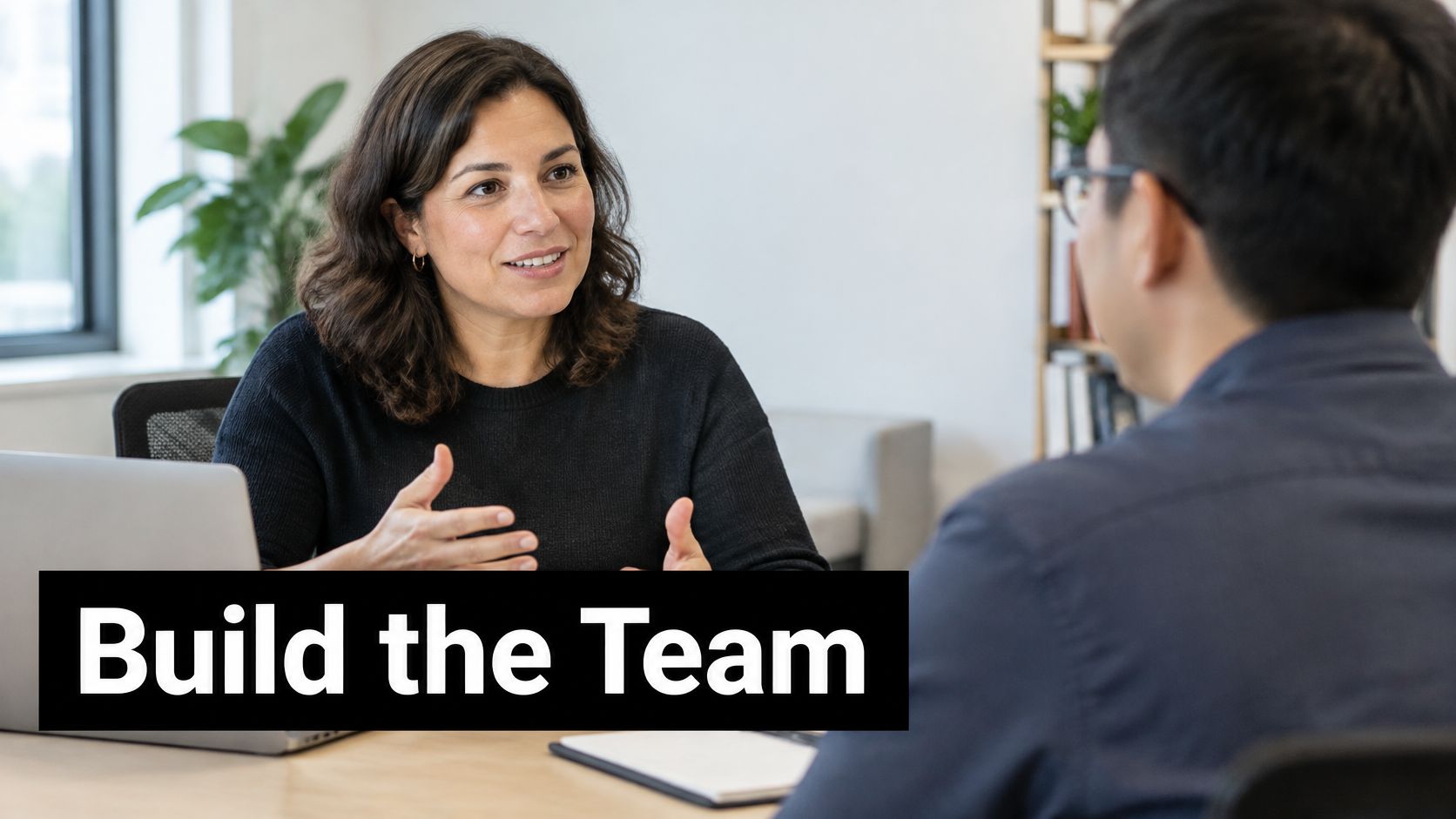
Think of it like picking a crew for a specific voyage. You need people who can handle the route ahead, not just impressive titles with no destination.
Say you're expanding into payments. You don't need another generalist. You need a senior backend engineer who's lived through transaction failures and knows where they break.
A good VP turns that reality into role scope, clear outcomes, and what evidence to look for in interviews.
Hire against the work, then build the structure around it.
That also means holding different bars for different jobs. Engineers should show technical judgment and ownership. Managers should show coaching, delegation, and how they handle a tough performance conversation.
The VP doesn't need to sit in every interview. But they should read the scorecards, join a few key loops, and push back when excitement starts replacing evidence.
- Clear scope ties every opening to a real roadmap outcome.
- Consistent standards give interviewers shared questions and a common way to evaluate.
- Management readiness makes sure someone can actually develop the hire after day one.
Develop Managers Who Build Independent Teams
Once people join, leadership is the multiplier. A VP should coach managers on expectations, feedback, growth, and team friction on a regular cadence. Not become everyone's unofficial manager.
Here's a common one: an engineer keeps missing commitments. The VP can help the manager figure out if it's unclear scope or a real skill gap. Then build a specific support plan, not just a vague "needs to improve."
- Set expectations around ownership, communication, and quality.
- Review examples of actual decisions and feedback with managers.
- Follow through on development goals and agreed changes.
And push engineers to explain how the work was built, why it mattered, and what changed for the business. Use demos and reviews to build that muscle, not just walk through closed tickets.
Before you add another layer of management, check how to choose a software development team structure that fits how you actually work.
Match Hiring to the Duration of the Need
Not every gap needs a permanent hire. A migration spike might be perfect for temporary engineers under your current managers. Ongoing product ownership is a different story — that needs a lasting team.
| Need | Hiring Path |
|---|---|
| Ongoing engineering ownership | Direct hire |
| Defined project spike | Temporary capacity |
For leadership gaps, TekRecruiter's Executive Search covers VP, Head of, and C-level technology and engineering leaders. Take a look at TekRecruiter's hiring options.
Look at your next 2 quarters before you open another req. Hire for that work, not the org chart you wish you had.
A VP of Engineering sits alongside product leadership, not at the end of a ticket queue. Think of it as a planning partnership — you agree on the destination first, then commit to when you'll get there.
Partnering With Product and Executives

In a good weekly product meeting, the VP will push on scope, sequencing, and dependencies. Product owns the customer outcome. Engineering lays out what has to be true before that outcome is safe to promise.
Say an enterprise customer wants bulk imports before renewal. A strong VP might suggest shipping a limited import workflow first, then locking down access controls and recovery testing before you open it up further.
A clear no on scope helps the business more than a hopeful yes the team can't keep.
That kind of partnership takes explicit decisions. Friendly agreement followed by two different plans doesn't cut it.
- Define the outcome so both sides know what customer success actually looks like.
- Name prerequisites before sales puts dates or features in writing.
- Record exclusions so work you deferred doesn't quietly creep back in.
For practical ways to build that shared ownership, check this guide to cross-functional teamwork.
Translate Roadmap Gaps Into Business Choices
When the roadmap is bigger than team capacity, the answer isn't just to ask for more engineers. A good VP shows executives the real constraint and lays out the tradeoffs.
| Option | Best Question |
|---|---|
| Hire permanently | Will this work remain essential? |
| Narrow scope | Can customers succeed with less? |
| Add vetted capacity | Can existing leaders onboard effectively? |
TekRecruiter's nearshore engineers are one way to add that capacity — vetted, English-speaking engineers in your time zone at about 50% less than US hires. You can compare that route through TekRecruiter's staffing services.
Lower rates don't erase the work, though. Onboarding, code review, and coordination still take time. Factor that in before you assume extra hands will save a deadline.
A lot of executive communication is translation. Tell the CEO which customer commitment is at risk, tell the CFO what each option costs, and give the board the exposure, the decision needed, and the next checkpoint.
Frame cost of delay in real terms — a slipped renewal, a deferred launch — and be clear about what's an estimate versus a firm commitment. Same with hiring. Plan around realistic start dates and ramp time, not just open headcount.
Bring these four questions to your next executive meeting:
- Which customer outcome matters most?
- What must we stop to protect it?
- Which risk needs a decision today?
- Who owns that decision, and by when?
Get aligned on those answers, revise the roadmap together, and only then make the next customer promise.
What does a VP of Engineering actually do when growth starts breaking how work gets planned, staffed, and shipped? Here are a few familiar situations that show the thinking behind the title — not client case studies, just the kinds of calls VPs have to make.
When The Founding CTO Is Still The Bottleneck
Picture an early startup where the founding CTO still reviews every pull request. Releases stall waiting on one person, interviews eat into build time, and no one is quite sure who settles competing priorities.
This is where a VP steps in to install some structure. They work with the CTO, product lead, and recruiting to sort out ownership first — who decides what, who hires for what — before any reqs go live.
- Before: Every staffing or delivery question lands back on the founder.
- After: Managers own their team commitments, and the CTO finally gets room for real technical direction.
- Stalling mistake: You hire managers, but the founder keeps overriding every call.
The move that makes it stick is simple: write down which decisions managers can make on their own. Without that, you’ve just redrawn the org chart. The founder isn’t relieved, and engineers still don’t have clarity.
Protect Delivery During Cloud Modernization
Now picture a scale-up with an overloaded roadmap. Product is pushing for features, while infra is asking for time to modernize cloud services and chase down repeat incidents.
The VP has to own that capacity tradeoff. That means getting product, infrastructure, security, and finance in one room to sequence the work together. Reliability work needs to tie back to service objectives and operational readiness, consistent with SRE practices for dependable delivery.
- Reserve engineering capacity for migration and recovery testing.
- Agree which customer features will have to wait.
- Set checkpoints before you widen the migration.
Before, you’ve got two roadmaps fighting over the same people. After, you’ve got one funded plan. The stalling mistake is promising both and changing neither.
Build The Enterprise Team That Remains
Finally, think of an enterprise migration running on temporary specialists. Someone has to decide which skills leave when the program ends, and which ownership has to stay in-house. That pulls in program leadership, engineering managers, procurement, and HR.
Before, contractors hold all the critical system knowledge. After, they’ve handed it off to a permanent core team before they walk out the door.
TekRecruiter's Direct Hire places full-time, permanent technology and engineering hires. Explore permanent engineering hiring options.
The stalling mistake is keeping a contractor rolling indefinitely without ever deciding who owns the system long-term.
Map the temporary versus permanent roles for your next program before you ask for candidates.
The VP makes engineering able to ship what the company promised again next quarter, not just this one.
Hiring for this seat should fix a real operating gap, not just add another title to the org chart.
FAQ
Does a Small Company Need a VP of Engineering?
Not necessarily. If your CTO and managers can still clear dependencies, grow people, and make commitments you can trust — without the founder stepping in every time — you’re probably fine for now.
But don’t ignore the pattern. If releases keep slipping, coordination is eating all the technical direction, managers aren’t getting coached, or no one truly owns delivery across teams, it’s time to look at the role.
- Keep the current structure if ownership is clear and commitments still hold.
- Consider a VP if every conflict or staffing call still lands on the CTO’s desk.
The trigger isn’t headcount. It’s leadership workload that no one is actually carrying.
How Does the Role Change as a SaaS Company Grows?
Early on, the job is hands-on. Expect the VP to be close to engineers, in architecture conversations, interviewing candidates directly, and helping new managers build basic habits.
As the company gets bigger, span of control becomes the real puzzle. The week should tilt toward coaching leaders, spreading capacity across teams, and clearing dependencies through managers instead of going straight to individual engineers.
Keep technical judgment close, but push everyday technical authority out to the people doing the implementation.
There’s no perfect split between people work and architecture work. Just ask one question often: is the VP’s involvement making decisions better, or just making teams wait?
What Should a VP Stop Doing Once Managers Are Established?
Stop being the default coder and ticket referee. If critical work can’t ship unless an executive with a fragmented calendar jumps in, that’s a structural problem.
Same goes for assigning work around managers or second-guessing normal implementation calls. Set escalation lines together — then respect them.
- Delegate team planning and routine technical decisions.
- Review recurring patterns, not every single ticket.
- Intervene when risk goes past the boundaries you agreed on.
For example, dig into why three teams keep missing the same dependency instead of rescheduling their tickets yourself.
How Can a New VP Show Value in Ninety Days?
Agree on visible operating improvements, not just a hiring number. Start by making ownership explicit, pressure-testing commitments, and writing down a clear hiring bar.
Then build a delivery rhythm that surfaces risk early. A good board update is simple: what changed, who owns what’s left, and when you’ll check progress next.
Bring your leadership bottleneck and the outcomes you need to TekRecruiter. Discuss an executive search for the engineering leader your organization actually needs.
 Ron SmithPresident & Lead RecruiterTekRecruiter