What Is Direct Hire Staffing and How Does It Actually Work
Learn what is direct hire staffing, how it differs from contract and temp hiring, what it costs, and when it is the right move for your engineering team.
Direct hire staffing is a recruiting arrangement in which an agency sources and screens a candidate, but the hiring company places that person on its own payroll from day one as a permanent employee. The model typically involves a one-time placement fee and a 90-day replacement guarantee, while the employer takes responsibility for the employment relationship immediately.
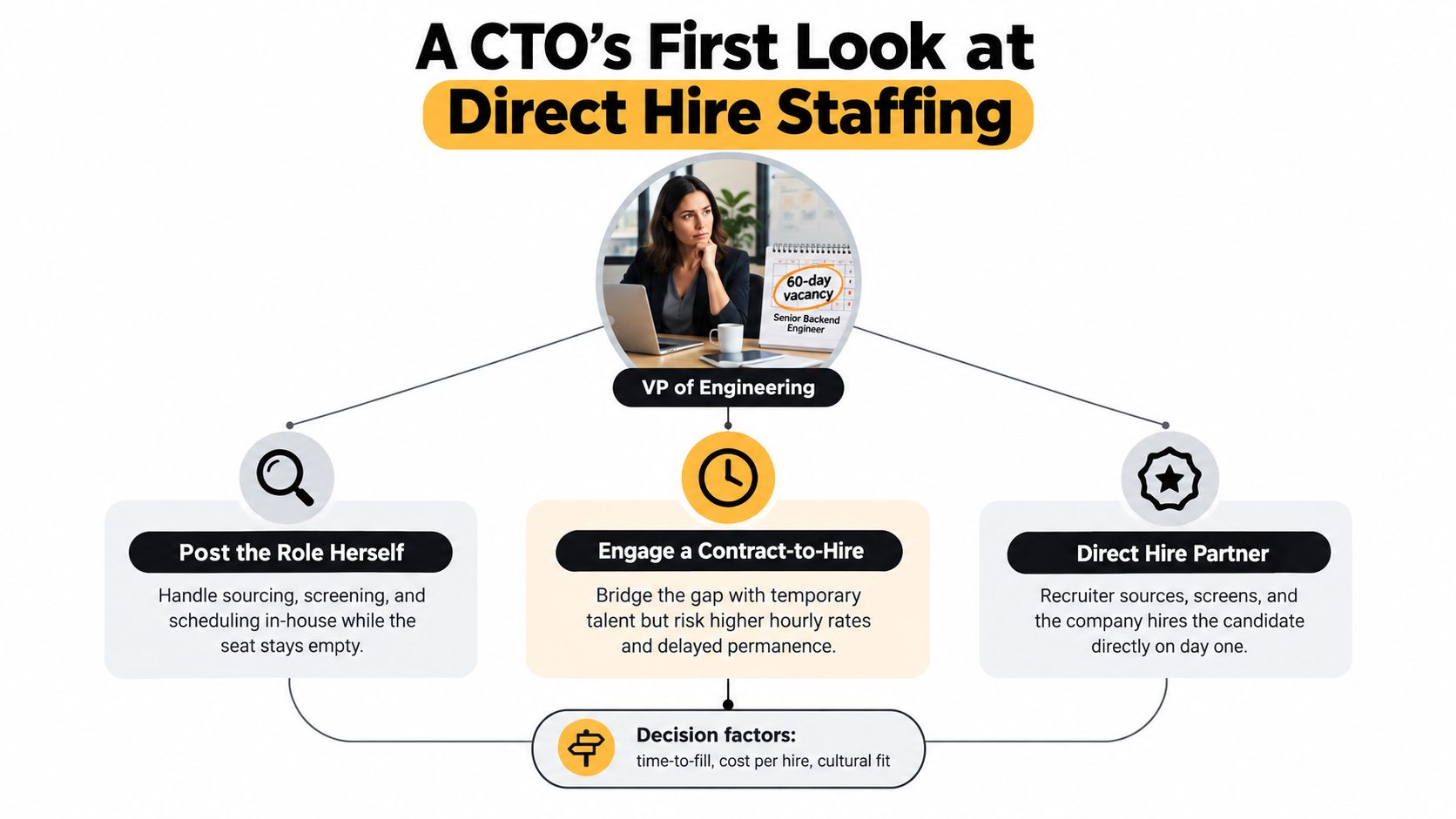
A VP of Engineering staring at a 60-day vacancy for a senior backend engineer usually has three imperfect choices. She can post the role herself and ask her team to absorb sourcing, screening, scheduling, and candidate persuasion. She can bring in a contract engineer to protect the roadmap, accepting that temporary capacity may not become durable ownership. Or she can pay a direct-hire fee and outsource the search while keeping the employee, payroll, and long-term responsibility in-house.
A CTO's First Look at Direct Hire Staffing
The distinction matters because “direct hire” describes the employment outcome, not necessarily who performs the recruiting work. In an agency-led direct hire, the recruiter identifies candidates, evaluates their fit, presents a shortlist, supports negotiation, and helps move the candidate to a start date. The client makes the hiring decision and employs the person directly.
That means the agency doesn't become the worker's employer. The candidate doesn't remain on an agency payroll, receive temporary-worker administration from the agency, or report to the agency for performance management. The worker joins the client's payroll from the first day and normally receives the client's benefits, policies, intellectual-property obligations, supervision, and development structure. The direct hire definition from Eddy makes this distinction between direct placement, temporary staffing, and contract-to-hire explicit.
What moves to the recruiter
The agency takes on the front end of the talent-acquisition funnel:
- Search execution: It finds active and passive candidates through its network, outreach, referrals, and specialist communities.
- Initial qualification: It tests whether a candidate's experience, compensation expectations, availability, and motivation align with the role.
- Technical assessment: For engineering positions, a specialist recruiter or technical interviewer can examine architecture decisions, ownership, delivery constraints, and business impact.
- Candidate management: The agency coordinates interviews, gathers feedback, manages competing offers, and helps resolve counteroffers.
- Offer support: It can communicate the opportunity and explain why the employer, team, and role deserve a permanent move.
The client still owns the decision. It also owns everything after the person joins, including wages, benefits, onboarding, supervision, compliance, performance management, retention, and termination. That risk transfer is the part hiring leaders rarely hear clearly enough. A placement fee buys search efficiency, not an external employer.
For technology organizations, direct hire often fits positions where context compounds over time. A platform engineer who understands the company's cloud architecture, security controls, deployment habits, and product constraints can contribute differently from a rotating resource assigned to a fixed deliverable. The American Staffing Association's long-running survey infrastructure distinguishes temporary and contract staffing from search and placement, which includes direct-hire placements and related recruiting services. Its survey has been conducted since 1992 and collected quarterly, providing a formal industry framework for separating permanent placement from temporary labor. The American Staffing Association's staffing industry playbook provides that background.
Practical rule: Pay for external search when the role needs internal ownership. Don't pay a direct-hire fee merely to avoid writing a job description.
The payroll distinction sets up the central trade-off. Direct hire gives the company control and a permanent capability, but it also makes the company responsible for the cost of a vacancy, the quality of the assessment, the employee's experience, and the consequences of a mismatch. The rest of the decision is cost versus control, not agency versus employer.
For background on how technology staffing partnerships fit around internal hiring teams, see TekRecruiter's overview of tech staffing.
How the Direct Hire Process Actually Works
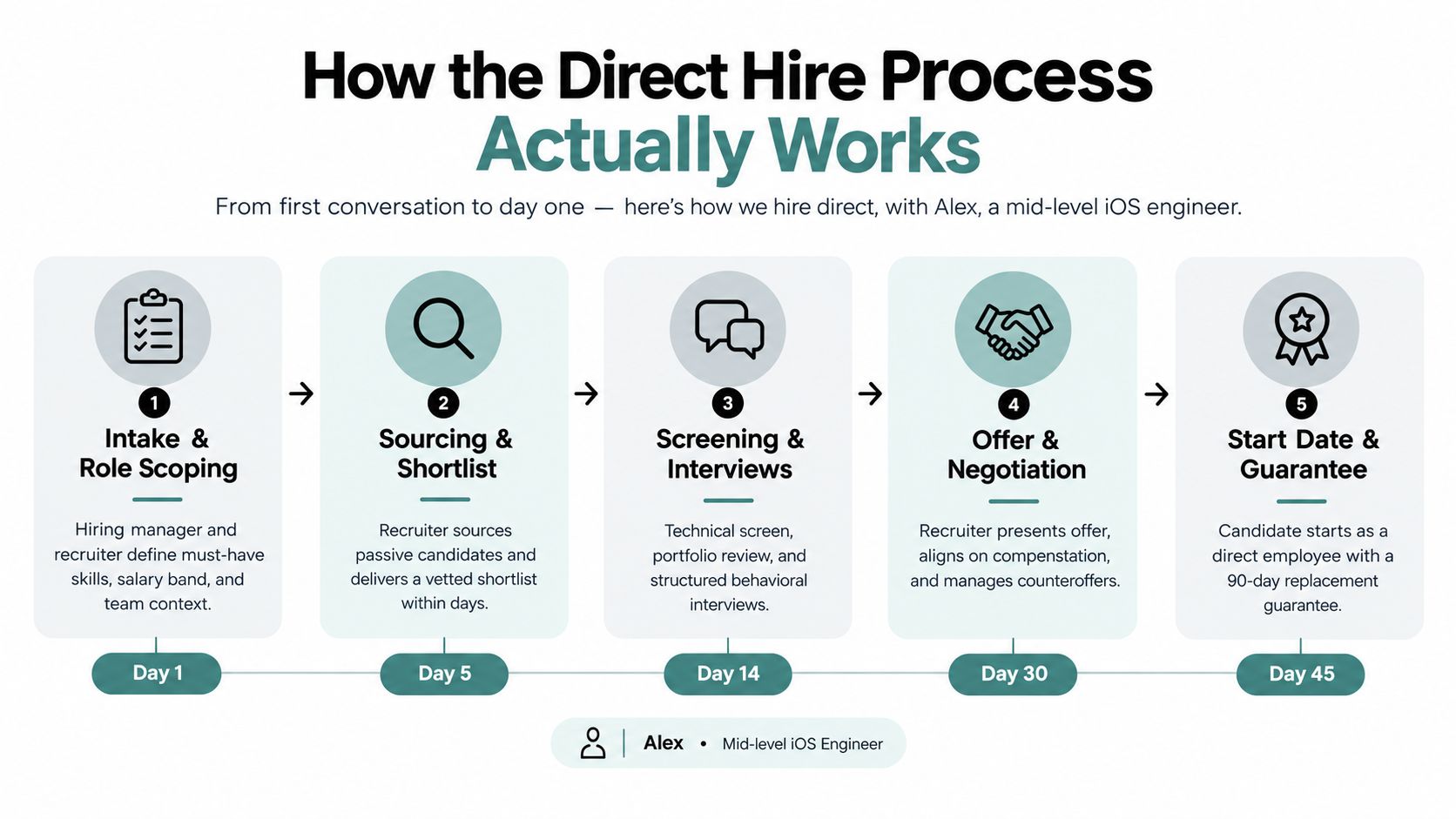
A strong direct-hire search is a sequence of defined handoffs, not a recruiter forwarding resumes until someone says yes. Consider Alex, a mid-level iOS engineer being evaluated for a product team.
Start with a calibrated intake
The hiring manager and recruiter first define the role's actual requirements. The useful artifact is a written intake brief covering iOS or Swift competencies, system and product context, seniority, reporting line, compensation range, working model, interview stages, and the outcomes expected from the hire.
Many searches fail before sourcing begins. A vague list containing every preferred framework creates contradictory screening decisions. A salary band that doesn't match the market produces conversations that collapse at offer stage. A hiring manager who can't explain what Alex will own in the first months makes it difficult for a recruiter to sell the role with conviction.
Build and test the shortlist
The agency owns sourcing and initial outreach. It searches its network, approaches people who may be open to a move, reviews resumes and portfolios, and checks whether the candidate's stated work matches the role. Alex's portfolio might show an iOS application, but the important questions are whether Alex owned the release, handled production issues, influenced product decisions, and can explain trade-offs.
The recruiter then conducts an initial screen covering motivation, compensation, availability, communication, and relevant experience. A technical interviewer may follow with a structured discussion or work-related exercise. The Census Bureau's description of employment-placement agencies reinforces the employment boundary: these agencies recruit, refer, or place applicants, while the people placed aren't employees of the agency.
The employer owns the substantive decision from this point. Its engineers conduct the deep technical panel, product interview, and team conversations. The output should be a comparable scorecard, not a collection of impressions. Interviewers should record evidence against agreed competencies before discussing whether they personally liked the candidate.
Close the handoff carefully
The agency can coordinate references and compliant background checks, manage scheduling, and help negotiate the offer. The client approves the compensation, signs the employment documents, supplies benefits information, and owns onboarding. Alex becomes the client's direct employee on the agreed start date.
The biggest stalls usually come from slow scheduling, unapproved compensation, unclear interview ownership, and feedback that arrives too late to keep a strong candidate engaged. A recruiter can't repair a process in which four interviewers ask overlapping questions and nobody can make a decision.
A direct-hire agency's core accountability ends at the successful start date, although a contract may provide a replacement guarantee after that point. It doesn't own the employee's performance, retention, or termination. That is why the intake and assessment need to be rigorous before the offer is issued.
For a more detailed operational view, TekRecruiter's guide to hiring process steps gives hiring teams a practical process reference.
Direct Hire Compared to Contract and Temp Staffing
The cleanest comparison starts with one question: who employs the person while the work is being performed? In direct hire, the client employs the candidate from day one. In contract and staff augmentation, the agency generally remains the employer of record and bills the client for labor. In contract-to-hire, the worker starts under the agency's employment arrangement and may convert after a stated period.
| Model | Employer of Record | Cost Structure | Best For | Main Drawback |
|---|---|---|---|---|
| Direct Hire | Client from day one | One-time placement fee | Durable roles tied to product, platform, security, or leadership ownership | Client assumes payroll, benefits, compliance, retention, and termination responsibility immediately |
| Contract | Agency or contracting supplier | Hourly bill rate, usually including a supplier markup | A defined project, urgent delivery need, or temporary capacity | Higher ongoing labor cost and less guaranteed long-term ownership |
| Contract-to-Hire | Agency during the interim period, client after conversion | Hourly bill rate first, then a conversion arrangement | Testing mutual fit before permanent employment | Conversion timing can delay commitment and create uncertainty for both sides |
| Staff Augmentation | Agency or supplier | Hourly bill rate or ongoing markup | Migration sprints, backlog relief, and flexible specialist capacity | The client manages the work while the supplier retains the employment relationship |
Direct hire
Direct hire makes sense when the role should accumulate institutional knowledge. A staff platform engineer, security lead, or engineering manager typically needs authority, context, and accountability that extend beyond one project. The employer pays a one-time fee, then carries the employee's salary, benefits, payroll obligations, supervision, and retention risk.
Contract and staff augmentation
Contract staffing trades permanence for flexibility. It can protect a deadline when a team needs immediate help with a migration, seasonal data work, or a narrowly defined implementation. Staff augmentation works particularly well when the client already knows how to manage the work and needs additional hands with a specific technical capability.
The drawback is not merely the hourly rate. A contractor may leave with important context, and the agency's employment relationship can limit the client's control over benefits, employment policy, and long-term development. For organizations comparing temporary leadership options with permanent executive hiring, the discussion of why startups choose interim leaders offers useful context on matching employment structure to uncertainty.
Contract-to-hire
Contract-to-hire creates a trial period before permanent conversion. That can help when the role is important but the team needs to observe collaboration, delivery habits, or technical judgment in practice. It isn't automatically cheaper or safer. The client pays for interim flexibility, and the eventual conversion terms need to be understood before the first day.
The right answer depends on the role's strategic importance, the budget cycle, and the time horizon. A company can use contract talent to stabilize urgent delivery while recruiting a direct employee for a capability it expects to retain. The models aren't mutually exclusive.
Teams comparing these structures should also review TekRecruiter's comparison of staff augmentation and staffing, particularly when a requisition may need a blended solution.
What Direct Hire Really Costs and When the Math Works
A direct-hire decision fails when leaders compare a placement fee with salary and ignore the rest of the ledger. The comparison includes vacancy cost, manager time, recruiting effort, onboarding, benefits, payroll obligations, ramp-up, and the cost of correcting a bad decision.
Published guidance commonly places contingency direct-hire fees around 15% to 25% of first-year salary, while executive or highly specialized retained searches can total roughly 25% to 33%. Avua's direct-hire glossary provides that industry framing. Another benchmark cited in the available evidence places average direct recruiting expense at approximately $4,683 per hire, before vacancy-related productivity loss, interview time, onboarding, and ramp-up effects. The cited SHRM benchmarking analysis explains why the agency invoice isn't the full cost of recruiting.
A concrete fee calculation
Take a $160,000 platform engineer. At an 18% to 25% placement fee, the search fee ranges from $28,800 to $40,000. The employee's first-year cost also includes the salary itself, employer payroll obligations, benefits, insurance, equipment, recruiting time, onboarding, and the productivity gap before the person operates independently.
The fee becomes easier to defend when the vacancy blocks a platform launch, forces senior engineers to carry operational work, or leaves a security responsibility uncovered. It becomes harder to defend when the role isn't properly defined, the company expects layoffs, or the team has access to a deep and responsive candidate pool through internal recruiting.
The infographic above uses a separate $100,000 example to show how a fully loaded first-year cost can reach $144,150 after adding a 20% placement fee, employer payroll taxes of 7.65%, benefits and insurance of $12,000, and recruiting and onboarding time of $4,500. Its comparison shows a $20,000 direct-hire fee against $55,000 in contract markup over a year, with a stated break-even after month 7. Those are illustrative assumptions, not universal rates. Teams should replace them with their own payroll, benefits, vacancy, and supplier data.
Price the downside
Replacement-cost estimates vary by role and method, but published HR analyses commonly place total replacement cost at roughly one-half to two times annual salary, with specialized and leadership roles potentially higher. That range makes a replacement guarantee worth examining, but the guarantee isn't a substitute for due diligence. Review its duration, exclusions, eligibility, and remedy in the contract.
The useful break-even question is simple: how much does an empty seat cost each month, and how much value does the permanent employee create once ramped? Track qualified-submittal-to-interview rate, interview-to-offer rate, offer acceptance, time-to-productivity, 90-day retention, and 12-month retention. Those measures connect the fee to delivery and workforce outcomes rather than treating speed as the only success metric.
Why Resume Screens Miss the Best Engineers
A recognizable employer and a long list of technologies can create confidence without proving ownership. The strongest backend engineer on a high-traffic system may have a sparse GitHub profile and little public visibility, while a polished resume can conceal someone who never made a production decision without close supervision.
The evidence supports skepticism about years of experience as a standalone signal. A 2022 reanalysis of personnel-selection research estimated the validity of years of job experience at 0.07, compared with 0.42 for structured interviews. The cited resume-screening analysis explains why a resume should start the conversation, not finish the assessment.
Ask for evidence of ownership
An engineer-to-engineer screen should move from tools to decisions. Ask the candidate to reconstruct a real product or feature:
- Context: What problem did the team need to solve, and who was affected?
- Contribution: Which parts did the candidate personally own?
- Constraints: What limited the architecture, delivery plan, reliability, or cost?
- Trade-offs: Which alternatives did the team reject, and why?
- Outcome: What changed for customers, operators, delivery teams, or the business?
- Reflection: What would the candidate change with the benefit of hindsight?
For a staff-level role, the interviewer should also explore ambiguous system design, debugging under pressure, cross-functional disagreement, operational impact, and the candidate's ability to connect technical choices to product outcomes. A candidate who can explain the whole chain usually offers stronger evidence than one who can recite framework terminology.
Structured interviews outperform casual conversations because they use consistent competencies, comparable prompts, and explicit scoring. The cited research places structured-interview validity at 0.42, compared with 0.19 for unstructured interviews. The research summary on structured interview validity supports using a shared rubric rather than letting every interviewer follow instinct.
Use work-related evaluation
Work-sample tests offer an additional signal. The cited selection research places their validity around 0.54, while general mental-ability tests and structured interviews are each around 0.51. The analysis of resume predictive validity also reports that an earlier meta-analysis placed years of experience at 0.18, reinforcing the case for testing what candidates can do rather than counting time served.
The standard should be proportional and respectful. Don't make candidates complete a disguised unpaid project. Use a realistic architecture discussion, code review, debugging exercise, or feature-reconstruction conversation that mirrors the work they would perform.
This depth matters more in a permanent placement because the client inherits the consequences of weak judgment. Contract work can still fail, but a direct-hire mismatch can affect team trust, system quality, delivery continuity, and future hiring. TekRecruiter's skills-based hiring guide reflects the shift from keyword matching toward evidence of capability.
Choosing Direct Hire for the Right Roles in 2026
A permanent hire isn't a promise that the job description will remain unchanged. It's a commitment to a capability the business expects to keep developing. Labor-market evidence for 2026 shows why a binary choice between permanent employees and contractors is too simplistic: 60% of surveyed hiring managers planned to hire permanent staff in the first half of the year, while 55% also expected to use contract talent for immediate needs. A separate survey reported that 66% planned to increase permanent hiring in the second half, while 58% said skilled talent was harder to find than the previous year. Robert Half's 2026 labor-market update contains those survey findings.
Apply three filters
First, ask whether the role is core to the product roadmap and likely to survive a change in budget conditions. A platform engineer supporting the company's operating foundation usually clears that test more easily than a specialist needed only for a short migration.
Second, ask whether the team needs long-tenured context. Security controls, data models, customer workflows, deployment architecture, and product strategy all reward people who stay long enough to understand the consequences of their decisions.
Third, ask whether the salary band, equity, benefits, working model, and decision authority are competitive enough to persuade a passive candidate. Employer selling is part of conversion. One compiled employer-brand report states that 78% of candidates consider employer brand as important as salary when accepting a job and reports that a positive employer brand can raise offer acceptance by 28%. The compiled employer-brand report provides those figures.
Score the requisition
| Role | Core to Roadmap? | Long-Term Context Needed? | Competitive Salary Band? | Recommended Model |
|---|---|---|---|---|
| Staff platform engineer | Yes | Yes | Required | Direct hire |
| Engineering manager | Yes | Yes | Required | Direct hire |
| Security lead | Yes | Yes | Required | Direct hire |
| Seasonal ETL specialist | Usually not | Limited | Variable | Contract or staff augmentation |
| Short migration sprint engineer | No, if project-bound | Limited | Variable | Contract or staff augmentation |
| Product engineer for a durable customer area | Yes | Yes | Required | Direct hire or blended search with interim support |
A requisition that fails the salary test needs redesign before sourcing. A role that fails the roadmap test may belong in contract staffing. A role that passes all three deserves a direct-hire search, even if the team uses contractors to cover the immediate gap.
Bring in a direct-hire partner when the role is scarce, the internal team lacks technical screening capacity, or the vacancy is consuming senior engineering time. Keep ownership inside HR and the hiring team for approvals, compliance, onboarding, and the final decision. A partner should plug into that workflow, not replace the operating discipline it requires.
Building a Direct Hire Strategy You Can Run On
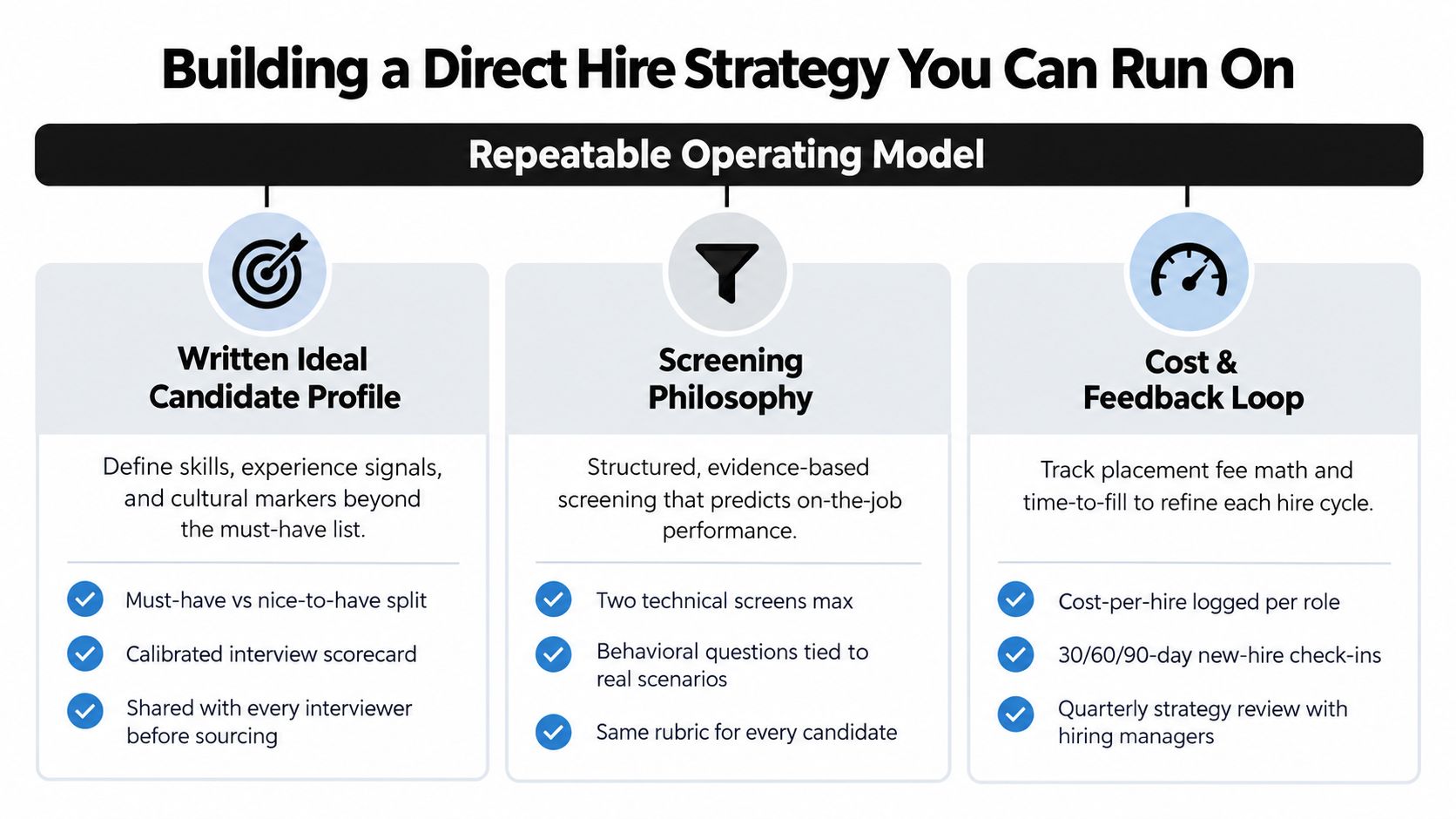
A durable direct-hire program rests on three operating habits: define the candidate precisely, screen against evidence, and keep a live measurement loop. Continuous pipelining makes the process stronger because the search starts with relationships rather than a blank page.
Week one defines the target
Write an ideal candidate profile that goes beyond technologies. Separate must-have capabilities from preferences, describe the team's working style, identify the decisions the person will own, and specify the outcomes that define success. Include signals such as learning velocity, systems thinking, accountability, communication, and business judgment.
The hiring manager and recruiter should hold a calibrated intake before any candidate is contacted. They should agree on compensation, interview stages, decision rights, and the evidence each stage must produce. Internal HR should confirm employment policies and approvals, while the recruiter translates the role into an honest candidate pitch.
Week two tests the process
Use a structured scorecard with the same core competencies for every candidate. Keep technical evaluation focused. Two strong technical discussions can reveal more than a long series of disconnected interviews when they require candidates to explain real work, constraints, and results.
Be transparent in initial outreach. A practical anonymized message can protect the company's name while still disclosing the job description, compensation range, bonus package, equity, healthcare benefits, working model, and team context. In the direct-hire workflow described here, fuller early disclosure increased the number of candidates willing to respond and begin a conversation.
Week three builds the pipeline
Don't wait for an approved requisition to meet every candidate. Maintain relationships with engineers who are currently employed, satisfied with their work, and open to the right opportunity. A software engineering specialist with an existing network can move quickly because the first conversation doesn't begin with a cold search.
The fastest direct placement described in this workflow closed in one week because a suitable candidate had already been pipelined. That speed came from prior relationship-building, not from rushing the assessment.
External recruiting technology can support this activity, but automation shouldn't make the judgment call. A resource such as the dreach AI sales agent guide is relevant when teams are evaluating AI-assisted staffing workflows, while human interviewers still need to test ownership, judgment, and communication.
Week four measures the outcome
Track the funnel and the result for each requisition:
- Search efficiency: qualified submittals, interviews, offers, and acceptance.
- Candidate experience: response quality, drop-off points, and reasons for withdrawal.
- Hiring quality: time-to-productivity, 90-day retention, 12-month retention, and hiring-manager satisfaction.
- Business value: delivery progress, reliability, customer outcomes, or revenue contribution where the role affects them.
Tenure is the most meaningful measure in the placement results discussed here. The latest reported average is three years, which is more informative than celebrating a fast start date alone. Internal HR should own the employment experience and retention plan. The agency should own search quality, candidate communication, and honest calibration.
TekRecruiter offers direct-hire recruiting for permanent technology and engineering roles, including sourcing, screening, candidate presentation, offer support, and a 90-day placement guarantee. That model fits companies that want a technical recruiting partner without moving the employee relationship off their own payroll.
TekRecruiter can help you define the role, reach qualified technology and engineering candidates, and run an evidence-based direct-hire search while your team retains the employment relationship. Visit TekRecruiter to discuss a permanent hire that needs stronger screening, transparent candidate selling, and a pipeline built before the vacancy becomes urgent.
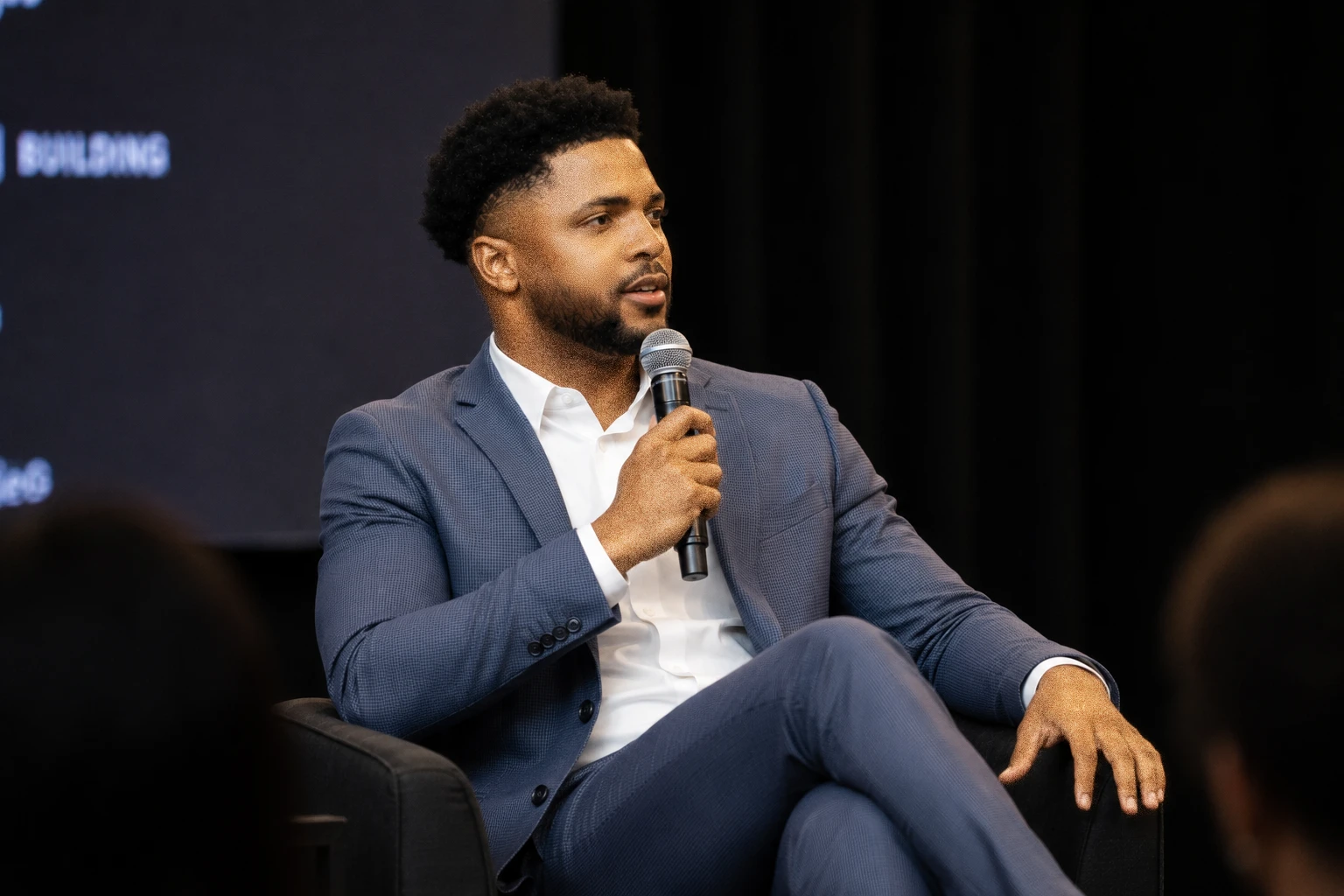 Ron SmithPresident & Lead RecruiterTekRecruiter