How Does Contract to Hire Work? Stages, Fees and Risks
Learn exactly how does contract to hire work, from the first contract to the permanent offer, plus fees, risks and when this hiring model fits.

Your team needs a senior backend engineer, and a promising candidate has cleared the interviews. You still don't know how they'll learn your codebase, handle production problems, or work with your product manager. The candidate has questions too, especially about whether the job matches the interview pitch.
That's the situation contract-to-hire is designed for. But understanding how does contract to hire work takes more than knowing there's a trial period. You need to know who employs the worker, what conversion will cost, and whether both sides want the permanent arrangement.
What Contract-to-Hire Means in Plain Terms
Say a software company brings that backend engineer onto its team through a staffing firm. The engineer takes on real assignments during a defined evaluation period, with the possibility of joining the company permanently afterward.
Think of it as a test drive with an option to buy. You evaluate something under real conditions, but the test drive isn't the purchase. The important difference is that a worker has an equal say in whether the relationship continues.
Contract-to-hire has two stages:
- Contract phase: The worker performs the role through the staffing arrangement while both sides assess the match.
- Optional permanent phase: The worker accepts a direct-employment offer and moves onto the client company's payroll.

Conversion isn't automatic. Performance, business need, budget, mutual interest, and the agreed terms all influence the outcome. The employer gets evidence of technical ability, communication, delivery habits, and team fit; the candidate gets a closer look at the manager and workplace.
With direct hire, the permanent offer comes before employment starts. With staff augmentation, the purpose is to extend the team's capacity, not necessarily to create a permanent position.
Agency-mediated work is an established employment category: temporary-help-agency workers represented 0.6% of total U.S. employment in July 2023, according to the Bureau of Labor Statistics. That measures agency employment, not contract-to-hire conversion.
Practical rule: Treat the assignment as a paid evaluation with a documented destination, not a promise of permanent employment.
How the Stages and Party Roles Unfold
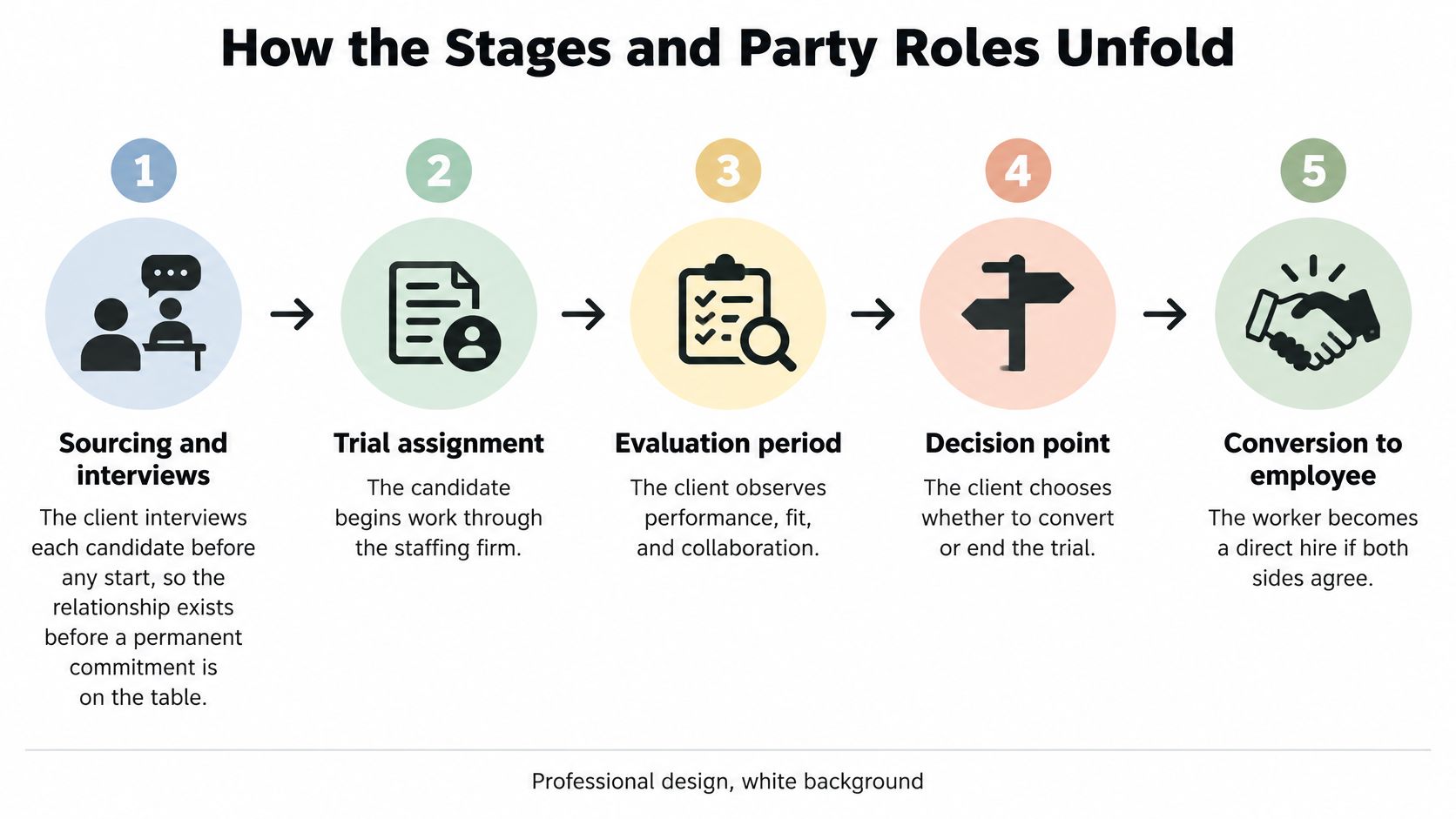
The transition from a contract assignment to a permanent role takes more than a final performance review. The client and consultant both decide whether the role is right for them, and the arrangement changes only when they agree.
Sourcing and interviews. The staffing firm identifies candidates, and the client interviews each consultant before they start. With TekRecruiter's contract-to-hire service, this gives the client a chance to build the relationship before making a permanent commitment.
Contract start. The consultant joins the client's team under the signed arrangement. The consultant is a TekRecruiter W-2 employee with health and PTO benefits; the client directs the consultant's daily assignments.
Evaluation period. The hiring manager assesses agreed outcomes rather than relying on a general impression. For a backend engineer, that might mean delivering a service change, writing maintainable tests, explaining architectural decisions, and responding constructively to code review. Evaluate incident response only if the assignment provides a fair opportunity to demonstrate it.
Conversion review. A named decision-maker reviews evidence against the original criteria. The consultant considers the proposed role, compensation, benefits, and working conditions. Both parties must agree to the move.
Direct offer or exit. If the consultant accepts the offer, the client becomes the direct employer. With TekRecruiter's contract-to-hire service, there are no conversion restrictions. Other arrangements may include conversion fees, so the parties should settle any applicable terms before the assignment starts. If either side declines, the assignment ends with a handover and access removal. An extension should have a revised purpose and decision date.
The process below shows where the two-way decision takes place.
Who does what at conversion
Roles of each party before and after conversion
| Party | During the contract | After conversion |
|---|---|---|
| Staffing firm | Employs the consultant and handles payroll and employment administration | With TekRecruiter, exits the employment arrangement with no conversion restrictions. Other arrangements may include a conversion fee. |
| Client company | Directs daily work and sets evaluation criteria | Becomes the direct employer and signs a new employment agreement |
| Worker | Works under the assignment terms and is paid through the staffing firm | Becomes the client's employee under the offered salary, benefits, and PTO |
The label “contract” describes the assignment, not necessarily the worker's tax classification. For more context on the parties' roles, see this guide to working with a staffing agency.
A healthy evaluation gives the consultant useful feedback while there is still time to act on it. New performance requirements should not first appear at the final review.
Contract Terms That Govern the Trial Period
The written agreement governs the assignment before anyone reaches a conversion decision. Keep the operational terms together in a signed agreement, with clearly incorporated schedules where necessary, so the recruiter, manager, and worker aren't following different instructions.
Make the working arrangement explicit
- Duration and conversion: Identify the evaluation period, decision date, conversion conditions, and any restriction or fee provision. Explain how an extension would be approved.
- Pay mechanics: Record the worker's pay rate, applicable overtime treatment, payroll schedule, client invoicing cycle, and timesheet approver. Distinguish the worker's pay rate from the agency's client bill rate.
- Scope and supervision: Define the assignments, reporting relationship, and person authorized to change priorities. Name who evaluates performance and who can approve the permanent role.
- Ownership and protection: Address source code, inventions, confidentiality, repository access, customer information, and security responsibilities from the start.
- Termination and handover: Set notice expectations, early-ending rights, equipment return, deliverable handover, and access removal responsibilities.
For a closer look at assignment documentation, our staff augmentation contract guide is useful when external engineers work under your management. For software teams also negotiating vendor agreements, DMpro's guide to SaaS contracts offers adjacent context on contract terms. A SaaS agreement doesn't replace employment or staffing documentation.
Turn expectations into observable work
Avoid criteria such as excellent fit without explaining what they mean. For the backend engineer, specify an agreed service change, test expectations, documentation requirements, and the reviewer responsible for sign-off.
Separate performance questions from approval questions. A manager may confirm that an engineer meets the technical standard while finance still hasn't approved permanent headcount.
Put each obligation beside an owner. An agreement that says someone will approve timesheets or review security access leaves an avoidable gap.
Have the arrangement reviewed against the applicable jurisdiction before work begins, not when the conversion paperwork arrives.
Conversion Fees and the Terms to Settle Early
Conversion is a commercial and compliance transition, not an automatic employment right. The client and staffing firm should settle whether direct hiring is unrestricted, subject to a fee, or limited during an agreed period.
A percentage-based fee links the charge to expected compensation. A declining fee gives credit for time already worked. A time restriction may affect when the client can hire directly, even if the manager and worker are ready sooner.
Compare the fee structures
Common conversion fee models
| Fee model | How it is calculated | Who usually pays | Best fit |
|---|---|---|---|
| No restriction, no fee | Client may hire the worker at any time without a fee | Not applicable | Clients seeking flexibility and expecting to convert |
| Percentage of first-year pay | An agreed share of expected first-year compensation | Client, unless negotiated otherwise | Roles with a defined expected permanent salary |
| Declining fee | The amount falls as time on assignment increases | Client, based on the agreed schedule | Assignments where the evaluation needs a longer work cycle |
| Time-restricted conversion | A fee or hiring restriction applies before a contractually specified point | Client, under the agreement | Arrangements with a defined early-conversion provision, subject to applicable law |
The distinction matters when planning the hiring budget. A percentage formula can change the fee when compensation changes; a declining formula can make timing financially significant. Neither should encourage an employer to prolong an evaluation after it has enough evidence.
A proposed U.S. federal bill defined conversion fees as charges to host employers for directly employing agency-introduced temporary workers and contemplated restricting those fees after at least 60 days at the host company. That proposal is not a universal rule. Check the applicable state, federal, and non-U.S. requirements rather than treating its threshold as permission or prohibition.
Write down the calculation before the start
The agreement needs more than a statement that a conversion fee applies:
- Trigger: Specify whether the obligation arises when an offer is accepted, direct employment begins, or another defined event occurs.
- Calculation base: Identify the compensation components used, including how bonuses or other variable compensation are treated.
- Payment deadline: State when the invoice becomes payable and how disputes are handled.
- Post-assignment coverage: Explain whether hiring after the assignment ends can still trigger a charge, and define the relevant conditions.
At TekRecruiter, our contract-to-hire service has no conversion restrictions. We also charge no upfront costs, and every service is contingent on the client hiring someone who starts. Those are distinct terms: unrestricted conversion doesn't, by itself, describe every element of an engagement's pricing.
Budget check: Have the person approving the permanent offer read the commercial agreement before they promise a start date.
Benefits and Drawbacks for Employers and Candidates
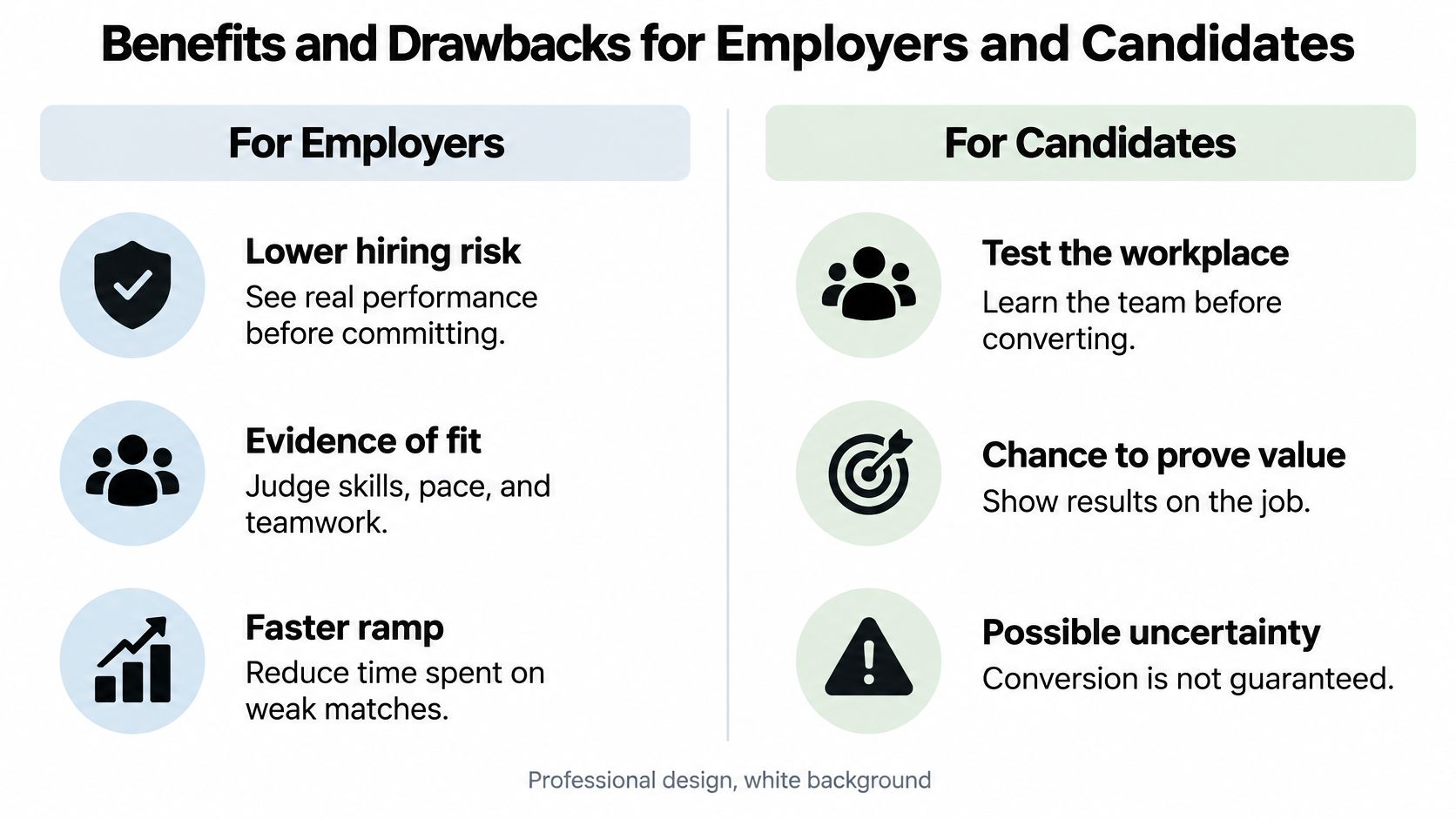
Is becoming an employee always better? Not necessarily. The answer turns on what each side receives, what changes, and whether the permanent arrangement supports the worker's priorities.
The comparison below highlights why the same assignment can look attractive to a hiring manager and uncertain to a candidate.
For employers
- Gain, evidence from real work: Managers can assess delivery, judgment, and collaboration in their actual environment, rather than relying entirely on interview answers.
- Gain, continuity after acceptance: A converting engineer already knows the repository, deployment process, and stakeholders. The permanent role can build on that familiarity.
- Drawback, delayed commitment: A strong consultant may accept another opportunity while the employer waits for approval. This matters when recruiting software, AI, cloud, or security specialists.
- Drawback, additional administration: The team must manage evaluation, agency coordination, commercial terms, and a later employment transition. The trial doesn't eliminate hiring work.
For candidates
- Gain, an informed choice: The worker can assess the manager's communication, workload, technical practices, and opportunities to develop before accepting permanent employment.
- Gain, another way to demonstrate ability: Real delivery can reveal strengths that don't come through in an interview.
- Drawback, uncertainty: Good performance doesn't ensure approved headcount. Candidates need a realistic plan for the assignment ending.
- Drawback, changed conditions: Conversion can alter flexibility, benefit eligibility, leave arrangements, location expectations, or responsibilities. A higher contract hourly rate, where offered, isn't automatically a better overall package.
Communication deserves explicit attention. A 2025 contractor survey reported that contractors rated communication alongside health insurance and pay when evaluating workplace priorities, as described in the survey coverage published by TMCnet.
Compare total value, not just pay
For the employer, the comparison includes payroll taxes, benefits, paid leave, equipment, compliance administration, and agency fees. For the candidate, it includes take-home implications, benefit costs, development opportunities, equity terms, and the value of flexibility. Our comparison of direct hire and contract employees helps frame the choice.
A candidate can decline conversion even when the company wants to proceed. Say the permanent offer adds office attendance and a benefits waiting period without compensating for those changes. Declining may be a reasonable economic decision, not a lack of commitment.
Misclassification Risk Before You Convert
The dangerous assumption is that a trial arrangement makes employee-classification rules temporarily irrelevant. It doesn't. Converting someone later doesn't erase obligations that arose while they were working.
The actual relationship matters: who controls how work is performed, whether the worker bears financial risk, how permanent the arrangement is, and how economically dependent and integrated into operations the worker becomes.
Consider an engineer who uses company tools, follows company schedules, and works under the same supervision as permanent staff. Those facts call for careful review if the person is being treated as an independent contractor. They don't automatically make an agency-employed arrangement improper, because an agency employee and an independent contractor are different categories.

Review the relationship, not just the label
The IRS, Department of Labor, and state authorities apply different classification frameworks. Passing an analysis for one purpose doesn't necessarily resolve every employment or tax question.
The Department of Labor's proposed independent-contractor rulemaking FAQs describe a proposed framework change involving economic dependence and control. A proposal shouldn't be treated as settled law; counsel should establish which requirements currently govern the assignment.
International arrangements need their own review. 30% of UK interim workers surveyed in 2024 said they had sought or secured permanent roles because of IR35 changes, up from less than 10% in the prior survey, according to Barclay Simpson's 2024 Salary & Recruitment Trends Guide. That finding concerns the surveyed UK interim workers, not U.S. agency employees.
Audit before the conversion review
- Jurisdiction and classification: Have qualified counsel examine the actual working relationship under the applicable tests.
- Timekeeping and overtime: Confirm recorded hours, approval practices, exemption analysis, and treatment of additional work.
- Payroll and benefits: Check that withholding, enrollment, deductions, and employment administration match the arrangement.
- Employer responsibilities: Document which party employs the worker and assess whether the client has additional obligations. Check intellectual-property and confidentiality coverage too.
If an independent-contractor model is legally appropriate in Florida, Coto & Waddington, Attorneys at Law, provides a resource to customize a Florida contractor agreement. A template can document a lawful relationship; it can't make an employee relationship independent contracting.
Use these checks alongside disciplined contractor management practices, including controlled access, clear reporting lines, and accurate records throughout the assignment.
Decide Whether Contract-to-Hire Fits Your Hire
Choose the model because the evaluation will answer a meaningful hiring question, not because the team wants to postpone a decision. A useful trial has work that can reveal the answer and a manager who has time to assess it.
When it fits
- Interview limits: You need to observe technical judgment and collaboration in your own codebase.
- Uncertain scope: The team needs to understand the role through actual delivery before settling its permanent responsibilities.
- Approval uncertainty: Budget or headcount isn't final, and the candidate understands that limitation.
- Candidate caution: The worker wants to assess the company before accepting a permanent position.
When another model is stronger
- Immediate permanent needs: The candidate requires a permanent package now, and the company can provide it.
- A settled hiring decision: The role is well defined, approvals are complete, and another evaluation adds little value.
- Limited management capacity: Nobody can provide feedback, track milestones, or own the decision.
For international candidates, work authorization may determine which opportunities are practical. JobGlance's listings of international jobs with sponsorship options can support that search, but a contract-to-hire label doesn't establish sponsorship eligibility.
Before launching a search, confirm the evaluation owner, written terms, fee arrangement, and jurisdiction-specific classification review. Then gather the role's need, stack, budget, timeline, and contract, IP, security, and location requirements to scope the assignment.
Our first step is a 20-minute call to understand those requirements. Contract-to-hire starts with a contractor and supports conversion to full-time when the customer is ready and the worker agrees.
Use contract-to-hire when the value of evaluating real work outweighs the uncertainty and administrative cost of a documented, time-limited trial.
TekRecruiter offers contract-to-hire for technology and engineering roles, with consultants employed on our W-2 payroll and no conversion restrictions. Visit TekRecruiter to book a scoping call and discuss the role, evaluation requirements, and path to a permanent hire.
 Ron SmithPresident & Lead RecruiterTekRecruiter