Top Engineering Recruiting Firms: What to Look For
Discover how to choose engineering recruiting firms that deliver top talent for your team. Compare strategies and find the right fit in 2026.

You've got a critical engineering role open, the hiring manager is rejecting most resumes within minutes, and the recruiting agency keeps promising a stronger slate “next week.” Meanwhile, your internal team is spending interview time on candidates who lack the required systems experience, can't explain their own projects, or never intended to change jobs.
That's not a sourcing problem alone. It's a vendor selection failure.
Engineering recruiting firms should be evaluated like any other high-impact supplier. You need evidence about delivery quality, technical judgment, economics, communication, and accountability before you give one access to your hiring funnel. A recognizable brand or polished website doesn't tell you whether a recruiter can distinguish platform engineering from general software development, or whether the firm can consistently convert qualified submissions into interviews and hires.
Why Most Engineering Recruiting Engagements Fail Before the First Call
A CTO approves a firm after comparing logos, office locations, and claims about “technology talent.” The first call then reveals that the recruiter cannot distinguish platform engineering from general software development. That mistake turns a shortlist into a costly vendor decision made without delivery evidence.
Ask for recent placements that match your role, stack, seniority, and operating environment. A firm experienced in JavaScript hiring may still lack the judgment to assess AI infrastructure, cloud security, embedded systems, or staff-level engineering leadership. Generic “top 10” rankings rarely show that difference. They reward visibility, not role-level performance.
Capacity is another early warning signal. A firm that sends five resumes within hours may appear productive, but speed has little value if candidates have not been screened for technical depth, motivation, compensation expectations, or availability. A 2025 tech recruiting benchmark report found that recruiters managing 20 or more concurrent requisitions averaged 45 days to hire, compared with 29 days for recruiters managing only 1 to 4 requisitions. Ask how the firm protects search quality when recruiters carry large workloads, and require an answer tied to process, not enthusiasm.
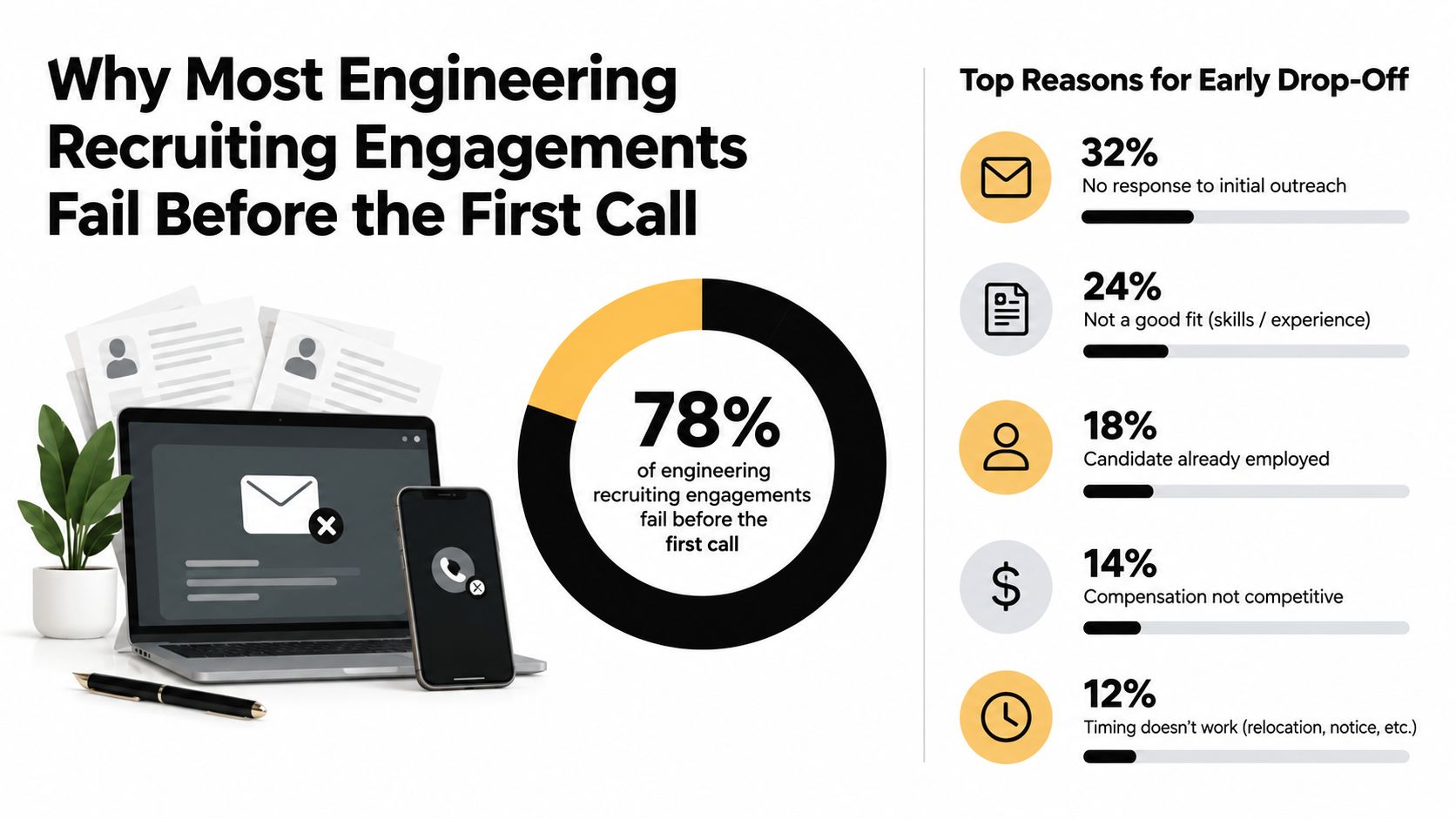
The chart showing that 78 percent of engineering recruiting engagements fail before the first phone call highlights why the initial qualification step deserves scrutiny.
The fee isn't the main risk
A recruiting fee appears on an invoice. The larger cost often sits in delayed roadmap work, overloaded engineers, missed launch commitments, and manager time spent correcting weak submissions. Before approving a search, document what the vacancy blocks, which milestones depend on the hire, and how long the team can operate without that person. This gives the shortlist a financial standard instead of a branding standard.
Market scale makes that discipline practical. Engineering and technical staffing represented 22% of global placements in 2025, with more than 4.7 million engineers hired through staffing firms in 2024, according to industry recruitment staffing market data. Treat the firm as a supplier with measurable exposure, not as a source of extra resumes.
Use a pre employment screening process overview covering identity, work history, references, and role-relevant checks. Keep compliance screening separate from technical qualification. The recruiting partner still has to show that candidates can do the engineering work.
Practical rule: Judge a recruiting firm by the candidates your engineers agree are worth interviewing, not by the number of resumes it can produce.
Service Models and When Each One Actually Fits
The wrong service model creates friction before the recruiter even starts sourcing. Match the commercial structure to the hiring problem, the urgency, and the amount of ownership you expect from the partner.
Contingency direct hire
Contingency search works when you need an individual contributor or mid-level engineer and can manage the internal process yourself. You pay when the candidate accepts and starts, which limits upfront exposure. The tradeoff is competition. Several firms may pursue the same role, so you should expect less exclusivity and confirm how the agency protects candidate experience when other suppliers are involved.
This model fits a company scaling a platform team with several similar openings, provided the hiring manager can provide fast feedback and the role has a clear profile. Read the commercial distinction carefully in this direct hire versus staffing agency comparison.
Retained search
Retained search makes more sense for a VP of Engineering, chief architect, engineering director, or a highly specialized staff-level role. You pay for dedicated attention, market mapping, confidentiality, and a defined search process rather than waiting to see whether a recruiter happens to find a candidate.
The firm should commit to a search plan, reporting cadence, target-company strategy, and candidate assessment process. If the recruiter can't explain those deliverables, the engagement may be contingency search with a larger deposit.
Staff augmentation
Staff augmentation adds engineers for a project, modernization effort, migration, incident-response backlog, or temporary capacity gap. It suits a team that needs velocity without immediately adding permanent headcount. Clarify who manages the contractor, who owns delivery quality, how hours are approved, and what happens if the person isn't effective.
This is the practical option for backfilling a legacy-stack role while your permanent search continues. It isn't a substitute for deciding who owns architecture, performance management, or long-term technical direction.
Embedded or on-demand recruiting
Embedded recruiting gives you ongoing sourcing and recruiting capacity without hiring a full internal team. It fits a continuous funnel, repeated hiring across one discipline, or a startup whose requisition volume changes quickly.
The important questions are recruiter allocation, exclusivity, reporting access, candidate ownership, and exit terms. A strong provider integrates with your ATS, attends intake meetings, and learns your hiring bar. A weak one merely supplies more resumes.
| Model | Typical Fee | Best-Fit Scenario | Time-to-Fill | Replacement Guarantee |
|---|---|---|---|---|
| Contingency direct hire | Success-based fee | Individual contributors and repeatable roles | Depends on role and market | Written replacement or refund terms |
| Retained search | Upfront engagement fee | Executive, confidential, or rare searches | Defined search process, not an instant promise | Negotiated guarantee |
| Staff augmentation | Hourly bill rate or markup | Project spikes and temporary capacity | Based on available qualified talent | Replacement provision for unsuitable contractors |
| Embedded or on-demand | Recurring service fee | Ongoing pipeline and variable hiring volume | Continuous delivery model | Contract-specific replacement terms |
Do not select a model because it appears cheapest. Select it because its incentives match the work you need done.
The Eight Criteria That Separate Real Engineering Recruiting Firms From Resume Mills
A weak firm can waste weeks before its first viable interview. Shortlist recruiting partners as vendors, not as entries in a “top 10” article. Score each firm against the same evidence, demand role-specific answers, and reject polished claims that cannot be verified.
1. Technical screening depth
Ask who conducts the technical screen and what the screen tests. A credible firm can explain how it evaluates systems thinking, project ownership, architecture decisions, debugging, and role-specific tools. Resume mills focus on keywords, availability, and rapid submissions.
2. Time-to-fill by role type
Request historical ranges by discipline and seniority. The answer should distinguish common software roles from scarce cloud, security, AI, platform, and staff-level searches. Treat one universal promise as a warning. A reliable partner explains the variables behind its delivery time.
3. Submission-to-interview quality
Require a funnel showing how many submitted candidates reach a hiring-manager interview. As noted earlier, phone-screen and onsite conversion rates vary sharply by role and hiring process. Use those benchmarks as context, then ask for the firm's own role-level data, sample size, and definitions for “submitted,” “screened,” and “interviewed.”
A high submission count can conceal poor qualification. Review a sample of candidate summaries and compare each one with the agreed must-haves before approving more work.
4. Offer acceptance
Interview volume does not equal hiring success. Ask how the recruiter tests motivation, compensation alignment, competing offers, location preferences, notice periods, and decision criteria before presenting a candidate. The firm should identify likely offer risks early and record them in the search update.
5. Niche stack expertise
Require recent examples from the exact engineering niche you need. “We recruit software engineers” says little about AI platform engineering, cloud infrastructure, security engineering, or principal-level architecture. Ask what comparable environments the recruiter has understood firsthand and which requirements commonly disqualify candidates.
6. Reference-check rigor
Establish whether references come from the candidate or are independently requested by the recruiter. The process should verify employment, project scope, reporting relationships, licenses where relevant, and reasons for leaving. Candidate-provided praise alone is weak evidence.
7. Guarantee language
Read the guarantee before signing. It should define the replacement window, refund schedule, candidate eligibility, exclusions, and any conditions that could void coverage. “We stand behind our placements” has no operational value unless the contract states the remedy.
8. Domain-specific client roster
A credible firm can describe the companies and engineering environments it serves without disclosing confidential names. Look for experience with comparable team sizes, product complexity, operating constraints, and hiring standards. Anonymous claims and a page of logos do not establish relevant expertise.
| Criterion | Strong Signal | Weak Signal | Weight |
|---|---|---|---|
| Technical screening | Named, role-specific evaluation process | Resume review and generic phone call | High |
| Time to fill | Historical ranges by role | One universal promise | High |
| Submission quality | Role-level funnel reporting | Resume volume only | High |
| Offer acceptance | Motivation and compensation validation | Candidate is “interested” | High |
| Niche expertise | Recent placements in the target discipline | Broad technology language | High |
| Reference checks | Structured, independently verified references | Candidate-provided praise only | Medium |
| Guarantee | Written replacement or refund terms | Marketing language without terms | Medium |
| Client roster | Verifiable experience in similar environments | Anonymous claims and logos | Medium |
For broader recruiting context, Spark's recruiting articles provide useful background reading. Keep the decision role-specific. A firm that fails technical screening or cannot show funnel evidence should leave the shortlist, regardless of brand recognition or candidate database size.
Diagnostic Questions to Ask Before You Sign Anything
Use the same discovery-call script with every firm. Score each answer 0 for evasive, 1 for partial, and 2 for specific and verifiable. The score matters less than the evidence behind it, but a consistent rubric prevents the most persuasive salesperson from winning by personality.
Sourcing depth
Which engineers have you placed in this discipline recently? Strong answers identify comparable roles and environments. A red flag is a list of unrelated placements.
How do you reach passive candidates? Look for named channels, referrals, technical communities, and direct outreach methods. “We have a large database” signals inventory selling.
How do you handle competing searches? Strong firms explain ownership, prioritization, and candidate consent. Weak firms imply that every available resume is fair game.
How many candidates do you have available right now? A serious partner starts with role definition before presenting inventory. Immediate candidate counts suggest answer-shopping rather than search strategy.
Screening rigor
Who conducts the technical screen? You want a named recruiter, engineer, or validated assessment process. “Our recruiters know technology” isn't enough.
What would disqualify a candidate for this role? Strong answers reflect your must-haves. Generic answers reveal shallow intake.
Can you provide a redacted candidate write-up? Review whether it explains evidence, tradeoffs, project scope, and risks instead of repeating the resume.
How do you verify employment and references? Ask when checks happen and who owns them. Delaying every check until after the offer creates avoidable risk.
Partner economics
What happens if the hire leaves? Require the replacement and refund process in writing.
Who owns the candidate if another firm or our team already contacted them? Strong answers define ownership clearly. Ambiguity creates disputes.
What costs sit outside the stated fee? Ask about sourcing, assessments, background checks, onboarding, contractor administration, and payment terms.
Can you guarantee a hire in 30 days? Strong firms explain what they control and what depends on the market. A promise designed to win the call is answer-shopping.
Operational fit
Who will work on the search, and how many searches do they carry? You need named accountability and realistic capacity.
What response time do you expect from our hiring team? Good partners establish a two-way operating rhythm rather than blaming delays later.
What will you report each week? Look for pipeline stage, rejection reasons, candidate risks, and next actions. A list of submitted resumes is not reporting.
| Question Block | Sample Question | Strong Answer Signal | Resume-Mill Red Flag |
|---|---|---|---|
| Sourcing depth | How do you reach passive candidates? | Specific channels and outreach logic | “Large database” |
| Screening rigor | Who conducts technical screens? | Named evaluator and structured method | Generic recruiter call |
| Partner economics | What happens after an early departure? | Written replacement process | Verbal assurance |
| Operational fit | What will you report weekly? | Funnel, risks, and actions | Resume count only |
Use established vendor selection criteria to supplement this scorecard, then request two client references per firm. Ask each reference what the agency did after the first placement failed, not just how the first search started.
Pricing, Fees, and the Fine Print Worth Reading Twice
Recruiting fees only make sense when you connect them to risk, ownership, and the work the firm performs. A low headline fee can become expensive when it produces poor submissions, weak replacement protection, or administrative charges you didn't budget for.
Contingency fees
Contingency direct hire charges a success fee when the candidate starts. It suits repeatable roles where you can run the hiring process internally and where multiple firms may compete. Confirm whether the fee applies to base salary only or includes bonuses, commissions, signing payments, or other compensation.
Retained search
Retained search uses an upfront engagement structure in exchange for dedicated attention and a defined process. It fits senior leadership, confidential searches, and roles where market mapping matters more than resume volume. Payment milestones should correspond to real deliverables, such as kickoff, calibrated slate, and finalist stage.
Embedded and staff augmentation fees
Embedded recruiting typically uses a recurring service charge, while staff augmentation uses an hourly bill rate that includes the contractor's compensation, employment costs, administration, and recruiting margin. Ask what happens when demand changes, whether unused capacity carries forward, and how quickly you can reduce the engagement.
The contract deserves as much attention as the fee:
- Replacement terms: Define eligibility, time limits, exclusions, and whether the remedy is replacement, refund, or credit.
- Payment terms: Check invoice timing, payment triggers, late fees, and accelerated-payment penalties.
- Candidate ownership: Specify how long the firm owns a candidate and what happens if your team sourced the person independently.
- Non-solicit language: Limit restrictions to a reasonable scope and period.
- Pass-through charges: Identify background checks, assessments, onboarding, payroll administration, travel, and other additional costs.
- Exclusivity: Require the firm to explain what it will deliver in return for exclusive access.
- Refund schedule: Make the schedule precise enough that finance can apply it without interpretation.
A useful recruiting agency contract guide can help your team identify clauses that deserve legal review. For teams comparing recruiting spend with broader go-to-market planning, plans for sales teams provide a useful reminder that recurring service costs should be evaluated against the operating capacity they create.
| Fee Model | Typical Rate | Payment Structure | Best Fit Scenario |
|---|---|---|---|
| Contingency direct hire | Percentage or success fee | Due on start, subject to guarantee terms | Repeatable permanent hiring |
| Retained search | Negotiated engagement fee | Milestones or scheduled installments | Executive and confidential searches |
| Staff augmentation | Hourly bill rate | Invoiced for approved time | Temporary project capacity |
| Embedded recruiting | Recurring service fee | Periodic subscription or retainer | Ongoing pipeline ownership |
As a rule, use more dedicated structures when the role is senior, confidential, or unusually difficult. Use flexible contingent or embedded structures when volume and changing demand matter more than exclusivity.
Onboarding a Recruiting Partner in the First 30 Days
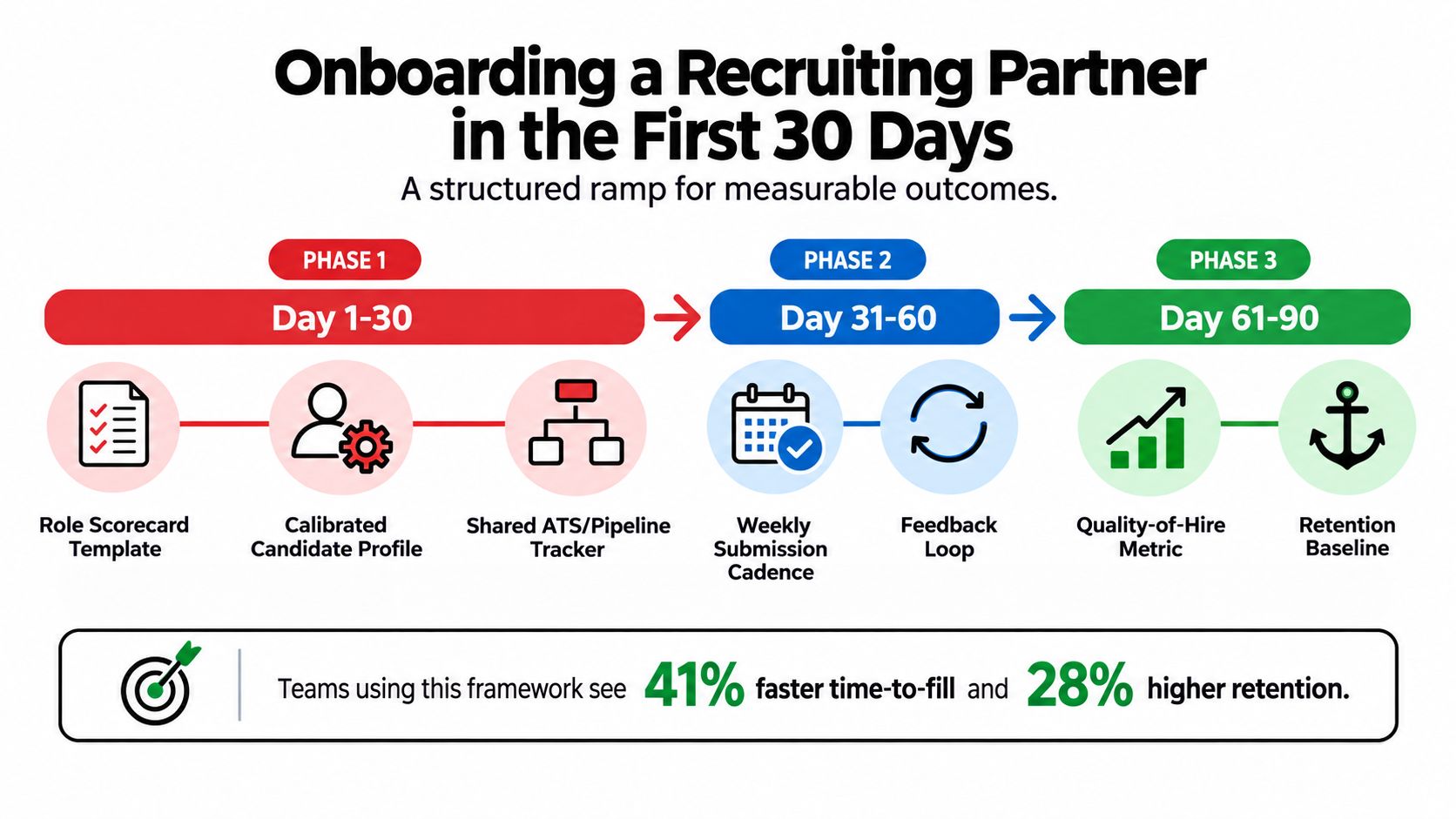
A signed contract doesn't create alignment. The first month should produce shared artifacts, measurable working habits, and enough evidence to decide whether the relationship deserves more investment.
Days 1 to 7
Hold a kickoff with the hiring manager, recruiter, technical interviewer, and talent leader. Create four artifacts before sourcing begins:
- Role scorecard: Outcomes, technical requirements, decision authority, collaboration expectations, and reasons a candidate would join.
- Calibrated candidate profile: Must-haves, teachable skills, disqualifiers, acceptable adjacent backgrounds, and compensation alignment.
- Shared ATS or pipeline tracker: One source of truth for stage, owner, feedback, next action, and candidate consent.
- Communication agreement: Submission format, feedback owner, meeting cadence, escalation route, and response expectations.
Give the partner access to the systems it needs, but don't grant broad access without defined permissions. The recruiter should understand your interview stages, rejection categories, and approval process before the first candidate arrives.
Days 8 to 30
Review the first submissions together. Don't merely accept or reject them. Record why each candidate passed or failed, then update the profile so the next search iteration improves. Require a consistent candidate brief that explains technical evidence, motivation, location, compensation expectations, notice period, and known risks.
Set service levels in writing. They should cover submission quality, response times, feedback turnaround, interview coordination, data privacy, and replacement handling. Avoid rigid promises about hiring outcomes that depend on your interview team, but insist on predictable recruiter activity and transparent reporting.
The onboarding framework should also include a weekly submission cadence and a feedback loop. After the first interview slate, compare the firm's claims with your engineering panel's assessment. If the recruiter keeps sending the same mismatched profile, the calibration process isn't working.
A short operational overview can reinforce the importance of role clarity and documented handoffs:
At day 30, choose one path. Scale the engagement if submissions are qualified and communication is reliable. Reset expectations if the firm is close but missing a repeatable requirement. Exit if the partner can't produce evidence of progress, learn from rejection, or maintain accountable ownership.
Measuring Success, Spotting Trouble, and Knowing When to Walk Away
A recruiting partnership needs a dashboard, not anecdotes. Track leading indicators weekly and lagging indicators at defined hiring milestones. Your objective isn't to reward activity. It's to determine whether the firm is reducing the work your internal team must do.
The first leading indicator is qualified candidates submitted per requisition. Count only candidates who meet the agreed profile, not every resume delivered. Then track submission-to-interview movement, interview-to-offer conversion, time spent in each stage, and the ratio of submissions that become hires.
Technical funnel data gives useful context. A recruitment funnel benchmark summary reports that technical roles typically convert only about 3.6% to 4.7% of applications into interviews, with interview-to-offer rates near 7%. It also reports that software and technology employers generally accept offers at about 77% to 82%. Those figures don't set your agency's target, but they show why qualification near the top of the funnel matters.
Signals that deserve intervention
Watch for shrinking submissions without a clear market explanation, repeated re-pitches of the same unsuitable profile, vague pipeline updates, and recruiters who become less responsive after the contract is signed. A partner should be able to explain what changed, what it tried, what candidates rejected, and what it will do next.
Track candidate retention after hire and manager satisfaction alongside hiring velocity. If the firm fills seats that don't survive the onboarding period, a high placement count is misleading. Use a structured quality of hire metrics framework to connect recruiter performance with engineering outcomes.
| KPI | Healthy Benchmark | Renegotiate Trigger | Exit Trigger |
|---|---|---|---|
| Qualified submissions | Consistent against the agreed role profile | Quality varies by recruiter | Repeatedly irrelevant |
| Interview conversion | Hiring team advances credible candidates | Feedback shows calibration gaps | Almost no qualified interviews |
| Time by stage | Delays have named owners | One stage repeatedly stalls | No corrective action |
| Submission-to-hire ratio | Improves as calibration develops | High volume with weak outcomes | No learning from rejection |
| Early retention | New hires meet agreed expectations | Preventable mismatch appears | Repeated early departures |
| Manager satisfaction | Hiring team receives useful signal | Communication is inconsistent | Partner stops engaging |
Renew when the firm produces qualified pipeline, learns quickly, and supports roadmap hiring. Renegotiate when the process is viable but the scope, response times, or screening standard needs correction. Exit when the evidence shows persistent mismatch, opaque reporting, or a lack of ownership. Document the decision, because the next vendor review should begin with performance data rather than recollection.
 Ron SmithPresident & Lead RecruiterTekRecruiter