Hire Node Developer: A Step-by-Step Guide for 2026
A step-by-step guide to hire node developer talent, with sourcing channels, screening criteria, interview exercises and onboarding tips.

The most popular advice on hiring a Node.js developer starts with years of experience, a framework checklist, and a coding test. That's a weak filter for someone who'll inherit a live service. A candidate can write clean Express routes and still struggle when a queue stops draining, database connections run out, or an npm dependency becomes unsafe.
Hire for production ownership, not keyword coverage. Define what the person must operate, collect evidence that they've handled comparable work, and test their security judgment before making an offer. The distinction isn't whether they can build an API. It's whether you can trust them with what happens after deployment.
Pick the Seniority Level Before You Post
Hiring on the title alone creates a predictable mismatch: the company wants an independent service owner, but the job description attracts developers who expect well-defined tickets and close review. Start with the decisions the hire will make without escalation.
Node developer levels, ownership and what to verify
| Level | Owns | Verify on the CV | Interview prompt |
|---|---|---|---|
| Junior application developer | Features and bug fixes in an existing service | Tests and a shipped API backed by a database | Walk through how a route handles an invalid request body |
| Mid-level service developer | One API or queue consumer end to end | A production service with logging, retries and alerts | Describe a time an async job failed silently and how you found it |
| Senior platform owner | Architecture across services, data and deployment | Incidents handled, scaling decisions and cost trade-offs | Which workloads would you choose Node.js for, and which would you avoid? |
A junior can be the right hire when a senior engineer has time to explain service boundaries and review changes. A mid-level developer should own delivery within an established architecture. A senior platform owner must challenge that architecture when its operational cost or failure modes no longer fit the business.
On the CV, look for a shipped service using relevant components, such as PostgreSQL, Redis, or a queue. Then separate personal responsibility from team achievement. Ask what the candidate implemented, what another engineer decided, and what they changed after release.
Calibrate responsibility before compensation
Years of experience describe elapsed time, not independence. Someone who mainly wrote scripts against external APIs may be less prepared than an engineer with a shorter career who operated a customer-facing service through an incident.
For a useful adjacent career perspective, StoryCV's guide to progressing from junior developer to lead can help frame responsibility growth. For backend hiring, translate that progression into service ownership, operational decisions, and accountability for failures.
Senior roles represented 71% of the increase in software-development postings between May 2025 and May 2026, according to CNBC's software-developer jobs coverage. If you need that level of ownership, allow more sourcing effort rather than advertising a junior budget with senior expectations.
The U.S. Bureau of Labor Statistics' May 2023 occupational estimate reported a mean annual wage of $138,110 for software developers. That's a broad U.S. benchmark, not a Node.js salary quote. Check comparable offers in your hiring market before setting the range.
Calibration test: Write down the first production incident this hire must handle alone. Choose the level that can own it, not the title your budget makes convenient.
Where to Find Node Developers and What Each Channel Delivers
The pool is international, but a large pool doesn't eliminate screening work. Stack Overflow's 2024 survey methodology records 65,437 responses from developers in 185 countries; its technology results show that 40.7% of professional respondents used Node.js for extensive development during the previous year.
Sourcing still requires a conversation about what the candidate shipped.

Sourcing channels for Node developers
| Channel | Strength | Trade-off | Screening load |
|---|---|---|---|
| Engineer referrals | Strongest early signal when the referrer shipped with the candidate | Scales slowly | Verify the relationship and individual contribution |
| Open-source contributors | Public repos with tests and CI | Needs repo review | Inspect changes, review discussions and maintenance work |
| Job boards | High volume | Node keyword appears on many full-stack CVs | Tight first screen needed |
| Specialist recruiters | Several hires or niche profiles | Requires budget and technical calibration | Agree on evidence required before submission |
Choose channels around the missing skill
Ask referring engineers about specific working behavior: Did the person investigate failures methodically? Did they communicate breaking API changes? A referral based on friendship isn't equivalent to a recommendation from someone who reviewed their production code.
For open-source sourcing, examine contributions to Express, Fastify, or packages your service already uses. Look beyond repository popularity. A modest bug fix with a regression test and a thoughtful review discussion can tell you more than a polished tutorial project.
Job boards work when the application screen distinguishes server-side ownership from frontend exposure. Ask applicants to describe a deployed backend component and their responsibility for it. Don't reject candidates because their previous framework differs from yours.
A specialist recruiter is useful when you need parallel hiring capacity or a narrow combination, such as event-driven services and cloud deployment. At TekRecruiter, we recruit across Node.js and adjacent technologies including TypeScript, React, Kubernetes, Azure, Python, and Terraform. Define which combinations are essential instead of asking for the entire stack.
Use candidate sourcing strategies to organize channel selection around evidence rather than application volume.
For a supplementary video resource:
Run referral outreach alongside a broader channel for an initial sourcing cycle. Compare how many candidates reach a credible technical discussion, not how many profiles arrive. Keep the channel that produces relevant evidence without consuming disproportionate engineering time.
Screen Candidates Against a Weighted Scorecard
Set the scorecard before interviewing. I recommend the following allocation as a hiring rubric, not a scientifically validated prediction of job performance. It gives correctness and asynchronous reasoning more influence than presentation polish.
Node developer scorecard weights and strong signals
| Criterion | Weight | Strong signal |
|---|---|---|
| Correctness and tests | 30% | Tests cover failure paths and edge cases, not only the happy path |
| Async and concurrency reasoning | 25% | Explains promise handling, cancellation and where the event loop can block |
| Production resilience | 20% | Describes retries, timeouts, graceful shutdown and what they monitored |
| Maintainability | 15% | Clear module boundaries, readable error handling and sensible dependency choices |
| Communication | 10% | Explains trade-offs in plain language and says what they would change |
| Total | 100% | Score each criterion 1-4 with written evidence from past work |
Treat the scoring scale as an internal decision aid: unsupported, partial, independent, or strong enough to guide others. Require a written example for each rating, distinguishing evidence from the candidate's previous work from evidence observed during the assessment.
Relevant, purposeful assessments and interviewer technical competence matter to perceived assessment validity, as discussed in this ACM technical-hiring paper. A difficult interview isn't automatically a credible one.
Move from claims to a decision
Use a consistent funnel:
- Verify systems experience. Match the candidate's work against your architecture: Express or Fastify, PostgreSQL or Redis, queues, containers, CI/CD, and cloud deployment. Separate necessary experience from tools they can learn.
- Collect implementation evidence. Run a realistic service exercise rather than accepting fluent descriptions as proof.
- Conduct a structured review. Ask each candidate the same core competency questions, with follow-ups tied to their answers.
- Complete a production-readiness debrief. Examine failure modes, monitoring, security boundaries, and rollback decisions.
In the initial call, ask for a named service, its workload characteristics, and something that broke. Candidates don't need to disclose confidential customer metrics. They should still explain whether they handled interactive requests, batch processing, large payloads, or unreliable downstream systems.
Red flags include framework lists without deployment history, explanations that end at local success, and performance claims without a workload definition. Probe further before rejecting someone: a vague CV may reflect weak writing rather than weak engineering.
Our guide to a structured interview process provides a useful basis for keeping interviewer questions and evaluation consistent.
A high overall score shouldn't compensate for a critical weakness. Decide which competencies require independent performance before meeting candidates.
Have interviewers record ratings separately before discussion. During the hiring meeting, challenge unsupported praise as firmly as unsupported criticism. If someone recommends hiring because the candidate seemed senior, ask which decision or behavior demonstrated it.
Run a Work Sample That Mirrors Your Real Service
Give the candidate an existing HTTP service and a focused extension: validate a request, persist a record, handle a temporary downstream failure, produce structured logs, and test the behavior. Use a synthetic repository, not unpaid work from your product backlog.
Keep the scope achievable within the agreed time box. You're evaluating decisions and failure handling, not how much code someone can produce after sacrificing an evening.
The exercise should follow a recognizable service-development flow.
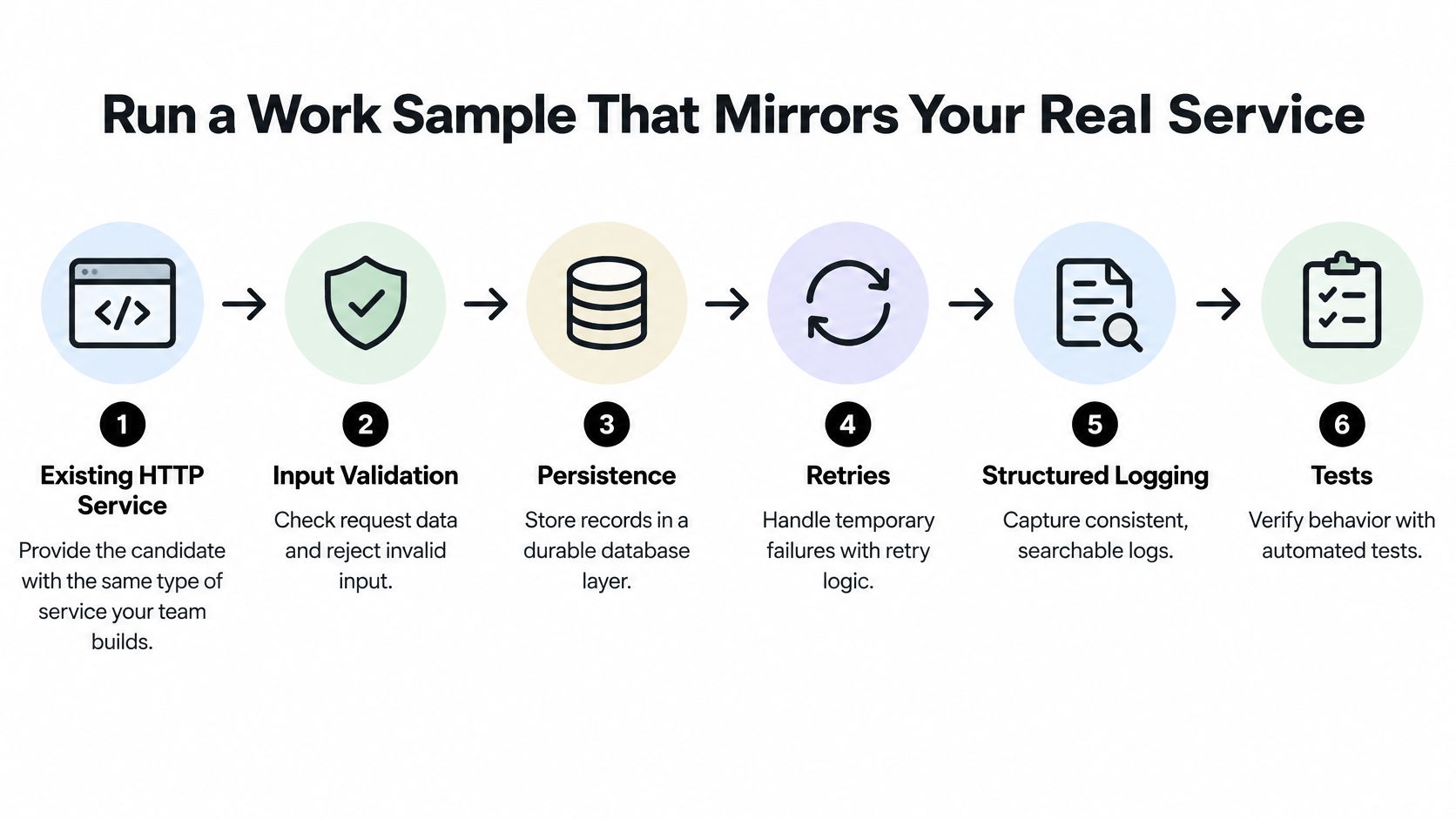
Give enough context to make real decisions
- Share the repository and operating context. Explain who calls the service, what a successful request means, and a known failure such as a slow downstream API. Without context, candidates must guess which trade-offs matter.
- Ask for a plan before coding. Listen for assumptions, clarification questions, and a sensible implementation order. A candidate who identifies ambiguous retry semantics is giving you useful evidence before opening an editor.
- Allow normal tools and documentation. State the policy on AI assistance explicitly. If it's allowed, ask candidates to explain and verify generated code rather than measuring typing speed.
- Review tests before implementation details. Check invalid input, persistence failures, and downstream errors. Then inspect whether the implementation satisfies those tests for the right reasons.
- Request a reproducible measurement. Node.js provides high-resolution timing, User Timing, and performance entries through its official performance measurement APIs. Ask candidates to identify what they measured, describe the workload, and explain what the result cannot establish.
- Debrief the unfinished work. Ask what they deliberately omitted, what they'd change before release, and which assumption they'd validate first. Good prioritization matters more than pretending the exercise is production-ready.
Our discussion of the importance of programming assessments is useful when deciding how an exercise should contribute to the hiring decision.
Follow the failure paths
Use the submitted code as the interview surface. If the route starts background work, ask what happens when its promise rejects. If the client disconnects, ask which downstream operations should be cancelled and whether cancellation is supported.
For a stream or queue, ask how the implementation prevents producers from overwhelming consumers. For persistence, explore connection-pool exhaustion and what the caller experiences while waiting. For shutdown, ask how the process stops accepting work and handles requests already in flight.
CPU-heavy processing deserves a separate probe. Ask candidates to identify blocking work and explain when they'd use worker threads or move computation into another service. Don't reward the tool name without a discussion of serialization, operational complexity, and failure handling.
Avoid making algorithm puzzles the primary gate for service-development roles. If you need a live assessment, use a short paired change with a collaborative interviewer. The strongest evidence is an explanation of how the design fails, supported by code, tests, and a plausible recovery plan.
Test Security and Dependency Judgment Before Launch
Broad npm familiarity can mean good ecosystem judgment. It can also mean adding packages without understanding who publishes them, which scripts they execute, or what privileges they receive.
The OpenJS security checkpoint for 2025 covers dependency-management practices, Trusted Publishing risks, coordinated vulnerability response, and Node.js Permission Model improvements. Treat those topics as operating responsibilities, not optional security trivia.
Review a deliberately flawed manifest
Provide a package.json containing a loose version range and a postinstall script, with no lockfile alongside it. Ask the candidate what they'd inspect and in what order.
A strong answer doesn't declare every install script malicious. The candidate should inspect its purpose, confirm package provenance, examine the resolved dependency tree, and establish reproducible installation with a reviewed lockfile. They should also distinguish pinning a version from proving that version is safe.
Evaluate these dimensions:
- Dependency provenance. Can they explain where a package comes from and how changes enter the build?
- Vulnerability triage. Do they check affected versions, reachability, and exploitation conditions rather than treating every scanner alert identically?
- Secret handling. Do they keep secrets out of repositories and logs, limit CI exposure, and plan rotation?
- Runtime privilege. Can they restrict file, network, and process access appropriately, including assessing where Node's Permission Model fits?
- CI/CD security. Do they inspect third-party actions, pin references appropriately, and scope tokens?
- API boundaries. Can they distinguish authentication from authorization and enforce access to individual resources?
- Incident communication. Do they explain who needs notification and what evidence responders need?
Test the compromise response
Present a scenario in which a heavily used transitive dependency is reported as compromised. Ask what the candidate checks first, who they contact, and how they decide between rollback and a patched deployment.
Look for verification of the affected version in deployed artifacts, not just the developer's local dependency tree. The candidate should consider install-time execution, reachable secrets, suspicious activity, and whether the proposed rollback still contains the compromised package.
Security gate: Assess dependency judgment separately from feature correctness. A working endpoint doesn't establish that its build and release process is safe.
A credible response includes containing exposure, rotating secrets the package could access, selecting a verified safe dependency resolution, and communicating uncertainty clearly. Apply this standard consistently to local, remote, and nearshore candidates. Location and previous job titles aren't substitutes for evidence.
Choose Your Engagement Model and Onboard the Hire
Choose the engagement model around the work's duration, your management capacity, and how much institutional knowledge the role requires. Don't use a temporary contract to avoid defining a permanently intended responsibility.
Engagement models compared for a Node developer hire
| Model | Best when | Commitment | What to check |
|---|---|---|---|
| Direct hire | You need a permanent team member | Permanent | Placement terms and onboarding support |
| Contract-to-hire | You want to test fit before a permanent offer | Starts as contractor, then converts | Your own interview of each consultant before start |
| Staff augmentation | You need extra capacity under your management | Temporary or project-based | Who sets priorities and who reviews the code |
| Nearshore | You need English-speaking engineers in your time zone | Set by the agreed hiring or contract arrangement | The same production ownership bar as any other hire |
Direct hire fits ongoing ownership of a core backend. Contract-to-hire offers a working relationship before a permanent commitment, but you still need a clear scope and a fair evaluation process. With our Contract-to-Hire service, the client interviews each consultant before they start and builds the relationship before deciding on permanence.
Staff augmentation fits teams that can direct the work and review the code. Our external engineers work under the client's management on a temporary or project basis. If nobody internally can explain the architecture or approve a deployment, extra capacity alone won't resolve that gap.
For nearshore hiring, we provide vetted, English-speaking engineers in Latin America working in the customer's time zone. Confirm actual collaboration hours and incident responsibilities, then compare written quotes against your own requirements rather than assuming geography determines total cost.
Separate delivery capacity from advisory scope
Our comparison of direct hire versus contract employees can help clarify the employment decision. Also decide whether you need an engineer executing an established plan or someone advising on what should be built.
For startup leaders considering an advisory engagement, SpecStory, Inc.’s consultant hiring guidance for startup teams offers a useful companion perspective. A consultant's deliverables, decision authority, and handover obligations need definition just as much as an employee's responsibilities.
Make onboarding an ownership test
Use the first month to validate the role calibration through increasingly independent work. The following is a suggested onboarding schedule, not a deadline every service or hire must meet.
- During the opening week, have the hire read the service map and runbook, set up their environment, and ship a small change to staging. Assign a named reviewer who can explain deployment permissions and recovery procedures.
- In the following week, give them a bounded ticket that includes tests and a deployment. Check whether they identify affected consumers and ask for missing acceptance criteria.
- Next, introduce operational responsibility. Have them shadow on-call and investigate an alert with an experienced engineer. Ask them to explain whether the alert supports a clear action.
- Before closing the month, ask the hire to lead a change review and document unclear setup steps, ownership boundaries, or runbook instructions. Turn those observations into assigned improvements.
Record what support each task required. If a supposed senior owner needs detailed direction on every operational decision, investigate whether the problem is missing context, missing access, or a genuine level mismatch before increasing responsibility.
Write the intended level, engagement model, and first independently owned incident on a single page. Add your stack, budget, timeline, and contract, IP, security, and location requirements so the hiring discussion starts with decisions rather than a vague job title.
TekRecruiter recruits Node.js engineers through direct hire, contract-to-hire, staff augmentation, and nearshore engagements, with the same standard across roles. Visit TekRecruiter to book a 20-minute call and share that role outline, including the production responsibilities and security judgment you need the hire to demonstrate.
 Ron SmithPresident & Lead RecruiterTekRecruiter