Distributed Systems Engineer Guide for Leaders
Distributed systems engineer guide for 2026: role scope, failure skills, seniority, pay signals, and a hiring checklist for engineering leaders.
The most common advice for hiring a distributed systems engineer is to look for backend experience, Kafka, Kubernetes, and a cloud platform. That's a keyword filter, not a hiring standard. It tells you someone has worked near distributed infrastructure, not whether they can change it without losing customer data or turning a dependency failure into a company-wide outage.
Hire for the decisions the engineer will make when the system stops behaving predictably. Then check whether they can work in your stack.
What a Distributed Systems Engineer Is Responsible For
A distributed systems engineer isn't a backend engineer with a more elaborate deployment diagram. The distinction is responsibility for behavior across independent machines, especially when those machines can't reliably agree about what happened.
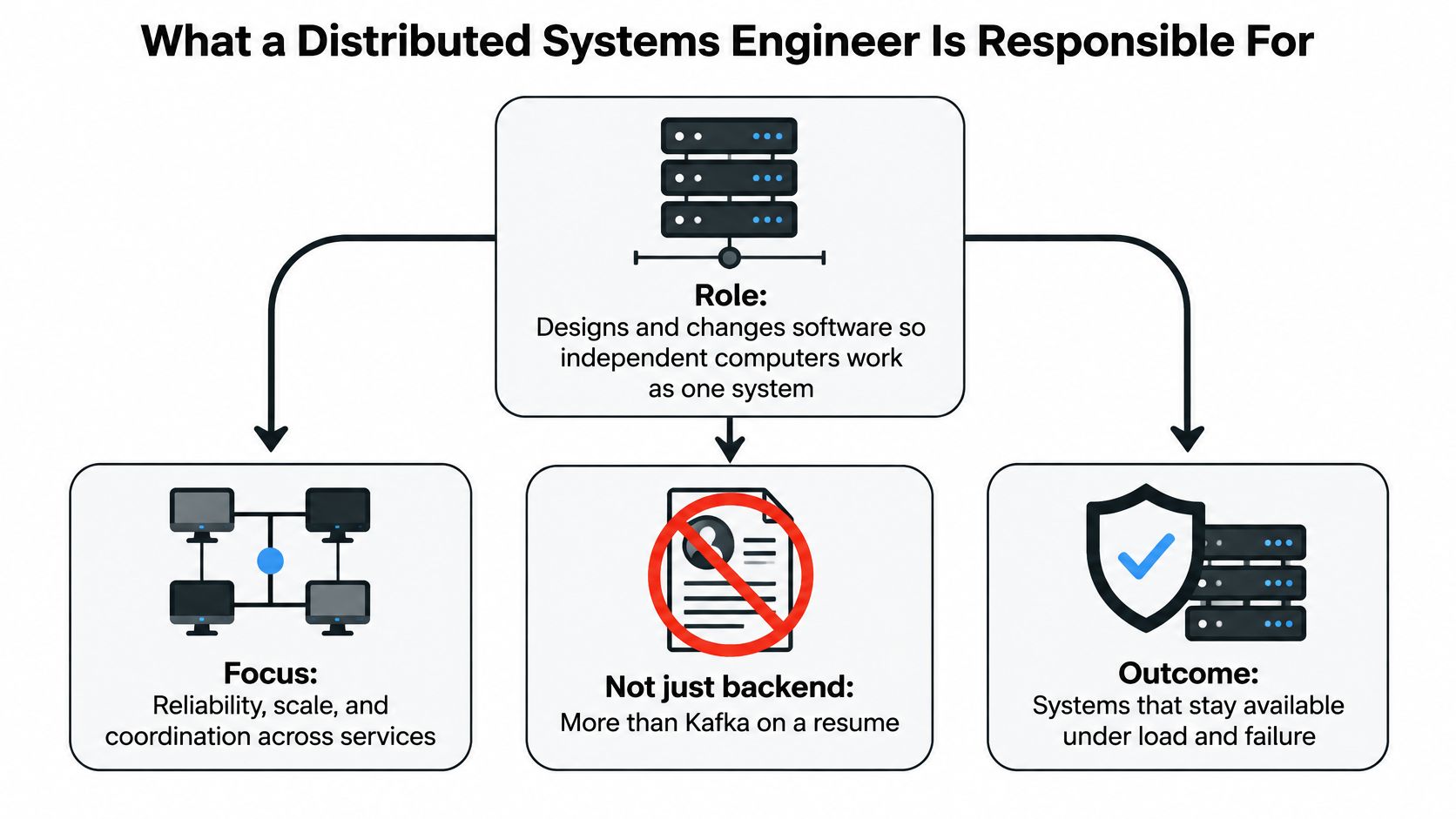
A distributed systems engineer designs and changes software so independent computers keep serving users when clocks disagree, messages duplicate, and a process fails.
Say a customer submits a payment. The payment service records the transaction, but its response disappears before the checkout service receives it. Checkout retries. A replacement worker picks up the request while the original worker is still running.
An ordinary implementation review might ask whether the API returns the correct response. A distributed-systems review asks whether the customer can be charged again, which record proves the payment happened, and how operators resolve uncertainty without inventing a second transaction.
Coordination is the job
This discipline didn't begin with containers. A scholarly review published in Computing describes distributed computing as an active field for over 60 years, tracing networked computing through ARPANET and local networks, and discusses the 1985 Fischer–Lynch–Paterson result that deterministic consensus cannot guarantee termination in a fully asynchronous system if even one process may fail.
The production lesson isn't that agreement is hopeless. It's that engineers must state the assumptions under which their system makes progress. A timeout tells you that a response hasn't arrived; it doesn't prove the remote process stopped working.
During a network partition, a service might reject writes to preserve an invariant. Another might accept updates locally and reconcile them later. Neither choice is automatically correct: the engineer must connect the behavior to what the business can tolerate.
The responsibility spans databases, cloud platforms, service architectures, and globally distributed applications. It includes deciding where state lives, how replicas converge, which operations require coordination, and what callers can safely assume after an ambiguous response.
The responsibility map is broader than a tool stack.
Measure behavior, not service count
Don't assess this role by how many microservices someone creates. Splitting an application can introduce more coordination problems than it solves.
Look instead at the guarantees the engineer can describe and defend:
- Correctness boundaries: Which business rules must hold even when components disagree?
- Failure containment: Which users and operations remain unaffected when a component becomes unavailable?
- State recovery: How does the team identify authoritative records and reconcile incomplete work?
- Operational clarity: Can responders distinguish slow progress from a stalled system without guessing?
A feature engineer can deliver excellent product behavior within an established service boundary. This specialist must also reason about what happens between boundaries, including work that completes after its caller has given up.
Your hiring decisions follow from that responsibility. Define the scope appropriate to your company, identify evidence of safe system evolution, and assign a level that matches the consequences of the person's decisions.
Who Owns the Work at Each Company Stage
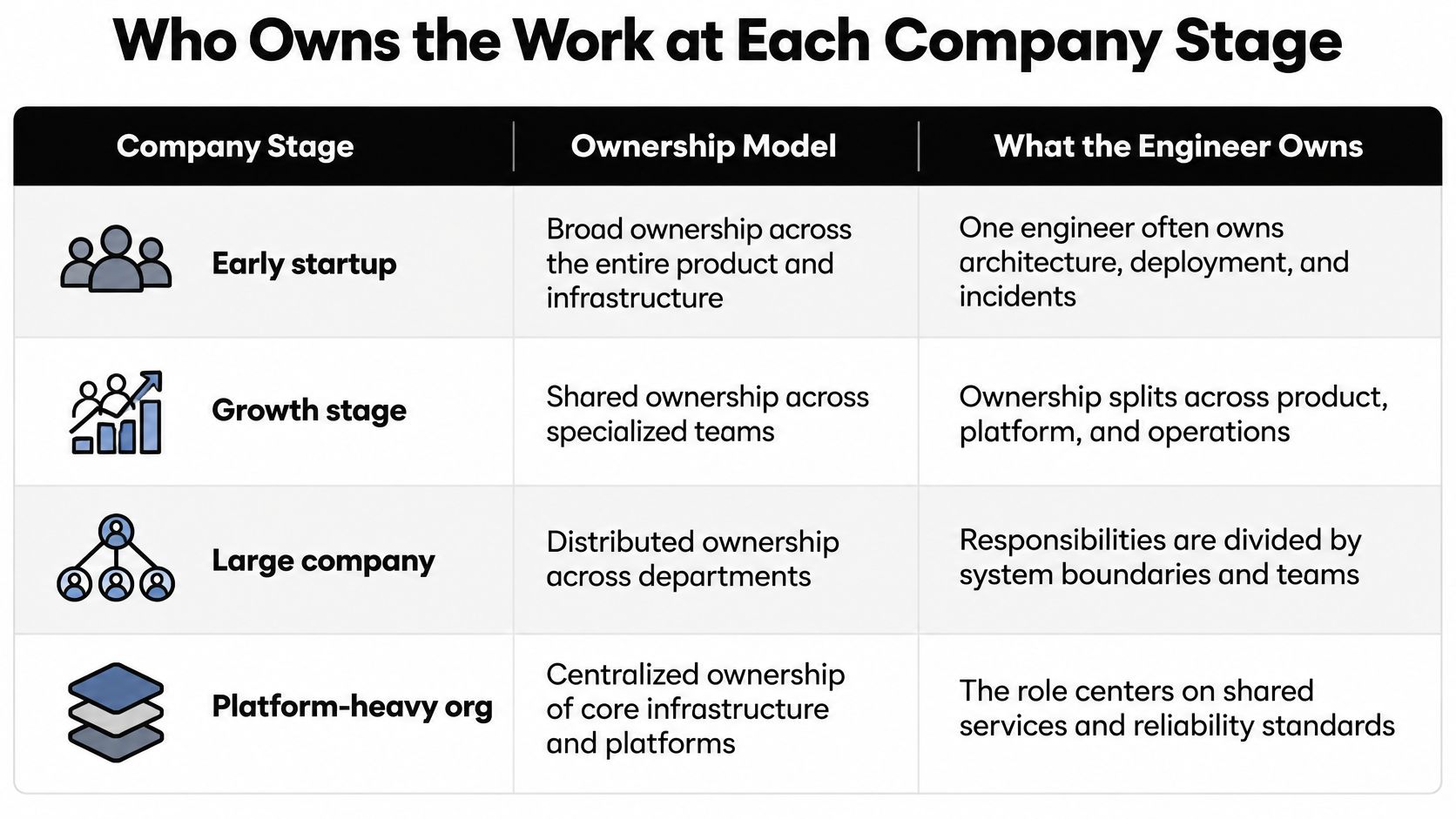
Distributed systems ownership by company stage
| Operating model | Architecture owner | Incident owner | This engineer owns |
|---|---|---|---|
| Early startup | The same engineer | The same engineer | Design, deploy, and recovery |
| Scale-up | Shared with platform | Shared with SRE | One critical path or control plane |
| Large organization | Platform and domain teams | SRE with service owners | Consistency, replication, and change safety |
| AI or multi-region platform | Platform plus this role | SRE plus service owners | Regional failure, dependencies, and serving latency |
These are operating models to choose deliberately, not universal reporting structures. A large company can have a startup-like team, and a smaller infrastructure business can need specialist ownership early.
The organizational distinction is easier to see when responsibilities are separated explicitly.
Choose an owner before choosing a title
At an early startup, end-to-end ownership shortens decisions. The engineer may design the service, deploy it, and respond when it fails because there's nobody else to hand it to. That arrangement becomes fragile when incident response repeatedly interrupts delivery.
At a scale-up, give the engineer a named critical path or control plane. Platform engineers can own cluster provisioning and shared deployment infrastructure, while SRE coordinates paging standards and incident practice. The distributed systems engineer still owns the correctness of the service's behavior; an SRE team doesn't absorb that responsibility.
In a large organization, specialization helps teams make changes without negotiating every implementation detail. Application teams own product semantics, platform teams own shared infrastructure, and the distributed-systems specialist reviews coordination and state-management risks across those boundaries.
For AI or multi-region platforms, add the actual workload to the charter. Model-serving work can require accelerator capacity planning, admission control, queue management, and latency decisions. Regional operation introduces placement and dependency questions that a generic Kubernetes job description won't capture.
A paper available through SSRN describes a job-posting sample in which observability appeared in 22% of roles and AI in 9%. Don't assume a distributed systems requisition includes model infrastructure just because the title sounds advanced.
Separate accountability from collaboration
You need collaboration across teams, but shared accountability without a decision owner produces escalation loops. Name who can halt a deployment, who authorizes failover, and who owns repairs after an incident.
Use your software development team structure to settle those boundaries before opening the search. Otherwise, interviewers will assess different jobs: one wants a platform builder, another wants an incident commander, and another wants a database specialist.
Ownership rule: If the requisition doesn't say who gets paged and who can stop a rollout, it isn't ready to recruit against.
End-to-end ownership is useful while a person can hold the system and its operational demands in their head. Specialization becomes necessary when concurrent changes and incidents require sustained attention from different people. Split the work at stable system boundaries, not wherever the org chart has spare capacity.
Use this discussion of distributed systems as a prompt for an ownership conversation with your engineering leads.
Write the on-call and rollout boundary into the requisition. That's how you avoid hiring the neighboring role and discovering the mismatch during an outage.
Skills That Survive a Bad Deploy
Job ads emphasize what's easy to search. Production work demands capabilities that are harder to express as keywords.
The SkillenAI distributed systems engineer profile reports the sampled posting rates below and summarizes a study of 26 major fintech incidents in which 80% were triggered by internal changes and 69% lacked proactive alerting.
What distributed systems job ads mention
| Advertised signal | Share of postings | What it proves alone |
|---|---|---|
| Java | 45.2% | Language familiarity, not failure design |
| Go | 32.9% | Language familiarity, not failure design |
| Kafka | 32.9% | Messaging exposure, not safe consumer design |
| Kubernetes | 30.1% | Orchestration exposure, not rollout safety |
| Observability | 15.1% | A named practice, not evidence of useful alerts |
The left column is what recruiters keyword-match. It isn't what stops an outage. The incident evidence points toward change management and detection, not another infrastructure badge.
Ask for working artifacts
Your interview should reveal whether the candidate can produce these capabilities, not merely define them:
- Idempotent consumers: Ask for a design that records a business operation and its deduplication state safely. Have the candidate locate the crash window between performing the effect and acknowledging the message.
- Bounded retries: Require deadlines, exponential backoff with jitter, retry budgets, and limits on concurrent requests. A candidate should know when to stop retrying and return a useful failure.
- Service-level objectives: Ask them to select a user-visible success measure, explain an error budget, and connect budget consumption to a release decision. Infrastructure health alone isn't a customer outcome.
- Schema-change testing: Expect compatibility checks across old and new producers and consumers. For database changes, look for an expand-and-contract sequence rather than a deployment that assumes every process upgrades together.
- Blameless postmortems: Request an anonymized example or a scenario response that identifies a missing guardrail, assigns corrective work, and explains how the team verifies completion.
These artifacts reveal different weaknesses. A candidate might understand consumer correctness but struggle to define an actionable alert. Don't collapse everything into an impression of technical depth.
Judgment must be visible too
The engineer must explain blast radius to a product manager without burying the decision in protocol terminology. They should distinguish a recoverable delay from an irreversible state change and name the condition that makes a launch unacceptable.
Ask what happens when rollback isn't enough. A reverted binary won't necessarily undo a destructive migration or retract an external side effect. Use disaster recovery planning to probe whether recovery procedures have been exercised, not merely documented.
Postmortem actions also need a path into delivery planning. For a practical way to connect remediation to accountable work, use the resource on tackling debt with The OKR Hub. Ask the candidate how they would distinguish a safety-critical fix from a broad cleanup project that never reaches production.
Language fluency still matters where the codebase requires it. Test that after the candidate's failure analysis is credible, not instead of it.
Score the competencies individually. A polished Kafka diagram with no account of how to reverse or contain a bad change is a no-hire for an ownership role.
Architectures They Are Hired to Keep Alive
Cloud infrastructure made creating distributed systems easier. It didn't make their coordination problems disappear.
An arXiv review of distributed computing traces viable web-delivered software to the late 1990s and the introduction of Amazon Elastic Compute Cloud and Simple Storage Service to 2006. On-demand provisioning and consumption-based billing let teams add capacity without buying and installing every machine themselves.
That shifts engineering attention toward automation, distributed state, observability, and recovery. A useful architecture review starts with a failure, not a shopping list of managed services.
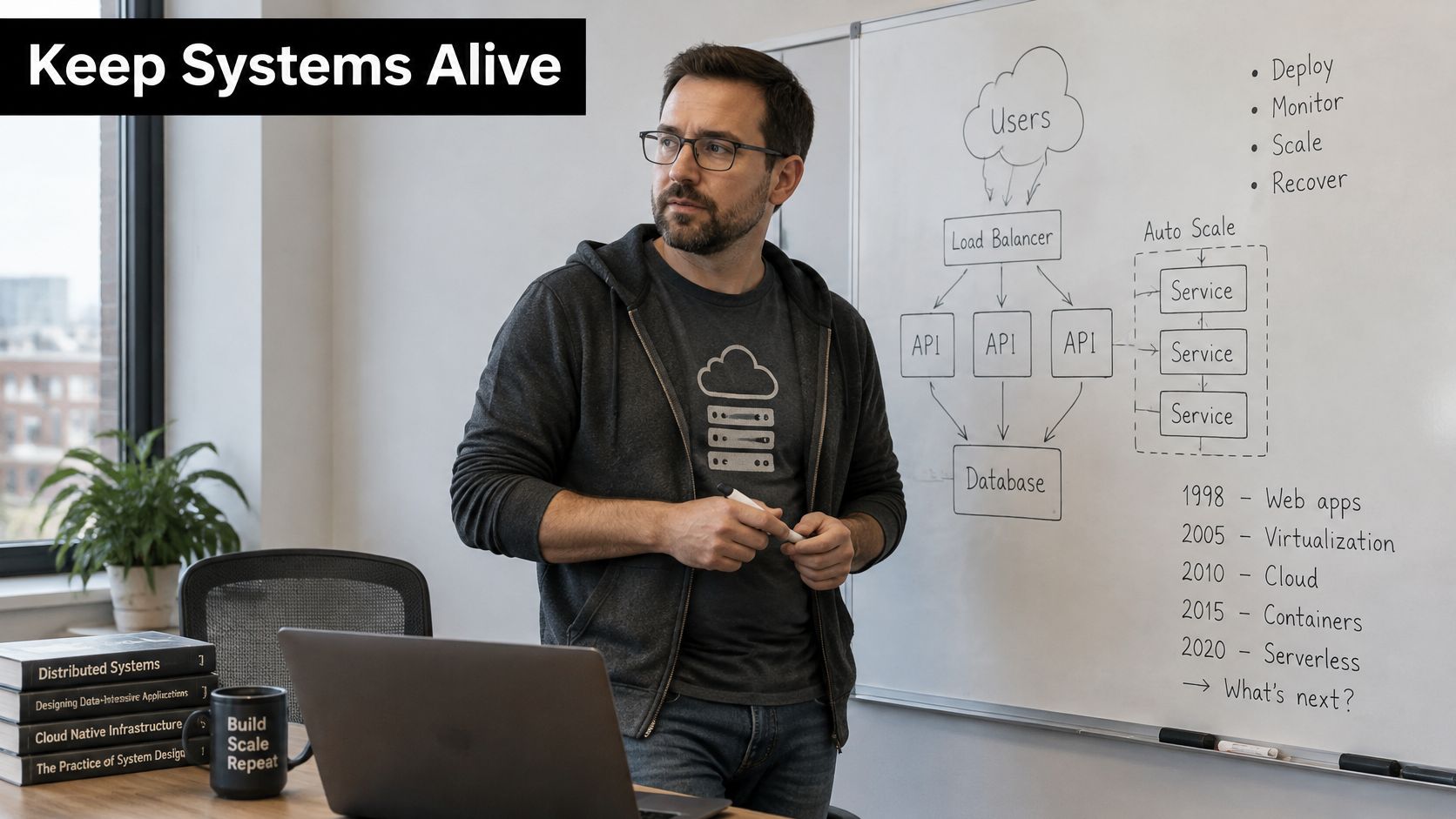
A whiteboard should expose those decisions, not just display infrastructure.
Regional services and asynchronous pipelines
A regional service with a replicated database. Say an account-management service acknowledges an update before a replica receives it. The primary becomes unavailable, and the team promotes that replica. The customer's confirmed update is now missing.
The engineer must define which writes can be acknowledged under which replication conditions. Ask a candidate for a promotion runbook that addresses replica lag, fencing the former primary, and reconciling uncertain writes. The useful tradeoff is consistency against latency and availability, not whether replication is generally good.
A queue-backed pipeline. A document-processing service calls an unavailable third-party API. Workers repeatedly retry, queue age rises, and the dependency receives a flood of requests when it begins recovering.
The design decision is how to enforce backpressure across the pipeline. A candidate can present a worker implementation or test harness showing bounded concurrency, delayed retries, poison-message handling, and controlled replay. Recovery should not immediately recreate overload.
Regional control and disconnected execution
A multi-region control plane. A partition separates regions while both continue accepting changes to the same resource. Operators later discover incompatible assignments, each valid according to its local records.
The engineer must choose a write-authority model: a designated home region, quorum-backed coordination, or explicitly mergeable operations. Ask for a state-transition model and a partition test, including how the system rejects stale actors. A claim that the database handles it isn't a substitute for explaining the database's guarantees.
An edge or fog deployment. A device loses its cloud connection but continues acting on cached instructions. The cloud subsequently revokes permission for an operation the device still believes is allowed.
The question is what remains safe while disconnected. Require explicit rules for local authority, instruction expiry, queued actions, and reconnection reconciliation. A useful candidate artifact is an offline-behavior specification with tests for reconnecting after state has changed.
These patterns appear in SaaS, fintech, health tech, telecommunications, media, and public-sector systems. Industry context changes the consequence of an error, but it doesn't remove the need to define authority and recovery.
Use cloud-native architecture discussions to inspect those choices. Each architecture should yield a concrete evaluation artifact: a failover procedure, an overload test, a state model, or a disconnected-operation contract.
Seniority Levels and Pay Signals
Pay for this role is easy to benchmark badly. The closest occupational categories, such as network architecture, pay differently by experience, scope, and location, so level against local benchmarks for the specific charter rather than anchoring on a single national figure.
Hiring volume gives context without setting your budget. CompTIA reported nearly 470,000 active U.S. employer postings for technology positions in May 2025, spanning software developers and engineers, systems engineers and architects, and cloud-related roles. That volume doesn't establish scarcity for your particular requisition or justify a specialist premium on its own.
Level by the decisions the person owns
Leveling a distributed systems engineer
| Level | Scope | How to set pay |
|---|---|---|
| Senior | A critical service, its deploys, and its on-call quality | Benchmark against local service-owner compensation |
| Staff | Failure and consistency standards across several teams | Benchmark cross-team authority separately before adding a premium |
| Principal | Control-plane or multi-region design and complexity limits | Use principal infrastructure comparisons |
| Head of infrastructure | Org design, hiring, and reliability outcomes | Use a leadership compensation band |
Treat the right-hand column as rules for setting compensation. No occupational proxy establishes level-specific pay, equity, bonuses, or location adjustments, so never inflate one into an offer range with invented multipliers.
A senior engineer independently owns a critical service's operating quality. They plan a risky change, coordinate its execution, and leave the service easier for the next responder to understand.
A staff engineer changes how several teams work. The contribution might be a common compatibility policy, a cross-service migration strategy, or a release standard other teams adopt. Reviewing more diagrams isn't sufficient.
A principal engineer makes consequential system-wide decisions and limits complexity. They reject a technically impressive architecture when the organization can't operate it safely.
Promotion requires a different kind of evidence
Senior-to-staff progression requires repeated safe change plus influence beyond the engineer's own service. Look for teams that adopted their approach without requiring the candidate to personally supervise every deployment.
Staff-to-principal progression requires durable architectural judgment. Can the person make other senior engineers more effective, resolve competing system guarantees, and prevent an expensive commitment the business doesn't need?
Don't use a staff title to compensate for a senior-shaped job. You'll create a leveling problem before the person starts.
Moving toward head of infrastructure or CTO is a separate choice. The work shifts toward organization design, budget allocation, hiring, succession, and business outcomes. Exceptional protocol knowledge doesn't establish readiness to run that organization.
In an offer conversation, compare the actual scope, location, compensation components, and operational burden against relevant local roles. Keep salary separate from total compensation so neither side mistakes equity for guaranteed cash.
If the search stalls, inspect the job before raising the budget. An ambiguous charter, unbounded on-call expectations, or principal-level accountability paired with senior-level authority repels qualified candidates. Price the demonstrated ownership: an engineer who stood up Kafka once and an engineer who kept it alive through broker failures and partial outages are different hires. A broad posting count won't tell you how long your particular search should take.
How to Interview and Write the Req
Run a loop that produces evidence against an agreed job. Don't assemble a collection of favorite technical questions and hope the debrief reveals a hiring standard.
Before interviews begin, assign each interviewer a competency and an artifact to capture. Candidates should receive the same core scenario, equivalent constraints, and a clear explanation of what the exercise assesses.
Use this hiring checklist to keep the process anchored in production responsibility.
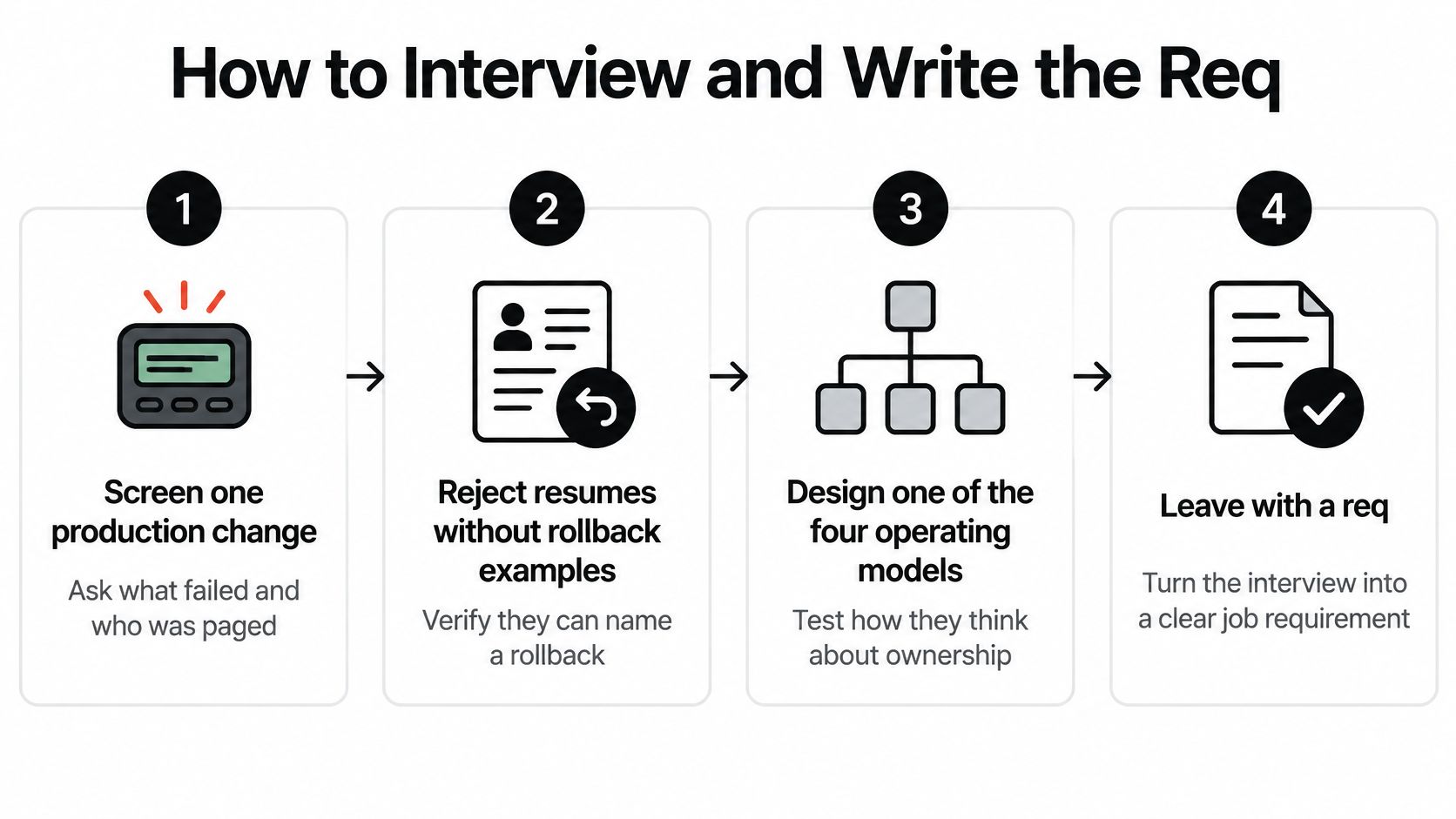
Run an evidence-led interview loop
Screen a production change. Ask the candidate to choose a deployment, migration, or configuration change they helped own. Establish their personal contribution, what failed or nearly failed, who was paged, and what customers experienced. Don't accept a team accomplishment without clarifying the candidate's decisions.
Verify a reversal or containment example. A résumé doesn't need the word rollback, but the conversation must establish that the candidate can name a concrete recovery path. Ask what state changed and whether reversing the software could restore that state. Reject ownership claims that remain vague after follow-up.
Design a relevant architecture. Choose a regional service, queue-backed pipeline, multi-region control plane, or disconnected edge system that resembles your work. Introduce a failure after the candidate establishes normal behavior. Use architecture interview questions to structure the discussion, but follow the candidate's assumptions rather than reading a trivia script.
Probe the operating details. Ask how the consumer handles duplicate delivery, how retries avoid overload, which SLO could block a launch, how schema compatibility is tested, and what a postmortem changed. Select a detail and follow it into implementation. A candidate who names a pattern should also explain where its state lives and how it fails.
Test risk communication. Ask the candidate to explain the proposed change to a non-engineering leader deciding whether to launch. Require a clear account of affected customers, reversible consequences, and unacceptable risk. Assess whether they can recommend a decision without either exaggerating certainty or hiding behind jargon.
Score evidence independently. Record demonstrated production judgment, sound theoretical reasoning, and unresolved gaps separately. Give partial credit for a correct explanation when production exposure is limited. Give no credit for tool names without an account of behavior.
Debrief against the job. Meet the same day where practical, with written evaluations submitted before discussion. Compare evidence with the selected ownership model and level. Resolve disagreements by identifying missing evidence, not by letting the most senior interviewer's enthusiasm settle the decision.
Consistent prompts and documented criteria help you distinguish capability from presentation style. For a complementary process resource, use the guide to defensible hiring with Paradigm International, particularly when standardizing interviewer expectations.
A coding exercise that never tests timeout or failure behavior can't establish distributed-systems competence. A design session that rewards drawing Kubernetes components without checking state transitions is equally weak.
Leave with a usable requisition
Write the role description around a system and its operating contract. This example uses a service-owner scope:
You'll own the event-processing service that turns customer actions into billing records. You'll design for duplicate delivery, dependency outages, and compatible schema evolution. You'll own service on-call and application rollout decisions, while platform owns cluster infrastructure and SRE coordinates incident response. Your initial outcome is a deploy and replay path that preserves billing correctness during interrupted processing.
That description gives interviewers something concrete to assess. Add the level, reporting relationship, and decision authority without replacing the operating contract with a long technology inventory.
Make the demonstrated competencies must-haves. Treat a particular language as optional unless immediate work in the existing codebase makes proficiency necessary. Security requirements, access constraints, and domain-specific correctness obligations belong in the requisition when they affect the job.
Choose the engagement before opening the search
Use direct hire for a critical path that needs lasting ownership. Contract-to-hire can help assess production judgment when the engagement includes meaningful work, appropriate access, and fair evaluation criteria. A fixed-term contractor fits a bounded migration with explicit acceptance tests and a named employee who will own the result.
Don't use a contractor as an unnamed substitute for missing organizational accountability. Someone still needs authority over tradeoffs and responsibility after the engagement ends.
Lock ownership, level, and engagement before sourcing begins. Pass candidates who can evolve the system under partial failure and explain when a rollout must stop, not candidates who merely recognize your stack.
TekRecruiter offers direct hire, contract-to-hire, and engineering staff augmentation for software, platform, SRE, and cloud infrastructure roles. Bring your system ownership, failure modes, and hiring level to TekRecruiter to shape a search around production judgment rather than tool matching.
 Ron SmithPresident & Lead RecruiterTekRecruiter