How to Find Robotics Engineering Talent in Miami
Learn how to find robotics engineering talent in Miami with a skills map, local sources, work samples, and hiring models.
What if the engineer you need in Miami has never held the title robotics engineer, and the person who has held it can't get your system running on real hardware? That's the gap most searches run into. Teams filter for a degree and a keyword, then discover in week two that the hire can write an algorithm but can't own sensing, control, compute, and deployment together.
Learning how to find robotics engineering talent in Miami starts with a different question. Don't ask who looks like a robotics engineer on paper. Ask who can prove systems readiness, meaning they've built something, tested it, watched it fail, and recovered it. I would hire for that evidence first and treat titles as a weak secondary signal.
Where Miami Robotics Talent Actually Comes From
Miami doesn't have a deep bench of people whose diploma says robotics, and you don't need it to. The stronger pool sits across adjacent engineering tracks, then gets proven on projects in labs, capstones, competition teams, and field work. Start by deciding which of three tracks your open seat is, because each track pulls from different people and demands different proof.
| Track | Core skills | Where to look in Miami | Proof to require |
|---|---|---|---|
| Robotics software | C++, Python, ROS or ROS 2, one simulator | FIU and University of Miami labs, open-source contributors, nearshore software | Repository, architecture diagram, tested code |
| Controls and perception | Kinematics, control loops, sensor fusion, computer vision | Capstones, applied-research staff, vision and autonomy labs | Simulation plus a hardware-validation story |
| Hardware and mechatronics | Embedded systems, sensors, mechanical integration, field deployment | Field service, advanced manufacturing, technicians moving into engineering | Logs or visuals of a working system and a failure-recovery example |
Why a Title Search Starves Your Funnel
The federal training picture explains the math. In the federal occupational-training data for Florida, Florida International University completions for the July 1, 2024 to June 30, 2025 reporting year included 10 bachelor's degrees in general engineering and 5 master's degrees in telecommunications engineering. Those are the cited program counts feeding a much wider occupation, not a ready-made robotics class you can hire from every spring.
That same dataset maps robotics engineering to systems, electrical, computer, telecommunications, and other engineering programs. In practice, that's exactly how the work gets done. A controls engineer who has tuned loops on real actuators, an embedded engineer who has debugged a sensor that misbehaves under vibration, and a computer vision engineer who has validated a model outside a clean dataset can each be the right hire for the right track.
If a candidate can't show you a system they touched, a test they ran, and a failure they handled, a robotics title on the resume doesn't close that gap.
Point Each Track at a Real Source
For robotics software, look where code meets machines. FIU and University of Miami research labs, capstone teams working on autonomy, and engineers contributing to open-source ROS projects all produce people who write C++ for real-time components and Python for tooling and experiments. Ask for the repository and the architecture diagram before you ask where they went to school.
For controls and perception, your sources are the labs and applied-research staff working on kinematics, motion, and vision. A capstone lead who fused noisy sensor data and then discovered the simulation was lying about friction has a story worth hearing. For hardware and mechatronics, don't overlook field-service technicians and advanced-manufacturing engineers in South Florida who already integrate equipment for a living. They often bring the deployment instincts that pure software hires lack, including how to read logs on a factory floor and how to get a machine back up safely.
Build the Relationship Before the Requisition
Local pipelines reward employers who show up early. Get to know FIU engineering faculty, capstone sponsors, research labs, and student organizations tied to autonomous systems, industrial automation, and embedded work. Offer a guest critique, sponsor a project, or host a lab visit, and you'll meet juniors for internships and experienced alumni who stayed connected to the campus.
That investment also fits where the regional market is heading. If you're weighing Miami against other hubs, it's worth reviewing the outlook for tech jobs in South Florida before you assume you must recruit every seat from Boston or the Bay Area. The local pool is real, it just doesn't sort itself by job title.
Before anyone writes a requisition, identify the one track the role needs most. A role that needs all three is either a senior systems lead or two hires pretending to be one. I would split it on paper now rather than discover the overload after the offer letter.
Write the Robotics Brief Before You Search
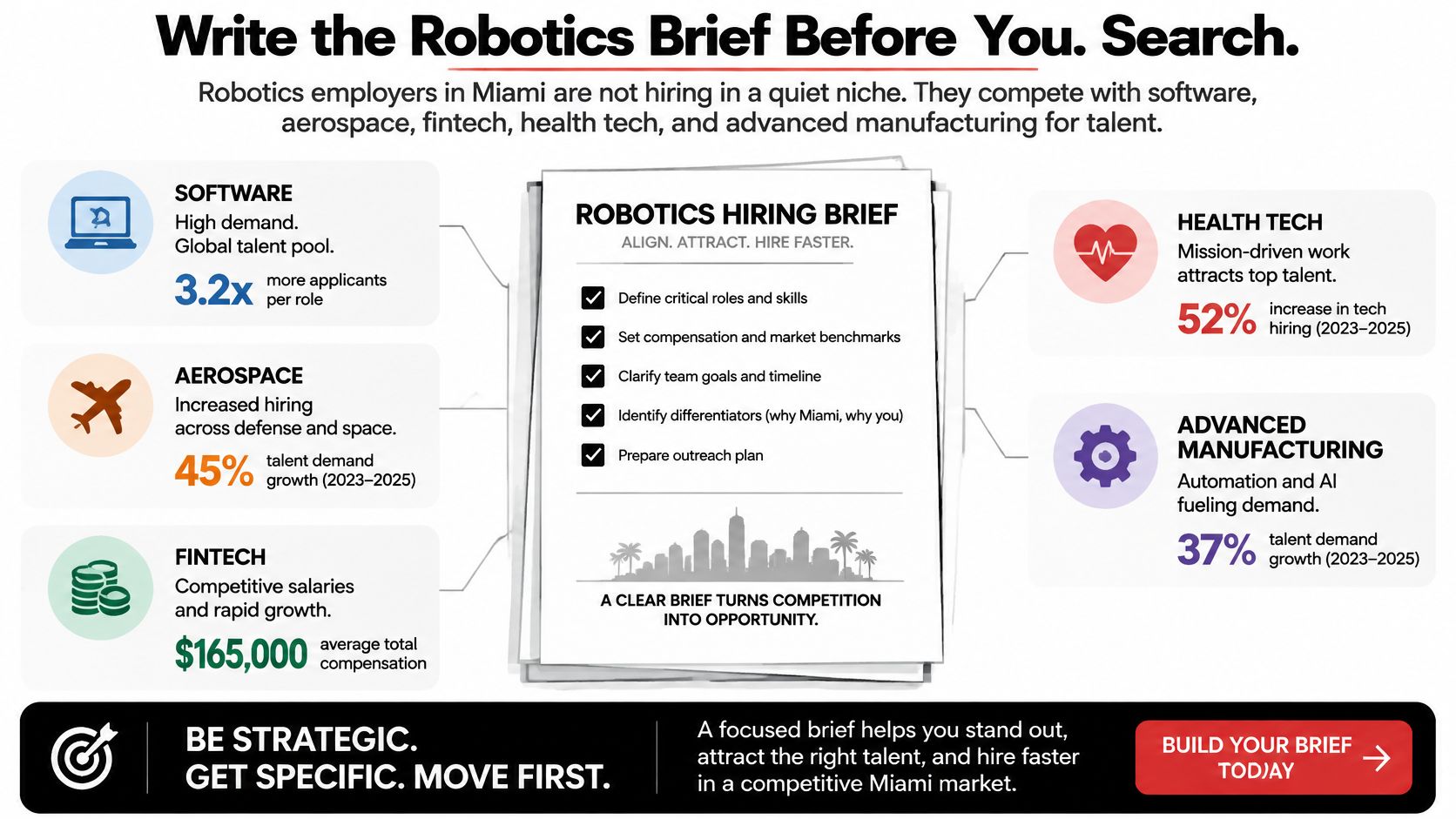
You're not hiring into a quiet niche. The University of Miami engineering materials report that 57 companies committed to expand or relocate to Miami-Dade County over a recent one-year period, with a 29% increase in technology job postings and hiring of nearly 700 software developers and analysts each month. Those aren't robotics headcounts, and I wouldn't treat them as one.
They do tell you who else is calling your candidates. Software, aerospace, fintech, health tech, and advanced manufacturing firms all want people who can write real-time code, work with data, and reason about systems. If your brief is vague, you'll lose strong engineers to employers who can describe the work, the setting, and the on-site expectation in the first conversation.
The market pressure is easier to see when you lay the competing sectors next to the brief itself.
Four Fields on One Page
Keep the brief to a page and force decisions in four fields:
- The system they'll own: Name the robot, cell, vehicle, or platform, plus the part that's theirs. "Own perception for a mobile base" beats "join the robotics team."
- The operating setting: State whether it's a lab prototype, a warehouse, a marine system, a minerals process, or a factory line. Dust, water, vibration, and people nearby change the engineering completely.
- Miami presence: Write down how many days must be on site, which days involve hardware, and what's hybrid. Candidates won't relocate on a guess.
- The bar for done: Say whether success is a research demo or a system that fails safely in the field, logs its state, and can be supported by someone else.
That last field does the most work. A demo rewards novelty. A field-ready system rewards testing, observability, and boring reliability, and it'll pull a different kind of candidate into your funnel.
Limit Must-Haves to the Track
List only the skills the chosen track requires on day one. Everything else goes in a "can learn here" column that you mean. When you pile ROS, deep learning, embedded Linux, mechanical design, and cloud infrastructure into one junior req, you're not raising the bar. You're shrinking the pool to people willing to exaggerate.
Explicitly accept adjacent proof. A candidate from cloud systems, real-time software, data engineering, AI, cybersecurity, embedded systems, or automation can be a strong fit if they can explain the constraints they worked under and the operational outcome they produced. That's what you should screen: how they built it, what broke, and what changed because of their decision.
Say a warehouse team needs lidar fusion and motion control for a mobile robot working near people. The brief should screen for noisy sensor handling, control-loop timing, and safe stopping behavior, not for a generic software resume that mentions robotics once. A strong applicant might come from industrial automation or autonomous vehicles and show you test results from a moving platform.
Make that one page the document every recruiter, sourcer, and interviewer uses. If a screen, a work sample, or a debrief can't be tied back to a field on the brief, cut it. You'll move faster and argue less.
How to Source Robotics Engineers in Miami
Run sourcing as a funnel with a fixed order. Don't start with a job board keyword search and hope Miami sorts itself out.
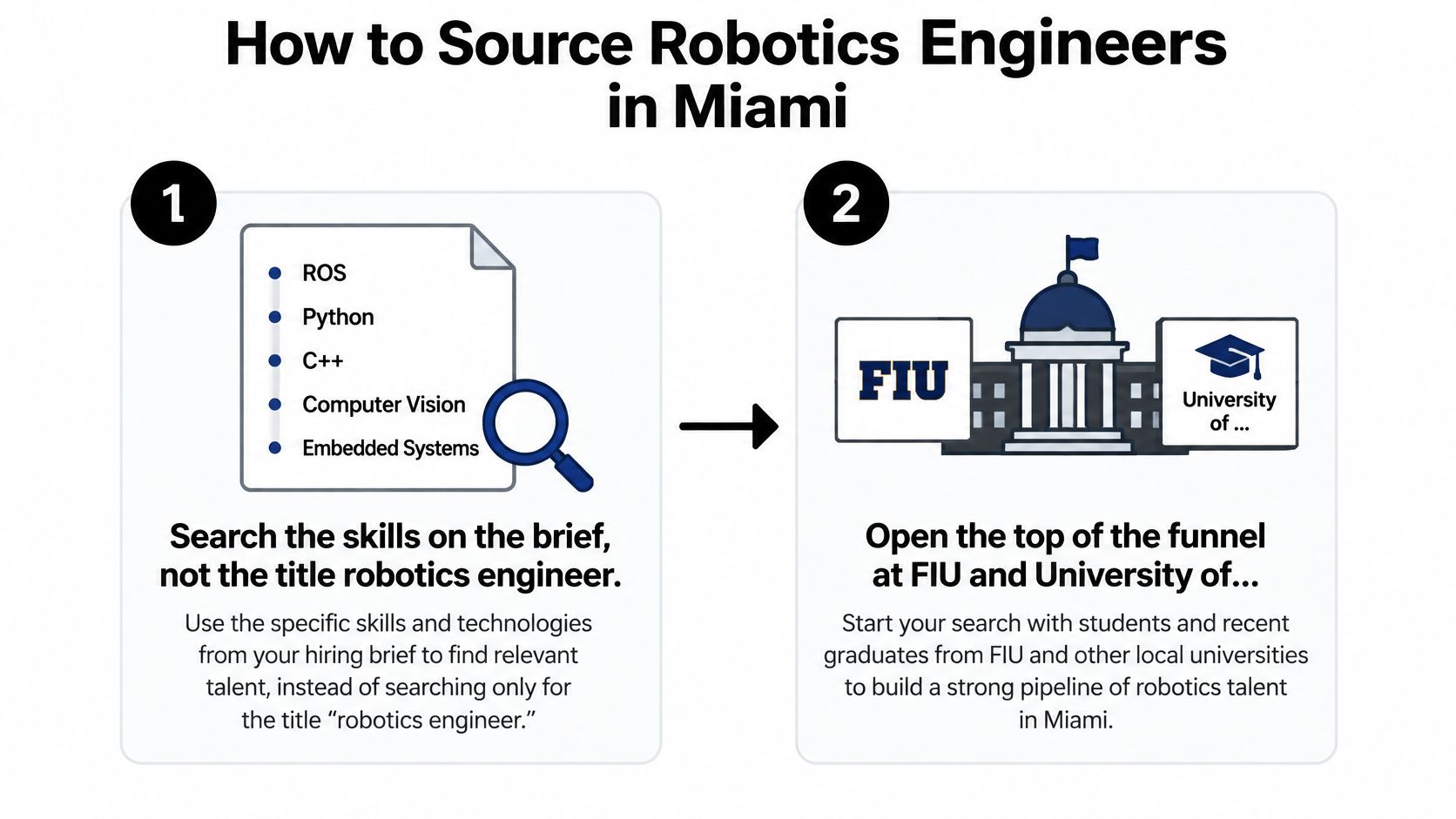
The six-step flow below keeps the sequence tight, from skills search to portfolio proof.
A Six-Step Funnel You Can Run This Month
- Search the skills on the brief, not the title. Build your strings around ROS or ROS 2, sensor integration, kinematics, control systems, embedded C++, a named simulator, or computer vision. Title-only searches miss the automation engineer and the research staffer doing exactly your work under another name.
- Open at FIU and the University of Miami. Go to engineering departments, capstone teams, research labs, and the faculty who supervised autonomy, vision, or embedded projects. Ask who built the thing that moved, not who has the highest GPA.
- Add the people job boards miss. Competition teams, advanced-manufacturing projects, field operators, technicians, and postdoctoral or applied-research staff who want production exposure belong in the same funnel. I would map them by project, not by current employer brand.
- State location terms in the first note. Put hybrid days, Miami on-site hardware days, or relocation expectations in the opening outreach. Engineers with options won't take a call to discover basics you could've written in two lines.
- Widen deliberately when local supply is thin. For software, simulation, or test automation, extend to other U.S. markets and to English-speaking Latin America in overlapping time zones. Keep hardware integration anchored where the machines are.
- Require a portfolio before interviews. Ask for a repository, an architecture diagram, test results, and a short demonstration of a functioning system. A resume alone shouldn't earn a slot on your calendar.
The portfolio gate matters because robotics capability leaves artifacts. Good guidance on recruiting software development talent makes a similar point for software roles, and it applies even more here, since a robot either moved under control or it didn't. If you're tightening your own top of funnel, these candidate sourcing strategies pair well with a portfolio-first screen.
A short walkthrough of the sourcing logic can help hiring managers see why proof beats pedigree.
Treat Portfolio Benchmarks as Directional
One published robotics-hiring analysis reports that explicit ROS requests in job postings increased 73% over five years, candidates with documented project portfolios were 3.7 times more likely to reach final interviews, and 76.3% of successful hires showed both code repositories and visual evidence of working systems. Use those numbers as directional support for a portfolio gate, not as official labor statistics.
Portfolio rule: No repository, diagram, test result, or working-system visual means no interview yet. Offer a short window to send proof, then move on.
The pitfall at this stage is over-filtering. Don't reject open-source work because it wasn't shipped at a famous company, a competition robot because it was built by students, or a research prototype because the candidate hasn't held a product title. Judge the evidence: clean node boundaries, tests that run, sensor data handled accurately, and a demo that matches the claims.
You'll end up with fewer names than a keyword blast produces. You'll also end up with people you can evaluate, which is the point of learning how to find robotics engineering talent in Miami without burning your team's interview hours.
Run a Systems Readiness Work Sample
Replace the resume tour with one shared exercise. Every finalist gets the same core prompts, the same time box, and the same scoring rubric, so you're comparing engineering judgment instead of interview polish.
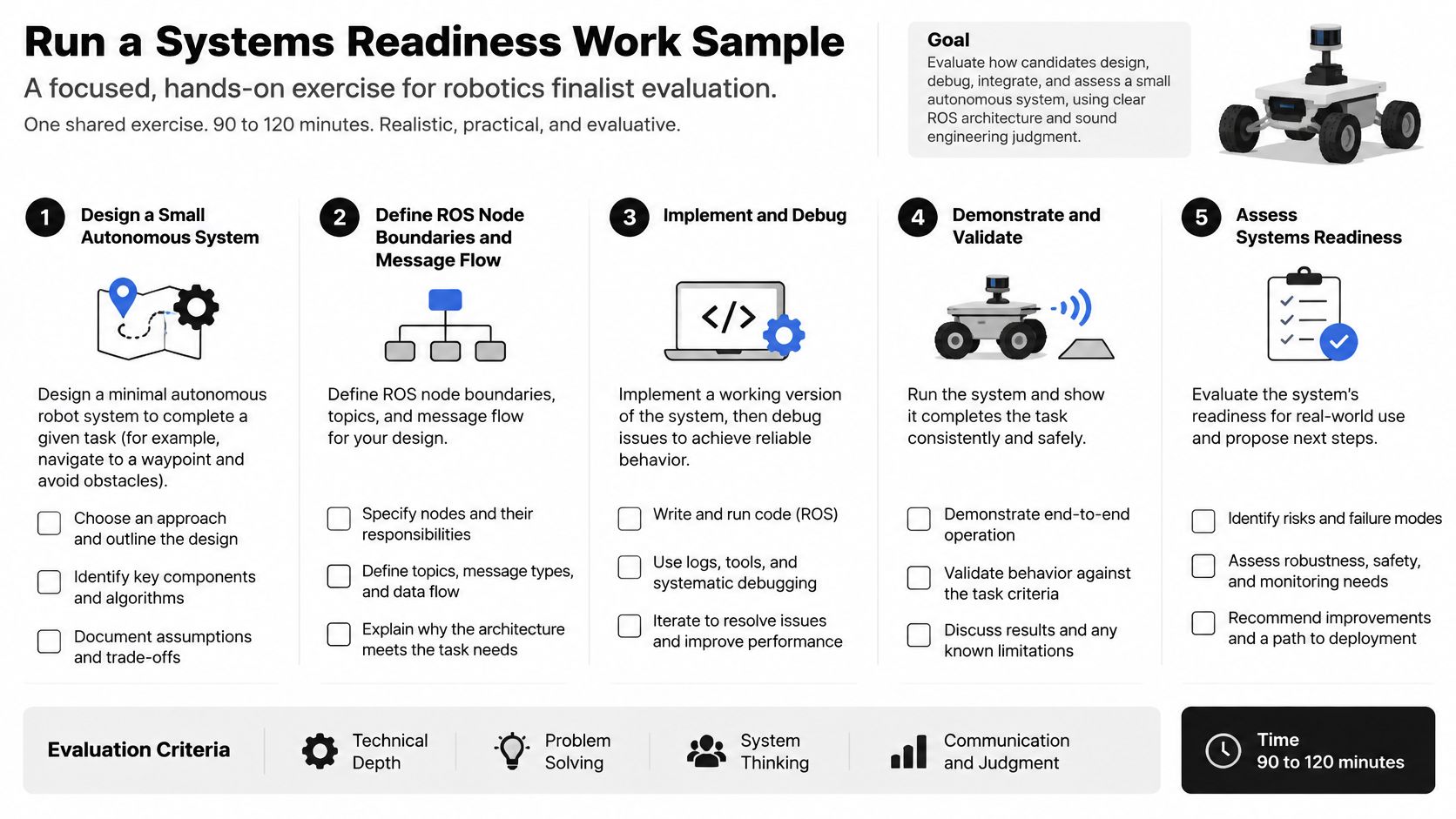
This checklist view breaks the exercise into the pieces a candidate has to produce under time pressure.
The 90 to 120 Minute Exercise
Give candidates 90 to 120 minutes to design and debug a small autonomous system. Ask them to define ROS node boundaries and message flow, fuse a stream of noisy sensor data, explain control-loop timing, name the failure modes they're worried about, and submit tested C++ or Python in a containerized environment. Keep the scope small enough to finish, but real enough that shortcuts show.
Score predetermined dimensions on anchored 1 to 5 rubrics. Two interviewers score independently before they compare notes, and neither gets to rewrite the other's sheet in the debrief. That discipline is what makes the exercise a measurement instead of a vibe.
| Dimension | Evidence to look for |
|---|---|
| Systems reasoning | ROS node boundaries and message flow defined clearly |
| Algorithmic correctness | Tested C++ or Python that handles the stated sensor data |
| Hardware and software trade-offs | Explains sensing, compute, and control-loop timing choices |
| Observability | Logs, metrics, and visualization that show system state |
| Testing | Test results with simulation behavior checked against hardware |
| Safety | Named failure modes and recovery behavior |
| Communication | Clear explanation to both engineers and non-specialists |
Anchor each score before you meet anyone. A 5 on safety, for example, names specific failure modes, describes detection, and states the recovery behavior without prompting. A 2 waves at "add some error handling." Written anchors keep a confident talker from collecting points for style.
Add a Short Architecture Discussion
Miami employers often need a hybrid profile, not a specialist who lives in one layer. Miami-area robotics postings point to combinations of kinematics, dynamics, motion planning, control, Python and C++, simulation, embedded systems, and physical deployment. So after the exercise, ask the candidate to walk you through a robot they built.
Probe the trade-offs among sensing, planning, controls, compute, safety, and deployment. Ask how simulation results were checked on hardware, what the logs showed when the machine disagreed, and what they changed. Then push on testing, failure recovery, observability, field support, and how they explained problems to operators or product partners. That's where you separate a research prototype from a production-capable engineer.
This is also where a broader skills-based hiring approach pays off. You're not counting keywords or degrees. You're scoring whether the person can connect layers of a system and defend the choices with evidence.
Why Structure Beats Conversation
The U.S. Office of Personnel Management guidance on structured interviews states that higher-structure interviews improve validity, rater reliability, and evaluator agreement, and a cited meta-analytic benchmark places structured-interview predictive validity around 0.42 versus 0.19 for unstructured interviews. Base your prompts on the relevant competencies, keep them consistent, and you'll make decisions you can defend later.
Track the funnel by sourcing channel: qualified-to-screen, screen-to-work-sample, work-sample-to-onsite, offer acceptance, and 90-day retention. Compare university, community, referral, and wider searches against actual outcomes instead of resume volume. If capstone referrals keep passing the work sample and job board applicants don't, put your time where the evidence points.
Avoid trivia questions that reward memorization, oversized unpaid take-homes that screen out working engineers, and debriefs where one charismatic interviewer overrides the rubric. I would rather re-run a tight exercise than hire the best storyteller in the room.
Choose the Hiring Model and Start This Week
Choose the hiring model based on who will direct the work, how long you need the person, and whether the role requires regular access to the machine.
| Model | Best when | Speed | Cost or terms | Candidate it fits |
|---|---|---|---|---|
| Direct hire | You need an owner for controls or embedded work | Permanent search | U.S. salary | Experienced engineer with hardware ownership |
| Contract-to-hire | Strong talent needs production exposure before a permanent offer | Starts as a contract | Converts to permanent when ready | Researcher or field engineer moving into product work |
| IT staff augmentation | The team needs capacity under its own leadership | Fast start once vetted | Contractor rate, flexible term | Vetted contractor on the robotics stack |
| Nearshore | Local supply is thin for software, simulation, or test automation | After a targeted search | About 50% lower cost than a U.S. hire | English-speaking Latin America talent, including Brazil |
How the Models Map to Miami Talent
Miami robotics hiring draws on adjacent engineering tracks, labs, and field roles. Match the model to the work: a deployment seat may call for field experience and hardware access, while simulation or test automation can often be done remotely.
Use direct hire when an experienced controls or embedded engineer will own the system long term. Choose contract-to-hire when a researcher or field engineer needs production experience before a permanent offer. Staff augmentation fits when your lead can direct the work and needs additional capacity. Nearshore fits software, simulation, or test automation that does not require daily access to the machine. For a closer look at the trade-offs, read this guide to direct hire versus using a staffing agency.
For a Miami minerals-robotics startup building an underwater collection system, keep perception and field integration local so engineers can test in real water and debug hardware in person. Nearshore support can handle simulation and the automated test bench. The division follows the work, not a headcount quota.
Your Moves This Week
- Write the one-page brief for the seat blocking the roadmap.
- List five FIU or University of Miami contacts connected to the relevant track, then send the first notes.
- Run the work sample with two independent scorers.
- Choose the hiring model from the table before discussing offers.
- Get technical help screening if your team cannot assess ROS, embedded work, and hardware ownership in one conversation. A technical recruiter who can evaluate a repository can help filter candidates more effectively than a generalist desk sending volume.
Define the track, ask for evidence, score candidates consistently, and choose the model that fits the role. To start with a one-page brief for your next robotics hire, contact TekRecruiter, which recruits for direct hire, contract-to-hire, staff augmentation, and nearshore roles.
 Ron SmithPresident & Lead RecruiterTekRecruiter