Recruiting Agency Miami: How CTOs Choose the Right Firm
Recruiting Agency Miami. A practical guide for CTOs and hiring leaders on choosing a recruiting agency in Miami for technical roles
Your senior DevOps req has sat open for six weeks. The last three candidates could name every tool on the job description and still couldn't walk through an incident they owned. The generalist firms calling themselves a recruiting agency Miami option keep cycling polished résumés through your loop. You're the CTO who has to sit in those interviews, and keyword overlap is a poor stand-in for competence.
The same pattern shows up on AI platform engineers, cloud leads, and technical account executives. A specialist changes the inputs. Recruiters pressure-test architecture. The pipeline is built for people who aren't applying. The screen asks how the system was built, why that design won, and what it did in production.
You need three decisions, not a directory of logos. Which engagement model matches this req. When a Miami-only search stops making economic sense. How AI-assisted sourcing stays auditable instead of becoming an opaque filter. Office count and brand recognition are weak filters. Technical judgment, documented scoring, and commercial terms you can audit are what predict hire quality.
Why Miami Hiring Leaders Need a Specialized Recruiting Agency
A VP of Engineering I advise had a platform role open through two generalist shops. Both sent people whose résumés listed Kubernetes, Terraform, and AWS. In the room, none of them could explain a rollout they had reversed, a cost trade-off they had made, or a failure they had owned past the postmortem. Titles matched. Ownership didn't. Weeks of interview time went to candidates who had never shipped the system the req actually needed.
That gap is what specialization is for. A technical recruiter doesn't score a résumé by string match. They ask what the candidate designed, which constraints forced the design, and which production numbers moved. They know the difference between someone who configured a pipeline and someone who owned reliability when it broke on a Friday. For senior SaaS and engineering searches, identical titles hide very different levels of architectural ownership. If your recruiter can't hear that difference, your hiring managers will waste the loop finding it.
What changes when the firm is technical
Passive access. The engineers you want are employed, and they don't answer a blast about "exciting opportunities in Miami." A specialist already talks to them about stack, scope, and compensation, so the first slate isn't whoever applied this week.
A real screen. The conversation covers build method, design choice, and business impact. Answers an automated résumé parser could produce don't pass.
Speed on scarce roles. DevOps, AI platform, and security reqs don't get better by waiting for inbound. They get better when someone is already in market with people who can do the work.
Practical rule: If the recruiter can't challenge a senior engineer's design story on the intake call, they won't challenge it before they send you the person.
Brand recognition and headcount don't tell you any of this. A large database of keyword-matched profiles makes the problem worse, because it looks like a pipeline while it isn't one. Judge the firm on whether it can separate people who shipped production systems from people who listed the tools those systems used.
Understanding the Miami Technical Talent Market
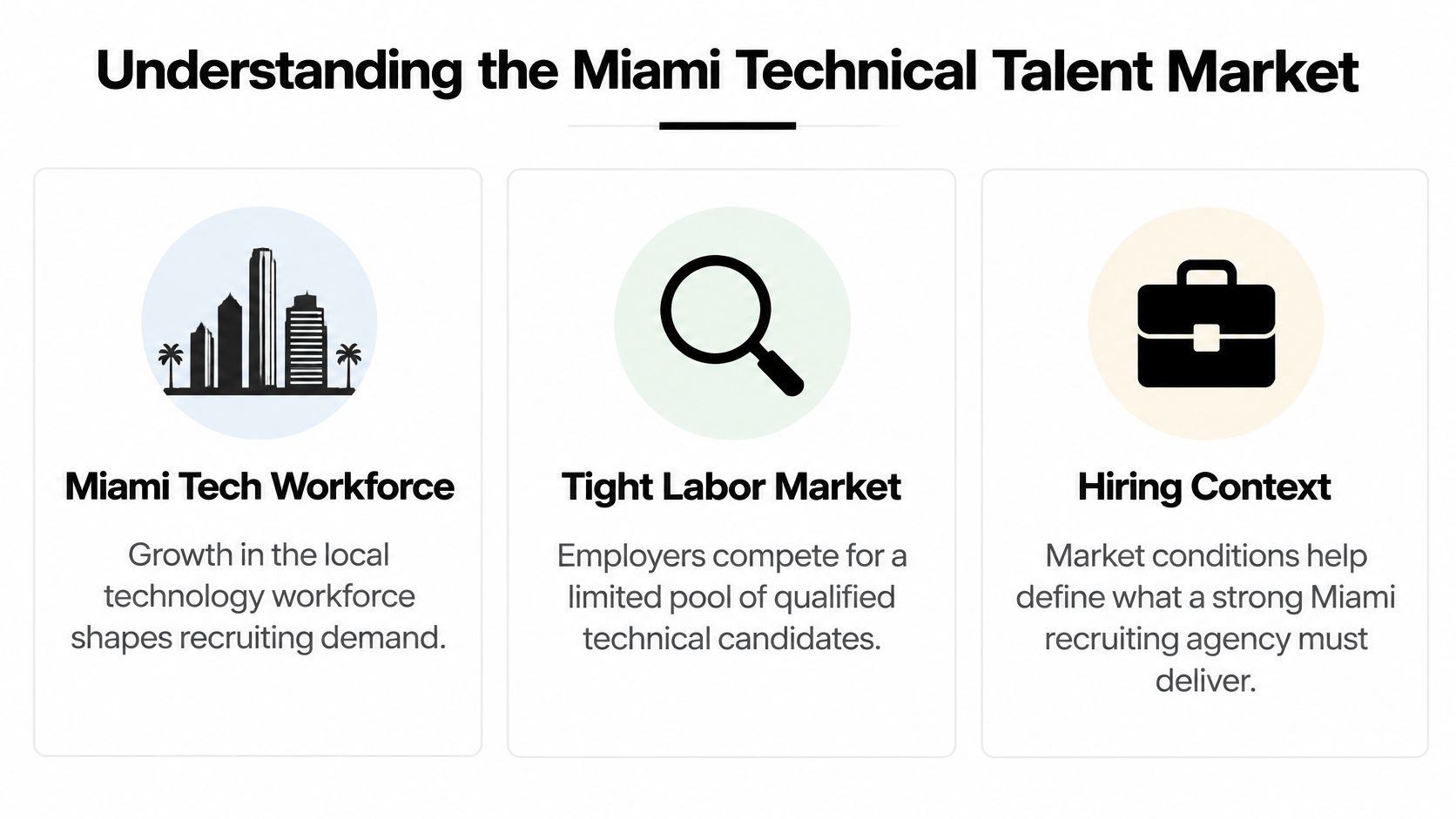
Miami is not a services town that happens to have a few tech jobs. In Miami-Dade County, advanced-industry occupations, including computer systems design, software publishing, and advanced manufacturing, rose from about 43,000 workers in 2010 to about 62,000 in the first quarter of 2021. Their share of the county workforce moved from 5.3% to 6.5%, roughly 44% more workers and a 1.2-point rise in concentration, according to reporting in the Miami Herald on the region's advanced industries. Across the broader metro, including Palm Beach County, STEM employment grew from 98,390 jobs in 2015 to 110,790 in 2020, a 12% increase. STEM's share of the regional labor force went from 4.0% to 4.4%. The Bureau of Labor Statistics counted 58,580 computer-related occupations in South Florida in 2020, about 700 more than the year before.
A tight market on top of that growth
By November 2024 the county was tight, not just growing. Employment stood at nearly 1.364 million, up 0.1% year over year, while Florida employment fell 0.8% and national employment fell 0.5%. Miami-Dade unemployment was 2.4%, under Florida's 3.4% and the U.S. rate of 4.2%. Among residents ages 26 to 65, 80.8% were in the labor force and 78.8% were employed. Average weekly hours rose 2.6% to 35.9, and average earnings rose 5.7%. Those figures are in the Miami-Dade November 2024 labor market report. Metro workers earned $31.88 an hour in May 2024, against $32.66 nationally.
Pay sits near the national benchmark while unemployment sits well below it. Senior candidates compare a Miami offer with a national remote offer, and they can. One market read puts about 60% of local technology openings on-site, 25% hybrid, and 15% remote, with wide pay spreads by role and seniority. Miami data-scientist median pay was $127,450 in 2025, with a middle range of $85,840 to $154,890, per South Florida software and cybersecurity openings. For what local bands actually look like by role, see tech salaries in Miami and what to expect.
A Miami-only search makes sense when the work needs a desk, a lab, or a customer on site. It stops making sense when the role is scarce, the band won't clear national remote competition, and presence isn't required. That's when U.S.-wide remote, contract-to-hire, or time-zone-compatible Latin American engineers belong on the table. If you want a comparison point for how another large state prices engineering talent, ProfessionLens data on Texas engineers is a useful external benchmark, not a Miami substitute.
Employers here are hiring inside low unemployment, at pay close to the national number. Passive access and a fast, technical screen beat a bigger résumé database.
Comparing Recruiting Service Models for Technical Roles
Don't let a firm sell you one motion for every req. The model is the decision. A partner that pushes direct hire for a three-month modernization, or staff aug for a VP of Engineering, is optimizing its menu, not your problem. A side-by-side of direct hire versus a staffing agency is worth reading before you take a proposal.
| Service Model | Best For | Key Terms |
|---|---|---|
| Direct hire | Permanent engineers who will own a system for years | Percentage of salary, replacement window if the hire fails |
| Contract-to-hire | Roles where you want proof of delivery before a permanent offer | Start as a contractor, convert with no artificial lock-in |
| IT staff augmentation | Project capacity under your own leads | Contractors on your direction, short start, no long minimum |
| Nearshore | Time-zone overlap when a U.S. salary won't clear the req | Vetted, English-speaking engineers in Latin America, often near half a U.S. cost |
| Executive search | VP, Head of, and C-level technology leaders | Retained work, a small slate, heavy reference depth |
| MSP and outsourcing search | Work better done by a company than a person | You sign with the supplier, you don't pay the search firm |
Direct hire fits a staff software engineer, a data lead, or a technical account executive who will own a book. Long-term ownership is the point, so the screen has to cover delivery, not availability.
Contract-to-hire fits uncertainty. You like the person, the scope may shift, and you want ninety days of real work before you commit salary and equity conversations.
Staff augmentation fits a burst. A cloud migration, a test-automation push, or a security remediation under your existing manager. You keep the technical direction. The firm supplies people who can start quickly.
Nearshore fits when the work is real engineering, Miami presence isn't required, and the U.S. band loses to remote offers. Brazil and other Latin American markets can sit in your business hours. Judge them with the same competency bar you use locally. Cheaper is not a screening standard.
Executive search is a different job. A CISO or Head of Data won't come from a job board blast. You need a retained process, a named researcher, and references that go past the last boss.
MSP and outsourcing search is the contrarian option. Sometimes you don't need a hire. You need a managed service provider, a software studio, or a fractional CTO. The useful firm is vendor- and stack-agnostic, tells you whether you can hire for that stack later, and lets you contract with the supplier directly.
If every answer on the call is "we can staff that," walk. The right answer names the model, the reason, and the model they would refuse.
Building Your Recruiting Agency Evaluation Checklist
Bring this to the intake call. Don't accept a capabilities deck in its place.
Four tests that predict hire quality
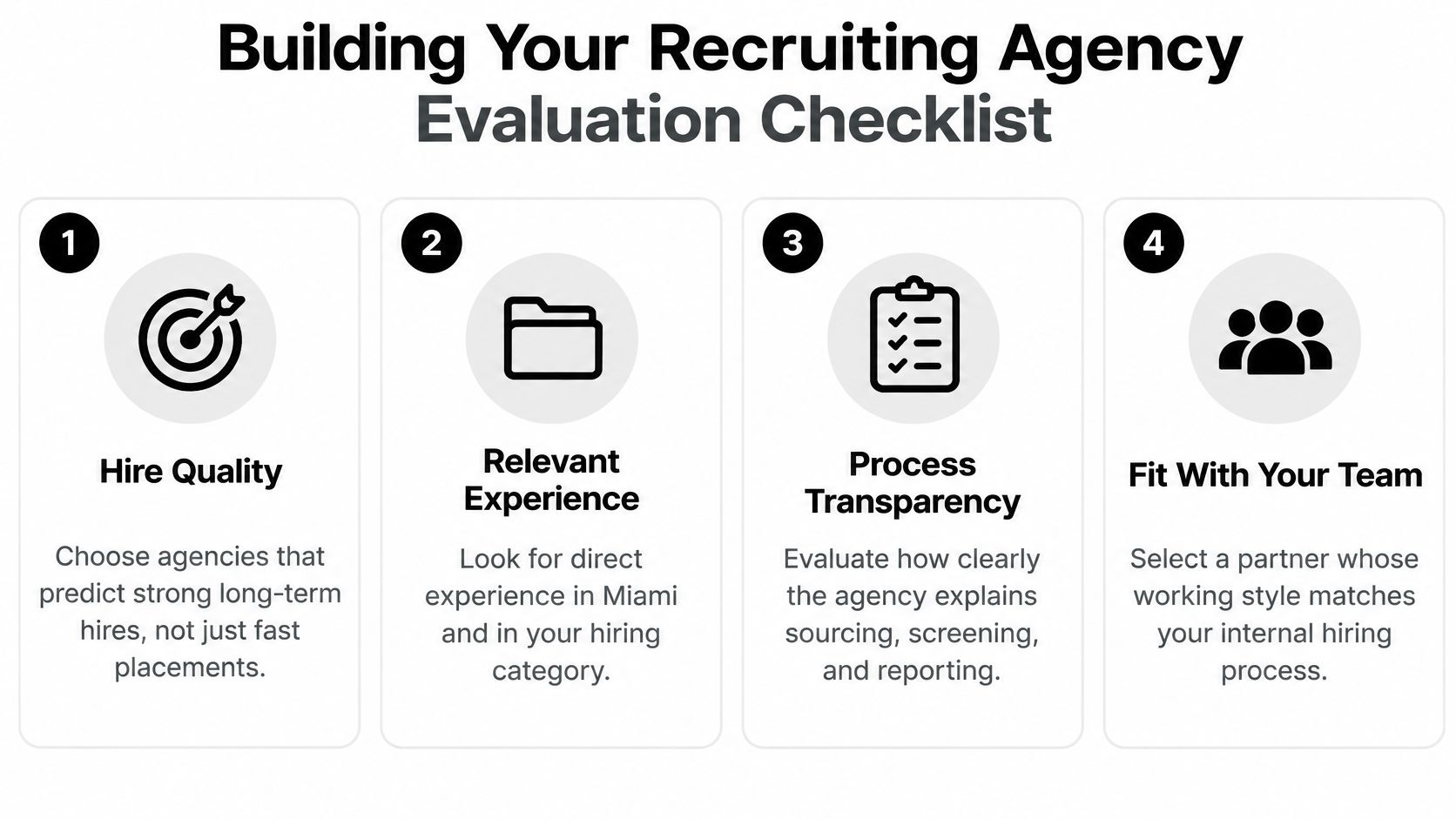
Technical judgment. Ask the recruiter to pressure-test the req live. For a senior platform engineer, they should probe system-design reasoning, a debugging method, a cloud trade-off, and what the person personally owned. If they pivot to years of experience and a keyword list, they're matching text, not competence.
Speed you can audit. Ask for time-to-first-submission, time-to-interview, and time-to-offer on the last three AI or DevOps searches they closed, not a blended average across easy roles. Vague "we move fast" claims fail this test. So does a pipeline number with no names behind it.
Model flexibility. Describe two reqs, one permanent staff engineer and one six-week infrastructure surge. They should recommend different models. One motion for both is a warning.
Screening rigor. Ask what they reject. A serious firm has deep conversations about how something was built, why, and what it did for the business. They don't forward answers a language model could draft from the résumé.
Questions to ask before you sign
- Who runs this search by name, and have they hired this role in the last year?
- What evidence do you collect before a candidate reaches my hiring manager?
- Which model would you refuse for this req, and why?
- How do you report pass-through from submit to interview to offer?
- Where does automation stop, and who can override it?
Red flags are simple. No named technical recruiter. No written screen. A guarantee with no definition of what "didn't work out" means. A promise that Miami has unlimited senior AI talent if you'll just raise the fee.
Skip the firm that can't show you a scored example from a search like yours. A process they can't show you is a process they don't run.
Interview and Vetting Questions That Reveal Recruiter Quality
The hardest thing to see from outside is whether the screen produces signal. Structured interviewing is a measurement design, not a compliance ritual. You standardize the competencies, the prompts, the scoring anchors, and the way every candidate is run. The U.S. Office of Personnel Management's guidance on structured interviews reports that higher structure improves validity, rater reliability, and interviewer agreement, and that it reduces adverse impact. Questions tied to a formal job analysis show stronger content and criterion-related validity.
The accuracy gap is large enough to change how you hire. One synthesis finds unstructured interviews explain about 4% of the variance in later job performance, against about 32% for structured interviews, a 28-point gain in predictive ability. Earlier psychometric work found a highly structured interview with inter-rater reliability of r = .88 and corrected predictive validity of r = .56 in a sample of 149 employees, as reported in research on structured selection interviews. Informal recruiter chats don't clear that bar. They collect impressions, then call them judgment.
What to demand on a specific role
Ask the firm to show the competency matrix for your req before they source. A DevOps search should score incident diagnosis, infrastructure-as-code quality, observability design, security judgment, and collaboration with developers. A product-engineering search should score product reasoning, implementation depth, experimentation, and commercial impact separately. Each candidate gets comparable prompts and a written score against behavioral anchors. Independent scores come before your hiring team calibrates. That order matters. Personal impressions should not lead.
Then ask how they audit the system. Pass-through, interview, offer, and retention by role family, and by demographic group. A structured process can still be a bad instrument if the competencies are irrelevant or the anchors are vague. "Strong communicator" is not an anchor. "Explained a rollback, named the customer impact, and described the fix they shipped" is.
The questions that separate a selection system from a résumé forwarder:
- Show me the matrix for this exact role, not a generic engineering template.
- Who scores, and do they score before they talk to each other?
- What would make you kill a candidate your client liked on paper?
- Which outcome do you review when a hire leaves inside the guarantee?
Skills that make a recruiter able to run this process are covered in what technical recruiter skills actually require. If they can't produce the matrix on a follow-up, they don't have one.
How AI Screening Fits Into an Auditable Hiring Process
Speed is the sales pitch, and it's the wrong prize. Stanford researchers report that 90% of U.S. employers use AI screening tools, and their analysis found these systems can amplify racial bias and reject the same applicants again across employers on the same vendor. The study found that 26% of Black applicants and 15% of Asian applicants applied to roles where the AI discriminated against their racial group, as described by the Stanford Institute for Human-Centered AI. An agency that competes on application volume is competing on the part of the stack most likely to hide a bad decision.
Where automation should stop
AI is fine at sourcing, deduplicating, and keeping a pipeline consistent. It is a weak judge of whether an engineer can explain what they built. Résumé similarity is a poor proxy for competence, especially when senior titles compress very different scope into the same words. The human has to test the claim. What shipped. Why that design. What the business felt.
An auditable process has four properties you can ask for on a call.
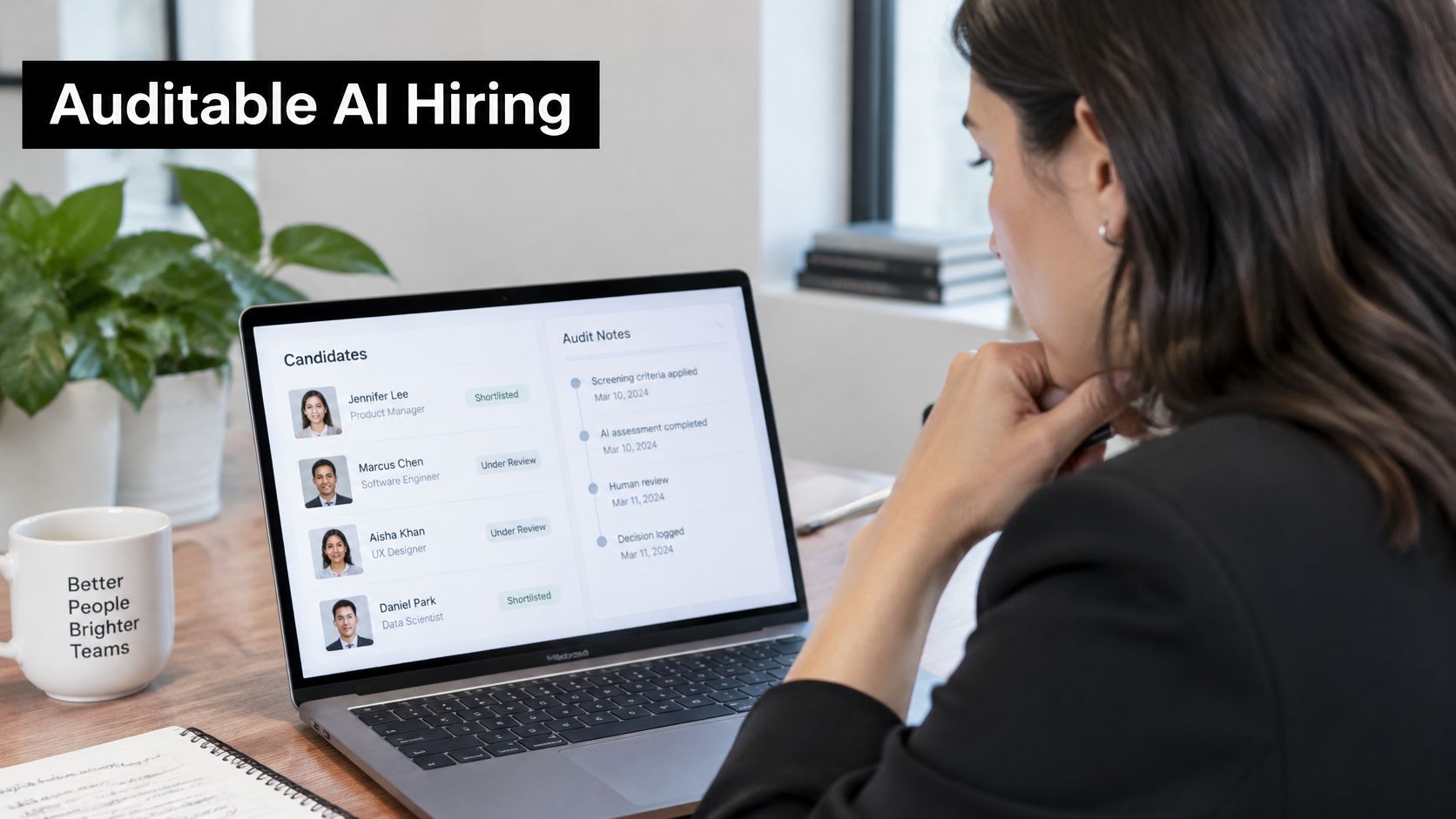
A stated boundary. Which steps are automated, and which require a recruiter who understands the work. "Our platform handles screening" is not a boundary.
Evidence, not a score. You should see the notes from the technical conversation, not a single match percentage. If you can't reconstruct why someone advanced, you can't defend the hire or the rejection.
Adverse-impact monitoring. Ask whether pass rates are reviewed by demographic group, and what happens when a stage diverges. A structured process from the prior section still fails if the model upstream already dropped the people who would have scored well.
Recourse. Candidates shouldn't be permanently invisible because one vendor's model disliked their résumé format. A human review path matters, including for people your team asks the firm to reconsider.
Tools roundups such as a comparison of AI recruiting tools help you see what vendors claim. They don't replace the four questions above. If a Miami firm can't tell you where the model stops, treat the speed as a risk, not a benefit.
Pricing, Fees, and SLAs You Should Expect
Compare proposals on risk and alignment, not on the headline percentage. A cheaper fee with a weak slate costs more than a clearer fee with scored candidates.
Direct hire is usually a percentage of first-year salary, paid when the person starts. You carry the risk that the search drags. The firm carries the risk that the hire fails early, which is why you want a written replacement window. A 90-day placement guarantee is the common direct-hire term. Read what triggers it. Resignation, termination for performance, and "mutual agreement" are not the same event. If the guarantee excludes the cases you commonly see, the percentage is a fiction.
Contract and staff augmentation price by the hour or the month. You pay for capacity, not for a permanent outcome. Alignment is better when there's no long minimum term and no conversion penalty that traps a good contractor. Ask what happens in week two if the person can't do the work. That's the SLA that matters, more than a rate card.
Executive search is typically retained. You pay for a process, not a stack of résumés. The trade-off is commitment. A retained search should come with a named lead, a research plan, and a stop date if the slate misses the bar.
Supplier search flips the invoice. When the job should be a company, you sign with that supplier and pay the recruiting firm nothing. Suppliers pay an industry-standard 10% finder's fee, the same rate for each supplier. Your price matches going direct, and it's often lower, because you're not funding a second markup.
Terms to lock before you sign
- Time-to-first-submission on this role family, with a date, not a range like "soon."
- Interview rate on submitted candidates, so a fat pipeline can't hide a weak screen.
- Replacement terms in plain language, including who decides the hire failed.
- What you owe if you hire a supplier or a contractor the firm introduced, and for how long.
- Reporting cadence. Weekly scored notes beat a monthly slide.
Hold the firm to the dates. A recruiting agency Miami contract that can't name a first slate date is selling effort, not a search.
Making Your Decision and Taking the Next Step
Decide in order, and don't skip ahead to price.
Name the problem. Permanent owner, prove-it contract, short capacity, distributed engineers, an executive, or a supplier. One model. If presence isn't required and the Miami band loses to national remote offers, don't pretend a local-only search will save it.
Test judgment before paperwork. On the intake call, make the recruiter challenge the req. No matrix, no named recruiter, no refusal case, no signature.
Require the screen in writing. Competencies, prompts, anchors, independent scores, then your calibration. Audit pass-through later. Feel is not a system.
Draw the AI line. Sourcing and workflow can be automated. Advancement on an engineering req cannot rest on a hidden score. You want notes, a human override, and a check for uneven pass rates.
Price the risk. Percentage, rate, or retainer only makes sense next to a guarantee you can trigger and dates you can miss in public.
So far in 2026, TekRecruiter has made 167 tech and engineering placements, and 82% of the candidates it submits get interviewed. It's a Miami-headquartered, tech-only firm founded by a former software engineer. An AI-native system sources and organizes talent. Recruiters who know the work run the conversations and score for HEART: high agency, execution, accountability, resourcefulness, and transparency. That interview rate is the number to care about. It means the screen is doing work before your calendar does.
Book the intake with the checklist in front of you. Bring one real req, the competencies you refuse to compromise, and the model you're willing to walk away from. You'll know in that hour whether the firm can hire, or only forward résumés.
TekRecruiter recruits software, AI, cloud, data, DevOps, and go-to-market engineers for Miami companies that are done with keyword-matched slates. The firm runs direct hire, contract, nearshore, executive, and supplier searches with a human screen you can audit. Visit TekRecruiter and bring one open req to an intake call.
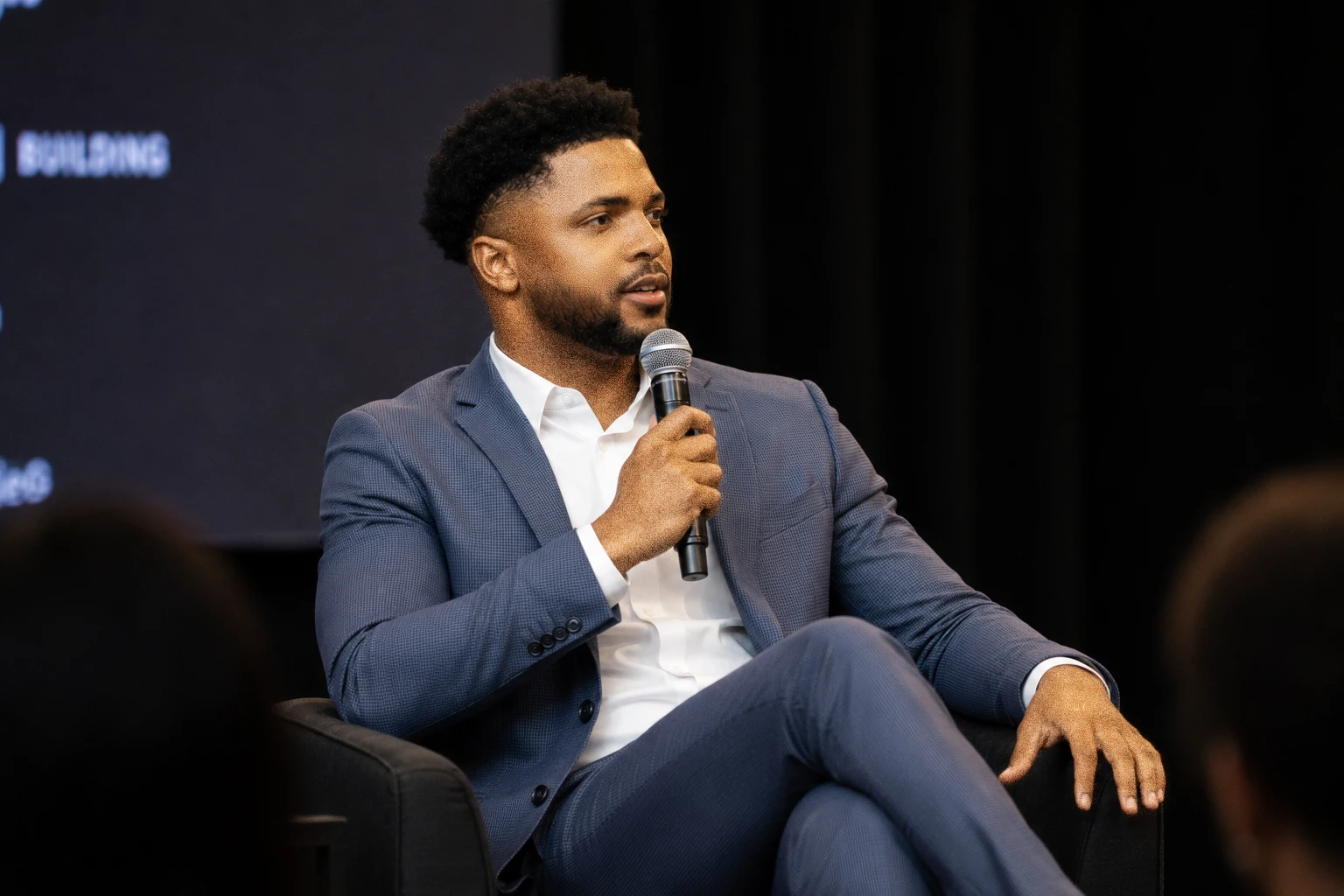 Ron SmithPresident & Lead RecruiterTekRecruiter