Python Developer Job Description: Free Template for 2026
Use this Python developer job description template with responsibilities, qualifications and skills, plus tips to tailor it by seniority and role.
You've opened an old job posting, changed the title to Python Developer, and started updating the tools. Then the engineering lead asks whether this person will build APIs, maintain data pipelines, or turn an AI prototype into a service. The skills list doesn't answer that, and neither will the applications it attracts.
A useful Python developer job description starts with what the person will own. Name the systems, the business outcome, the engineering decisions they can make, and what happens when their code fails in production. Frameworks matter, but they're supporting detail, not the definition of the job.
Python Developer Job Description Template to Copy
[Job title: Seniority and specialty, such as Senior Python Backend Engineer.]
[Role summary: Join the named team to build and maintain the named product or system. Explain the customer or business outcome and identify the engineering manager or technical lead this role reports to.]
[Responsibilities:
- Design the named services, pipelines, or automation workflows using the team's framework and architecture.
- Implement maintainable Python modules and document public interfaces.
- Test application behavior, failure paths, and integrations before release.
- Deploy changes through the team's packaging, containerization, and CI/CD workflow.
- Operate owned systems using logs, metrics, traces, and documented incident procedures.
- Collaborate with named product, data, infrastructure, or security partners.
- Improve the agreed reliability, latency, data quality, or delivery outcome.]
[Required qualifications: Relevant experience at the stated ownership level; the supported Python version range; primary framework; database skills; dependency management; testing and code review; deployment experience appropriate to the role.]
[Nice-to-have skills, optional: Tools or domain knowledge that would help but can be learned after joining.]
[Production scope: Named services and environments; packaging and deployment responsibilities; cloud platform; current service objectives; ownership shared with platform or SRE; on-call participation, escalation, and rollback expectations.]
[Location, work model, and salary range: Eligible locations; remote, hybrid, or office arrangements; working-hour expectations; approved compensation range and currency; benefits and any separately stated variable compensation.]
[Evaluation process: Explain the practical assessment, design discussion, and code review. State the expected candidate effort, assessment criteria, permitted tools, and any alternative assessment route.]
[How to apply: Provide the application destination and required materials. Specify whether a portfolio is optional and how candidates can request accommodations.]
Define the production boundary
Prototype Python and production Python require different evidence. A notebook can demonstrate that an approach works. An operational service must also survive dependency changes, malformed requests, deployment failures, and investigation by someone who didn't write it.
That distinction matters in an expanding ecosystem: GitHub's analysis of fast-growing development tools found that nearly half of new AI projects were primarily built in Python as of August 2025. Don't assume that experience building an AI project establishes experience operating one.
Specify whether the developer owns packaging, CI/CD, container images, observability, and cloud deployment, or consumes capabilities provided by another team. For performance requirements, identify the endpoints and operating conditions behind the target rather than asking for fast APIs.
Practical rule: If the developer will receive the production alert, the posting should say so before the candidate applies.
Fill every bracket before publishing. A blank field doesn't disappear, it becomes a question the candidate must ask during the first interview.
Python Developer Role Variants and Their Stacks
| Variant | Core Stack | Owned Outcome |
|---|---|---|
| Backend API engineer | Django or FastAPI, PostgreSQL, Redis | Service uptime and API latency |
| Data engineer | pandas, Spark, Airflow, cloud data warehouse | Reliable pipelines and data quality checks |
| Machine-learning engineer | PyTorch or scikit-learn, MLflow, model serving | Models deployed and monitored in production |
| QA or test automation | pytest, Playwright or Selenium, CI pipelines | Automated regression coverage and release gate |
| DevOps or platform Python | Python scripting, Terraform, Kubernetes | Infrastructure automation and deployment reliability |
Use these role families to identify the work before choosing the title.
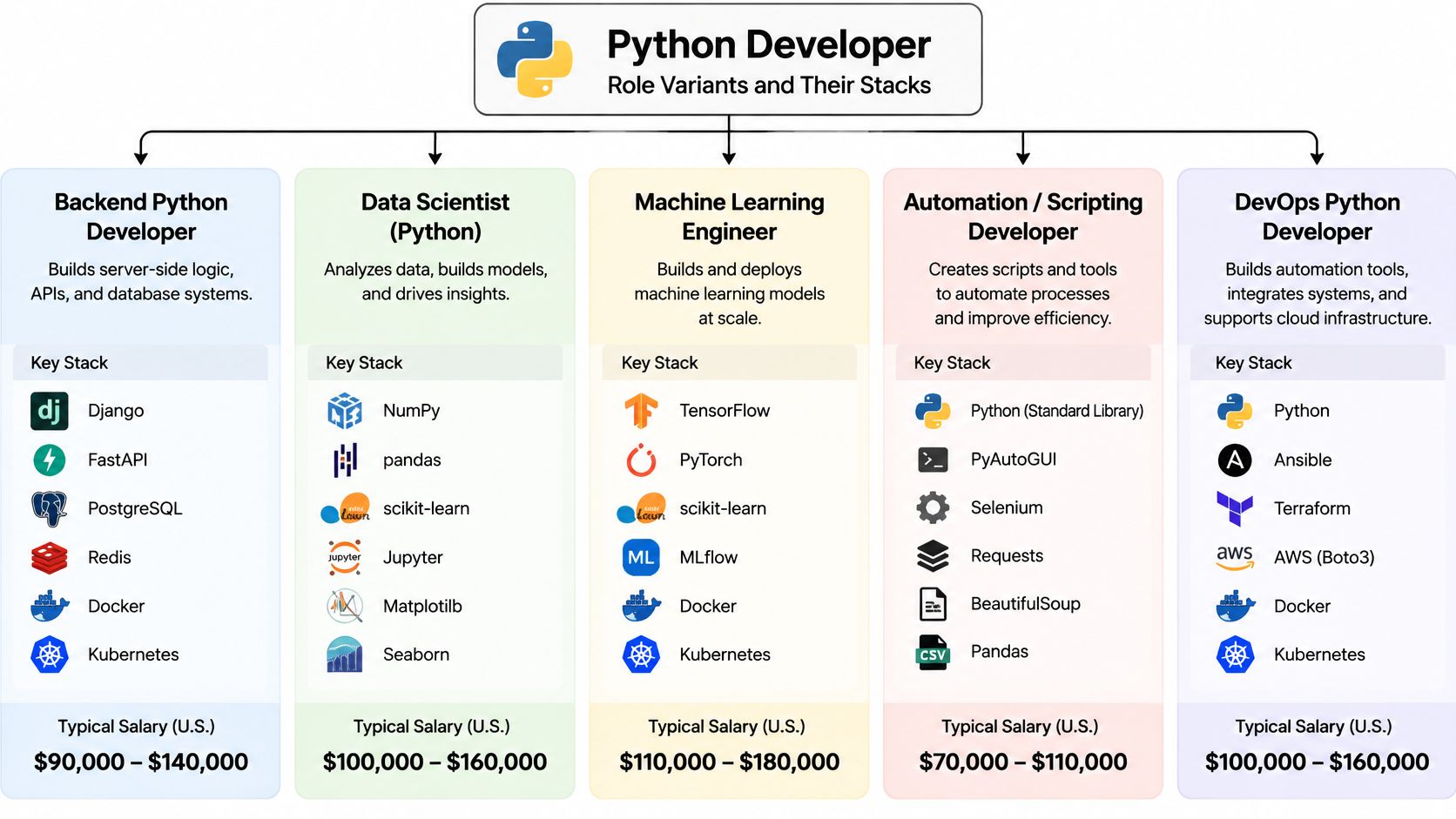
A bare Python requirement doesn't distinguish these candidates. In Stack Overflow's 2025 Developer Survey, Python adoption increased by 7 percentage points compared with 2024. The language now connects several materially different kinds of engineering work, so syntax familiarity alone is a poor basis for deciding fit.
Choose the primary job before the secondary skills
Start with the deliverable. If the hire must maintain customer-facing endpoints and database transactions, choose backend engineering, even if the product includes a model. If the deliverable is a validated dataset available on schedule, choose data engineering.
Then make the stack follow the job:
- Select the primary variant. Choose the work that will dominate the person's responsibilities.
- Name the actual stack. List what the team uses, not every library that could solve the problem.
- Assign an owned outcome. Explain how the team will judge successful delivery.
- Add secondary scope selectively. Include adjacent responsibilities only when the hire will perform them.
A backend developer can integrate model inference without owning model training. A platform engineer can automate deployments without becoming the application team's feature developer. State these boundaries to prevent an apparently focused vacancy from becoming an unmanageable combination of jobs.
For a practical wording comparison, browse backend developer openings from HiredBySkill and compare the named services and responsibilities, not just the titles. When organizing a search for Python developers for hire, use the same distinction to separate relevant delivery experience from overlapping keywords.
The video below provides additional context for discussing Python development roles with hiring stakeholders.
Before approving the posting, read its title, stack, and owned outcome together. They should describe the same job.
Responsibilities to Write for Each Seniority Level
| Seniority | Ownership Expected | Sample Responsibility |
|---|---|---|
| Junior | Implements and tests assigned features | Write unit tests for API endpoints under code review |
| Mid-level | Owns features end to end | Design and ship a background job service with retries and logging |
| Senior | Owns service architecture and reliability | Set latency targets and lead incident reviews for the API |
| Lead or staff | Owns standards across several services | Define typing, testing, and release rules across the service portfolio |
Seniority describes decision-making scope, not a larger collection of tools. A junior developer may use the same framework as a staff engineer. What differs is who frames the problem, assesses trade-offs, approves the approach, and remains accountable after release.
Use the table as an ownership guide rather than treating time served as proof of capability. A candidate who has repeatedly delivered reviewed features may still need support with architecture, while another may already have substantial incident and migration responsibility.
Write responsibilities around engineering activities
Group the work into development, testing, deployment, collaboration, and operations. These categories help you spot a posting that describes implementation thoroughly but says nothing about releases or maintenance.
- Development: Name what the developer builds and how much design authority they have. A junior implements an agreed endpoint contract; a senior resolves competing requirements and chooses the service boundary.
- Testing: Identify the behavior they must establish. For an individual feature, that might mean failure-path tests. For a lead, it might mean establishing consistent release criteria across teams.
- Deployment: Distinguish following a documented release procedure from designing the procedure and assessing migration risk.
- Collaboration: Name the partners and the decision. Agreeing an invoice schema with finance is more informative than requiring excellent stakeholder management.
- Operations: Explain whether the person investigates a known fault, coordinates recovery, or changes the architecture to prevent recurrence.
The verb alone doesn't establish seniority. Design can mean choosing a function signature or defining the transaction boundary between services. Add the object, the constraints, and the expected authority.
Match accountability to support
For a junior role, describe the review and escalation available. Don't promise mentorship while assigning sole responsibility for production reliability.
A mid-level developer should be able to carry a bounded feature through design, implementation, release, and follow-up. A senior should make decisions that account for failure modes, performance, and maintainability beyond the immediate feature.
If a responsibility requires authority the employee won't have, rewrite the responsibility or change the role.
Lead and staff postings need particular care. Establishing engineering standards isn't the same as managing people, and technical leadership doesn't automatically include hiring, performance reviews, or budget ownership.
Keep the final responsibility list short enough that each line represents meaningful work. Remove minor activities already implied by the larger responsibility, and match the title to the highest sustained level of ownership, not an occasional stretch assignment.
Experience and Qualifications by Level
Name the Python version and compatibility scope, not just Python proficiency. A developer maintaining a legacy application faces different package constraints and migration decisions from someone building a new service.
The IBM overview of Python records that Python 2.7 reached official end of support on January 1, 2020. If the role includes older code, disclose the modernization work explicitly rather than hiding it behind a generic maintenance responsibility.
The following is an illustrative hiring rubric, not a market standard. The experience bands and runtime choices are examples to adjust to your own leveling framework and deployed environment.
| Level | Years of Experience | Python and Framework Expectation | Degree Expectation |
|---|---|---|---|
| Junior | Illustrative band of 0-2 years | Python 3, one framework, basic SQL | Degree or bootcamp background welcome, neither mandatory |
| Mid-level | Illustrative band of 3-5 years | For example, Python 3.10 or later, the team's framework, pytest | Degree or equivalent experience |
| Senior | Illustrative band of 5-8 years | For example, Python 3.11 or later, production APIs, dependency management | Degree or equivalent, not a hard filter |
| Lead | Illustrative band of 8+ years | Packaging, performance tuning, legacy migration | Equivalent experience, education stated as a preference |
Use experience bands as context
Don't make elapsed time do the work of a technical assessment. Pair any experience preference with evidence: maintaining an API through releases, diagnosing database contention, or planning a migration without breaking consumers.
For junior candidates, a well-explained project can establish useful fundamentals. Ask how they tested it, what they found difficult, and what they would change. Don't require commercial production ownership for a role designed to teach it.
For experienced hires, distinguish participation from accountability. Someone who used a deployment pipeline may not have designed its rollback behavior; someone who worked on a migration may not have selected its compatibility strategy.
State qualifications that predict the work
Require dependency management, tests, and code review when those practices are part of delivery. Specify whether the developer must maintain a reusable package, coordinate supported runtime versions, or replace an unsupported dependency.
Treat a degree as a preference unless a documented requirement makes it necessary. If equivalent experience is acceptable, say so directly and make sure the application form doesn't automatically reject those candidates.
Use the qualification row that matches the actual role, then replace its illustrative runtime with your supported environment. A newer runtime isn't a seniority credential. The relevant qualification is the ability to understand compatibility, deployment constraints, and lifecycle responsibility.
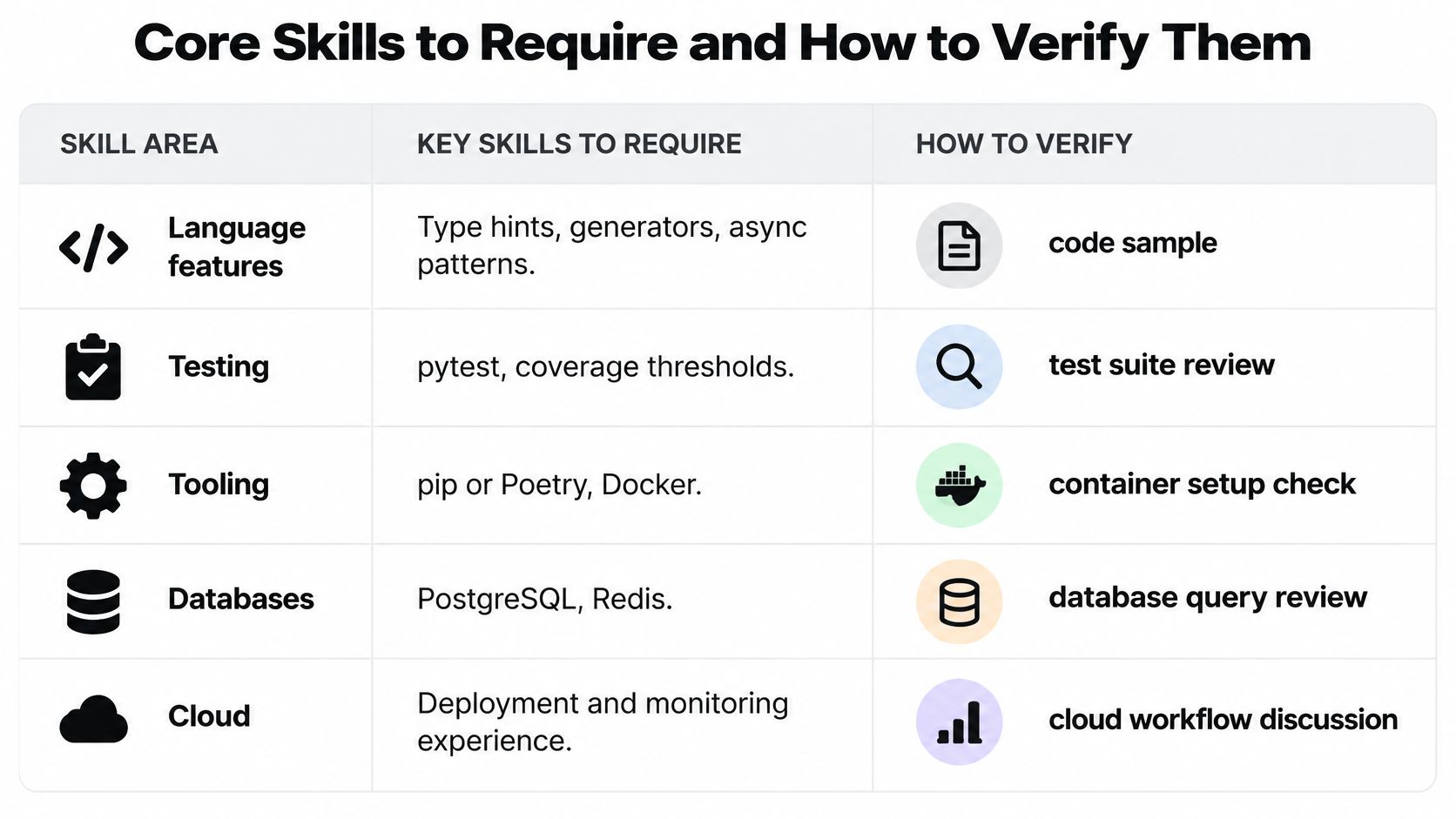
Core Skills to Require and How to Verify Them
Organize required skills around work a candidate can demonstrate, rather than adjectives such as expert or advanced.
- Language features: Type hints, generators, exception handling, and async patterns where the application needs concurrency.
- Testing: pytest, meaningful fixtures, integration tests, and the team's agreed coverage policy.
- Tooling: pip or Poetry, reproducible dependency installation, Git, and Docker.
- Databases: PostgreSQL query behavior, transaction boundaries, migrations, and Redis usage appropriate to the service.
- Cloud and CI/CD: Deployment, monitoring, release checks, and recovery in the platform the team operates.
Use the verification methods below to connect each requirement to observable evidence.
Make typing an engineering requirement
For a production service or shared library, typed public interfaces give reviewers something concrete to assess. Require explicit parameter and return types at boundaries rather than treating annotations as decorative documentation.
Python's typing best practices recommend built-in generics such as list[str], abstract input types such as Mapping, Sequence, and Iterable, and object rather than Any when accepting arbitrary values. The guidance also cautions against return contracts that force callers into repeated checks and describes tools such as assert_type and reveal_type for inspecting typing behavior.
A copy-ready requirement can specify:
- Public contracts: Annotate exported functions and document supported input and output behavior.
- Automated enforcement: Run the approved checker, such as mypy or Pyright, in CI and resolve checker failures before merging.
- Dynamic boundaries: Document justified exceptions around untyped integrations instead of spreading
Anythrough the application. - Regression protection: Test exported behavior and preserve compatibility when refactoring shared interfaces.
Avoid requiring maximum annotation strictness everywhere without considering maintenance cost. A dynamically generated integration may need a small, documented boundary; the candidate should explain that choice rather than silence errors indiscriminately.
Verify through a bounded refactor
Provide a small repository containing type errors, failing tests, and a clearly described behavior to preserve. Ask the candidate to repair it, then explain a design choice during review.
Assess whether they understand the failure, improve the contract, and add relevant protection. Don't reward a green test run if they weakened assertions or ignored checker errors.
Use the principles in assessing programming skills with an online coding test to keep the exercise aligned with the vacancy. Tell candidates what tools they may use, and assess their reasoning consistently.
Keep only the skills you'll evaluate as requirements. Move learnable tools and adjacent experience into the optional list.
Security and Production Requirements to Include
A framework requirement doesn't establish who will secure the code around the framework. The gap to close is ownership of untrusted inputs, dependencies, and operational recovery, not merely familiarity with authentication middleware.
The OWASP Serverless FaaS Security Cheat Sheet treats event payloads as untrusted and recommends input validation, injection defenses, dependency controls, centralized logging, and restrictions on outbound destinations. Translate those controls into responsibilities the developer can demonstrate, especially when the service accepts external events or makes outbound requests.
Ask for specific defensive practices
- Input boundaries: Validate length, type, and format. Use parameterized database access and avoid unsafe deserialization of untrusted content.
- Outbound requests: Treat user-supplied URLs as untrusted. Prefer destination identifiers resolved by the application and enforce strict allowlists where external fetching is necessary.
- Secrets and credentials: Use Python's
secretsmodule for security-sensitive randomness, not non-cryptographicrandomfunctions. Store passwords using appropriate password hashing rather than reversible encryption. - Key lifecycle: Document generation, storage, access, rotation, and decommissioning responsibilities.
- Dependency risk: Run pip-audit or an equivalent scanner, keep deployment packages focused, and establish how findings are triaged and remediated.
- Auditability: Produce structured security events without exposing credentials, tokens, or unnecessary sensitive payloads.
Security requirements should match the person's authority. An application engineer may implement credential handling while a platform team controls the secret store. Name that handoff instead of assigning the developer responsibility for controls they can't change.
Include operational recovery
Specify the observability expected for owned services, the on-call arrangement, and the release rollback procedure. Database changes deserve explicit attention because reverting an application image doesn't necessarily reverse a schema change safely.
Interview check: Ask where the candidate would place the trust boundary, what outbound access they would permit, and how they would verify the fix after deployment.
Use a concrete scenario, such as a webhook processor that retrieves an attachment from a submitted address. Ask the candidate to explain validation, network restrictions, failure logging, regression tests, and deployment through CI/CD.
If they discuss a previous remediation, distinguish their own decisions from the team's work. Broader organizational responsibilities, including access awareness and escalation, should remain consistent with your workplace cybersecurity practices.
Filled Example of a Complete Posting
This fictional example shows a coherent backend vacancy. It deliberately makes no invented compensation claim: an employer must insert its approved salary band before treating the example as publish-ready.
Senior Python Backend Engineer (Payments)
Role summary
Join the payments team to build and run the API that processes customer invoices. Work with product and finance engineers to deliver dependable payment workflows and agree measurable latency and reliability objectives with the engineering lead.Reporting and ownership
Report to the payments engineering manager. Own application behavior, service releases, schema changes, dashboards, and incident follow-up. The platform team owns the underlying cloud infrastructure and provides deployment tooling.Responsibilities
- Design and deploy FastAPI services and own their production uptime within the agreed service objectives.
- Set and measure latency and reliability targets, and lead incident reviews for the payments API.
- Define and maintain typing and testing rules for the service and its shared modules.
- Ship PostgreSQL schema migrations with compatibility checks and rollback or recovery plans.
- Participate in the on-call rota for owned services, using documented escalation and handover procedures.
- Coordinate API contracts and invoice-state changes with product and finance engineers.
Required qualifications
Demonstrated senior-level ownership of production backend services. Practical experience with the team's supported Python runtime, FastAPI, PostgreSQL, Redis, Docker, dependency management, pytest, and automated delivery. Ability to explain transaction handling, failure recovery, and architectural trade-offs. A degree or equivalent experience is welcome; a degree isn't a mandatory filter.Nice-to-have skills, optional
Kafka, Terraform, and experience with payment reconciliation workflows.Work model and compensation
Remote within the United States, with agreed collaboration hours. Publish the employer-approved base salary range in US dollars for the eligible locations, with benefits and any variable compensation described separately.Evaluation process
Complete a bounded take-home refactor containing type errors and failing tests, discuss a service design scenario, and review a design choice from the refactor. Assessment instructions explain expected effort, permitted tools, and available accommodations.Application
Apply through the employer's careers portal with a résumé. A short description of relevant service ownership is welcome; public source code isn't required.
Check the consistency
The title matches the authority: this person makes service-level decisions, leads incident reviews, and coordinates changes with downstream users. The optional tools don't become mandatory qualifications.
Before publication, the hiring manager must replace the compensation instruction with a real approved band and disclose the actual on-call schedule. The technical lead must also add the deployed runtime, service objectives, and relevant operating scale.
That review is substantive, not administrative. If the team can't agree on those details, it hasn't finished defining the vacancy.
Pre-Publish Checks and Publishing Steps
Run the posting through a final review for scope, priorities, operating context, leveling, runtime compatibility, and candidate-facing terms. Assign an owner to every unresolved item rather than publishing with an intention to explain it later.
| Mistake | Why It Hurts | Fix |
|---|---|---|
| Listing only Python | Attracts scripting candidates for production roles | Name the framework, database, and production scope |
| An oversized required-skills list | Can discourage strong candidates and hide priorities | Keep requirements focused and move learnable tools to nice-to-have |
| Missing production context | Candidates can't tell whether they'll own services | State the systems owned, relevant traffic scale, and on-call duty |
| Experience ranges with no seniority label | Mixes junior and lead expectations | Pair each range with a seniority label and scope |
| No Python version stated | Legacy and modern code expectations can clash | Name the supported Python version and migration scope |
| Missing pay range | Candidates can't assess compensation fit | Publish the approved range for the role and location |
| Vague verbs such as handle or support | Responsibilities read as generic duties | Use design, ship, own, and measure with a named object |
Resolve disagreements before candidates encounter them
Ask the engineering manager and technical lead to review the same posting independently. If they describe different first assignments, reporting relationships, or release responsibilities, resolve those differences before opening applications.
Check the application form too. A posting that welcomes equivalent experience is undermined by a mandatory degree field. A remote role needs consistent location eligibility across the careers page, recruiter outreach, and interview invitations.
For broader guidance on aligning responsibilities, qualifications, and candidate expectations, use the same discipline as writing a position description. Technical specificity won't compensate for contradictory employment terms.
Finalize in a deliberate sequence
- Choose the primary variant. Confirm whether the business needs backend, data, machine-learning, test automation, or platform engineering.
- Select the ownership level. Adapt the responsibility and qualification language to the authority the employee will receive.
- Remove untested requirements. If no interviewer can explain how a requirement affects the hiring decision, make it optional or delete it.
- Add relevant controls. Include the security and operating responsibilities that belong to this particular system.
- Obtain technical approval. Have a senior engineer validate runtime compatibility, framework usage, migration expectations, and assessment difficulty.
- Publish complete terms. Include the approved pay range, eligible locations, work model, application route, and evaluation process.
When screening capacity is limited, keep the assessment anchored to the role rather than substituting résumé keyword counts. Our tech recruiters screen through peer-to-peer technical conversations, asking candidates to explain what they built, why they chose the approach, and what outcome it produced.
Publish this week once the unresolved fields have owners and answers. Track which applicants reach the technical round, why others are declined, and where candidates withdraw. Use those reasons to correct misleading wording or an assessment that doesn't match the advertised work, rather than adding more requirements.
TekRecruiter recruits Python talent and engineers working across related technologies, including Kubernetes, Azure, Terraform, and data platforms. Visit TekRecruiter with your draft job description, the systems the hire will own, and the outcome you need to discuss recruiting support aligned with the actual role.
 Ron SmithPresident & Lead RecruiterTekRecruiter