Business Development Manager Job Specification Template
Business development manager job specification with ready-to-use template, responsibilities, skills, KPIs, seniority levels and examples by company size.
You've been asked to hire a business development manager, but the sales leader wants more meetings, the founder wants partnerships, and finance expects new revenue. You can write a polished advert around all of that and still attract candidates for completely different jobs.
A useful business development manager job specification is an ownership document. It tells candidates which commercial outcomes they control, where their authority ends, and how the company will judge their work. Start with those decisions, then write the requirements.
Job Specification Template to Copy
Use the template below as the working document for your hiring meeting. Replace the example entries with approved company details, and remove responsibilities that belong to another team.
For a comparison with a live recruitment listing, review this opening on LatoJobs alongside your draft. Use it to test whether your own posting makes the commercial remit clear, rather than borrowing requirements without checking their relevance.
Business development manager job specification template fields
| Field | What to write | Example entry |
|---|---|---|
| Role summary | Market-expansion purpose, revenue owned and segments served | Develop pipeline across fintech and B2B SaaS accounts; own approved mid-market opportunities through signed agreement. |
| Reporting line | Manager, peers and key handoff partners | Report to the CRO; work with account executives, sales engineers, recruiting leaders and delivery leads. |
| Responsibilities | Outcome-based duties, each starting with a verb | Identify target accounts; qualify opportunities; develop referral partners; shape proposals; negotiate approved terms; coordinate delivery handoffs; maintain forecasts. |
| Required experience | Type of B2B selling and evidence of relevant ownership | Demonstrated B2B technology-services or SaaS selling, supported by examples of qualified pipeline and commercially viable agreements. |
| Required skills | Competencies with evidence an interviewer can check | Conduct structured discovery, map buying stakeholders and produce a written account plan with explicit assumptions. |
| Tools | CRM and sales-intelligence expectations | Maintain CRM stage discipline; use approved account-research and AI tools with human review. |
| Owned KPIs | Metrics with definitions, cadence and targets | Own qualified pipeline value and sourced gross profit, measured under the attached attribution policy and company-approved targets. |
| Compensation | Base, variable split and plan terms | Publish the approved local base-salary band, target variable compensation, payment triggers, eligibility rules and treatment of cancellations. |
| Compliance statement | Equal opportunity and data-handling standard text | We assess applicants against job-related criteria and provide reasonable accommodations under applicable law. Employees must protect confidential information and follow company privacy, employment and procurement policies. Submit for local legal approval. |
Make the fields usable
Write the role summary as a commercial promise, not a personality description. “Develop new technology-services accounts in an assigned segment” gives candidates something to evaluate. “Energetic growth champion” doesn't tell them what they'll own.
Separate essential evidence from preferences. A candidate may have the right buyer relationships, negotiation experience and commercial judgment without knowing your CRM configuration. Requiring every preferred tool or industry background turns a focused search into an unnecessarily narrow one.
For responsibilities, use verbs that produce an observable result. Replace “support business growth” with “qualify target accounts against agreed buyer, need, timing and delivery-fit criteria.” Replace “manage relationships” with “develop referral partners that introduce commercially qualified opportunities.”
Practical rule: If an interviewer can't explain how they'll assess a requirement, rewrite it before publishing.
Every metric also needs a definition, attribution rule and review period. Candidates should know whether they receive credit for originating an opportunity, closing it, or both.
The same document structure works for an early commercial hire and a regional enterprise appointment. Change the seniority, account scope, decision rights and targets to match the actual job, rather than changing the title alone.
Core Responsibilities and Commercial Boundaries
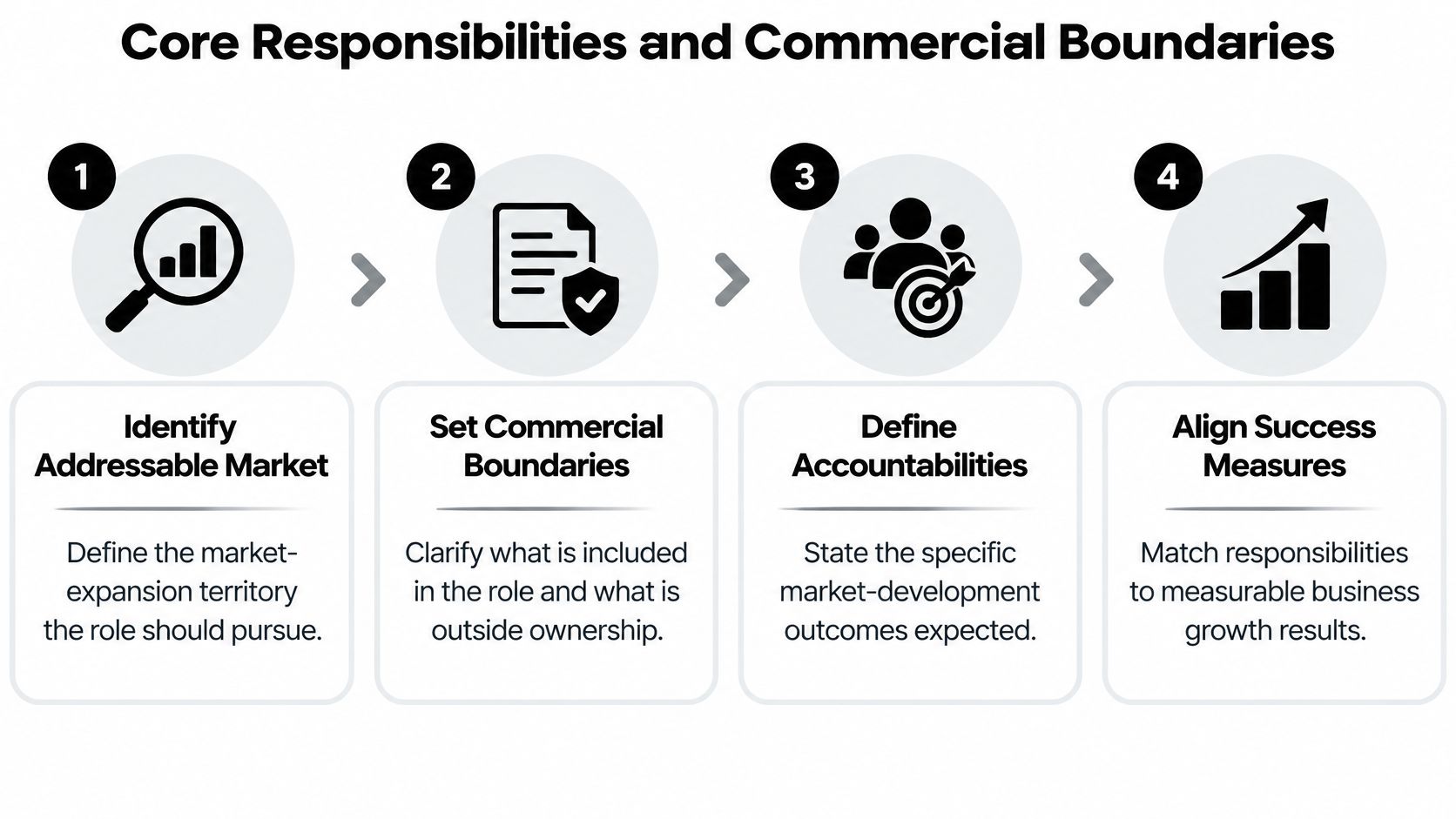
Business development is market-expansion work, not a spare pair of hands for every unfinished sales task. The manager identifies addressable markets, investigates customer needs and competitors, develops partnerships, qualifies opportunities, shapes positioning and negotiates commercially viable agreements.
The U.S. Department of Labor's sales-manager occupation listing includes establishing territories, quotas and goals, alongside using performance information to identify improvements. Your specification should translate that broad remit into decisions the employee can make.
Choose the boundary sentence
Select the sentence that matches the vacancy, then add the relevant segment or territory.
- Pipeline-development role: Own the identification and qualification of opportunities until an account executive accepts the handoff.
- Full-cycle role: Own assigned opportunities from initial discovery through signed agreement, within approved pricing and contractual limits.
- Channel-development role: Own partner recruitment, activation and partner-originated opportunities, with direct sellers responsible for closing where specified.
- Individual-quota role: Own bookings or gross profit from the assigned account portfolio, with sourcing credit recorded separately.
Don't combine these into an unlimited remit. A manager who must build a channel, close enterprise deals and qualify every inbound lead needs explicit priorities and supporting resources.
When account executives take over qualified deals, align the specification with your account executive hiring criteria. Otherwise, both employees may believe the other owns discovery, proposal development or commercial follow-up.
Specify the handoff sequence
| Stage | Entry criterion | What must leave the stage |
|---|---|---|
| Marketing lead | Named company and contact, with a recorded reason for interest | Account context and permission or appropriate basis for follow-up |
| Business development qualification | Target-account fit and an engaged contact | Business problem, budget owner, decision process and agreed next action |
| Sales engineering scoping | Confirmed use case and technical discovery access | Integration requirements, security concerns, delivery assumptions and exclusions |
| Account executive close | Accepted scope and a commercially qualified opportunity | Approved agreement, commercial commitments and delivery expectations |
| Customer success onboarding | Executed agreement and an assigned delivery owner | Success criteria, stakeholder contacts and an agreed onboarding plan |
Document who accepts or rejects a handoff. A CRM stage change isn't enough if the receiving person hasn't agreed that the opportunity meets the entry criteria.
Public-sector pursuits need an additional procurement checkpoint. If that market is in scope, discuss whether govcon software from SamSearch belongs in the approved workflow, and name who decides whether an opportunity is eligible for pursuit.
Say the manager sources a fintech prospect seeking data-engineering capacity. They establish the business need, identify the security approver and record the client's data-access restrictions before handing over scoping notes. They don't promise a deployment model or start date that delivery hasn't approved.
Required Skills and How to Score Them
A candidate who describes a strong sales process still needs to show how they would apply it to a real opportunity. Replace vague requirements like “excellent communicator” and “strategic thinker” with skills the interviewer can test against evidence.
The O*NET sales-management competency profile identifies influencing, relationship management, information gathering, negotiation and strategy development as relevant capabilities. Use a consistent 1-to-5 scale to assess the evidence: 1 means the answer relies on unsupported claims, 3 shows coherent analysis with partial evidence, and 5 gives a quantified, technically credible plan with risks, next actions and stakeholder alignment.
Translate competencies into interview evidence
| Competency | What to look for and ask | Weak, acceptable and strong evidence |
|---|---|---|
| Structured discovery | Ask how the candidate would establish the cost of a delayed software release. | Weak answers jump to staffing. Acceptable answers identify the operational problem. Strong answers separate confirmed business impact from assumptions and explain how to validate both. |
| Stakeholder and decision mapping | Ask who could approve, influence or block a cloud-services purchase. | Weak answers name only the contact. Acceptable answers identify technical and commercial approvers. Strong answers explain competing priorities, procurement dependencies and gaps in stakeholder access. |
| Pricing and margin defense | Ask how they would respond when procurement requests a lower price without reducing scope. | Weak answers offer an immediate discount. Acceptable answers discuss scope and value. Strong answers weigh concessions against commitments and check delivery economics. |
| Honest risk communication | Ask what they would tell a buyer when delivery capacity is unconfirmed. | Weak answers promise first and escalate later. Acceptable answers flag uncertainty. Strong answers offer conditional options, identify who must approve them and avoid implying certainty. |
| CRM hygiene and forecasting | Ask the candidate to explain why a deal belongs in its current stage. | Weak answers rely on buyer enthusiasm. Acceptable answers cite recorded milestones. Strong answers connect evidence, unresolved risks and dated customer actions to the forecast. |
| Technical fluency | Ask how an integration or security constraint could affect the proposed solution. | Weak answers repeat product language. Acceptable answers identify relevant dependencies. Strong answers explain business consequences and bring in a technical specialist at the right point. |
Technical fluency means understanding enough about SaaS architecture, cloud, DevOps, AI and data work to ask useful questions and describe business outcomes. It does not require designing production architecture during a sales call.
Use a bounded practical case
Give candidates the same hypothetical engineering-services or SaaS opportunity and the same available information. Ask them to produce four outputs:
- Commercial diagnosis: Identify the market-entry or workforce constraint, separating known facts from missing information.
- Partner strategy: Recommend a route to market and explain why a partner would participate.
- Account plan: Map stakeholders, qualification gaps and the next customer commitments.
- Forecast: State the likely outcome, dependencies and assumptions without disguising uncertainty.
Keep the exercise short enough to avoid turning it into unpaid consulting. Score each output against the same anchors, and record evidence before interviewers compare overall impressions.
Use a shared set of candidate interview questions to keep follow-ups consistent, including questions about past decisions, evidence and results. The employer questions candidates may ask during an interview can also help interviewers anticipate what applicants need to understand about the role.
Assess ethical judgment, too. Look for accurate representation of candidate and supplier capabilities, protection of confidential information, fair treatment, and compliance with applicable employment, privacy, anti-bribery and procurement rules.
Seniority Levels and Experience Requirements
Set seniority from the decisions the person will make, not from the title your competitors use. Someone supporting account research isn't doing the same job as someone negotiating enterprise partnerships, even if both hold a business development manager title.
Experience requirements should describe relevant exposure and accountability. Calendar tenure is a rough screening shortcut; it doesn't tell you whether someone originated opportunities, inherited mature accounts or merely attended the closing meeting.
Business development manager seniority levels
| Level | Years of B2B selling | Scope | Primary ownership |
|---|---|---|---|
| Associate business development manager | Early-career experience; assess qualification evidence rather than a fixed tenure threshold | Research, prospecting and qualification support | Qualified pipeline support for senior account executives |
| Business development manager | Established independent selling experience | Named segment; qualifies and closes mid-size deals | Segment pipeline and bookings |
| Senior business development manager | Substantial complex-deal experience | Enterprise accounts and channel partners | Partner-sourced revenue and named accounts |
| Head of business development | Demonstrated commercial leadership experience | Strategy, team, territories and forecast | Team pipeline, territory plan and forecast accuracy |
These are scope distinctions, not automatic promotion rules. An experienced individual contributor may be right for an enterprise-account remit without being ready to manage a team. A capable commercial leader may have fewer years in your exact vertical but stronger evidence of territory planning and coaching.
Separate essential from trainable
For an independently operating technology-services role, require relevant B2B commercial experience. Accept SaaS experience where the candidate can demonstrate consultative selling, buying-committee management and an understanding of delivery economics.
- Essential evidence: Ownership of relevant opportunities, credible customer discovery and judgment about commercial fit.
- Trainable knowledge: Your Salesforce or HubSpot setup, internal sales methodology, proposal templates and reporting conventions.
- Conditional requirements: Sector knowledge, procurement familiarity or language skills only where the assigned customers require them.
Don't require a degree unless the work demands it. Don't ask an associate to arrive with an established enterprise network while offering a qualification-support remit. Those requirements screen for access and tenure rather than the ability to do the advertised job.
For a public-sector business development director, a resource such as Bidwell's tender alerts for BD directors can prompt a useful scope discussion: will this person monitor opportunities, decide which bids to pursue, or lead the response? Those responsibilities belong to different levels of authority.
Seniority should increase the complexity of decisions and the consequences of ownership, not simply the length of the requirements list.
Add the approved local salary band only after you've agreed the level. Use your compensation team's market benchmarks and internal equity checks, then align variable pay with outcomes the person can influence.
KPIs and a First-Year Scorecard
| KPI | Definition | Review cadence |
|---|---|---|
| Qualified pipeline created | Currency value of opportunities meeting agreed qualification criteria and accepted into the pipeline | Monthly |
| Sourced revenue or gross profit | Closed revenue or gross profit for which the manager is the documented originator, under the attribution policy | Quarterly |
| Strategic partnerships activated | Partners with an executed agreement and a live, accepted opportunity | Quarterly |
| Opportunity-to-close conversion | Closed-won opportunities divided by qualified opportunities in the defined measurement population | Monthly |
| Forecast accuracy | Forecast bookings compared with actual bookings for the same period, with assumptions recorded | Monthly |
| Expansion and retention quality | Retention or expansion outcomes on accounts the manager opened, where account responsibility makes this attributable | Quarterly |
Set company-specific targets beside this scorecard in the approved compensation or performance document. Base them on comparable historical performance, territory potential, delivery capacity and the sales cycle, not on an attractive-looking quota borrowed from another employer.
The Indeed business development manager hiring guide provides a starting point for the role's commercial skills; your scorecard must go further by separating pipeline creation from revenue ownership. A person who hands accepted opportunities to account executives shouldn't be evaluated as though they control every negotiation and closing decision.

Resolve attribution before setting targets
Define what counts as a qualified opportunity. At minimum, specify the customer problem, account fit, buying-process evidence and next commitment your team requires. An introductory meeting shouldn't become pipeline merely because someone entered a currency value.
Then settle the difficult cases:
- Partner origin: Decide whether the partner introduced the account, influenced an existing opportunity or reopened a dormant relationship.
- Shared contribution: Record sourcing and closing separately so collaborators don't have to compete over a single credit field.
- Gross-profit measurement: State which delivery costs finance includes and how later scope changes affect credit.
- Account expansion: Distinguish commercial sourcing from service quality that customer success or delivery controls.
For conversion, choose a consistent cohort or clearly defined reporting population. Dividing this month's wins by unrelated opportunities created this month can misrepresent performance when sales cycles cross reporting periods.
For forecast accuracy, state whether you track absolute currency variance, percentage variance or both. Don't let optimistic over-forecasting cancel out under-forecasting elsewhere without showing the underlying misses.
Use the scorecard to make decisions
High activity isn't automatically productive activity. A calendar full of poorly qualified meetings can leave account executives with less time for viable deals.
Review stage progression, rejected handoffs, stalled opportunities and qualification evidence alongside activity. Calls and meetings are useful diagnostic measures, but they shouldn't substitute for commercial progress.
Coordinate the scorecard with your broader go-to-market recruiting plan. Hiring another prospector won't fix a process where technical scoping or commercial approval blocks every qualified opportunity.
Schedule an early ramp review, a development review and a year-end assessment. Use them to decide whether to adjust enablement, territory coverage or resources, not merely to announce whether the employee has missed quota.
How the Role Changes by Company Size
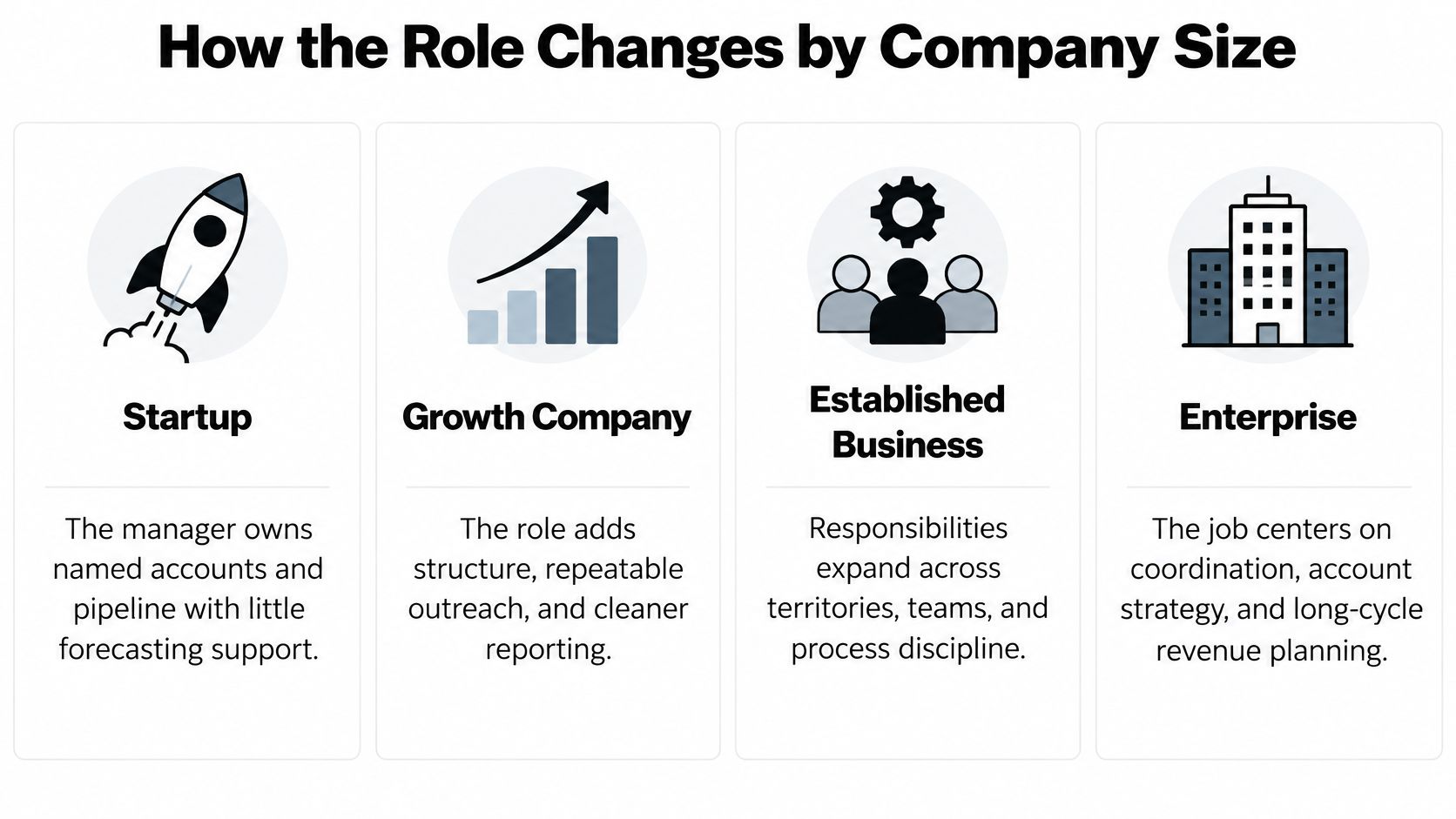
A founder handing over personal customer relationships needs a different hire from an enterprise sales leader opening a new territory. The title may stay the same, but the candidate's working environment, authority and support will differ sharply.
Company size is only part of the decision. A partner-led startup can need a channel specialist, while an established company entering a new market may need someone comfortable with incomplete processes.
Business development manager ownership by company model
| Model | Owns | Does not own | Primary KPI |
|---|---|---|---|
| Startup | First named accounts and founder handover | Designing the company-wide forecasting process or building channel programmes unless explicitly assigned | Qualified pipeline value |
| Scale-up | Named segment and quota-carrying deals through close | Pricing policy and partner-contract approval | Opportunity-to-close conversion |
| Enterprise | Net-new enterprise accounts and buying-committee coordination | Product roadmap and legal-term approval | Sourced revenue and sales-cycle length |
| Partner-led | Referral and reseller channels, partner-sourced pipeline | Direct quota on every partner deal | Partner-sourced revenue |
The “does not own” column doesn't excuse poor coordination. An enterprise manager still needs to involve legal early, and a startup manager still needs to maintain accurate opportunity records. The distinction is between contributing to a process and having authority over it.
Change the sentence that matters most
Startup to scale-up: Change “develop the initial account base alongside the founder” to “own a defined segment within an established commercial process.” That change requires more repeatability and cleaner reporting, not necessarily a more impressive network.
Scale-up to enterprise: Change “progress assigned deals through close” to “coordinate complex buying groups across technical, commercial and procurement workstreams.” Candidates need patience and orchestration skills, but they must still know when an opportunity isn't progressing.
Direct selling to partner-led: Change “win customer agreements” to “activate partners that produce qualified customer opportunities.” A signed partner agreement isn't enough if neither side has an incentive or practical plan to generate business.
Say a growing SaaS company wants the new hire to sell additional services to existing customers. Use the segment-owning model, but explicitly address account-management overlap and expansion credit. Remove language about net-new enterprise market entry unless the person will do that work.
A common hiring mistake is choosing a candidate from a more established company because their former employer feels reassuring. Ask what support they relied on: brand recognition, sales engineering, bid teams, inbound demand or procurement specialists. Then compare that support with what you'll provide.
Hire for the environment the person will enter, not the environment you hope to build around them later.
How AI Changes What You Ask Candidates
AI familiarity belongs in a modern specification, but “uses AI tools” is too weak to be a selection criterion. The Brooks Group's sales research reports that 71% of surveyed B2B sales leaders used AI sales tools. Familiarity alone doesn't distinguish sound commercial judgment from fast production of unreliable outreach.
Write down what acceptable use looks like. The employee should know which tools are approved, what information they may enter and which outputs require verification before another person relies on them.

Specify permitted uses and limits
- Account research: Use approved tools to summarize public information, then check material claims against original sources.
- Lead scoring: Treat automated scores as prioritization inputs, not proof of budget, intent or customer fit.
- Forecast support: Use summaries and risk prompts, while keeping the opportunity owner accountable for assumptions.
- Workflow automation: Automate approved administrative tasks without allowing unverified information to overwrite customer records.
- Outreach drafts: Require human review for accuracy, relevance, confidentiality and tone before sending.
Prohibit unreviewed automated outreach and entry of confidential client information into unapproved tools. Require CRM updates after meaningful customer interactions so the team isn't forecasting from an old automated summary.
Don't confuse personalization with a sentence mentioning a prospect's latest announcement. Useful outreach connects a plausible business problem to a relevant reason for discussion without pretending that an inferred problem is confirmed.
Ask candidates to demonstrate judgment
Request a walkthrough of an account-research workflow using public or fictional information. Ask the candidate to identify what the tool produced, what they verified and what they chose not to use.
Then test a qualification decision. Give them an AI-generated account summary containing an uncertain buying signal and ask what evidence they'd need before advancing the opportunity. Strong candidates distinguish a useful hypothesis from a confirmed customer commitment.
Finally, ask when they'd stop automation and start a human conversation. Security objections, contradictory stakeholder requests and uncertainty about delivery capacity need dialogue and accountable decisions, not another sequence.
A polished AI-generated account plan is an interview artifact. The candidate's explanation of its assumptions is the evidence.
Prefer candidates who can use automation while preserving thoughtful discovery and trusted relationships. Don't reward the largest volume of generated content when the role requires accurate qualification and credible buyer conversations.
Finalize and Post Your Specification
Bring the hiring manager, commercial leader, delivery representative and recruiter into the same approval meeting. The document isn't ready if they give different answers about what the new hire owns.
Use this pre-posting checklist to settle the remaining decisions.
Close the hiring decisions
Approve the commercial boundary. Read the ownership sentence aloud and name the person responsible for accepting each handoff. Resolve any overlap with account executives, customer success or partnerships before candidates encounter it.
Confirm level and essential evidence. Check that the advertised seniority matches the decisions, account complexity and resources. Remove preferences that you've accidentally presented as mandatory qualifications.
Approve the performance attachment. Sign off metric definitions, attribution rules, targets and review dates. Make sure finance and the commercial leader use the same meaning of revenue, bookings and gross profit.
Calibrate the selection process. Have interviewers assess a sample case response before meeting applicants. Agree what credible evidence looks like and who evaluates commercial judgment, technical fluency and ethical risk.
Choose the hiring route. Consider internal mobility, a direct job posting, external direct-hire support or a contract-to-hire arrangement. TekRecruiter is one recruiting option for technology and go-to-market roles; confirm available services, employment arrangements and commercial terms directly rather than assuming them.
Publish a specification candidates can trust
Check the finished document against a practical position-description writing guide. Remove internal shorthand, reconcile conflicting responsibilities and verify that the compensation language matches the approved plan.
Contract-to-hire can let a team assess working performance before considering permanent employment, but it isn't a substitute for a defined role. Clarify supervision, assessment criteria, conversion expectations and applicable legal requirements before choosing that route.
Give candidates enough information to make an informed decision. They should understand what they'll inherit, what they'll build, who can approve their proposals and what support they'll receive.
Choose the route that fits your budget, timeline and capacity to assess candidates. Publish only when the commercial boundary, seniority and performance expectations are agreed.
TekRecruiter offers recruiting support for technology and go-to-market positions, helping teams connect role requirements with candidate assessment. Visit TekRecruiter to discuss your business development manager remit, success measures and hiring options.
 Ron SmithPresident & Lead RecruiterTekRecruiter