10 Best AI Recruiting Tools for Tech Hiring
Compare the best ai recruiting tools for tech hiring, including sourcing, screening, automation, integrations, pricing signals, privacy, and TekRecruiter fit.
Which AI recruiting tool saves the most time, and which one helps a weak hiring process move faster? That's the question most comparison lists avoid. Technical recruiting isn't a feature-count contest. It depends on whether a platform can uncover relevant engineers, preserve context beyond a job description, support meaningful evaluation, connect cleanly to the ATS, and leave experienced recruiters in control of consequential decisions.
The market is still fragmented. A 2025 Rutgers University study of 233 valid respondents found that 38% of organizations used no AI-enabled hiring tool, while only 3% used five or more. That makes workflow fit more important than a long feature list.
This comparison focuses on the full technical recruiting workflow, including data coverage, filtering, AI evaluation, outreach, screening, ATS connectivity, privacy, and human review. It also separates external software from TekRecruiter's internal AI-native process. TekRecruiter has seen success with Juicebox, while PIN is a tool the team hasn't explored meaningfully yet. Its custom workflow connects multiple data providers, applies broad filters, and uses LLM review with role-specific context. The team reports finding about 40% more candidates who might otherwise have been missed, particularly beyond the limited view created by conventional search workflows.
If you're evaluating AI tools for research and recruiting operations, this guide to boosting research productivity with AI offers useful context. The list starts with the platform that combines software, technical recruiting judgment, and continuous process review.
1. TekRecruiter
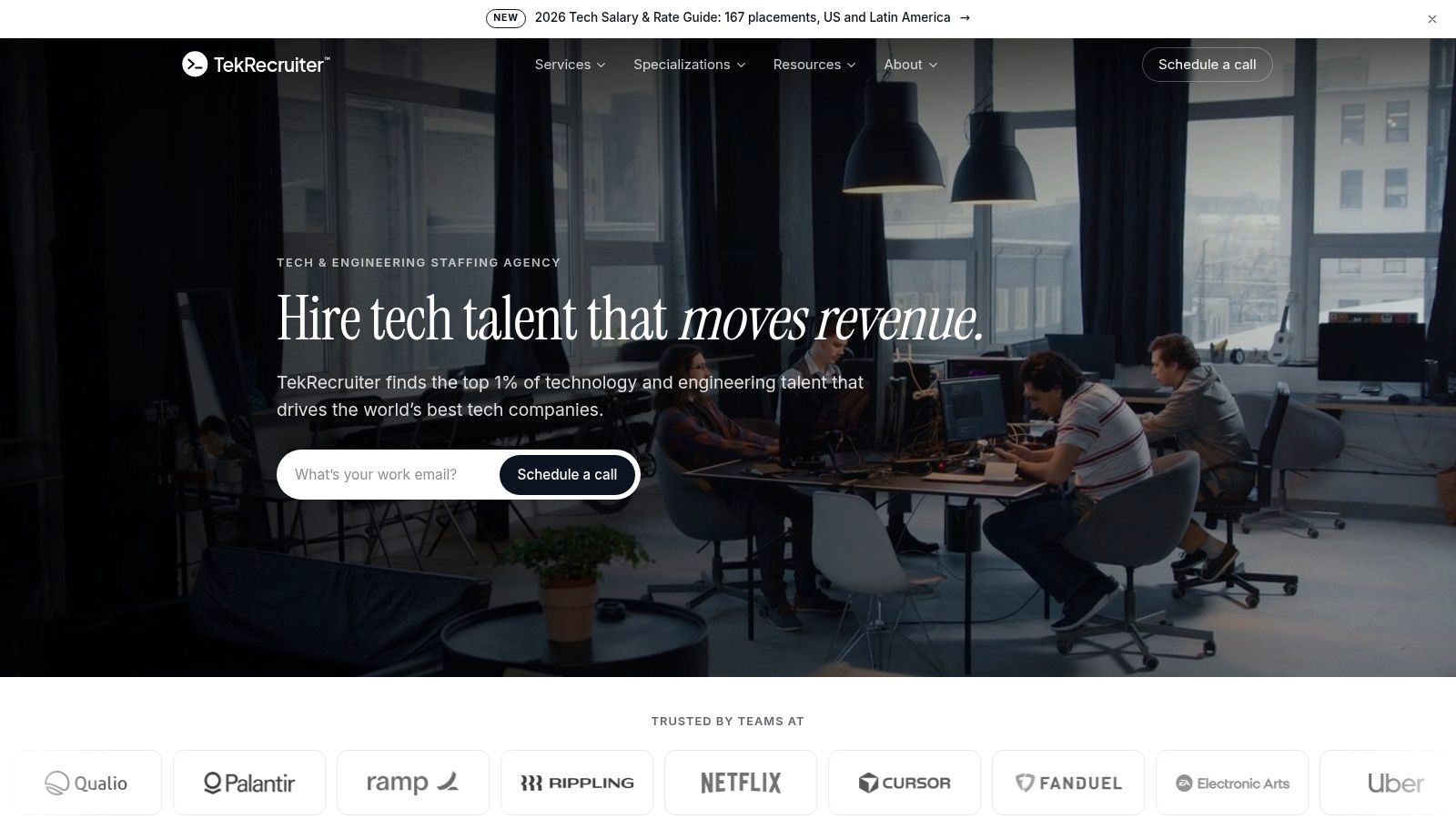
Can an AI recruiting tool identify an engineer who can explain what they built, defend the trade-offs, and connect the work to business results? TekRecruiter is designed for that requirement, combining an internal AI operating system with recruiter-led technical conversations rather than relying on résumé keywords alone.
The agency supports startups through Fortune 500 companies across direct hire, contract-to-hire, staff augmentation, nearshore recruiting, executive search, and MSP or outsourcing searches. Its founder, former software engineer Ron Smith, and its recruiters bring engineering context to candidate evaluation. That makes the service more specialized than a general-purpose sourcing database.
TekRecruiter reports contacting about 3,000 people and holding approximately 1,000 conversations per role, often presenting three to four vetted candidates in about a week for the technical roles it measures. It also reports 167 tech and engineering placements in 2026 so far, an 82% interview rate for submitted candidates in the measured technical searches, and 98% contract-to-hire conversion in the engagements measured for technical contract placements. These are agency-reported operating results, so buyers should validate the relevant workflow, role family, market, and measurement period rather than treat them as universal benchmarks.
The agency offers a 90-day direct-hire placement guarantee, staff augmentation starting in as little as three days, and nearshore hiring at about 50% lower cost than a U.S. hire, according to its supplied business information. Those terms should be checked against the engagement scope and contract.
How the internal AI workflow works
TekRecruiter's custom sourcing workflow connects to three data providers, including Coresignal, and creates access to a network of more than 900 million candidate profiles. Filters reduce the initial results, semantic search maps relationships between skills and experience, and LLMs review the shorter list. Gemini handles fast reads, while Claude Sonnet supports broader technical analysis, alongside company context and other proprietary signals.
The job description is only one input. A role can also include a hiring-manager call transcript, sample candidates, company information, prior results with the hiring organization, and previous context about a candidate. This gives the system more evidence for evaluating fit across filtering, outreach, screening, and human review.
Practical rule: Use AI to widen discovery and organize evidence. Keep technical judgment with people who understand the work.
TekRecruiter spent roughly a year testing the workflow before official rollout and continues reviewing roles for false positives, missed candidates, and incorrect evaluations. That review remains important because research summarized in recruitment and selection literature reports bias in audited algorithmic selection systems, including disparate impact affecting demographic groups.
TekRecruiter fits senior engineering, product, GTM-technical, and leadership hiring. It is less suitable for teams seeking a generalist platform for high-volume nontechnical recruiting. Buyers should also examine ATS connectivity, privacy controls, data provenance, and how recruiters can challenge AI recommendations. Pricing is engagement-dependent and isn't posted publicly. Visit TekRecruiter.
Pros: Engineering-first screening, proprietary AI sourcing, flexible engagement models, technical recruiter judgment, and a broad supplier network.
Cons: Specialized rather than general-purpose, and direct-hire or contract pricing requires a custom conversation.
2. SeekOut
SeekOut is a strong external platform for teams that need broad talent discovery, specialized search, and market intelligence in one environment. It searches across more than one billion profiles, supports ATS rediscovery, and offers workflows for technical, healthcare, cleared, and diversity-focused recruiting. Its GitHub and specialized talent coverage can be useful when a résumé database doesn't capture the strongest evidence of engineering work.
The platform combines AI candidate matching with inbound applicant screening, outreach, People Insights, and workflow collaboration. Recruiters can use skills-based criteria rather than depending entirely on job titles. SeekOut Agents and integrations with LLM assistants through MCP also make it relevant for organizations experimenting with agent-supported research.
Where it fits in technical hiring
SeekOut works best when the bottleneck is the top of the funnel. It can help a team identify passive candidates, rediscover people already sitting in the ATS, and understand where specific skills are concentrated. It doesn't replace a technical conversation. A profile that ranks highly because of cloud terminology still needs validation around architecture, ownership, testing, reliability, and delivery.
Data freshness and contact accuracy deserve a live pilot, particularly for difficult markets. Diversity filters can support a more deliberate search, but they shouldn't be treated as proof that a process is fair. TekRecruiter's candidate sourcing strategies provide a useful complement to the platform's search capabilities.
The main trade-off is complexity. SeekOut's feature depth can require onboarding, workflow design, and clear governance. Pricing is sales-quoted, so buyers should request a role-specific demonstration and test one common, one specialized, and one senior search before committing. Visit SeekOut.
Pros: Broad talent intelligence, specialized pools, ATS rediscovery, diversity search, and enterprise collaboration.
Cons: A steeper learning curve and sales-led pricing can slow adoption for smaller teams.
3. hireEZ
hireEZ, formerly Hiretual, is built around outbound recruiting. It helps teams discover, rank, enrich, and engage passive candidates across public data sources, making it especially relevant for hard-to-fill technical roles where inbound applicants are insufficient.
The platform's strength is the sequence that follows discovery. Recruiters can build candidate lists, enrich records, launch outreach, and track responses through CRM-style workflows. Integrations with major ATS and HR systems reduce the need to move candidate information manually, though buyers should verify what syncs in each direction and how duplicate records are handled.
The practical trade-off
hireEZ is more useful for a recruiter who already knows the target profile than for a team looking for a complete hiring operating system. It can accelerate the search for engineers with unusual combinations of technologies, domain experience, or seniority. It doesn't independently prove that someone has the depth to lead a migration, own an incident response process, or make sound design trade-offs.
The tool also needs thoughtful outreach controls. Automated sequences can save time, but generic messaging damages credibility with senior technical candidates. Recruiters should review the first batches, test personalization, and keep a human approval step before sending messages to high-value prospects.
Teams comparing the category should also read TekRecruiter's guide to the power of recruiting AI. hireEZ is a good candidate for a sourcing pilot, particularly when contact discovery and ATS connectivity matter. Pricing isn't publicly listed and may be premium for small teams. Visit hireEZ.
Pros: Strong outbound discovery, technical sourcing, data enrichment, outreach automation, and ATS or HRIS integrations.
Cons: Sales-quoted pricing and a workflow that still needs human quality control for niche roles.
4. Eightfold AI
Eightfold AI is designed for organizations that want talent intelligence across external hiring, internal mobility, and workforce planning. Its skills-based matching approach looks beyond exact title and résumé similarity, which can help large employers identify adjacent experience and internal candidates.
That breadth is its main advantage. A large organization can use one platform to connect recruiting, employee mobility, skills planning, and talent analytics. For technical hiring, this may help identify engineers whose next role is a logical progression even if their current title doesn't match the vacancy.
When enterprise breadth helps
Eightfold makes more sense when the organization has enough hiring volume, workforce data, and HR infrastructure to support a major implementation. Smaller teams may find that the platform solves problems they don't currently have while adding governance and integration work.
AI matching should still be treated as prioritization, not judgment. The 2025–26 HR.com recruitment technology study reports that 49% of HR professionals use AI in talent acquisition to some extent, while 37% don't use it at all. That uneven adoption supports a modular rollout rather than an immediate attempt to automate every hiring decision.
Buyers should request evidence for role-specific validation, subgroup performance, audit logs, and model-change notifications. They should also test whether the platform can explain why a candidate ranked highly and whether recruiters can override the recommendation without losing the decision record. Visit Eightfold AI.
Pros: Unified talent intelligence, skills inference, internal mobility, and workforce planning.
Cons: Enterprise complexity, implementation effort, and opaque pricing can make it excessive for smaller technical recruiting teams.
5. Gem
Gem combines AI sourcing, recruiting CRM workflows, outreach sequencing, scheduling, analytics, and ATS integrations. It's a practical option for an in-house technical recruiting team that needs to manage both candidate discovery and sustained engagement.
The platform is particularly useful when the team has a large existing network. Instead of starting every search from scratch, recruiters can rediscover previous applicants, contacts, and prospects, then place them into custom sequences. That can turn an underused database into a more active talent pipeline.
Better for engagement than technical assessment
Gem's value appears after a recruiter has defined the target profile. AI can help create segments, draft messages, schedule follow-ups, and report on funnel activity. It's less suited to independently determining whether a senior engineer truly understands distributed systems or has owned production outcomes.
That distinction matters because structured evaluation is stronger than unstructured judgment. Evidence summarized from Sackett and related selection research places structured interviews at an operational validity of approximately 0.42, compared with 0.19 for unstructured interviews and 0.07 for years of job experience. Gem can support a structured process, but the hiring team must define the rubric and conduct the conversation.
Pricing is limited publicly and sales-quoted. Buyers should test outreach quality, ATS synchronization, consent management, and the handling of candidate opt-outs before expanding usage. Visit Gem.
Pros: Strong sourcing and sequencing, recruiting CRM functionality, rediscovery, analytics, and integrations.
Cons: Limited public pricing and mixed sentiment around newer AI or ATS modules make a controlled pilot important.
6. Fetcher
Fetcher combines AI-assisted sourcing with a human review layer. It's designed for lean teams that want candidate batches, faster review, inbound screening, outbound sourcing, and a relatively simple operating model rather than a large talent-intelligence implementation.
The human-in-the-loop design is its most practical feature. Recruiters can review and filter AI-generated results, provide feedback, and use that feedback to improve later searches. That reduces the risk of treating an automated ranking as a final decision.
A useful option for lean teams
Fetcher works well when the sourcing process is repetitive and the team needs a manageable way to review large candidate pools. It can support a technical search, but the recruiter still needs to define what counts as evidence. “Python” or “Kubernetes” in a profile isn't the same as designing a reliable platform or taking accountability for outages.
Teams should compare Fetcher with a guide to sourcing tech talent beyond job postings. That broader approach helps prevent the AI from overvaluing candidates who are merely more visible online.
Fetcher's rollout is generally simpler than a full enterprise suite, but pricing specifics aren't fully public. Buyers should measure qualified-candidate yield, recruiter review time, and the number of relevant candidates missed during the pilot. Visit Fetcher.
Pros: Straightforward shortlist review, AI-assisted sourcing, inbound screening, feedback loops, and common ATS integrations.
Cons: Less market intelligence than larger platforms, with pricing often requiring vendor contact.
7. Paradox Olivia
Paradox, through Olivia, focuses on conversational recruiting for high-volume and frontline hiring. It handles candidate questions, conversational screening, interview scheduling, reminders, and rescheduling, including complex interview panels.
That makes it a poor substitute for a technical sourcing engine but a strong scheduling and screening layer for employers hiring across many locations. Candidates can interact through a mobile-first experience, while enterprise teams can connect Olivia to broader HR and ATS environments through integrations and APIs.
Why technical teams may still use it
A software company with a large volume of support, operations, sales, or frontline hiring may benefit from separating those workflows from senior engineering recruitment. Paradox can reduce repetitive scheduling and qualification work without forcing technical recruiters to use the same process for every job family.
The limitation is nuance. Conversational screening works best when questions have clear, job-relevant answers. It struggles when a candidate needs to explain a complex architectural decision, an ambiguous project, or the business consequences of a technical choice. Those conversations belong with a qualified human reviewer.
Pricing is enterprise-oriented and not public. Buyers should test edge cases, candidate escalation, consent, data retention, and the exact point where a recruiter takes over. Visit Paradox.
Pros: Conversational screening, mobile-first engagement, complex scheduling, reminders, and enterprise integrations.
Cons: Designed for volume hiring rather than deep talent intelligence or technical evaluation, with enterprise pricing.
8. Humanly
Humanly targets high-volume and hourly hiring with automated engagement, AI interviews, screening, scheduling, and continuous candidate pipeline programs. It's useful when recruiters spend more time coordinating first steps than evaluating a small number of highly specialized candidates.
The platform's value is consistency. A team can define a screening workflow, apply it across applicants, and reserve recruiter time for candidates who meet the initial criteria. AI-generated summaries and structured scoring can also create a more consistent record than scattered recruiter notes.
Keep the technical boundary clear
Humanly shouldn't be asked to determine whether an engineer can design a secure system or lead a difficult production migration without a structured human interview. The strongest use is operational. It can ask consistent initial questions, capture answers, schedule the next stage, and keep candidates informed.
A buyer should also examine how the scoring model was validated. Independent guidance on AI candidate screening emphasizes that validity is highly specific to the tool and context. A vendor's general accuracy claim doesn't establish that the system works for a particular engineering job family.
Pricing isn't published and may be opaque for smaller organizations. Humanly is best where applicant volume and scheduling create the bottleneck, not where technical depth is the central selection problem. Visit Humanly.
Pros: High-volume screening, automated engagement, interview scheduling, consistent workflows, and candidate pipeline support.
Cons: Narrower market intelligence and less suitability for senior technical assessment.
9. Textio
Textio solves a narrower problem than most tools on this list. It improves job descriptions, outreach, and recruiting communications by identifying potentially biased language, suggesting alternatives, and helping teams standardize content.
That focus is valuable because poor job content can reduce the quality and diversity of the applicants entering the funnel. Textio doesn't source candidates, screen résumés, schedule interviews, or assess engineering ability. It improves the input to those workflows.
Where a specialist tool earns its place
Textio works well as a layer on top of an ATS or CRM. Talent teams can build shared templates, preserve employer-brand standards, and give hiring managers guidance while they write role-specific content. The tool is most useful when an organization has many contributors producing inconsistent job descriptions and outreach.
It also helps teams avoid treating recruitment AI as a single platform category. Sourcing, screening, interviewing, scheduling, and content quality are different jobs. A specialist tool can be better than an all-in-one suite if the bottleneck is clearly defined.
TekRecruiter's guidance on writing a position description is a practical companion for teams using Textio. Pricing is sales-quoted and not publicly listed. Visit Textio.
Pros: Better job-content quality, inclusive language guidance, shared templates, and easy layering onto existing systems.
Cons: It doesn't discover, rank, screen, or evaluate candidates, so it must support another recruiting workflow.
10. Ashby
Ashby is a modern recruiting platform and ATS with strong analytics, scheduling, sourcing projects, and agency collaboration. Its main strength isn't being a specialized AI sourcing engine. It's giving a technical company a dependable system of record with flexible reporting.
That distinction matters. Teams often buy an AI sourcing product and then discover that candidate stages, interview feedback, agency submissions, and source data remain fragmented. Ashby can provide the operational backbone while external tools handle discovery or specialized automation.
Best as the measurement layer
Ashby's analytics, calculated fields, and reporting can help teams monitor qualified-candidate yield, interview conversion, recruiter workload, time-to-shortlist, and funnel drop-off. Its MCP Server also supports secure connections between LLM tools and Ashby data, subject to the organization's access and privacy controls.
The platform is especially useful for startups and mid-market companies that want stronger reporting without adopting an enterprise talent-intelligence suite. It won't replace a sourcing platform for passive technical talent, so pairing it with SeekOut, hireEZ, Gem, Fetcher, or an agency workflow may make more sense.
Buyers should confirm how credits, add-ons, permissions, retention, and external AI access work in their environment. Ashby's plan-level pricing may vary with usage and selected capabilities. Visit Ashby.
Pros: Strong analytics, flexible reporting, scheduling, agency collaboration, and a credible system-of-record role.
Cons: Not a dedicated AI sourcing engine, so teams may still need an external discovery platform.
Top 10 AI Recruiting Tools, Feature Comparison
| Provider | Core offering | Rating (★) | Key differentiator (✨) | Target (👥) | Pricing/value (💰) |
|---|---|---|---|---|---|
| TekRecruiter 🏆 | AI-native, human-led tech & engineering staffing (Direct-hire, C2H, Aug, Nearshore, Exec/MSP) | ★★★★★ | ✨ Founder-engineer + peer-to-peer technical screening; proprietary AI pipeline | 👥 CTOs, VPs Eng, hiring managers, startups → enterprise | 💰 Engagement-based; nearshore ≈50% cost savings; 90‑day guarantee |
| SeekOut | Talent intelligence + sourcing across 1B+ profiles, ATS rediscovery | ★★★★☆ | ✨ Massive profile coverage + diversity & market insights | 👥 Enterprise sourcers, diversity hiring teams | 💰 Sales-quoted (enterprise) |
| hireEZ (Hiretual) | AI outbound sourcing, ranking & engagement with ATS integrations | ★★★★ | ✨ Strong passive talent discovery & outreach automation | 👥 Tech recruiters, agency & in-house sourcers | 💰 Premium / sales-quoted; free trial reported |
| Eightfold AI | Enterprise talent intelligence for hiring, mobility & workforce planning | ★★★★☆ | ✨ Unified deep‑learning skills matching & internal mobility | 👥 Large enterprises, CHROs, TA leaders | 💰 Enterprise pricing (sales-quoted) |
| Gem | Sourcing + recruiting CRM with sequencing, analytics & ATS sync | ★★★★ | ✨ Combined sourcing + outreach sequencing and analytics | 👥 Agency teams & in-house TA needing outreach workflows | 💰 Sales-quoted; tiered plans/add-ons |
| Fetcher | AI-assisted top-of-funnel sourcing with human review loops | ★★★★ | ✨ Human-in-the-loop bulk shortlists for lean teams | 👥 SMBs, small in-house teams, volume sourcers | 💰 Clearer packaging for small teams; contact sales |
| Paradox (Olivia) | Conversational AI assistant for screening, scheduling & Q&A | ★★★★ | ✨ Mobile-first conversational screening + enterprise scheduling | 👥 High-volume/hours employers, multi-site enterprises | 💰 Enterprise-oriented pricing (sales-quoted) |
| Humanly | AI interviews, automated engagement & scheduling for frontline roles | ★★★ | ✨ Continuous candidate pipelines + AI interviews | 👥 Frontline/hourly hiring teams, retailers, staffing ops | 💰 Vendor-dependent; pricing not public |
| Textio | Job-content optimization to improve inclusivity and response rates | ★★★★ | ✨ Real-time bias reduction and high-performing templates | 👥 Hiring managers, TA marketing, recruiting ops | 💰 Sales-quoted; specialist add-on |
| Ashby | Modern ATS with analytics, sourcing projects & LLM connectors | ★★★★ | ✨ Robust analytics + MCP server for secure LLM integrations | 👥 US tech startups & mid-market TA teams | 💰 Plan-based; add-ons/credits may apply |
Choose the Workflow, Not Just the Tool
The best AI recruiting tools solve different bottlenecks. Talent-intelligence and outbound platforms are appropriate when recruiters can't discover enough relevant passive candidates or need to rediscover people already in the ATS. SeekOut, hireEZ, Gem, Fetcher, and Juicebox are useful in that layer, but each still needs a clear technical profile and a review process that distinguishes genuine evidence from keyword familiarity.
Conversational tools such as Paradox and Humanly make more sense for high-volume screening, candidate questions, reminders, and scheduling. They can reduce administrative load, but they shouldn't make autonomous decisions about senior technical capability. Textio belongs earlier in the funnel, where job descriptions and outreach need clearer, more inclusive language. Ashby is strongest as the system of record and analytics layer, particularly when leaders need to understand where the funnel is working and where it is losing qualified people.
TekRecruiter should use external tools to extend its internal AI-native process, not bypass it. Its workflow combines multiple data providers, broad filtering, semantic search, LLM ranking, job-specific context, company information, hiring-manager conversations, and continuous human review. That combination is more defensible than exporting a ranked list and assuming the ranking represents technical fit.
Adoption remains uneven. The Rutgers research found that only 5% of surveyed organizations always used AI-enabled hiring tools, while 60% never used them, a pattern that supports controlled implementation rather than wholesale automation. A tool that fits the current workflow and earns recruiter trust is more useful than an advanced platform nobody uses consistently.
A successful pilot should prove better decisions, not just faster activity.
Before expanding usage, establish a human-reviewed baseline for one job family. Compare missed candidates, false positives, technical-fit judgments, ATS data quality, recruiter review time, interview conversion, and candidate experience. Review outcomes by demographic group and role type. Ask vendors for audit logs, ranking explanations, override controls, subgroup performance, data-retention terms, model-change notifications, and incident procedures.
Governance matters because responsibility doesn't disappear when software makes a recommendation. The EU AI Act guidance for HR identifies recruitment systems that target advertisements, filter applications, or evaluate candidates as high-risk, with obligations for organizations using those systems. Human review only works when reviewers can understand, challenge, and override the output.
For sourcing specifically, Juicebox provides a useful benchmark exercise. Its published workflow describes searches across more than 30 data sources, a database exceeding 800 million profiles, and the ability to evaluate up to 5,000 profiles in one search. It reports ranked results from a natural-language prompt in roughly 60 seconds, while its early-customer materials claim up to a fivefold increase in recruiter efficiency and a 50% reduction in sourcing time. Those are vendor-reported results, not guaranteed outcomes. Test the same role brief across two or three tools, then measure elapsed time until a hiring manager accepts the shortlist.
The right question isn't “Which platform has the most AI?” It's “Which part of our technical hiring workflow is failing, and what evidence will show that this tool fixed it?” That answer may lead to one specialist product, Ashby plus a sourcing platform, or TekRecruiter's managed AI-native process.
TekRecruiter combines AI-powered sourcing with recruiters who understand engineering work, technical screening, and the context behind each role. If you need senior engineers, product talent, technical go-to-market professionals, leadership, nearshore teams, or flexible staffing support, visit TekRecruiter to discuss a workflow that improves discovery without removing human judgment.
 Ron SmithPresident & Lead RecruiterTekRecruiter