Retained Executive Search: How It Works and What It Costs
A practical guide to retained executive search: the process, fees, timelines, and when it beats contingency or RPO for senior hires.
Nearly two-thirds of every dollar spent on executive search in 2025 went to retained work. Mordor Intelligence's executive-search market research puts retained engagements at 62.88% of the global executive-search market, which makes the model the default for high-stakes appointments rather than the boutique option its reputation suggests.
That framing matters, because most buyers approach retained search as a relationship purchase. You pick a firm you trust, you pay a premium, and you wait to see whether the shortlist is any good. The firms that produce repeatable results run it closer to a risk-control system: a written success profile, one scorecard applied to every candidate, references that test specific claims, and checkpoints after the hire lands.
What follows is how the model runs, what it costs, where it beats contingency and internal succession, and when it's more machinery than your role needs.
What Retained Executive Search Means for Your Hire
Retained search puts one firm under contract to run a defined executive hire. You pay an agreed fee in stages, and the firm maps the market, approaches candidates discreetly, assesses them, checks references and supports the offer. The fee is tied to the search work, not to how many applicants respond to a job posting.
The firm goes out to the market rather than waiting for candidates to come to you. That can reach leaders who are not actively looking, but it also makes the quality of the search process matter: a clear role profile, consistent assessment criteria and evidence behind each recommendation reduce the risk of choosing on chemistry alone.
Executive-search market analysis values the market at approximately $58.13 billion in 2025 and projects $103.54 billion by 2031, a compound annual growth rate of about 10.11% from 2026 to 2031. It projects hybrid search models to grow at an 11.72% CAGR, as clients seek retained-search depth on more flexible commercial terms.
A retained engagement is most defensible when at least one of these conditions applies:
- Discretion: The incumbent has not been told, the board has not announced the appointment, or disclosure could affect the company's market position.
- Passive candidates: The likely candidates are employed and not responding to job postings. A sitting CISO, for example, may not be looking for a new role.
- Rigorous evaluation: The cost of a poor appointment warrants documented criteria, comparable candidate evidence and references that test specific claims.
In technology companies, these conditions often apply to CTO, CISO, VP Engineering and Head of Product roles. A weak appointment can affect product delivery, security, hiring and investor confidence. The retained fee buys a structured search; it does not guarantee the right hire. If the role requires neither discretion, access to passive candidates nor a more rigorous assessment, that structure may be more than the hire needs.
Self-test: Does the role require discretion, access to passive candidates or documented evaluation? If not, consider whether the retained premium buys enough risk reduction to justify its cost.
How a Retained Search Runs from Brief to Offer and How Long It Takes
A retained search is a project with eight stages, and each one fails in a characteristic way. If you want the general sequence, the standard hiring process steps are the same at every level; what changes at this altitude is the depth of each stage.
Most firms run the same five phases, expanded into eight working steps:
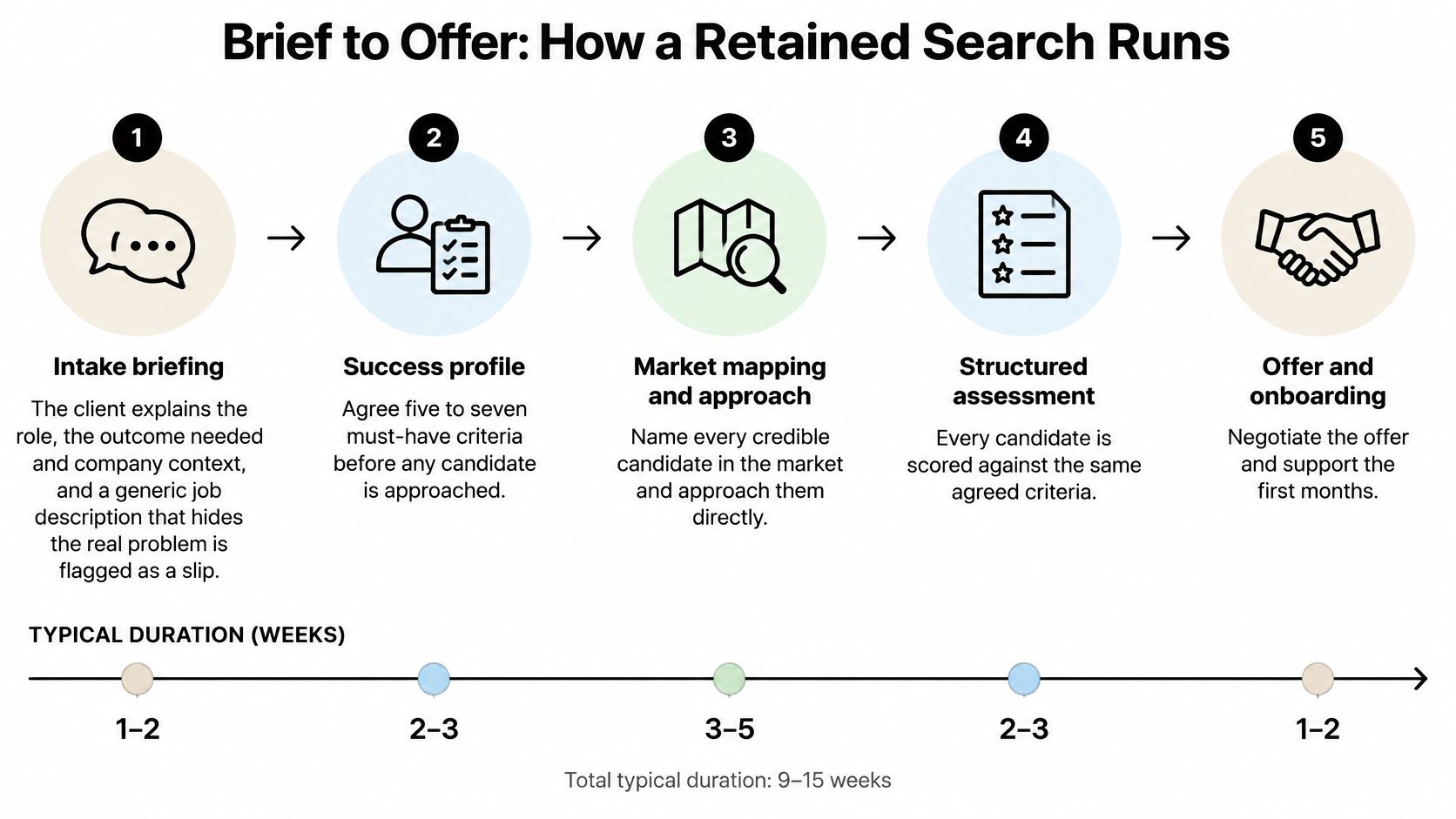
- Intake briefing. You explain the role, the outcome the hire has to produce and the context around it. The slip is sending a job description and letting the firm infer the problem. When we open a search we want the mission, what the company builds, how the product works, who it competes with, where it's headed and what the environment is really like.
- Success profile. Five to seven measurable outcomes for the first 12 to 18 months, plus the dimensions you'll score against. The slip is skipping stakeholder calibration, so the profile becomes one executive's wish list.
- Stakeholder interviews. Capture what the CEO, the board and the team each need, and write down where they disagree. Disagreement discovered after the shortlist is a failed search.
- Market mapping. A researched list of companies and named passive candidates, not a sweep of the applicant pool. The slip is calling a keyword filter a market map.
- Confidential outreach. Approach candidates discreetly, with enough of the brief to interest someone who has no reason to reply. The slip is naming the client too early, which leaks the search and loses the sitting executive with the most to protect.
- Structured assessment. The same competency questions, on the same scale, for every candidate. The slip is a different conversation per person, which produces a ranking nobody can defend in a debrief.
- References. Verify specific claims with former stakeholders. The slip is treating a reference as a character witness.
- Offer management. Negotiate terms, absorb the counteroffer, and stay close through the resignation. The slip is going quiet at signature.
The search rarely fails at the offer. It fails at the brief, three weeks earlier, when nobody wrote down what the hire is supposed to change.
The calendar you can plan against
Clockwork Recruiting's retained-search benchmark, built from more than 100,000 anonymized projects over four years, puts the average placement rate at 76% and average time to placement at 117 days for 2020 through 2023. That's just under four months, or roughly sixteen to seventeen weeks from launch to accepted offer.
Treat the 76% as a reference point, not a warranty. Role complexity, pay, geography, employer reputation and how quickly your decision makers decide all move it.
Three levers shorten the calendar. Agree the profile before launch, so the firm isn't re-briefing in week five. Book the decision group early and give them a week rather than a quarter. Work with a firm that already knows the market, because we stay in constant communication with the people in our pipeline and keep an evergreen network across our focus areas. An in-house recruiting team rather than a bench of freelancers also keeps the people who took the brief on the search.
Before the first call, prepare three things: the business context behind the hire, a draft list of outcomes for year one, and the names of everyone who signs off on the shortlist.
What Retained Search Costs and What the Fee Buys
Published fee benchmarks put retained search at 25% to 35% of the executive's first-year total cash compensation, according to Axiobench's 2025 industry figures. Specialist German firms averaged 27.5% of target income in 2024, based on figures attributed to the German Federal Association of Management Consultants (Leadbeyond's fee analysis).
| Fee benchmark | Rate and basis | Source |
|---|---|---|
| Retained search, typical low end | 25% of first-year total cash | Axiobench, 2025 |
| Retained search, typical high end | 35% of first-year total cash | Axiobench, 2025 |
| German specialist firms, average | 27.5% of target income | BDU as cited via Leadbeyond, 2024 |
For a $300,000 first-year total cash package, the 25% to 35% range equals $75,000 to $105,000. The German benchmark uses target income, a different fee basis, so it is not directly comparable.
Why the premium survives the arithmetic
The fee buys more than candidate introductions. A review summarizing analyses of roughly 20,000 executive searches reports that 40% to 50% of newly hired executives fail within 18 months. It also cites a U.S. estimate of about $2.7 million in direct costs for an unsuccessful hire, before accounting for strategic drift, lost momentum or subsequent departures (The Leadership Miss No One Wants to Own).
Against that potential cost, the fee is a form of risk control. The value depends on whether the process produces evidence that improves the hiring decision: a clear success profile, comparable candidate assessments, and defined checkpoints after the hire.
What the fee should include
- A documented intake and success profile, agreed by the interviewers before the search begins.
- A researched passive-candidate slate, supported by a market map rather than a stack of inbound applications.
- Structured assessment evidence, scored against the same criteria for every candidate.
- Reference triangulation, using specific claims and input from former stakeholders.
- Post-placement checkpoints, with timing and responsibilities agreed in advance.
If a firm quotes below the benchmarks for a senior role, ask what the fee covers. Compare the proposed research, assessment and follow-up work with the risk the hire is meant to reduce. A low fee may fit a narrower assignment, but it should not be assumed to include every part of a full retained process.
What to pin down in the contract
- Payment staging: the amount due at signing, shortlist and acceptance.
- Replacement terms: what happens if the hire leaves, and whether a second search is included or discounted.
- Scope: which markets and candidate pools are covered before additional fees apply.
Read the recruiting agency contract terms covering replacement and exclusivity closely. If the budget also covers onboarding support, set that spend separately and compare it with relevant development costs, such as the coaching investment for women business owners.
Ask whether the firm continues searching if none of its presented candidates is hired. TekRecruiter keeps searching because the role's pipeline is already built and evergreen.
Fee percentages are benchmarks, not a complete quote. The final amount depends on the role, compensation package and breadth of the market the search must cover.
Retained Search Compared with Contingency and RPO
Three models get confused constantly, and the confusion costs real money. Here they are on the same criteria:
| Factor | Retained search | Contingency search | RPO |
|---|---|---|---|
| How you pay | Agreed fee paid in stages | Fee due only on placement | Management fee, often plus per-hire fees |
| Firms on a role | One firm committed | Several firms may compete | One provider runs the hiring function |
| Best fit | Senior, confidential or hard-to-fill roles | Mid-level roles with a deep applicant pool | Steady, high-volume hiring across teams |
| Candidate sourcing | Mapped passive candidates | Active candidates and referrals | Pipeline across all requisitions |
| Speed to first candidates | Slower, research-led | Faster for active candidates | Fast once the process is built |
| Accountability | High, with scorecard and checkpoints | Moderate, competitive | High across the function, spread across roles |
- Retained search. One firm owns the role, works on a staged fee and answers for the shortlist. Its advantage is reach into people who aren't looking. Its cost is commitment: you pay before you see a candidate, and the first slate takes longer because research precedes outreach.
- Contingency search. You pay on placement, which keeps the downside small, but several firms may work the same role and none has skin in the game until it closes. It runs on active pools and referrals, so it works when the pool is deep and already interested. It breaks the moment the search needs discretion, because the format leaks.
- RPO. A provider runs a hiring function or a block of requisitions on a management fee, often plus a per-hire fee. It suits steady volume across many roles, where the constraint is capacity rather than one difficult seat.
The rule of thumb: retained for one senior, confidential or hard-to-fill role; contingency for a mid-level role with a deep applicant pool; RPO when hiring volume justifies an outsourced function.
These models combine better than they compete. A SaaS company might run a retained search for a CTO and an RPO arrangement for the twenty engineers joining under that CTO in the same year. The mistake is picking one vendor policy and applying it to every requisition.
If the seat carries board exposure, the calculation shifts, and why recruiters alone won't land board seats covers the difference between an executive search and a board search. If you're weighing a provider to own volume hiring, this guide to recruitment process outsourcing companies sets out what to compare.
When Retained Search Is Worth the Premium
The default assumption is that a confidential external search is the premium answer to any senior gap. The appointment data doesn't support that as a blanket rule.
CEO Worldwide's 2026 review of executive search found that 69% of CEO appointments in the first quarter of 2026 were internal, and that nearly three-quarters of financial-services CEO appointments in the first half of 2026 were internal promotions. External hiring still matters: 40% of new S&P 1500 CEOs in 2025 came from outside the company.

So the question isn't internal versus external. It's which leadership problem needs which talent market. Internal succession preserves context, trust and speed when the strategy is working. An external search earns its fee when the company needs a pivot, a cultural reset, a capability it doesn't have, or an independent voice in front of the board.
Four criteria decide it:
- The change agenda. A turnaround, a market pivot or a culture repair favors external. A strategy that's compounding favors someone who already knows where the bodies are buried.
- Bench depth. One credible internal contender with two years of stretch exposure is a succession plan. None is a search.
- Governance needs. If the board wants a challenger, an outsider carries that mandate in a way an internal promote can't.
- Time horizon. A leader who has to deliver in two quarters needs context. A leader building for five years can afford to learn it.
Say a SaaS company has a technically excellent head of engineering who has run platform and infrastructure well for four years. The next phase needs go-to-market partnership, an AI transformation and a credible board presence, and none of that is in their history. Promoting them is still defensible, but only if someone has named the gap and built a plan to close it. Otherwise you've filled the seat and left the risk where it was.
The practical answer is a dual-track process: develop internal contenders seriously while confidentially benchmarking the external market. That turns a retained search into evidence about succession risk rather than an automatic replacement, and it usually sharpens the internal candidate's development plan. In a mid-market engineering organization, the external benchmark often confirms the internal choice and tells you exactly what to coach.
The succession conversation is usually more political than analytical, and it's worth rehearsing before it reaches the board:
Best Practices for Briefing and Scoring a Retained Partner
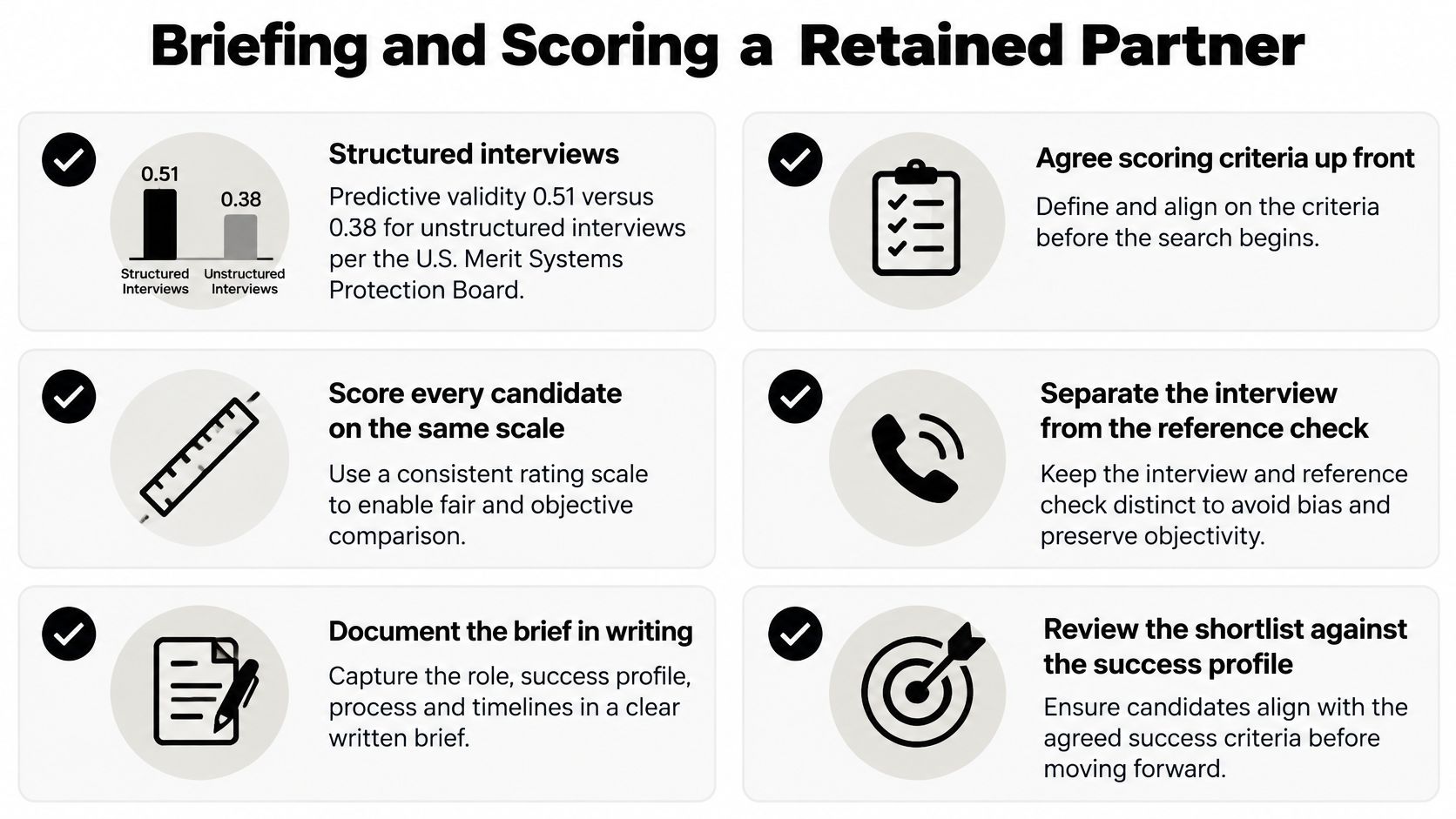
The U.S. Merit Systems Protection Board's study of the selection interview reports average predictive validity of 0.51 for structured interviews against 0.38 for unstructured ones. The practical implication for executive search is clear: confident interview impressions are not enough. A partner should be able to show how the process produces comparable evidence about each candidate.
Build the scorecard before the market map
Set five or six dimensions and use them consistently. For a technology leader, consider strategic scope (what they owned, not advised), operating cadence (how they run a quarter), technical depth (whether they can review an architecture and spot a flaw), talent leadership (who followed them and whom they let go), and measurable business outcomes (delivery reliability, platform resilience, security posture, hiring velocity, retention or revenue).
Define what each score means before interviews begin. Without clear anchors, “strong” can become a judgment about confidence or style rather than evidence.
Test execution, not articulacy
Ask candidates to explain a past architecture, security or AI transformation. Have them defend a trade-off and quantify what changed. The distinction is between describing a strategy well and demonstrating repeated execution.
Ask this: “Tell me about the decision you'd make differently now, and what the first version cost.” A rehearsed success story may not reveal how the candidate handles mistakes or trade-offs.
Use references to verify, not to vouch
Use reference calls to test specific claims raised in interviews. Ask what the candidate personally changed, under what constraints, and with what measurable result. A reference who offers only adjectives has provided little evidence.
Psychometrics can inform judgment, but they cannot replace it. Interpret results carefully across countries, where communication norms and expectations of executive presence may differ.
TekRecruiter uses the HEART standard, High agency, Execution, Accountability, Resourcefulness and Transparency, to assess candidates beyond skills and experience. Look for observed behaviour behind each quality: a project delivered, a decision made without waiting for permission, or a difficult truth raised early. A value without evidence is just a label.
Post-hire support may also matter. If the new leader needs development, consider the expected outcomes and cost before budgeting for executive coaching ROI in 2026.
A partner's evidence should begin before the shortlist. Ask how it identifies and speaks with relevant people, and how the resulting conversations inform the scorecard. TekRecruiter's approach is to have quality conversations with the right people on every role, rather than rely on a database alone. Find out who will conduct those conversations and how the partner will show that candidate assessments are grounded in evidence.
Confirm Your Brief Before You Engage a Partner
A retained search makes sense when discretion, access to passive candidates or rigorous evaluation warrants the added cost. If the role does not need those things, contingency search or RPO may be a better fit.
Before signing, get these points clear:
- Test the role. Which need justifies retained search? Record the reason and make sure the hiring team agrees.
- Write the success profile. Define five to seven measurable outcomes for the first 12 to 18 months, then set scoring dimensions tied to those outcomes.
- Assess the firm's process. Ask how it structures assessment, checks references and calibrates interviewers. Request a sample scorecard from a comparable search.
- Confirm the terms. Put the fee basis, payment stages and replacement terms in writing.
- Name decision makers. Identify everyone who approves the shortlist and confirm when they can interview.
Agree on three review points, each with a named owner: day 30 for profile and shortlist quality, day 60 for interview evidence against the scorecard, and day 90 for offer status and early-hire risk. These checkpoints expose delays while there is still time to address them.
If neither an internal successor nor the market fits the brief, revisit the role before authorizing a search. A clear position description with defined responsibilities and outcomes is a practical test of whether the need is specific enough to recruit against.
TekRecruiter conducts retained executive searches for VP, Head of and C-level technology and engineering leaders, with a Managing Director on every account. To start, tell the firm the role and the outcome you need, then speak with founder Ron Smith.
A shortlist is only useful when candidates are assessed against the same evidence and criteria. TekRecruiter's searches cover technology and engineering leadership roles, from CTO and CISO to VP Engineering and Head of Product. Visit TekRecruiter to discuss the role and the outcome it needs.
 Ron SmithPresident & Lead RecruiterTekRecruiter