What to Expect in a Technical Interview: A 2026 Guide
Learn what to expect in a technical interview: stages, question types, scoring criteria and prep steps for software engineers in 2026.
You've got a recruiter call on your calendar, a coding platform tab open, and no clear picture of what happens after that first screen. That's normal. Most candidates prepare for a single coding problem and then walk into a process built from several different checkpoints, each one collecting a different kind of evidence about how you'd work in practice.
Understanding what to expect in a technical interview means seeing those checkpoints in advance, so you can prepare for coding, design, past work, and AI tool policy as separate skills.
What a Technical Interview Really Measures
A candidate I interviewed solved the coding problem cleanly, with time to spare. He still didn't get an offer. His code was correct, but he'd never clarified whether the input could be empty, never said why he'd chosen a hash map over sorting, and went silent when I changed one requirement midway.
That's the gap most candidates miss. A technical interview is a multi-stage evaluation, not one conversation. You'll typically move through a recruiter call, one or more technical screens, a structured interview loop, and a final review where interviewers compare their written feedback before anyone decides.
Think of a pilot's certification. A simulator check, a flight check, and a logbook review all count, and no single maneuver settles the outcome. Interviewers work the same way, gathering evidence at each stage instead of trusting one performance.

The Two Things Being Scored
The first is technical execution. Can you write correct, reasonably efficient code and make sound design choices?
The second is your engineering process, spoken aloud. Do you clarify requirements, state assumptions, weigh trade-offs, and revise your approach when new information arrives? Interviewers write down both, often in separate rows on a scorecard.
Formats vary by company, level, and specialty, so treat the stages, question types, scoring, AI policy, practice plan, and follow-up steps below as a representative pattern. Preparing for one algorithm problem alone leaves most of that evidence uncovered.
The Stages You Will Go Through, in Order
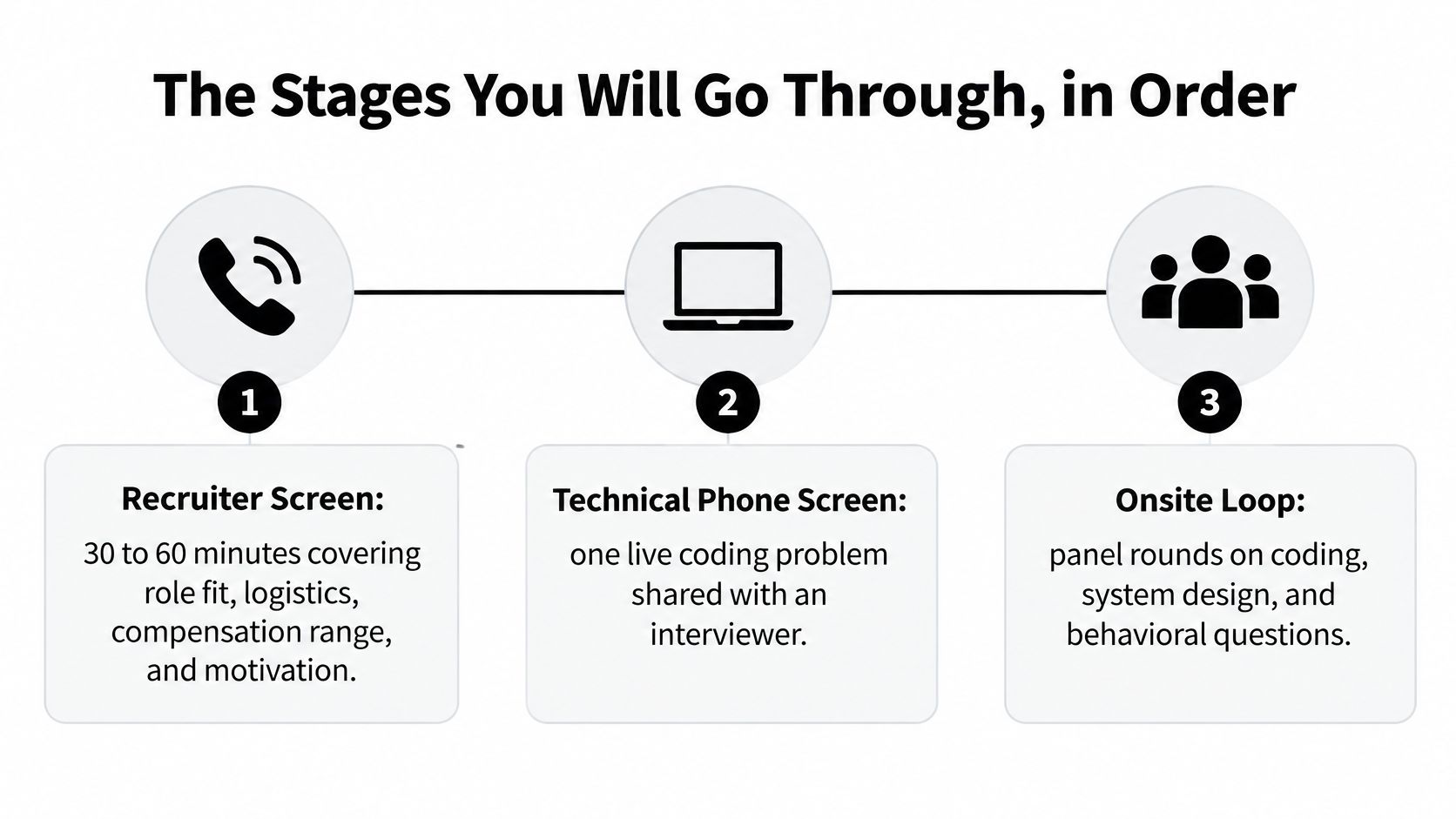
A recruiter may explain the role, then invite you to a technical screen. If that goes well, you may meet several interviewers in a loop before they review their notes and decide. Each checkpoint adds a different piece of evidence, so ask what each round involves and prepare for its format.
First Two Conversations
The recruiter screen is usually a conversation about role fit, logistics, compensation range, and motivation. Use it to ask what rounds are planned, which tools you will use, and who you will meet. A guide to the technical screening interview can help you prepare questions for this call.
The technical phone screen often involves a live coding problem in a shared editor, such as CoderPad or CodeSignal. Explain your reasoning as you work, so the interviewer can follow how you clarify the problem, choose an approach, and respond to new information.
The three stages shown in the timeline are the recruiter screen, technical phone screen, and interview loop. The loop contains several kinds of interviews rather than following them as separate stages.
| Stage | Typical length | Format | What it assesses |
|---|---|---|---|
| Recruiter screen | 30-60 minutes | Phone or video call | Role fit, logistics, motivation, compensation range |
| Technical phone screen | 45-60 minutes | Live coding in a shared editor | Core coding and problem solving |
| Interview loop | Several interviews, often around 45 minutes each | Virtual or onsite, with coding, system design, and behavioral rounds | Technical skills, design judgment, and collaboration |
| Debrief and decision | Days, not hours | Review of interviewers' written feedback | Evidence across the interviewers' scorecards |
The Loop and the Decision
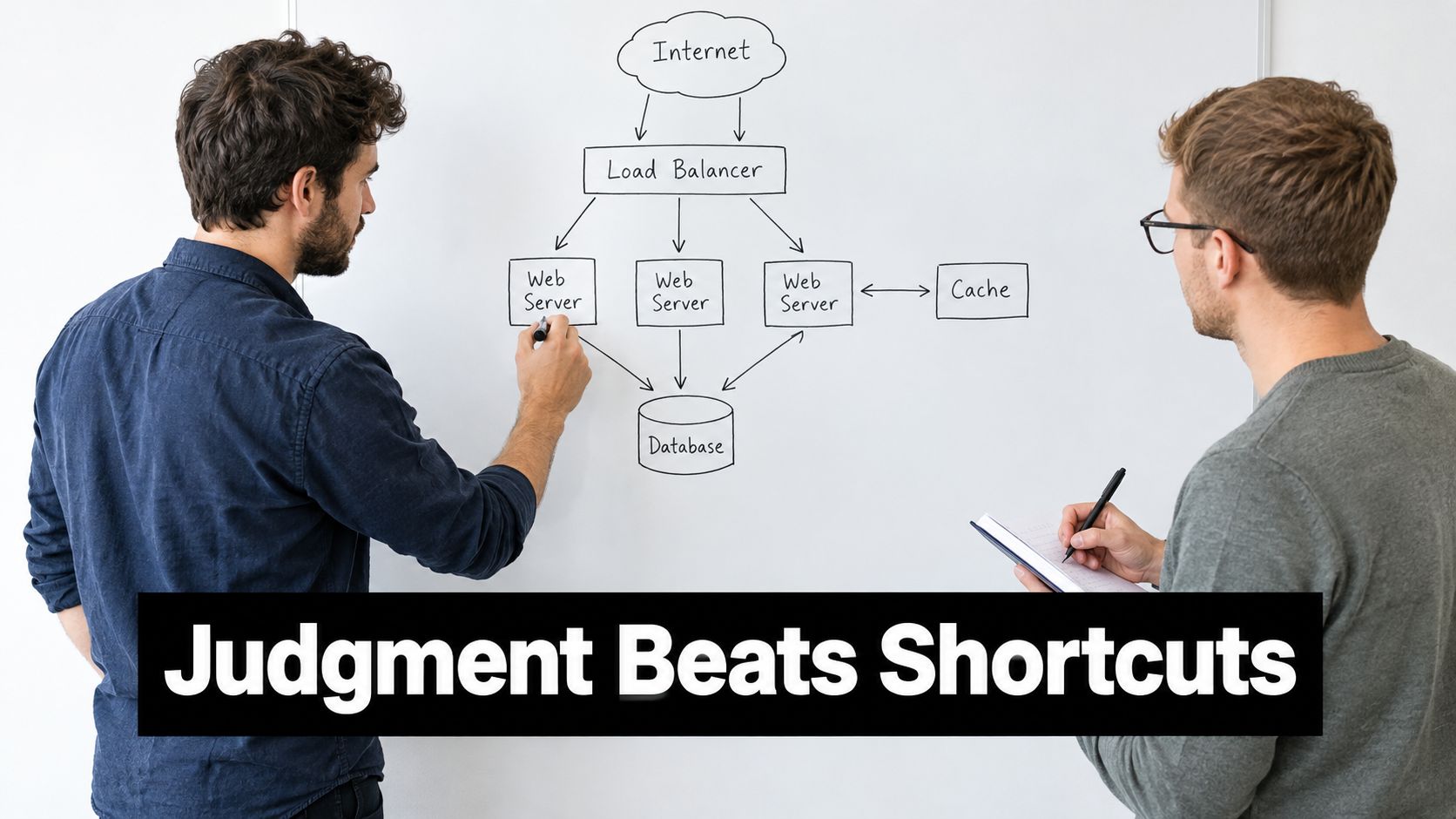
During the onsite or virtual loop, different interviewers assess coding, system design, and behavioral skills. A system design round may focus on architecture, scale, reliability, and trade-offs, particularly for mid-level and senior roles. Behavioral questions can cover ownership, collaboration, communication, and judgment at any level.
For a sense of how these rounds feel from the candidate's chair, watch this walkthrough before your first screen.
After the loop, interviewers submit written feedback for a panel or committee to review. Their notes record evidence from each conversation, and consistency across rounds matters because the decision is based on the combined picture, not a single interviewer's impression.
Practical rule: Ask your recruiter to list every round, its length, and its format in writing. Use that list to plan your preparation.
Question Types and How Much Each One Counts
A coding prompt, a design discussion, and a story about a production incident each reveal different evidence. The frequency of a question type can help you anticipate the format, but it does not tell you how interviewers score your answers.
One GitHub README compiles 426 Google software engineering interview questions and reports this distribution: coding and algorithms at 56%, behavioral and leadership at 19%, system design at 12%, software-engineering fundamentals at 10%, and machine learning topics at about 3%. These figures describe the questions in that compilation, not their share of an interview score. The README is a single, unvetted compilation, so treat its mix as a rough reference for Google-related questions, not a forecast for every company.
| Question type | Share in the compilation | What it tests |
|---|---|---|
| Coding and algorithms | 56% | Data structures, complexity analysis, and correct code under time limits |
| Behavioral and leadership | 19% | Ownership, conflict, communication, and judgment |
| System design | 12% | Scale, reliability, trade-offs, and data models |
| Software-engineering fundamentals | 10% | Operating systems, networking, databases, and object-oriented design |
| Machine learning design and ML | About 3% | Model systems and machine-learning concepts |
What Each Type Sounds Like
A coding prompt might give you a stream of log lines and ask you to return the five most frequent error codes from the last hour. You would need to clarify the input, count occurrences, sort or filter the results, and explain your choices. A collection of common coding interview questions can help you practise recognizing familiar problem formats.
A system-design prompt might ask you to design a URL shortener that handles many new links each month. You would explain how data is stored and cached, then discuss the trade-offs. A behavioral question could ask about a production incident you owned, from detection through resolution. A fundamentals question might ask how a database index speeds up a query and what extra work it creates for writes.
Work samples add another kind of checkpoint. You may debug an existing codebase, complete a SQL exercise, troubleshoot infrastructure, or present a take-home implementation and explain your decisions.
How the Mix Shifts With Level
The tasks often reflect the decisions attached to the role. An early-career interview may focus on data structures and algorithms, while a senior-level discussion may ask how you would handle architecture, reliability, scalability, security, and operational trade-offs. That is a useful preparation lens, not a frequency breakdown supported by the Google compilation above.
Timing also varies by employer and interview format. Ask the recruiter how long each exercise lasts and what tools or materials you may use; one company's reported schedule does not establish a general norm.
Whatever the format, interviewers can observe how you clarify the problem, test edge cases, explain complexity, and respond to new constraints. If preparation time is limited, practise coding and project examples, then review design problems relevant to the role.
How Interviewers Score Your Answers
A technical interview is a sequence of evidence-gathering checkpoints. In a structured interview, candidates receive the same job-related questions, interviewers use set criteria, and each person records evidence against skills such as system design, debugging, delivery, and communication. The structured interview process explains how employers build these scorecards.
Structure helps interviewers compare evidence consistently. The U.S. Office of Personnel Management says greater structure improves validity, rater reliability, and agreement between interviewers, while reducing adverse impact, in its guidance on structured interviews.
Structured interviews also predict job performance. A large meta-analytic synthesis found an operational validity of about r = .42 for structured interviews, compared with about .33 for work-sample tests and .31 for cognitive-ability measures, as the Society for Industrial and Organizational Psychology summary of that synthesis describes.
| Criterion | Strong signal | Weak signal |
|---|---|---|
| Problem clarification | Asks about inputs, scale, and constraints before coding | Starts coding within the first minute |
| Approach selection | Compares options and explains the trade-off | Commits to the first idea without comparison |
| Complexity analysis | Explains time and space complexity | Gives complexity only when asked |
| Edge cases and testing | Checks empty input, duplicates, and overflow, then walks through an example | Tests only the happy path |
| Communication | Explains reasoning and flags uncertainty | Stays silent for long stretches |
| Debugging and recovery | Forms a hypothesis and tests it incrementally | Makes random changes |
| Ownership and impact | Identifies personal decisions and a measured result | Describes team work without clarifying their role |
Making Your Answers Observable
Give the interviewer specific evidence to record: the context, constraints, decision, alternatives considered, reliability or security checks, and what changed in production. This makes your contribution easier to assess than a polished but vague summary.
Consider a slow checkout service. “We optimized the database and it got faster” leaves the interviewer unsure what you did. A clearer answer explains that you traced the delay to a query used frequently for reads, added an index to speed it up, and accepted the additional write cost. Then describe how you measured latency after deployment.
That answer shows observable evidence: your diagnosis, trade-off, and verification. Interviewers may ask what you owned, how you responded when something failed, and what the work changed for the business. Their notes can then capture engineering judgment you demonstrated, rather than knowledge you only described.
Handling AI Tools Without Losing Credibility
Candidates usually ask whether they can use an AI assistant. That's the wrong first question. Ask instead what the employer is evaluating, unaided problem solving, your judgment about AI output, code review, debugging, or your ability to explain trade-offs.
The context makes this urgent. HackerRank's 2025 global report surveyed 13,372 developers across 102 countries and found 97% use AI assistants at work, 56% reported using AI during coding assessments, and 73% said it's unfair to lose opportunities to candidates who use AI-assisted solutions, according to HackerRank's 2025 report on AI in hiring.
Ask Before the Interview
Send your recruiter four short questions in advance.
- Is AI allowed in this round, or is the work expected to be unaided?
- Which tools are permitted, for example an editor's built-in assistant versus a separate chatbot?
- Must usage be disclosed, and if so, how?
- How does evaluation change when AI is authorized?
If AI Is Allowed, Supervise It
Treat generated code like a junior colleague's pull request. Check correctness against your own test cases, look for security problems such as unsanitized input, judge maintainability, confirm test coverage, and consider licensing implications of copied patterns. Say your checks aloud so the interviewer can score that judgment.
If AI isn't allowed, work unaided and don't negotiate in the room. Hiding use creates a credibility risk, because interviewers routinely ask you to justify a design decision or modify your solution live. Code you can't explain reads as code you didn't write.
You don't lose points for asking about AI policy. You lose them for submitting work you can't defend.
Senior, platform, data, and AI engineering roles may weigh tool judgment more heavily than memorized algorithms. Baseline unaided competence still matters everywhere, since you can't supervise output you couldn't evaluate yourself.
How to Prepare for Your Technical Interview
Two to four weeks gives you time to practise each round's format, strengthen your examples, and review your approach without cramming. Treat preparation as a sequence of checkpoints: each practice session should produce evidence you can explain, whether it is a clearer project story or a solution you can discuss aloud.
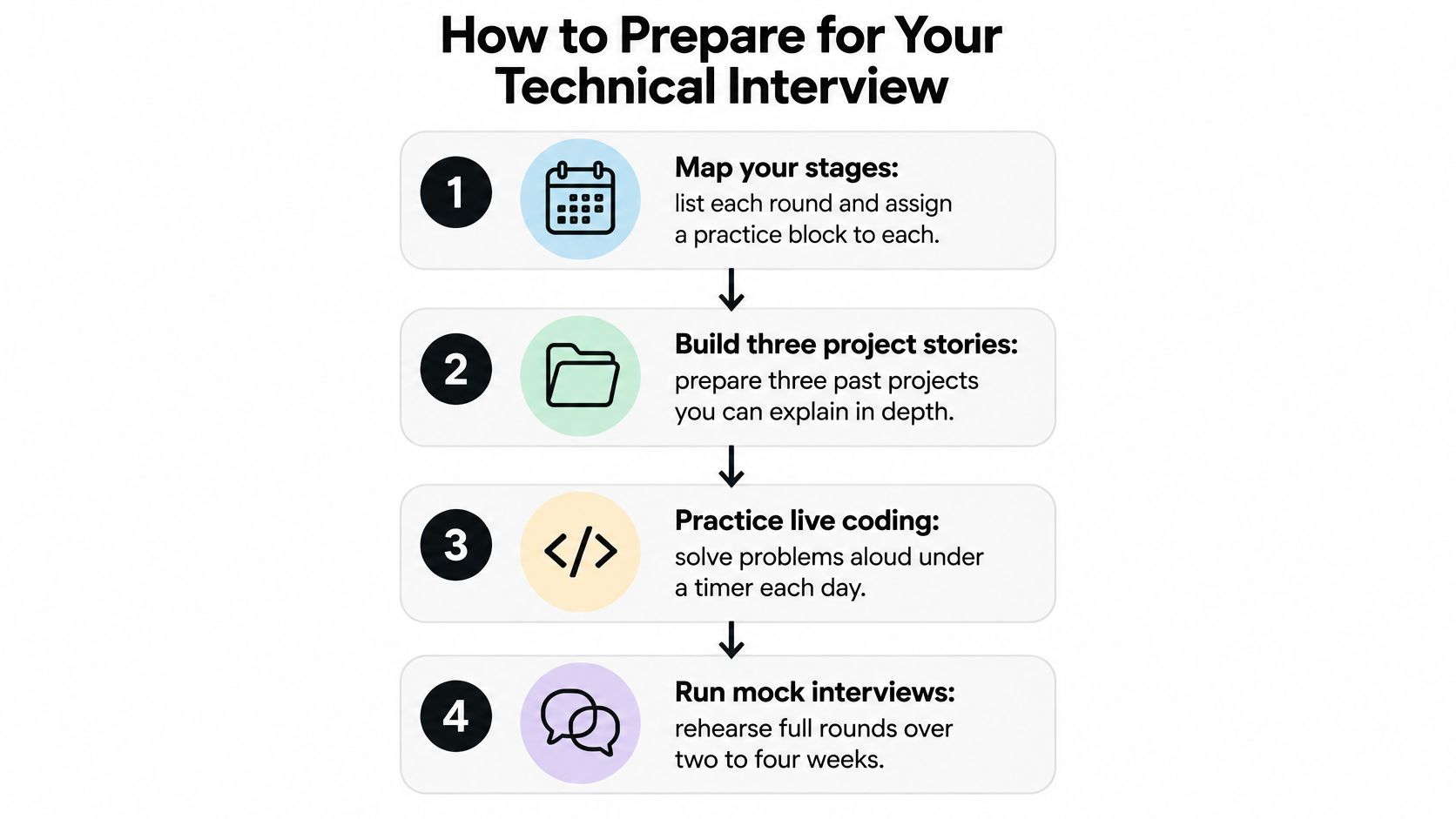
A Seven Step Routine
Map your stages. Use the rounds your recruiter described to assign each one a practice block. Match the exercise to the checkpoint: for example, practise explaining a past project for a behavioral round, and solving a coding problem for a coding round.
Build three project narratives. For each project, write down the context, constraints, decision, alternatives you rejected, and result. Use a measured outcome from your work, such as latency, defect rate, or cloud cost, if you have one. Interviewers can then record how you made a decision and what changed.
Practise the communication loop aloud. Clarify requirements, state assumptions, propose an approach, test edge cases, and summarize trade-offs. This sequence lets an interviewer follow your reasoning as well as assess your answer.
Solve timed problems. Use 45-minute practice blocks on platforms such as LeetCode or HackerRank. Mix medium and hard data-structure questions, then explain the solution's time and space complexity aloud.
Use a fixed design template. Before choosing components, cover the API, data model, consistency needs, availability target, observability, capacity estimate, and security boundaries. The template works like a checklist, helping you explain why a design fits the stated requirements.
Confirm logistics early. Ask about the format, timing, observers, permitted tools, breaks, and any accessibility accommodations you need. Clear arrangements let you focus on showing your work.
Rehearse your own rhythm. If ADHD, autism, anxiety, language differences, or remote constraints affect how you think aloud, practise jotting down brief notes before speaking.
Why Practicing Aloud Matters
Solving problems alone helps build skill, but it does not show whether another person can follow your reasoning. Interviews also assess how you explain decisions and respond to collaboration, so practise with an observer when you can.
Record a practice answer or ask a peer to watch a mock interview. Review one question: could they follow your reasoning without seeing your screen? If not, slow down and describe smaller steps.
Accessibility requests are part of preparation, too. A short, specific message to your recruiter can ask for written prompts in the chat or a brief break between rounds. This helps set expectations before the interview begins.
Judge the Process and Decide Your Next Move
The interview also tells you about the employer. Note whether the format was described before you started, whether interviewers kept a consistent scope, whether feedback arrived on the timeline promised, and whether clarifying questions were welcomed.
Poor transparency is information. Vague instructions and tests that don't match the role are documented reasons candidates lose confidence in a process, so weigh them alongside compensation and scope. Prepare your own checks using questions you should ask in an interview and notice how directly they're answered.
Act on the Outcome
- If you're rejected, ask which criteria were weakest and feed that answer into your next practice block.
- If you receive an offer, compare the role's scope, the team's stack, on-call expectations, and growth path against your other options before replying.
- Either way, send the recruiter a short thank you that names one topic you'd like to revisit.
Start this week. Schedule one mock interview with an observer, and send your recruiter your list of format and AI policy questions today.
If you're preparing for a technical loop or hiring engineers who can clear one, TekRecruiter screens candidates through deep technical conversations about how their work was built, why decisions were made, and what changed for the business. Visit TekRecruiter to discuss your next hire or your next role with a recruiter who understands the engineering behind the interview.
 Ron SmithPresident & Lead RecruiterTekRecruiter