How to Hire Engineers for Startup Teams
A practical 2026 guide on how to hire engineers for startup teams, covering role scorecards, sourcing, technical screening, offers, onboarding, and metrics that
You have a product deadline, a founder carrying too much of the architecture, and a job description that asks for a “rockstar” who can do everything. Applications arrive, interviews consume the week, and the strongest candidate disappears while your team debates whether they're senior enough. That isn't a talent problem. It's a hiring system problem.
Learning how to hire engineers for startup teams starts with a sharper question than “Who has the right stack?” Ask instead: What must this person deliver in the next 90 days, and what evidence proves they can do it? The answer determines the role, sourcing channel, interview process, compensation strategy, and onboarding plan.
Why Most Startups Hire Engineers the Wrong Way
A founder needs an engineer now. So they post a broad role, skim résumés, run unstructured interviews, and hire the person who sounds smartest on a call. It feels decisive. It usually produces a slow, expensive mess.
The mistake is simple. Startups hire engineers as if they are filling headcount, not buying execution against a specific business outcome. That is why weak hiring systems keep repeating the same pattern: vague role, noisy pipeline, inconsistent interviews, long debate, wrong hire.
A generic description makes this worse. “Build scalable applications in a fast-paced environment” says nothing useful to a strong engineer. Good candidates want to know what they are expected to ship, which constraints matter, what decisions they can make alone, and who they will need to work with. If you cannot explain that clearly, you are not ready to hire.
Set the operating rules before you source anyone.
- Define the business outcome. Name the result this hire owns. That could be launching a customer-facing service, stabilizing a fragile system, improving deployment speed, reducing latency, or taking over an ignored subsystem.
- Define the talent strategy. Choose the shape of hire that matches the problem. You may need a senior generalist, a junior engineer with tight support, a contractor for a narrow bottleneck, or a nearshore team that gives you senior capacity at a lower burn rate.
Those two decisions belong together. A startup that needs speed and broad ownership should not run the same search process as a company filling a specialized maintenance role. Scorecards and screening often break down in this context. Founders write one list for responsibilities, another for interview questions, then make compensation decisions separately. Run it as one system instead. Use a role scorecard, screen for evidence, and price the role against the hiring model you chose.
The market gives you little room for sloppy process. The U.S. Bureau of Labor Statistics projection for software developers estimates growth from approximately 1,693,800 jobs in 2024 to 1,961,400 in 2034, an increase of 267,700 positions, or 15.8%.
Practical rule: Do not open a search until you can name the outcome, the evidence you will accept, the budget range, and the final decision-maker.
A bad hire is not just payroll. At senior level, the true cost is usually six to twelve months of wasted salary once you count rework, review load, founder time, and delayed delivery. A delayed hire creates a different cost. Your strongest engineers absorb the missing work, technical debt grows, and the eventual search gets more rushed.
Use HEART-style judgment criteria to avoid that trap. Hire for Hunger, Execution, Autonomy, Range, and Trust. Then demand proof for each one. Founders who are still defining the first engineering seat should also review full stack engineering for founders.
Defining the Role and Benchmarking Compensation
Write the role scorecard before writing the job advertisement. Keep it to one page and make every line answer a practical question about ownership, capability, or expected behavior.
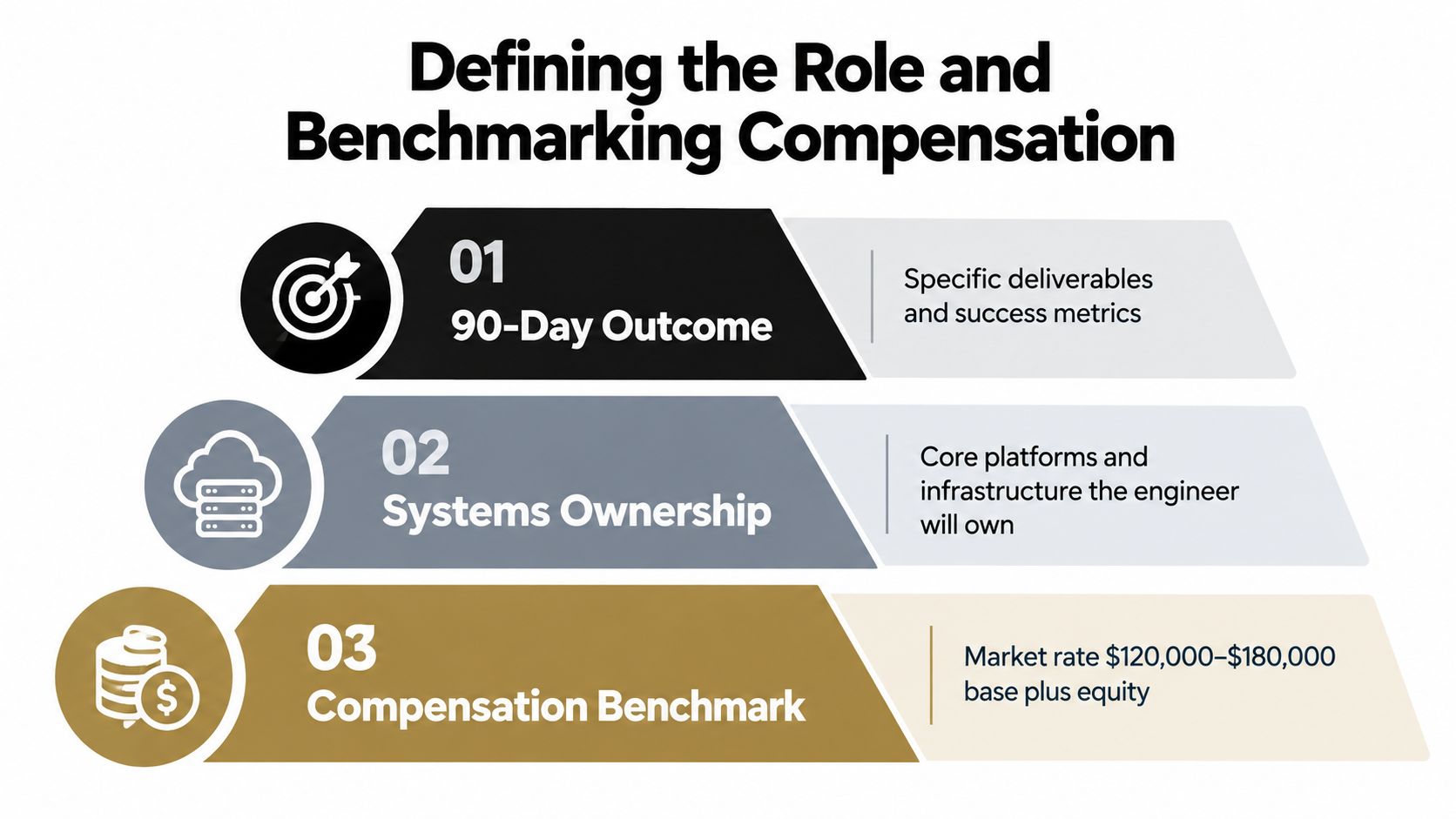
Start with a 90-day outcome
Use this structure:
- Outcome: What will be working, shipped, or measurably improved after 90 days?
- Ownership: Which services, systems, workflows, or customer problems belong to this person?
- Evidence: What past work demonstrates the required capability?
- Autonomy: Which decisions can the engineer make without approval?
- Collaboration: Which product, design, infrastructure, or customer-facing partners matter?
- Constraints: What must the engineer work within, such as an existing codebase, security requirement, or deployment process?
Separate must-have capabilities from tools you can teach. A founding product engineer may need breadth across architecture, implementation, deployment, and customer feedback. An infrastructure hire may need deeper experience with reliability, security, and cloud cost control. Don't list every technology the company has touched. A long stack list attracts keyword matches and scares away engineers who could solve the actual problem.
Pick the right seniority
Choose between a senior generalist, specialist, or junior engineer based on the bottleneck, not founder anxiety.
A senior generalist earns the premium when the role contains ambiguity, architectural responsibility, and little available mentorship. A specialist makes sense when one constraint threatens the business, such as production reliability or security. A promising junior engineer can work when the team has a clear technical owner, documentation, review capacity, and tasks that can be scoped safely.
That trade-off matters because entry-level hiring at early-stage startups fell roughly 75% from 2019 levels, while engineering hiring overall at those startups was 7% higher in 2025 than in 2019, according to SignalFire data reported by Startup Fortune. Startups still need engineers, but many are concentrating their searches on experienced candidates. Senior-only hiring can become a reflex rather than a strategy.
Build a compensation band
Benchmark a range, not a single number. Compare the role's level, location, employment model, scope, equity, benefits, and expected autonomy. A band gives you room to reward unusually strong evidence without pretending every candidate has identical market value.
Candidates will ask:
- How did you set the base range?
- What equity instrument is included, and how does vesting work?
- What does the role own in practice?
- How often do you review compensation?
- Is the company remote, hybrid, or location-bound?
- What would make someone successful in the first 90 days?
Answer directly. If the company pays below a large employer, explain the trade-off through ownership, product access, flexibility, or equity. For additional market context, review TekRecruiter's salary benchmarks, then validate the range against current candidate conversations rather than treating any benchmark as an absolute answer.
Choosing Between Direct Hire, Contract, and Nearshore
The engagement model should match the uncertainty in the work. Direct hire is right when the role is central to the company's long-term architecture and requires durable ownership. Contracting is better when the scope is defined, the need is urgent, or you're testing the shape of a future team.
Nearshore deserves more attention than it usually gets. English-speaking engineers in Latin America, including Brazil, can work in compatible time zones and may cost about 50% less than a comparable U.S. hire, according to TekRecruiter's stated service model. That can extend runway, but lower cost doesn't remove the need for technical leadership, security controls, clear contracts, or thoughtful collaboration norms.
For a practical overview of the operating considerations, founders can review nearshore staffing for U.S. companies. Treat nearshore as a talent strategy, not a cheaper task queue. Give the team meaningful ownership, establish communication expectations, and confirm who controls repositories, credentials, intellectual property, and production access.
A fractional CTO or external product team may be smarter than a founder-level hire when the company lacks technical direction but doesn't yet have enough stable work for a full-time executive. Executive search earns its cost when the hire will shape the engineering organization, recruit leaders, and represent the company to investors or strategic customers.
For the employment-model distinction between permanent and temporary work, see this direct hire versus contract comparison.
| Model | Best Stage | Typical Speed | Cost vs U.S. Hire | Best For |
|---|---|---|---|---|
| Direct hire | Stable core product work | Moderate | Full market compensation | Long-term ownership |
| Contract-to-hire | Uncertain fit or evolving scope | Fast | Variable, based on contract terms | Testing collaboration before conversion |
| IT staff augmentation | Immediate capacity gap | Fast | Variable, often lower commitment | Work managed by your technical lead |
| Nearshore | Cost-sensitive growth and distributed delivery | Fast to moderate | About 50% lower in the stated TekRecruiter model | Aligned-time-zone engineering capacity |
| Executive search | Leadership or high-consequence appointments | Moderate to slow | Premium search investment | CTO, VP, Head of Engineering, and similar roles |
Don't use a contractor to conceal an undefined role. Don't use executive search to compensate for weak decision-making. Pick the model that fits the work, then make ownership explicit.
Sourcing Channels That Actually Produce Senior Engineers
Senior engineers rarely respond to a generic job post because they don't need another list of technologies. They respond when the problem is interesting, the scope is credible, and the person reaching out understands their work.
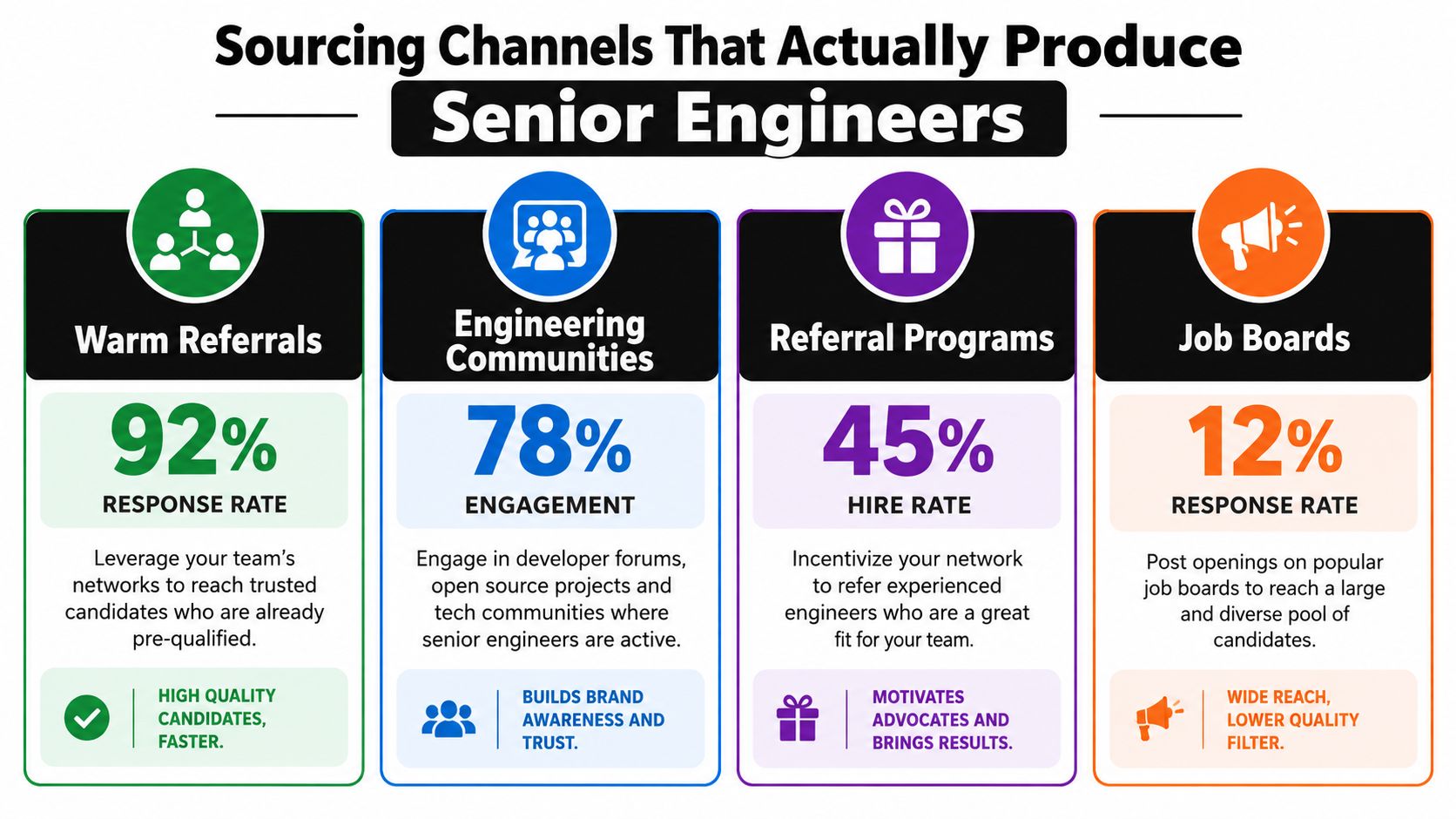
Warm referrals come first. Ask engineers to name people who have solved similar problems, not just people they like. Give each referral a short scorecard so the program doesn't become a popularity contest. Move quickly, provide feedback to the referring employee, and protect the candidate experience even when the answer is no.
Engineering communities work when you participate before recruiting. Open-source projects, technical Slack groups, focused forums, meetups, and specialist communities reveal how people think and collaborate. Look for sustained contribution, useful explanations, thoughtful issue discussions, and evidence of ownership. A GitHub profile isn't a résumé replacement, but it can create a stronger starting point than keyword screening.
Use outbound with a specific reason
LinkedIn outreach still works when it's targeted and personal. It fails when the message says “I found your profile and think you'd be a great fit.” Name the relevant project, explain the technical problem, state the ownership, and offer a short conversation. Don't pretend every passive candidate is already interested in your company.
Agencies can produce senior conversations when they understand engineering rather than just matching titles. Brief the recruiter on the scorecard, rejected profiles, compensation band, interview stages, and evidence that counts. Ask candidates to explain what they built, why they chose the design, how they measured the result, and what they'd change.
Candidate sourcing strategies can help teams compare channels, but the operating principle is simple: judge a source by qualified conversations and accepted offers, not by résumé volume.
University and bootcamp pipelines belong in a separate lane. They're useful for junior talent when you can provide mentorship and controlled work. Don't send early-career candidates into an unstructured environment and call the resulting failure a talent issue.
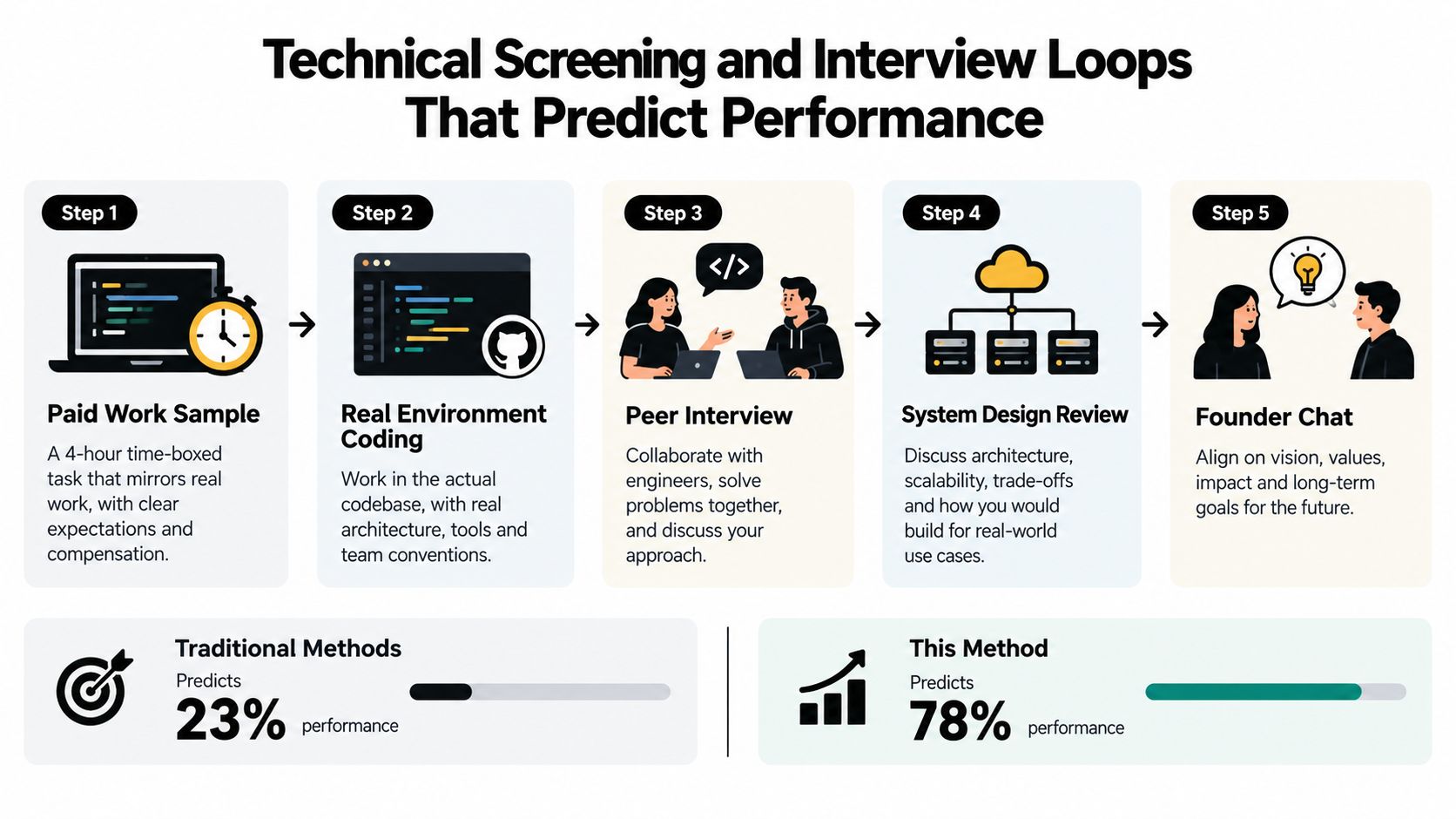
Technical Screening and Interview Loops That Predict Performance
Most startups over-test trivia and under-test judgment. A candidate can solve a polished algorithm exercise and still struggle to debug an unfamiliar service, communicate risk, or finish a messy project. Your process should resemble the work the engineer will perform.
HackerRank's 2025 developer research reports that 66% of developers prefer evaluation based on real-world skills, 96% believe problem-solving should matter more than memorization, and 62% report taking irrelevant assessments that don't help them get hired. Those findings support a practical change: use a paid, time-boxed work sample connected to your environment, then ask the candidate to defend the decisions behind it.
Build a compact loop
A useful loop can contain four conversations and one work sample:
- A 30-minute screen: Confirm motivation, communication, relevant ownership, location, compensation alignment, and availability.
- A paid work sample: Give a bounded problem that resembles the role. State the time limit, allowed tools, expected output, and evaluation criteria.
- A 90-minute technical deep dive: Ask the candidate to walk through the implementation, trade-offs, failure modes, testing, and next steps.
- A cross-functional conversation: Let product or design test collaboration, prioritization, and communication under disagreement.
- A founder or hiring-manager close: Explain the mission, constraints, decision rights, and growth path. Invite the candidate's hardest questions.
Use the same scorecard for every candidate. Score technical correctness, judgment, clarity, speed, accountability, and learning behavior separately. A correct answer with no explanation is weaker evidence than a thoughtful solution that identifies risks and proposes a sensible iteration path.
Evaluate HEART in the conversation
TekRecruiter describes its own screening lens as HEART, meaning High agency, Execution, Accountability, Resourcefulness, and Transparency. That framework is useful because it turns vague “culture fit” into observable behavior. You can also review guidance on how to assess candidate culture fit, as long as culture assessment stays tied to job-relevant behaviors rather than personal similarity.
AI-assisted coding shouldn't automatically disqualify a candidate. Ask what tools they used, how they verified generated output, which failure modes they considered, and whether they understand the system they produced. An engineer who can use AI while testing, reviewing, and taking responsibility is more useful than someone who refuses modern tools but can't explain operational risk.
For a practical interview structure, use this technical screening and interview guide. Keep the process short enough that strong candidates remain engaged, but rigorous enough that the final decision rests on evidence.
Closing the Offer Without Losing the Candidate
It's Friday afternoon. You finally decide you want the engineer, but you still have to sort out title, cash, equity, and who will manage them. That gap between “yes” and a real offer is where startups lose people. Candidates read hesitation correctly. If your team cannot explain the role in one clear story, the candidate assumes the job will feel just as messy.

Close the offer the same way you ran the interviews. With a scorecard, evidence, and judgment. The founder or hiring manager should make the verbal offer as soon as the decision is made, then explain three things plainly: why this person passed, what they will own first, and what constraints still exist. If you used HEART in interviews, use it here too. High-agency candidates want directness. Candidates who value Execution and Transparency notice when a company stalls, improvises, or hides trade-offs.
The written offer should confirm the same case you made verbally. Do not treat compensation, scope, and support as separate topics. They are one operating package. A senior engineer compares all of it together. That is especially true if they are weighing a direct hire against contract work or a nearshore team with different cash, time-zone, and ownership trade-offs. Spell out the actual job, the manager, the decision scope, and the reason this level fits the interview evidence.
Explain equity like an operator
Never hide equity behind “meaningful upside.” Explain the instrument, the number of units or shares when appropriate, the vesting schedule, exercise considerations, dilution reality, and whatever valuation context you are prepared to share. If you cannot explain the grant in plain English, bring in someone who can. Confusion at this stage kills trust fast.
Set a decision date. Keep it reasonable. Then ask what has to happen on the candidate's side for a confident yes. You want the actual blockers, not polite small talk. A spouse may need context. Another offer may be pending. The candidate may still be unsure about level or manager fit. Get the objections into the room and answer them directly.
Counteroffers need discipline. Ask what changed, what the candidate wants next, and whether the current employer is solving the root problem or just paying to delay it. If your role wins on ownership, pace, and clarity, say so.
Before you send the offer, confirm:
- Role level: The title and decision scope match the interview evidence.
- Compensation: Base, equity, bonus, benefits, and location terms are explicit.
- Manager: The candidate knows who will support and evaluate them.
- First outcome: The first meaningful deliverable is already discussed.
- Timing: Start date and response expectations are clear.
- Questions: Someone owns every open answer.
A slow offer feels like doubt. Strong candidates do not wait around to decode mixed signals.
A short conversation can help founders explain the role and expectations consistently:
Onboarding Engineers So They Ship in the First 30 Days
Hiring ends when the engineer ships, not when the offer is signed. The first month should remove uncertainty in a deliberate sequence: access first, context second, a small real contribution third, and larger ownership once the engineer understands the system.
A new engineer who starts on Monday should know who their manager is, who their onboarding buddy is, where the repositories live, how deployments work, which meetings matter, and what they're expected to accomplish during the first week. Don't make them search Slack for basic information while the founder assumes they're “ramping.”
Give the first week a written shape
A reusable week-one plan might include:
- Day one: Access, introductions, product walkthrough, architecture map, and a conversation about working preferences.
- Early technical work: Run the application locally, inspect the deployment path, read core documentation, and pair with an engineer on a small issue.
- Product context: Speak with a founder, product owner, or customer-facing teammate about who uses the product and what matters to them.
- First contribution: Make a small but real commit, such as a test improvement, safe bug fix, documentation update, or low-risk interface change.
- End-of-week review: Discuss what was confusing, what broke, what the documentation missed, and what should change before the next hire.
The first commit matters because it converts observation into participation. Keep it real, but don't make it a heroic rescue mission. A good first task lets the engineer learn the codebase, receive review, and see the path from local change to production.
Use the first 30 days to test fit
At the 30-day check-in, don't ask only whether the engineer is performing. Ask whether the role, team, and expectations match reality.
Discuss:
- What the engineer expected but hasn't found.
- Which decisions remain unclear.
- Where the codebase or process creates unnecessary friction.
- Whether the scope is large enough to be meaningful.
- Which support would increase independent execution.
- What the manager should stop, start, or continue doing.
A named buddy can answer everyday questions without turning the manager into a permanent help desk. The technical owner should still review the engineer's work promptly, explain trade-offs, and make standards visible through examples. Slow reviews are particularly damaging during onboarding because they leave the new hire uncertain about both the code and their standing on the team.
Make the 60-day transition explicit
By the second month, move from guided tasks to a bounded ownership area. The engineer should be able to explain the system they're working on, identify its risks, estimate work with increasing accuracy, and raise concerns before they become incidents.
The manager's job isn't to remove every obstacle. It's to make the decision boundaries clear. State which choices the engineer can make alone, which need peer review, and which require product or founder input. Startups often say they want autonomy while keeping every consequential decision trapped with the founder. That contradiction frustrates senior hires and prevents junior engineers from developing judgment.
At the 60-day review, assess the quality of decisions, collaboration, follow-through, and learning. Don't confuse activity with progress. A busy engineer who produces little usable work needs a different conversation from an engineer who ships carefully, surfaces risks, and improves the team's understanding of the system.
Use 90 days to confirm durable ownership
The 90-day review should answer a direct question: Can this engineer own the agreed problem with the level of support the company can realistically provide?
Review the original scorecard, not a moving target. Compare the promised outcome with what shipped, what changed in the business, which constraints affected delivery, and what the engineer now owns. A fair review includes the company's performance too. If priorities changed, access was delayed, or the manager disappeared, don't blame the employee for a broken operating environment.
Track a small hiring dashboard each month:
- Time to fill: How long qualified roles remain open.
- Offer-accept rate: Whether the offer and process match candidate expectations.
- Source-of-hire yield: Which channels create serious conversations and accepted offers.
- 90-day retention: Whether new hires remain after the initial ramp.
- Quality of hire: Evidence from the 30, 60, and 90-day reviews.
These metrics help you see where the funnel breaks. A low offer-accept rate points to compensation, expectations, or closing. Weak source yield points to targeting. Poor 90-day outcomes point to role design, assessment, management, or onboarding.
Avoid the quiet drains
Senior-only hiring can leave a startup dependent on a narrow talent pool. The SignalFire data cited earlier shows a roughly 75% decline in entry-level hiring at early-stage startups from 2019 levels, even as overall engineering hiring at those startups was higher in 2025 than in 2019. That doesn't mean every startup should hire juniors immediately. It means founders should make the decision consciously and build mentorship capacity before they do.
Other failures are easier to prevent:
- No interview rubric: Founders rely on charisma and compare candidates against different standards.
- Vague compensation: Candidates discover the actual range late and lose trust.
- Unbounded work samples: Candidates do unpaid project work that tests endurance rather than engineering judgment.
- Founder disappearance: The person who sold the mission becomes unavailable after acceptance.
- Slack-only onboarding: Important information remains scattered, undocumented, and impossible to repeat.
- No technical owner: New engineers receive contradictory feedback from people with different priorities.
Over the next two weeks, choose the next two engineering roles, write one-page scorecards tied to 90-day outcomes, select the engagement model for each, brief your referral and sourcing channels, and book the first structured interviews. That sequence will do more for hiring quality than another round of polishing a generic job description.
TekRecruiter offers direct hire, contract-to-hire, IT staff augmentation, nearshore recruiting, and executive search for startup engineering teams, with technical screening built around ownership, execution, accountability, resourcefulness, and transparency. If you need help turning a scorecard into a qualified pipeline, visit TekRecruiter and discuss the role with its recruiting team.
 Ron SmithPresident & Lead RecruiterTekRecruiter