Managed Services Consulting: What It Is and How to Buy It
Managed services consulting explained: how it differs from staff augmentation and direct hire, how it is priced, which SLAs to demand, and a vendor checklist.
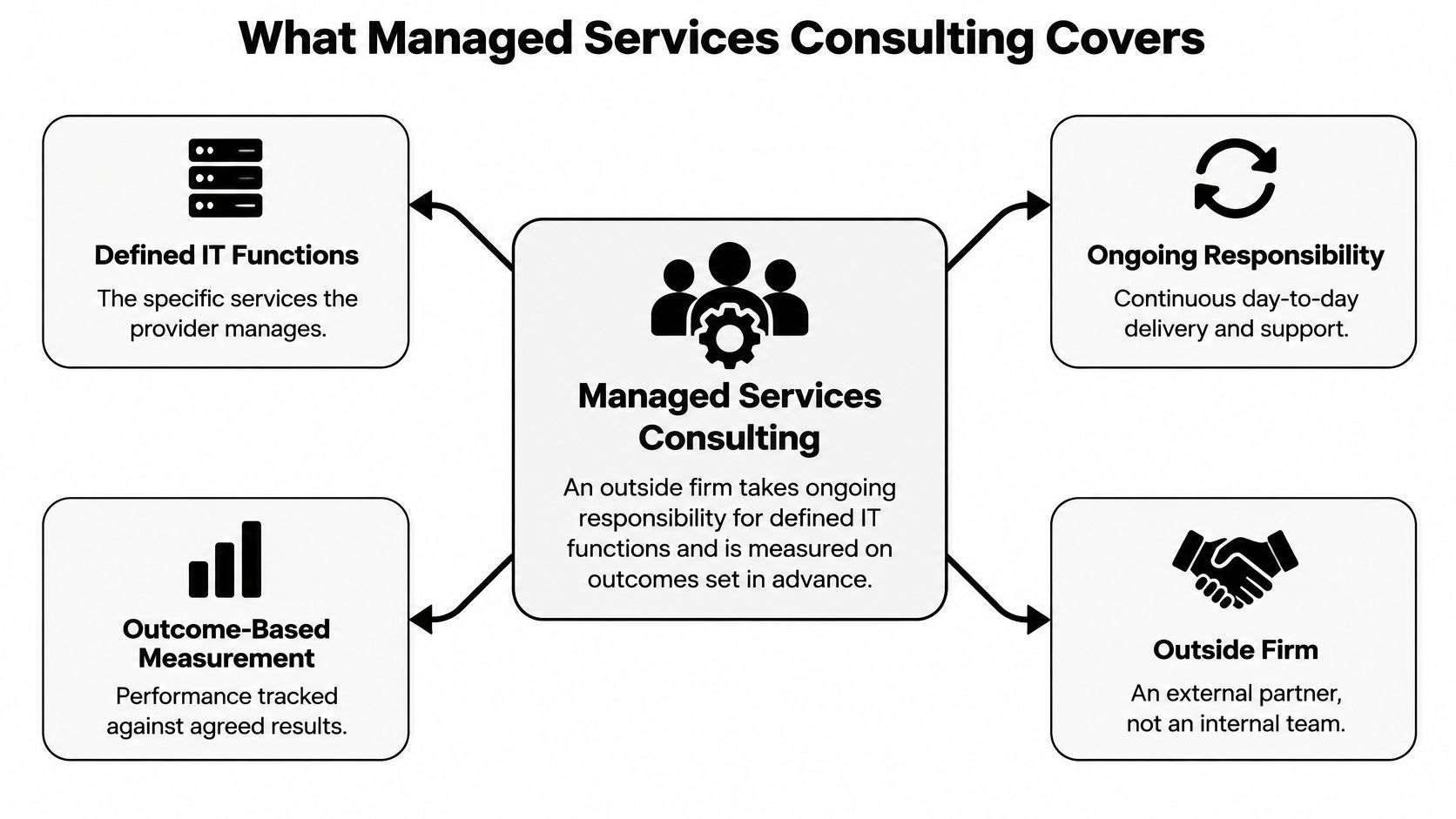
Managed services consulting means an outside firm takes ongoing responsibility for defined IT functions, is measured on outcomes set in service-level agreements (SLAs), and usually includes advisory work.
The popular advice is to compare monthly fees and choose the provider that takes the most work off your team. That's incomplete. A sound purchase starts with what the provider will own, what your team must retain, and the total cost of sustaining that capability, including the cost of changing suppliers later.
What Managed Services Consulting Covers
Managed services consulting combines responsibility for a running IT function with advice about how that function should evolve. The contractual distinction matters: Improving's explanation of managed services partnerships separates ongoing, SLA-based accountability from project delivery and staff augmentation.
Say your company hires someone to paint an office building. You wouldn't expect that painter to keep the building dry afterward. A facilities firm contracted to maintain the roof has a different obligation: inspect it, address defects, and respond when water enters.
IT purchasing needs the same distinction. A cloud migration can finish successfully while leaving nobody responsible for failed backups, overnight alerts, or rising consumption afterward. Managed services begins when a provider accepts defined operating obligations after delivery.
The relationships between scope, responsibility, and measurement should be explicit.
Separate the operating function from the advisory layer
Typical functions include:
- Service desk and incident management, including ticket ownership, escalation, and problem management.
- Cloud operations, such as configuration management, backup verification, capacity planning, and production recovery.
- Cybersecurity monitoring, with clear boundaries around detection, investigation, containment, and remediation.
- Application support, including troubleshooting, release support, and dependency management.
- Modernization planning, where the provider connects operational problems to a prioritized improvement backlog.
The advisory layer can include architecture reviews, roadmap development, tooling decisions, and vendor selection. Specify whether recommendations alone are included or whether implementation and subsequent support are also covered.
F1Group's discussion of proactive technology support for growing businesses is a useful reference when deciding which preventive activities belong in the service description rather than being treated as optional projects.
Contract test: A monthly retainer isn't proof of managed services. Look for named responsibilities, measurable service levels, and remedies for missed obligations.
Before engaging, answer three questions: Which functions are included? How will success be measured? What happens when targets are missed? A one-time audit, fixed-price build, or block of contractor hours doesn't answer those questions by itself.
How It Compares to Staff Augmentation and Direct Hire
Managed services consulting compared with staff augmentation and direct hire
| Dimension | Managed services consulting | Staff augmentation | Direct hire |
|---|---|---|---|
| Who is accountable for outcomes | Provider, measured against SLAs | Client manages the work | Client, through the employee |
| Contract basis | Ongoing service agreement | Time-and-materials or fixed term | Permanent employment |
| What you buy | A defined IT function delivered end to end | Individual skilled hours | One employee's capacity |
| Management control | Shared, set by RACI and SLAs | High, your leads direct daily work | Full control |
| Typical duration | Multi-year with renewals | Months, usually project-linked | Indefinite |
| Best fit | Run functions such as operations, support, cloud or security | Filling a known gap on a defined project | Core roles you must own long term |
Read the accountability row before the duration row. A long contractor engagement doesn't become managed services just because the contractor stays, and an outsourced function doesn't eliminate your obligation to set business priorities.
Staff augmentation fits a known delivery gap when your engineering managers can direct daily work. You supply the backlog, architecture, acceptance standards, and supervision. The distinction in staff augmentation versus consulting is especially useful when a proposal mixes individual specialists with broader delivery promises.
Direct hire fits work where institutional knowledge and enduring decision authority matter. A platform architect who understands why systems were designed a certain way may be more valuable inside your organization than available only through a supplier's account team.
Choose based on who must act during an outage
Consider a hypothetical mid-sized company that needs round-the-clock production monitoring but can't maintain a complete internal shift structure. Hiring four engineers might look workable on a staffing spreadsheet, yet leave, training, turnover, and overlapping incidents can expose coverage gaps.
Contractors can add coverage, but your managers still have to coordinate their work during an outage. Someone internally must assign incident command, decide what to restore first, and ensure a replacement appears when a contractor leaves.
A managed provider can instead own monitoring and response under an agreed service boundary. The company might retain an internal architect to approve platform direction while the provider handles alert triage, escalation, and restoration.
Buy skilled capacity when you can manage execution. Buy a managed function when you need the supplier to organize execution and answer for its performance.
Hybrid arrangements are often sensible. Keep product architecture and business-specific engineering inside, augment a temporary migration team, and place routine operations with a provider.
The mistake is buying staff augmentation while expecting outsourced accountability. If your team still allocates every task, covers every absence, and coordinates every incident, you've retained the management burden regardless of what the proposal calls the arrangement.
Where Managed Services Came From and Why Buyers Adopt It
The modern server room reflects a much older purchasing decision: whether to own every computing capability internally.

The Association for Computing Machinery's history of IT outsourcing traces external time-sharing and data processing to the 1960s, contract programming to the 1970s, and expanded network, telecommunications, application, and systems operations outsourcing to the early 1990s. Those later arrangements could include vendors operating customer facilities and taking over customer IT employees.
The category is now substantial: MarketsandMarkets estimates a global managed-services market of USD 412.72 billion in 2025, with a projected 8.9% CAGR from 2026 through 2031, while Grand View Research estimates USD 401.2 billion in 2025, projecting USD 847.4 billion by 2033 at a 9.9% CAGR. Different market definitions help explain the different estimates.
This video provides additional context for evaluating the model.
For buyers, the practical advantages of managed services center on access to scarce cloud, security, and data expertise, more forecastable operating costs, and coverage they can't readily staff internally. Those are purchasing objectives, not automatic consequences of outsourcing.
Engagement and Pricing Models Compared
Managed services pricing models and where the cost risk sits
| Pricing model | How it is billed | Best for | Cost risk to watch |
|---|---|---|---|
| Fixed monthly fee | Flat fee per month for a defined scope | Stable, well-understood workloads | Out-of-scope requests billed as change orders |
| Per-unit pricing | Charged per user, device, asset or ticket | Predictable growth in endpoints or users | Total cost climbs as usage grows |
| Block-hour retainer | Pre-purchased hours drawn down each month | Advisory work and periodic projects | Unused hours expire or overruns are billed |
| Outcome-based fee | Fees tied to agreed results such as uptime or migration milestones | Clear, measurable goals | Hard to define and verify outcomes |
| Time-and-materials or cost-plus | Actual hours or cost plus a margin | Scope that is still forming | Least cost certainty for the buyer |
A pricing structure allocates risk; it doesn't remove it. Fixed fees move staffing-efficiency risk toward the provider only within the agreed scope. Per-unit charges give you a visible rate but leave volume risk with you.
Outcome-based pricing requires particular care. If application availability relies on a database team outside the provider's control, the contract must explain how dependency failures affect payment. Otherwise, the parties can spend an outage arguing about attribution.
In Flexera's State of the Cloud findings, cost unpredictability and skills gaps are each cited as the top challenge by 30% of respondents. That makes the headline monthly fee an inadequate basis for comparison.
Calculate the total cost of capability
Build a cost model that includes the people, platforms, and obligations needed to deliver the function:
- Transition and discovery: Asset inventory, access setup, documentation repair, parallel operations, and migration effort.
- Retained internal roles: Service ownership, architecture, security governance, procurement, and business relationship management.
- Tooling and consumption: Monitoring licences, cloud usage, log storage, backup capacity, and provider-specific platforms.
- Exceptions and remedies: Change orders, security remediation, emergency work, and service credits received or owed.
- Exit and replacement: Data export, knowledge transfer, replacement-provider onboarding, and bringing work back in-house.
Ask for separate treatment of pass-through consumption and provider-controlled delivery costs. A supplier shouldn't describe its service fee as predictable while leaving essential logging, backup storage, or security tooling outside the proposal.
Stress-test the proposal before negotiating rates
For a hypothetical comparison, model current operations, then 50% more endpoints, a major outage, and eventual exit. These are planning scenarios, not forecasts.
Under growth, test whether the supplier charges for users, devices, agents, or overlapping categories. Under an outage, check whether recovery is included or becomes separately billable specialist work.
At exit, identify who pays to export configurations, transfer runbooks, and preserve access to operational history. A cheaper base rate can produce a higher total if the provider charges separately for the work your organization is most likely to need.
Shared Accountability and Risks After Signing
A provider deploys a model update that changes outputs in a customer-facing workflow. Who approves the change, who monitors errors and bias, who owns data lineage, and who leads incident response?
Outsourcing the implementation doesn't answer any of those questions. In KPMG's managed-services survey, 91% of surveyed companies report that managed services are highly integrated into digital-transformation strategy, while 87% identify AI implementation as a critical capability demanded from providers.
Put ownership beside every decision
Write a RACI, identifying who is responsible, accountable, consulted, and informed, for each capability. Avoid assigning accountability to a committee or to an unnamed client stakeholder.
For the model-update scenario, the provider might execute testing and deployment while an internal business owner approves the release. Security should have a defined role in reviewing data access, and the incident commander needs authority to suspend the workflow or roll back the change.
The operating boundary should be visible to both teams.
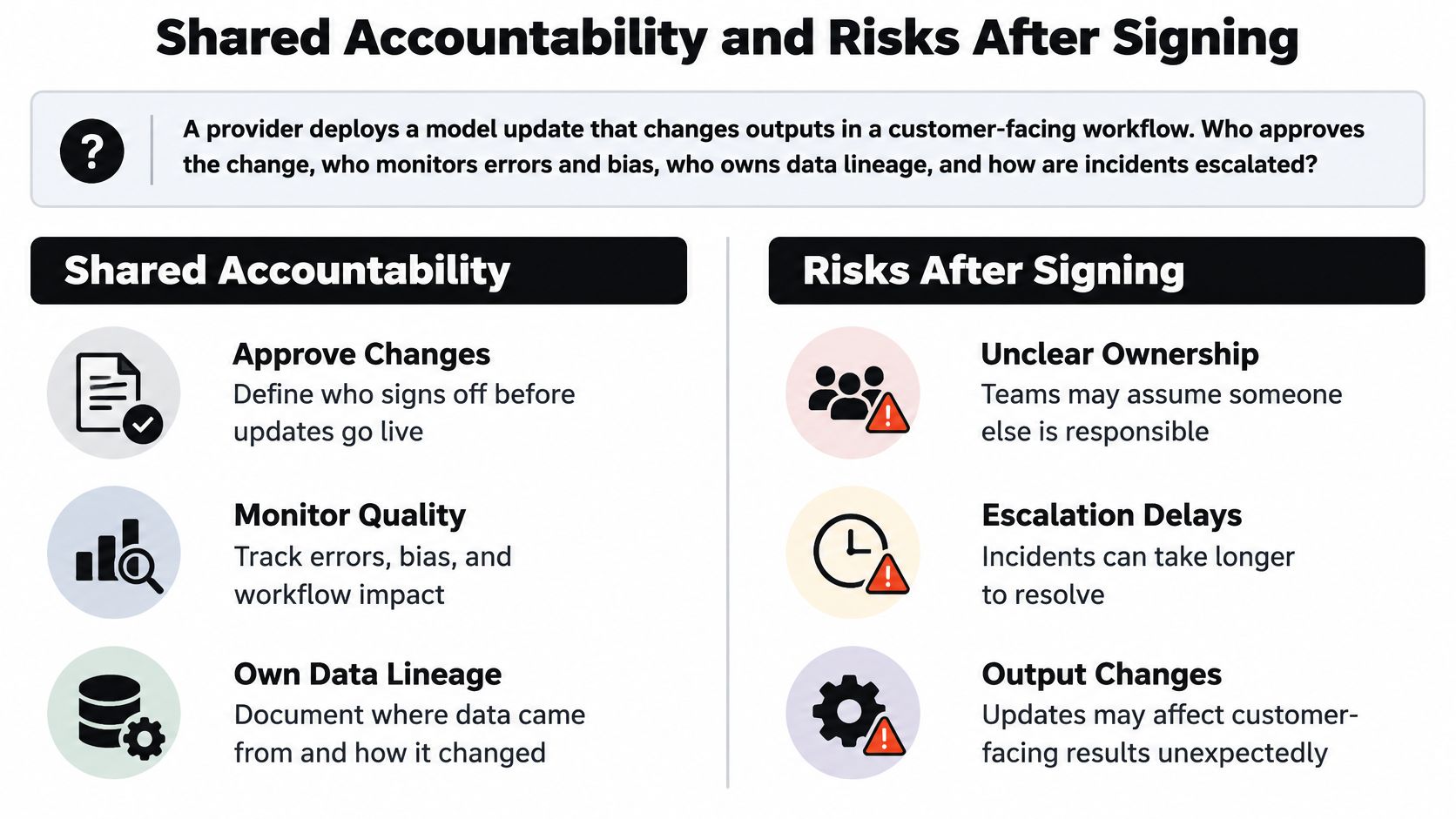
Support that ownership model with named escalation paths, model-risk controls, knowledge-transfer obligations, and exit readiness. For AI workflows, specify evaluation datasets, acceptable output behavior, rollback conditions, and human review for consequential decisions.
Keep the benefits without surrendering internal capability
The business case can be compelling: access to scarce AI, cloud, and security skills without completing a full hiring cycle; forecastable run costs; around-the-clock coverage; and a provider responsible for replacing its own unavailable staff.
Those benefits hold only when the commercial and operating terms support them. A supplier that absorbs staffing risk but controls all deployment tooling, credentials, and documentation can leave you dependent on its continued cooperation.
- Tooling dependence: Require exportable configurations and client access to relevant operational records.
- Blurred accountability: Name who authorizes production changes and who communicates with affected customers.
- Skills erosion: Give internal engineers access to runbooks, incident reviews, and architecture decisions.
- Architecture conflict: Review whether provider-selected platforms fit your security model and future hiring plans.
The broader decision about IT department outsourcing should therefore include what expertise you intend to retain, not just which activities you intend to transfer.
The strongest engagement may leave your team more capable, not merely less busy.
Retain people who can challenge technical recommendations and judge business risk. Let the provider accelerate delivery while your engineers and governance owners remain able to understand, approve, and eventually take over the work.
Contract Metrics and Onboarding That Hold Up
A managed-services contract is only as useful as the way it measures performance and assigns the work of fixing misses. Set targets the provider can control, define how each metric is calculated, and make shared responsibilities explicit before service begins.
SLA metrics to write into a managed services contract
| Metric | What it measures | Example target |
|---|---|---|
| Availability | Share of time a service is running | 99.99%, equivalent to about 52.6 minutes of downtime per year |
| Mean time to acknowledge | Time from alert to a human response | Set a severity-specific threshold after baselining |
| Mean time to resolve | Average time to restore service | Set restoration thresholds by severity and track them monthly |
| First-contact resolution | Share of tickets closed on first contact | 77%, reported for organizations using automated processes in the Freshservice 2024 benchmark |
| Auto-remediated incidents | Share of incidents fixed by tested runbooks | Establish a baseline before agreeing on improvement targets |
| Service credits | Financial remedy when a target is missed | Set as a percentage of monthly fees, with a cap agreed in the contract |
Use benchmarks as reference points, not automatic commitments. Each metric needs a target, a minimum acceptable level, a measurement method, and a defined consequence for breach. Service credits address the fee impact of a miss; they do not replace clear ownership of the corrective work.
Measure restoration, not just alert activity
Availability depends on recovery as well as monitoring. Specify how the provider will use redundant failure domains, tested backup restoration, dependency maps, and infrastructure-as-code to restore service when a failure occurs.
A provider can have infrequent outages and still deliver poor availability if restoration takes hours. Define when the recovery clock starts and stops, who verifies restoration, and how approved maintenance is counted.
The Freshservice benchmark also reported a 26.63% reduction in average resolution time with workflow automation. Treat that result as a reason to test automated routing, ticket enrichment, and runbooks, not as a guaranteed outcome for your environment.
Ask providers to demonstrate automation against recurring incidents. Keep human approval for remediation that changes production data or security controls, and require evidence that runbooks match current configurations.
Treat onboarding as an operational transition
A documented transition plan should set out communications, access needs, operational risks, milestones, and acceptance criteria. Verinext's onboarding guidance describes CISA recommendations that include transition planning, customer-controlled downtime scheduling, subcontractor responsibility, and performance SLAs.
Use this sequence before handing over production responsibility:
- Map responsibilities and dependencies. Identify application owners, upstream services, escalation contacts, and any work without an assigned owner.
- Set transition milestones and downtime windows. Schedule risky changes when business owners have agreed to the disruption.
- Confirm access and documentation. Test credentials and backup access; check architecture diagrams, asset inventories, and emergency procedures.
- Define subcontractor responsibility. Make the primary supplier accountable for subcontracted delivery and escalation.
- Agree acceptance criteria before cutover. Require evidence that monitoring, restoration, communications, and reporting work before transition is declared complete.
A kickoff meeting does not establish readiness. Require demonstrated operational control, including a recovery exercise and confirmation that the people receiving alerts can restore the service.
Vendor Checklist and TekRecruiter's Role
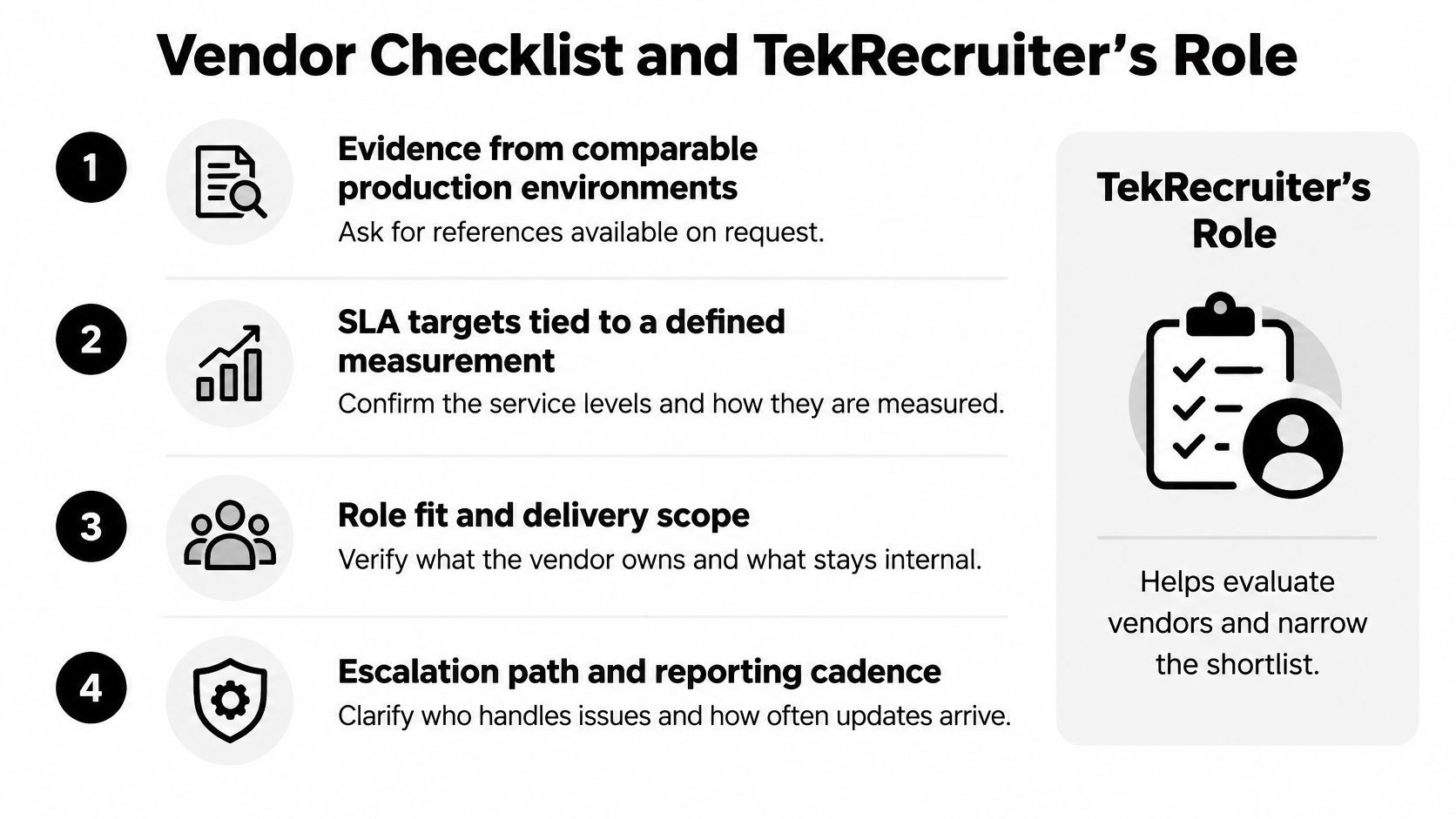
A supplier's monthly fee does not show the full cost of the capability you are buying. Compare vendors on delivery obligations, operating fit, and the cost of keeping the service running over time. Apply the same vendor selection criteria to every candidate.
- Comparable production evidence. Ask for relevant operating examples and references available on request.
- Measurable SLA targets. Confirm measurement windows, minimum acceptable levels, and breach consequences.
- Severity-specific response. Separate acknowledgement commitments from restoration commitments.
- Transition acceptance. Require a documented plan and agreed cutover criteria.
- Escalation and reporting. Name escalation owners and require monthly SLA and error-budget reporting.
- Exit readiness. Include knowledge transfer, configuration export, and return of data.
- Transparent economics. Account for change orders, tooling, consumption, and service credits.
- Future hiring fit. Confirm that you can recruit people to maintain the proposed stack later.
For location-specific requirements, managed IT services in NYC can help frame questions about local coverage and support scope.
TekRecruiter does not deliver managed services consulting. Its MSP and Outsourcing Search finds and vets managed service providers, IT outsourcing firms, and professional services firms. Clients contract directly with the supplier they select. The service is for sourcing providers, not delivering managed services.
When evaluating suppliers, compare the full cost of the capability, including the work needed to manage the relationship and maintain service levels. Visit TekRecruiter to discuss an MSP and Outsourcing Search based on your operating requirements, retained team, and future talent needs. Bring the same scope and cost assumptions to each conversation so you can compare delivery obligations, not just monthly fees.
 Ron SmithPresident & Lead RecruiterTekRecruiter