SaaS Recruiting Agency: What It Does and How to Choose One
What a SaaS recruiting agency does, which hiring model fits each role, and how to vet firms on screening, speed and contract terms.
Which agency would you rather hire: the one with 40,000 profiles in a database, twelve offices and the lowest fee on the shortlist, or the one that sends six candidates and gets five of them into a technical interview?
Most buyers pick the first. The numbers look bigger and the contract looks cheaper. Then the interview loop fills with engineers who list Kubernetes on a résumé and can't describe a single production incident they handled, and every weak interview costs two senior engineers an hour they were going to spend shipping.
This guide looks at the category from the other side of that table. It covers what a SaaS recruiting agency does, the five models you'll be offered, and the evidence that separates an agency that screens from an agency that forwards résumés.
What a SaaS Recruiting Agency Does for Your Team
Say a Series B software company approved a senior backend role in early spring. The quarter is closing. The requisition is still open, the billing service rewrite has slipped a sprint, and the two engineers who could have trained a new hire are covering on-call for the one service nobody else fully understands. The team has read 60 résumés, run nine interviews, and made no offer.
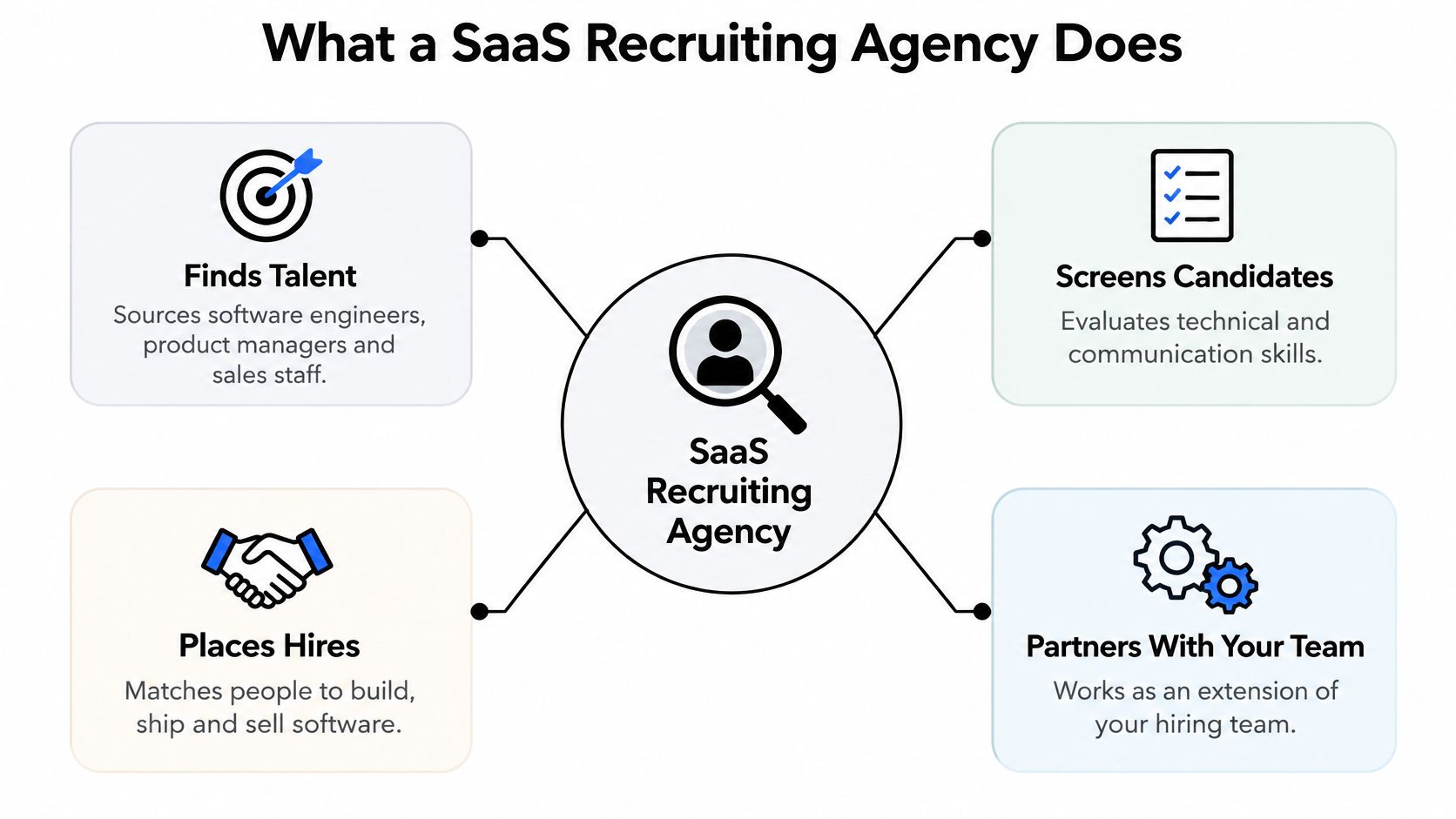
That gap is where a SaaS recruiting agency enters. The term describes a specialist firm that finds, screens and places the people who build, ship and sell subscription software: software engineers, product managers, GTM engineers and technical account executives. It doesn't replace your hiring manager or your engineers. It does the work in front of them, so their interview hours land on people who can already explain their own systems.
An in-house recruiter works like a shop's own stockroom. They know the shelves and the labels, but they can only hand you what the shop already stocks. An agency works like a broker with standing relationships across many suppliers. When the part is rare, the broker knows who makes it, what it costs, and which version fits the machine you're building.
Why SaaS teams rarely fill these roles alone
The demand side explains the economics. The U.S. Bureau of Labor Statistics projects software-developer employment to grow 15.8% from 2024 to 2034, adding about 267,700 jobs, the largest projected increase among the technology occupations in its analysis (BLS review of AI, IT and employment trends).
That projection understates the work. One subscription product needs engineers across application development, data, cloud infrastructure, security, testing and technical customer functions, so the developer count is a floor, not a ceiling. Every one of those roles competes with every other software employer in the same city, time zone or remote pay band.
Three situations where an agency earns its fee
- The role has been open for months with no qualified candidates. The pipeline isn't thin, it's exhausted. Reposting the same job description produces the same applicants.
- The team must scale faster than its recruiters can source. A funding round, a platform migration or a new region commits you to headcount that a two-person talent team cannot reach inside the roadmap window.
- The hire is senior enough that nobody in-house can assess the depth. A first Head of Infrastructure or a security leader needs a reviewer who can hear the difference between someone who has run the program and someone who has read about it.
From there, the work runs in three moves. The agency turns the job into specific skills and constraints rather than a title. It sources and screens against those skills, with conversations instead of keyword filters. Then it arranges interviews with your own engineers and manages the offer, so your team spends its time deciding rather than sorting.
Practical rule: an agency's value shows up in two numbers, how many of its submissions reach a technical interview and how many of those close. Everything else in the pitch is decoration.
If you want a structured way to capture what each stage produces, browse hiring signal templates that give intake, screening and offer decisions a consistent shape.
Judge the agency on screening quality and close rate. The rest of this guide shows you how to measure both.
Five Hiring Models and When Each One Fits
Five arrangements cover almost every SaaS hiring conversation. They differ in who employs the engineer, how long the commitment runs, and which problem each one solves. Picking the wrong row is expensive in both directions: a permanent hire for a six-month migration leaves you carrying salary after the work ends, and rotating contractors through a platform you will own for years means the knowledge walks out at every renewal.
| Model | Who Employs the Engineer | Commitment | Best Fit |
|---|---|---|---|
| Direct hire | Client, on payroll | Permanent, with 90-day placement guarantee | Long-term product and platform roles |
| Contract-to-hire | Contractor first, converted later | Trial period, no conversion restrictions | Roles where fit is still uncertain |
| Staff augmentation | Agency contractor, managed by the client | Temporary or project-based, no minimum term | Extra capacity for a release or backlog |
| Nearshore | Vetted Latin American engineers | Ongoing engagement | Steady teams that need time-zone overlap |
| Executive search | Client, as a permanent leader | Permanent | VP, Head of and C-level technology roles |
Direct hire places a full-time, permanent technologist on your payroll, and it fits work you intend to own for years: the billing service, the data platform, the security function you're building from scratch. Contract-to-hire starts the same person as a contractor and converts them when you're ready, which is the right shape when fit is unknown, such as the first AI platform engineer at a company that has never run inference workloads in production. The guarantee and conversion terms differ across agencies, so read those clauses before comparing fee percentages.
- Staff augmentation brings vetted external engineers who extend your team on a temporary or project basis and work under your management. Reach for it when the work has an end date: a cloud migration, a security backlog, a release that needs three more hands for a quarter. Some agencies can have consultants in seat within days, which matters when a deadline is already on the calendar.
- Nearshore places English-speaking, vetted engineers in Latin America who work inside your time zone. It suits steady collaborative teams where daily overlap beats a cheaper hourly rate, and it typically costs roughly half of a comparable US hire.
- Executive search covers VP, Head of and C-level technology leaders such as a CTO, Head of Infrastructure or CISO. The pool is small and the decision is consequential, so the process runs longer and heavier on assessment.
The contract-based rows aren't a niche arrangement. Staffing Industry Analysts reports that information-technology temporary staffing generated $51.9 billion globally in 2015, equal to 14.4% of a $360.9 billion temporary-staffing market, with North America accounting for $29.0 billion of it. Buyers have been choosing between employment models for a long time. The question isn't whether contract work is legitimate. It's which model fits this role.
Match the commitment to the length of the work
The choice works like a lease-versus-buy decision: you buy the house you plan to live in and lease the space you need for a season. A six-month migration should not trigger a permanent hire, and a platform you'll own for years should not be staffed by contractors who rotate out at renewal. That single principle settles most of the argument before fees come up.
The distinction between direct hire and a staffing agency is where buyers blur the lines most often, usually because procurement reads the contract while engineering reads the roadmap. Give both documents to the same person.
Contract-heavy work also shows up in adjacent stacks. If a project touches on-chain infrastructure, find elite Web3 contract developers through a specialist network rather than assuming a generalist bench can cover it.
Write down two things before you call anyone: how long the work lasts and who owns the outcome. Then pick the row where both fit, and ask every agency you speak with to justify that row rather than their default one. An agency that routes every role into the same contract type is optimizing for its margin, so ask what evidence sits behind their recommendation and how their submitted candidates perform at interview inside that model.
Vetting Engineers Beyond Keyword Matching
The most expensive sentence in technical recruiting is "the résumé matches." A React engineer with six years listed can still be unable to explain why their team moved rendering off the main thread, and you discover that in minute eleven of a 45-minute interview your staff engineer could have spent reviewing a pull request.

Keyword matching fails because it measures vocabulary. Screening measures judgment, and judgment has to be designed into the process rather than hoped for.
Turn the role into observable competencies
Research summarized in a review of candidate-screening methods reports corrected predictive-validity estimates of approximately 0.42 for structured interviews, 0.33 for work samples, 0.31 for general cognitive ability, and only 0.19 for unstructured interviews.
The gap between 0.42 and 0.19 is the cost of winging it. A consistent set of behaviorally anchored questions, asked of every candidate and scored the same way, predicts performance roughly twice as well as a free-form chat over coffee. Work samples add evidence of execution on top of that.
In practice, that means rewriting each role as observable behaviors. Designing an event-driven service. Explaining an incident-response decision and what changed afterward. Quantifying the business result of a feature, not just its architecture. Those are things a candidate can demonstrate in a conversation and a hiring manager can recognize.
Four questions to ask any agency
- Who writes the scorecard, and what does it measure? If the answer is a job description, there is no scorecard.
- Do your recruiters probe architecture trade-offs, or only the stack? Listen for whether they ask why a system was built that way.
- How do you verify that the candidate owned the work they describe? Probing work history for specific decisions, not team wins, is the tell.
- How do you judge communication with product and commercial teams? SaaS engineers ship through other people, so this is a performance trait, not a soft extra.
AI-assisted sourcing and AI-based judgment are different things, and the difference matters when you're buying. Tools can surface, organize and rank profiles faster than any human. They can't sit in a conversation and hear whether someone made the call under pressure, or whether the "we" in their story means they built it or attended the meeting.
A candidate who can't explain why their system is shaped the way it is hasn't been screened. They've been sorted.
Our version of that conversation is deliberately blunt. Every TekRecruiter candidate explains what they built, why it was built that way, and which business metric changed, and every candidate is screened for HEART: High agency, Execution, Accountability, Resourcefulness and Transparency. The framework matters less than the discipline of asking the same questions in the same order every time, which is what the structured technical screening interview is designed to do.
Test any agency on one artifact: ask for an anonymized sample candidate report. If you can see evidence rather than a verdict, the agency has done the work. If the report says "strong engineer, good communicator" with nothing behind it, the interview loop is about to become your screening process.
Speed, Capacity and Cost Behind Each Hire
An unfilled engineering seat isn't a gap in a dashboard. It's a deferred feature, thinner on-call coverage, and two senior people splitting attention between shipping and firefighting. The sequence below is the one that decides whether a search closes in five weeks or drifts into a second quarter.
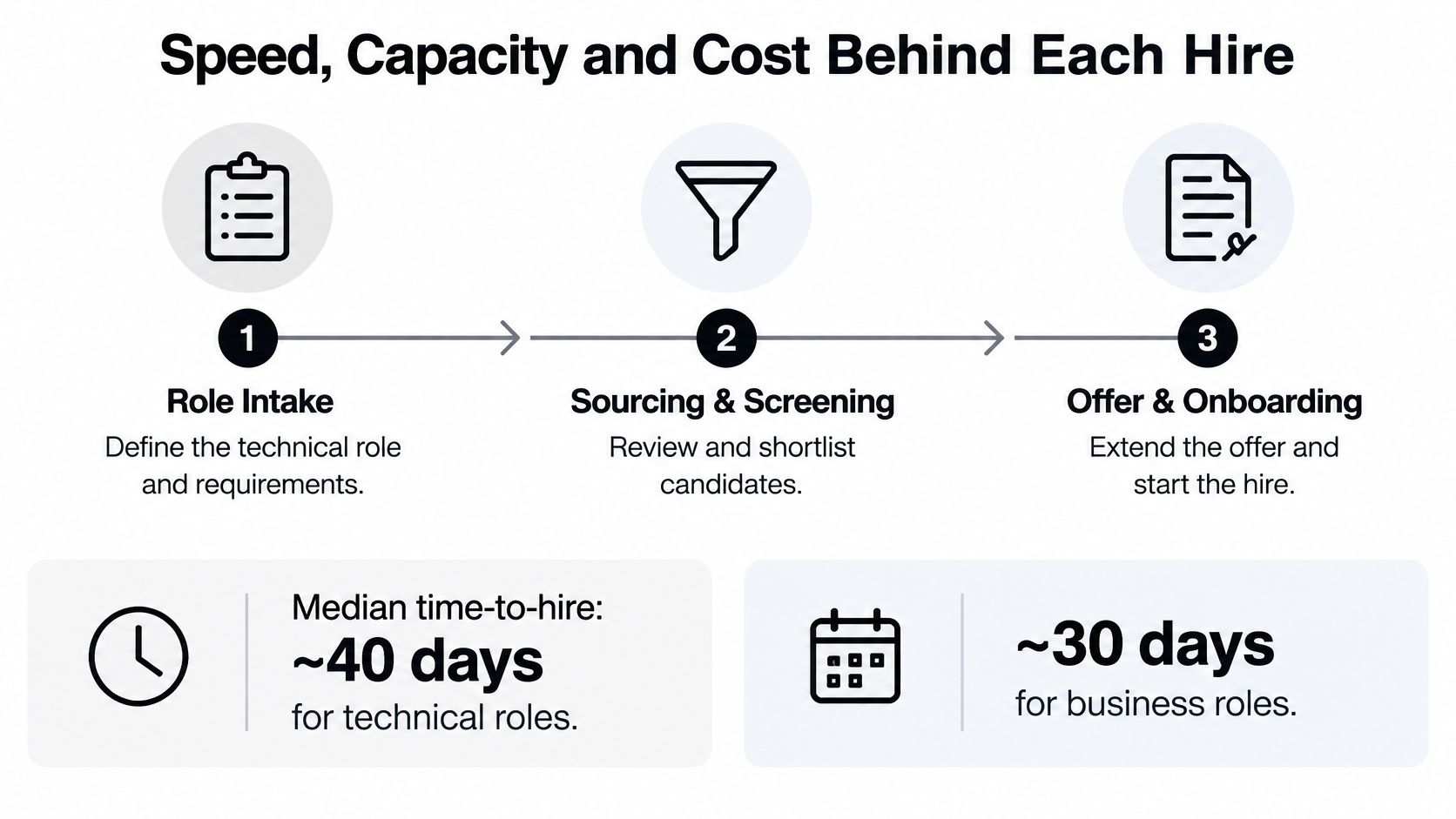
A 2026 IT-talent benchmark reports roughly 40 days median time-to-hire for technical roles against about 30 days for business roles, with technical positions commonly requiring an extra interview stage, while broader software-engineering time-to-fill estimates reach approximately 60 to 62 days (UPPER IT Talent Market 2026). Those numbers are medians, which means half of searches run longer.
The six stages and who owns each one
- Intake specification. The hiring manager and recruiter define required versus trainable skills, production-scale constraints, interview owners, decision deadlines, compensation range and acceptable adjacent stacks. Vagueness here is the most common cause of a slow search.
- Sourcing. The agency works pre-qualified pools by architecture and operating environment, such as Kubernetes and SRE, AWS data platforms, Salesforce integrations or AI evaluation systems, instead of searching generic titles.
- Technical validation. The agency runs the structured screen and produces a scorecard. This stage belongs to the agency.
- Client interviews. Your engineers assess. Scheduling becomes the bottleneck the moment more than three people need to meet the candidate.
- Offer. Compensation, level and start date. Slow approvals lose candidates who have a second offer.
- Onboarding. The first two weeks decide whether the hire works, and the agency should stay in contact through them.
If you'd rather see the sequence in motion before reading the metrics, the walkthrough below covers the flow.
Two clocks, not one
Most buyers track a single number, time to fill, and learn nothing from it. Split the timeline in two. Days from approved requisition to technically validated shortlist measure sourcing strength. Days from shortlist to accepted offer measure friction inside your own interview loop, which is often the longer half.
| Metric | Stage | What It Reveals |
|---|---|---|
| Days from approved requisition to technically validated shortlist | Sourcing | Whether the agency finds qualified engineers quickly |
| Days from shortlist to accepted offer | Interview and close | Friction in the company's own interview loop |
| Interview-to-submission rate | Agency screening | Whether pre-screening predicts real interviews |
| Submission-to-interview rate | Client review | Whether submitted candidates match hiring-manager expectations |
| Offer and acceptance rates | Close | Whether offers are competitive enough to land |
| 90-day retention by role family | After hire | Whether the placement lasted |
When the need is urgent capacity rather than a permanent seat, timeline matters more than pipeline depth. TekRecruiter can deploy staff augmentation consultants in as little as 3 days, which is a different promise from a six-week search and should be judged on different terms. For the full metric set and how to read it, see this guide to time-to-hire metrics.
Nearshore deserves its own warning, because the pitch usually leads with the hourly rate. Market material reports Latin American engineering rates commonly below U.S. rates, while real productivity depends on time-zone overlap, onboarding, communication practices and management quality. A cheap engineer with a four-hour offset and no onboarding can cost more per shipped feature than a local hire.
Cost rule: compare total cost per productive roadmap hour, including recruitment, onboarding, overlap hours, rework, contractor management and attrition. The hourly rate on the contract is the smallest part of that number.
Ask for all six metrics for a role like yours, filled in the last twelve months, before you sign anything.
Misconceptions That Waste Agency Budgets
The market has changed shape, and several pieces of conventional agency advice aged badly with it. U.S. companies hired about 113,000 software engineers from May 2025 through April 2026, less than half the 2022 peak of 239,000, while engineering openings grew only 2.5% over the latest year (Lenny's Newsletter on the state of the tech job market). Selective hiring rewrites the buying rules.
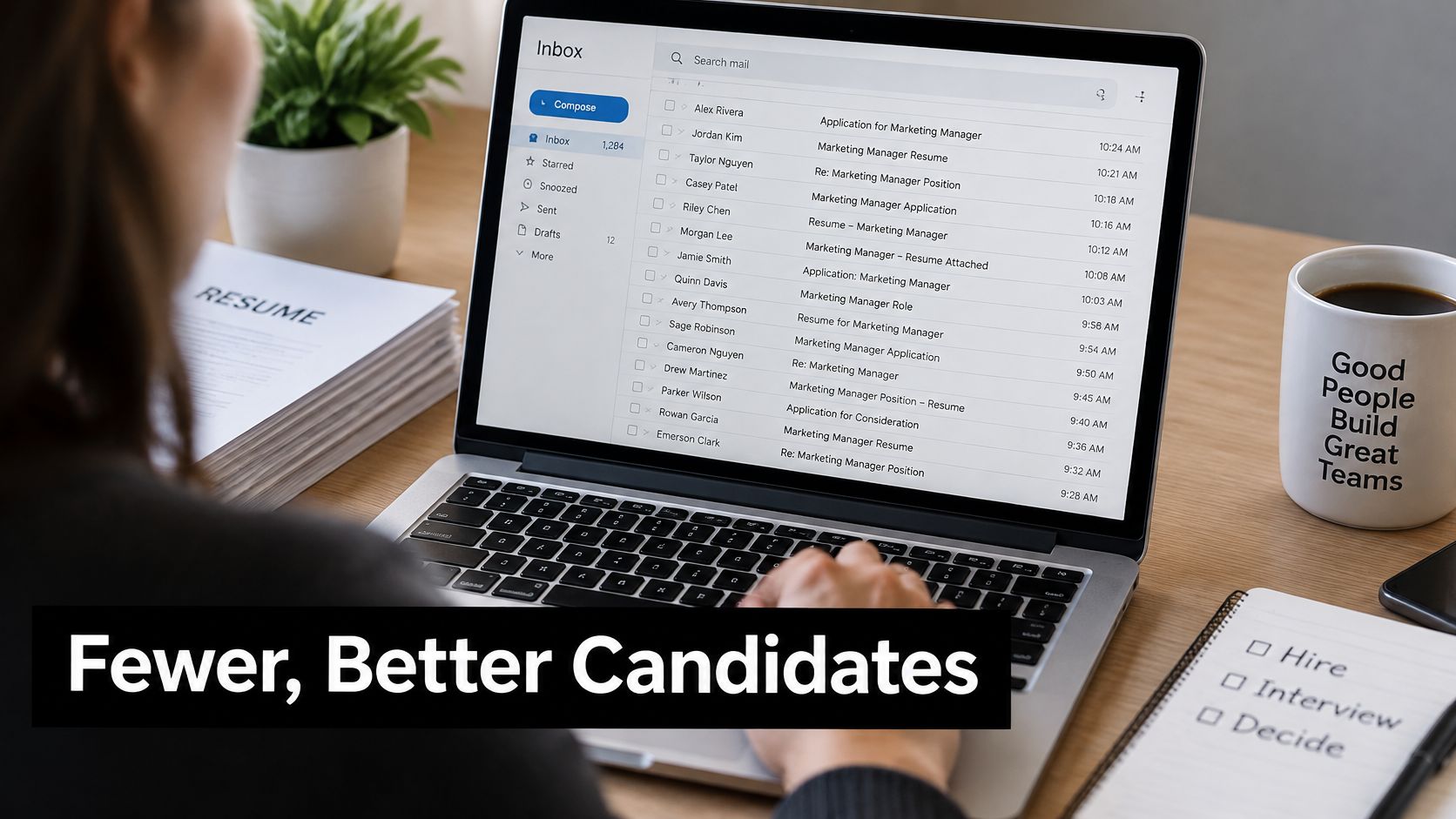
Misconception one: more candidates means a stronger agency. When openings barely move, volume adds interview load rather than options. Reducing false positives is the advantage worth paying for, and a firm that sends twelve résumés to find one conversation isn't doing you a favor.
Misconception two: a big database and a national office network mean better matches. Ask instead what share of last quarter's submissions survived the hiring manager's review. That answer tells you whether the agency reads your role or pattern-matches a title against a pool.
Misconception three: the agency makes the hiring decision. It screens and submits. Your engineers and hiring manager decide. Name a technical reviewer on your side before the search opens, or the shortlist sits idle for a week while everyone assumes someone else is reviewing.
Misconception four: an agency is always the fastest route. For a single, well-defined backfill that a referral can fill, an internal search can be cheaper and quicker. Paying a fee for a role your own network could close isn't speed, it's convenience.
The rule that survives every market: use an agency when the role is hard to fill, time-sensitive, or needs skills your team can't assess. Use your own network for everything else.
Contract Terms and a Final Agency Test
Contracts tell you how an agency gets paid. They rarely tell you how it thinks. Read both before the first interview, and turn each clause into a question.
The clauses to read before the first interview
- Fee trigger. Is the fee contingent on a hire who starts? Is there an upfront payment, a monthly fee or a retainer? Fees that land before a start date transfer the risk to you.
- Guarantee length. How many days does the guarantee cover, and does the agency replace or refund if the hire leaves inside the window? A short guarantee on a permanent hire is a warning.
- Conversion terms on contract-to-hire. What fee applies when you convert, and when does the restriction expire? A clean conversion policy keeps the trial honest for both sides.
- Term and notice on staff augmentation. What's the minimum term, how much notice ends the engagement, and how fast can a consultant be replaced?
- Replacement policy. What happens if the contractor doesn't work out in week two, and who pays for the gap?
- Rate changes. For nearshore and supplier engagements, confirm who signs, who pays, and how rates move at renewal.
On fees, the honest comparison is narrower than the pitch suggests. TekRecruiter charges no upfront costs, every service is contingent on the client hiring someone who starts, and there are no maintenance fees, monthly fees or retainers. The same clarity should apply to who does the judging. Our AI operating system sources, builds pipelines, screens and matches talent, while our recruiters hold the conversations, make the judgment calls and close the hire.
For a clause-by-clause view of what a balanced agreement looks like, read this guide to crafting the perfect recruiting agency contract before you sign.
A side-by-side test you can run in two weeks
- Write a one-page brief. Expected duration, the owner of the role, must-have skills and the adjacent stacks you'd accept.
- Pick the model. Use the hiring-models table to match commitment to duration, then tell every agency which row you chose and why.
- Request a sample scorecard. Ask for the actual screening questions they'd use on this role, not a generic competency list.
- Request the six metrics. Days to validated shortlist, days to accepted offer, interview-to-submission, submission-to-interview, offer and acceptance, and 90-day retention, for a comparable role in the last year.
- Get terms in writing. Fee trigger, guarantee, conversion, notice and replacement policy, all before the first candidate reaches your engineers.
- Run the same brief with two or three agencies. Compare time to a validated shortlist and the quality of the first three submissions. Most buyers discover the ranking changes once they measure this way.
Choose the agency whose screening you can explain back to your hiring manager in two sentences. If you can't describe how they decide who deserves an interview, you're buying résumés with extra steps.
TekRecruiter recruits the people who build, ship and sell SaaS products, from software engineers and product owners to GTM engineers and technical account executives, and every search is contingent on you hiring someone who starts. Bring us one role that has been open too long and we'll show you the screening evidence behind the shortlist before you commit to anything. Visit TekRecruiter to start the conversation.
 Ron SmithPresident & Lead RecruiterTekRecruiter