Sales Engineering Job Description: Templates and Levels
Ready-to-use sales engineering job description templates for junior to principal roles, with interview questions, skills and pay benchmarks.
You've got the req approved, the intake call done, and the posting is live. Two weeks later the pipeline is a stack of resumes from account executives who've never opened a terminal and backend engineers who've never sat in front of a customer. The hiring manager rejects all of them and asks what recruiting is doing.
The posting is usually the answer. Most sales engineering job descriptions are activity lists. Demo the product. Gather requirements. Support the sales team. Somewhere in the middle, a line about good communication skills. None of that tells a strong sales engineer what they'd own, what they'd be allowed to decide, or how anyone would know they were doing well.
A better version does three things at once. It publishes the deliverable each duty produces, it draws the line between the engineer and the quota-carrying rep, and it names the leading indicators the interview scorecard will test. Do those three and the document screens candidates before you book a single call.
What follows is how to write that document end to end, from the duties table through four levels, the screening scorecard, three templates you can paste, and the pay line that closes it.
Sales Engineer Duties and the Deliverables Each One Produces
Say a prospect's operations team tells your account executive they need better reporting. That's a symptom, not a requirement. A sales engineer sits with the buyer's analysts, finds the data lives in three systems with different refresh cycles, learns that one of them has no API, and comes back with a written requirement set plus a demo that shows the two integrations that work. That afternoon is the job.
Which is why the responsibilities section should describe a requirements-to-revenue function rather than a demonstration post. O*NET's task profile for sales engineers lists requirements assessment, configuration planning, technical presentations, demonstrations, technical documentation, customer support and diagnosis of installed-equipment problems among the occupation's tasks. Read that list in order and it stops looking like a checklist and starts looking like a chain.
The chain runs one direction. Stronger discovery produces more accurate requirements. Accurate requirements cut solution misfit and implementation risk. Credible demonstrations tie product capability to an outcome the buyer already cares about. Post-sale technical support protects the renewal and the expansion. Break a link and the next one fails, which is why a posting that lists demos with no discovery attracts people who can present but can't qualify.
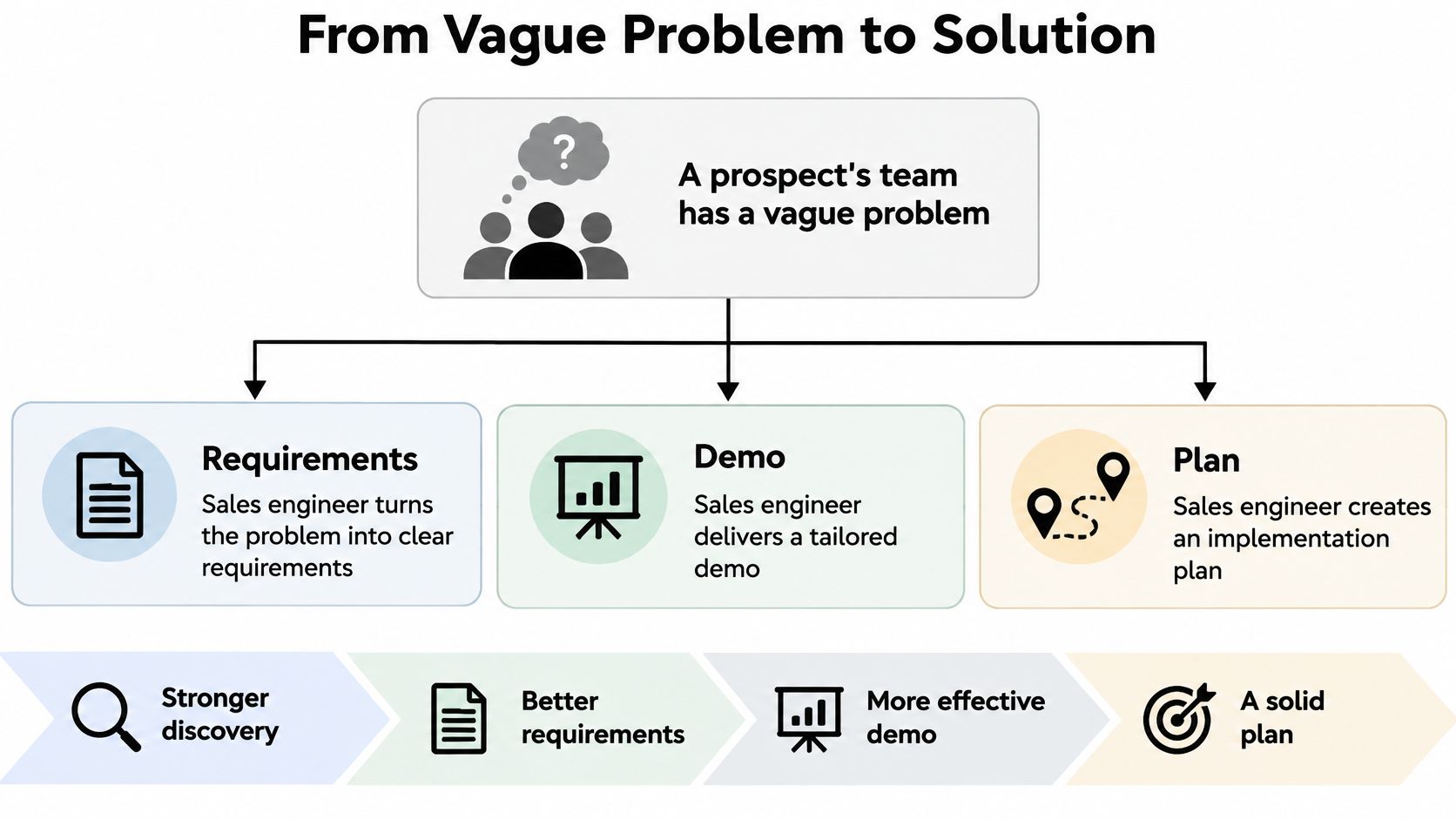
Use the table as the spine of the responsibilities section. Each row is one duty, one deliverable, and the people the engineer works beside to produce it.
| Duty area | Deliverable | Works with |
|---|---|---|
| Discovery and requirements | Requirements notes and technical fit assessment | Account executive, customer |
| Demonstrations and presentations | Tailored demo and technical presentation | Account executive, prospect |
| Proposal and RFP input | Technical sections of proposals and RFP responses | Account executive, product |
| Configuration and proof of concept | Solution configuration and proof-of-concept plan with results | Engineering, customer |
| Implementation and support | Implementation handoff and resolution of technical issues | Implementation team, support |
The artifacts to ask for in the first call
Every row above produces something a candidate can hand you. Ask each shortlisted sales engineer to walk through one real artifact from a past deal: discovery notes, an architecture or solution design, a proof-of-concept plan with its success criteria and results, the technical sections of a proposal, or a handoff document. You learn more from ten minutes on that document than from a list of tools they claim.
Duties the responsibilities list usually drops
Postings tend to stop at demos and proposals. The wider occupational picture includes customer and competitor research, sales forecasting input, technical documentation and training colleagues on customer applications. Those are the duties that separate an engineer who improves the function from one who only works the deals in front of them, so give them a line each.
Practical rule: if a duty doesn't produce an artifact you can ask to see, it doesn't belong in the responsibilities list. Replace "good communication skills" with "writes discovery notes an engineer can build from."
Where the Sales Engineer Role Ends and the Account Executive Begins
The question candidates ask most about this role is: how is a sales engineer evaluated when they don't own the quota? Most postings never answer it. The responsibilities are listed, the activities are familiar, and the reader still can't tell whether they're being hired as a technical seller, a solutions architect, a product consultant or post-sale support. That ambiguity costs you strong applicants and produces late-stage rejections.
The Bureau of Labor Statistics occupational data on sales engineers shows the shape of the mix: customer-needs assessment, engineering knowledge, sales and marketing, communication, analysis and persuasion, plus business, initiative, interpersonal and organizational skills. What the data can't do is publish your decision rights. That's your job, and four of them matter most.
- Discovery ownership. The engineer owns the technical qualification: requirements, constraints, integration surface, security posture, and the written record of all four.
- Disqualification authority. State plainly when the engineer can call an opportunity unqualified for technical fit, and what happens next. A veto that has to be negotiated with the rep is not a veto.
- Approval of custom commitments. Decide who signs off on scope promises, roadmap asks and unusual configuration work. Silence here is how engineers end up committing engineering teams to unpaid work.
- Forecast co-ownership. If the engineer's technical validation feeds the commit number, say so, and say how.
Contrast the roles out loud in the posting. The account executive carries the quota and owns the commercial relationship. The solutions architect designs systems that outlive the deal. The sales engineer owns the technical win inside a specific opportunity, and the difference shows up in the metrics.
Paste-ready sentence: The Sales Engineer owns technical qualification and proof-of-concept design, may disqualify opportunities that fall below agreed technical fit, and co-owns forecast accuracy with the account executive.
Then replace "support sales" with the indicators a scorecard can test: qualified technical opportunities, demo-to-trial conversion, proof-of-concept success, forecast accuracy and handoff quality. If the person you hire can't tell you which of those they'll be judged on, the description isn't finished, and you're about to pay architecture money for a demo resource. The same discipline applies when you're hiring account executives to work alongside them.
Sales Engineer Levels from Junior to Principal
Levels in this job are not measured by how many demos someone can deliver. They're measured by how much of a deal the engineer can run alone and how much technical strategy they set for the account. Get that wrong and you'll post a principal req with senior responsibilities and a junior scope, and the good candidates will spot it in the first paragraph.
The entry point is stable. The BLS occupational outlook for sales identifies a bachelor's degree as the typical entry-level education requirement for sales engineers, so keep the education line at that baseline and shift the weight to demonstrated experience as the level rises.
| Level | Scope of ownership | Typical experience |
|---|---|---|
| Junior sales engineer | Discovery and demos under supervision on standard products | 0-2 years |
| Sales engineer | Owns discovery and demos for a named segment | 2-4 years |
| Senior sales engineer | Complex SaaS deals, integrations, security reviews and proof of concept; mentors juniors | 5-8 years |
| Principal sales engineer | Technical strategy for named enterprise accounts and executive-level architecture discussions | 8+ years |
Treat the experience column as a starting reference and calibrate it against your own market before the req goes live. Now read each row into the posting.
Junior. Name the supervision explicitly and the products the hire will learn first. Add the mentorship path in one sentence, because the strongest juniors pick roles where someone senior is accountable for their ramp.
Sales engineer. Name the segment and the deal size range. "Owns discovery and demos for mid-market [segment] accounts" tells a reader far more than "works with the sales team."
Senior. List the hard parts: integrations, security reviews, proof-of-concept design, and the mentoring duty. The posting should say how many juniors the person supports and in what form.
Principal. Publish the technical domain, the named accounts, and the executive audience. A principal title that only demos is a senior role with a bigger label, and experienced candidates read that mismatch as a warning about how the company defines the function.
Posting check: every level should state the account segment, the typical deal size, the technical domain (cloud, security, data or integrations) and whether the hire mentors anyone.
Must-Have Skills, Interview Screening and Inclusive Wording
The threshold here is dual. The engineer needs enough technical depth to judge whether architecture and integration will hold, and enough communication to move both the buyer's engineers and their business sponsor. The federal occupational profile for sales engineers puts a bachelor's degree in engineering or a related field alongside technical product knowledge and interpersonal capability, and that pairing is the whole hiring problem in one sentence.
Must-haves, kept to four or five. Applied technical reasoning. The ability to turn an ambiguous request into functional and nonfunctional requirements. Enough integration judgment to spot constraints before a promise is made. Active listening. The discipline to explain limits without overpromising.
Optional, marked as preferred. Named platforms such as Salesforce, AWS, Microsoft Azure, Google Cloud, ServiceNow or NetSuite. Security or compliance background. Scripting or API experience for building demo environments. RFP writing. A named sales methodology. Everything in this list is trainable, so it doesn't belong in the requirements block.
State cross-functional ownership too. The engineer works with account executives to advance opportunities, with product and engineering to validate feasibility, and with implementation or support to make the handoff accurate. Candidates use that paragraph to decide whether the job is set up to succeed.
| Competency | Interview question | Strong answer signal |
|---|---|---|
| Technical reasoning | Walk me through a system you designed and the trade-offs you accepted | Names constraints and trade-offs before naming tools |
| Discovery | How would you turn a vague request for better reporting into requirements? | Asks about users, data sources and success metrics before any solution |
| Integration judgment | What would you check before promising a Salesforce integration? | Mentions data model, API limits, security review and sync direction |
| Communication | Explain a complex architecture to a non-technical executive in two minutes | Uses one business outcome and avoids jargon without losing accuracy |
| Commercial judgment | Tell me about a deal you disqualified or a promise you refused to make | Gives a specific example with the reason and the outcome |
Rate each competency from one to four and keep the numbers. Run one practical exercise: a prospect wants real-time reporting across three systems, so ask the candidate to convert it into requirements, name the integration constraints, walk through a performance versus cost trade-off, outline a proof of concept, and say what they wouldn't promise. Score the reasoning, not the delivery style, and ask for one real case where they declined a deal.
Put an account executive on the panel for commercial judgment and a senior engineer for technical depth, so no single interviewer decides alone. A structured interview process built this way makes rejections specific and defensible.
Wording swaps before you publish: replace "rockstar" or "aggressive closer" with the behavior, such as "runs a documented discovery call and records objections." State the required language proficiency instead of asking for a native speaker. Write "degree or equivalent experience" beside every education line. Swap "culture fit" for named working values such as clear written updates and shared ownership.
The closing rule is simple. Every must-have should be testable in an interview, and anything you can't test belongs in the optional list.
Three Ready-to-Use Sales Engineer Job Description Templates
Every template below shares one skeleton: a two-sentence summary, five or six responsibilities written as verbs with deliverables, a decision-rights paragraph, four must-haves, three optional skills, how success is measured, location and time zone, the pay range, and an equal opportunity statement. Cut nothing from that list. The guide to writing a sales engineer job post is worth reading alongside these if you want a second pass on structure. Swap [stack] and [segment] for your own platforms and account segment.
Junior Sales Engineer, [segment]
You'll run discovery calls and product demos for [segment] accounts alongside a senior sales engineer, turning what buyers tell you into written requirements. This is a supervised role with a defined path to owning your own [segment] territory.
- Run discovery calls on standard [stack] use cases and write requirements notes within two business days.
- Deliver demos built from the buyer's stated requirements rather than a canned tour.
- Draft proposal inputs, including technical responses and security questionnaire answers, for review before they go out.
- Support implementation handoff by writing the handoff summary and staying on the account through the first technical issue.
You may request a second discovery session and flag technical risk to the account executive. Custom scope commitments, roadmap requests and pricing exceptions route to the senior sales engineer and sales manager for approval.
Must-haves: customer-facing technical experience in any form, comfort with APIs and cloud fundamentals, a demo you can walk us through, and clear written English. Optional: [stack] experience, a security or compliance background, and RFP writing. Success is measured on discovery notes accepted without rework, demo-to-trial conversion, and handoff quality. [City or remote], [time zone]. Base range $[X] to $[Y] plus variable. We are an equal opportunity employer and consider equivalent experience in place of a degree.
Sales Engineer, [segment] SaaS
You'll own the technical win for [segment] deals on our [stack] platform, from discovery through proof of concept and security review. You'll work beside two account executives covering deals in the $[X] to $[Y] range.
- Qualify technically by documenting requirements, integration surface, security constraints and success criteria for every opportunity.
- Design and run proofs of concept against agreed criteria, then publish the results whether they help the deal or not.
- Build demos that mirror the buyer's architecture, not a generic feature tour.
- Own proposal and RFP technical sections, including security questionnaire responses.
- Feed product with recurring integration and adoption blockers from live opportunities.
- Write the implementation handoff so delivery starts from what was promised.
You own technical qualification and may disqualify opportunities below agreed technical fit. You co-own forecast accuracy with the account executive. Custom scope and roadmap commitments need approval from the head of sales engineering.
Must-haves: three or more years in a pre-sales or solutions role, integration and API literacy, proof-of-concept design experience, and the ability to explain trade-offs to a non-technical sponsor. Optional: [stack] certifications, scripting for demo environments, and a named sales methodology. Success is measured on qualified technical opportunities, demo-to-trial conversion, proof-of-concept success and forecast accuracy. [City or remote], [time zone]. Base $[X] with a [split] variable, OTE $[Y]. Equal opportunity employer.
Principal Sales Engineer, [segment]
You'll set the technical strategy for [named enterprise accounts] and lead architecture conversations with their engineering leadership and executive sponsors. You'll also set the technical bar for the sales engineering team.
- Own account technical strategy across a named enterprise list, including multi-year integration and platform plans.
- Lead architecture reviews with customer engineering leadership and document the resulting decisions.
- Present to executive sponsors on risk, cost and platform direction in business terms.
- Approve custom commitment scopes within your delegated authority and escalate the rest with a written recommendation.
- Mentor senior sales engineers through deal reviews and proof-of-concept design critiques.
- Shape product input by consolidating field patterns into a quarterly technical brief.
You approve scoped proof-of-concept work and configuration exceptions within the delegation documented in the sales policy. You may disqualify opportunities on technical grounds and co-own the technical forecast for your accounts.
Must-haves: depth across two or more platforms in [stack], a track record running enterprise security and architecture reviews, executive presentation experience, and commercial judgment on scope and cost. Optional: published technical writing, vendor certifications, and prior team leadership. Success is measured on influenced revenue in named accounts, proof-of-concept success, forecast accuracy and the ramp of engineers you mentor. [City or remote], [time zone]. Base $[X] to $[Y] plus variable. Equal opportunity employer.
Sourcing Sales Engineers for Tech and SaaS Teams
A narrow title search can leave a role open even when qualified candidates are available. Many sales engineers already have jobs, so search for relevant work, not just an exact title.
Widen the pool deliberately. Solutions architects bring integration depth and often want more contact with buyers. Customer and pre-sales engineers at cloud, security, and data vendors already lead similar customer meetings. Implementation and professional services consultants understand what can go wrong after a contract is signed. Senior engineers who have run proofs of concept know how buyers evaluate a product from the other side.
Search by stack and domain. Start with the platforms listed as preferred, such as Salesforce, AWS, or ServiceNow, then add the integration or security expertise the product requires. A focused guide to go-to-market recruiting can help frame the search around the work and capabilities the role needs.
Use a short paid exercise based on the scorecard, rather than a long take-home. It should test the same reasoning the engineer will use on the job, such as explaining a technical trade-off or deciding when an opportunity is not a fit.
Track qualified technical candidates sourced and the share who pass the practical exercise for each open role. If sourcing is healthy but few candidates pass, revisit the posting and exercise criteria. Before outreach, make the decision rights clear, including who owns discovery and when the engineer can disqualify an opportunity. That helps candidates from engineering understand how the role connects to quota.
Set Pay, Confirm the Level and Publish the Role
A principal who may disqualify an opportunity and a junior who only supports discovery should not share one pay line. The band you publish is the first signal of which decision rights the role carries.
The Bureau of Labor Statistics occupational outlook for sales engineers reports 2025 U.S. median annual pay of $124,900. That figure places the occupation among the higher-paid mainstream sales roles and reflects the work of translating complex products into business value.

A median hides the spread between levels. Pull level bands from current salary surveys for your own market rather than reusing one figure. Junior ranges typically sit under that median. Principal ranges sit well above it. A remote posting should also name the location basis the range reflects, because a national band and a high-cost city band answer different questions.
Pay transparency tends to shorten negotiation. The practices that make salary negotiation work for both sides start with a published band, so candidates can see whether the level, the decision rights, and the money describe the same job.
Then work through this in order:
- Confirm the level using the levels table, and check the experience range still matches the scope you wrote.
- Write the decision rights and the two or three leading indicators you'll measure. Name who owns discovery, and when the engineer may disqualify an opportunity.
- Choose the must-haves from the screening section, and move everything trainable to optional.
- Adapt one template, publish it with the pay range visible, and keep the equal opportunity statement.
- Have the scorecard ready before the first interview, including who sits on the panel. The scorecard should test those same leading indicators.
When the posting is written this way, the hardest part of the hire is already done. Sales engineers whose scope matches the level recognize the role as theirs, and candidates built for a different scope move on.
TekRecruiter recruits Go-to-Market roles including Solutions and Sales Engineers, Technical Account Executives, RevOps Developers and Marketing Automation Architects, and every search starts with a 20-minute call to learn your need, stack, budget, timeline, and contract, IP, security and location requirements. Book that call at TekRecruiter.
 Ron SmithPresident & Lead RecruiterTekRecruiter