AE Hiring Guide for Tech Sales Teams
AE Hiring. Learn how to hire Account Executives for tech companies with role frameworks, structured interviews, sourcing, compensation, onboarding, and KPIs.
The most popular advice in AE hiring is also the most dangerous. Hire the rep with the biggest quota, the best known logo, or the most years carrying a bag, and revenue will follow. It won't, not reliably. A polished enterprise seller can fail in a startup that hasn't found product-market fit, while a less decorated up-and-comer who has sold through ambiguity can thrive. The title tells you almost nothing. Your product, your stage, your buyer, and your sales motion tell you almost everything.
Why the AE Title Is Not a Job Description
Two candidates can both call themselves account executives and have done entirely different jobs. One inherited a mature territory, worked inbound demand, and renewed large accounts with support from sales engineering, marketing, and customer success. The other built pipeline from scratch, sold a technical product to skeptical operators, and fed what they learned back to product. Their quota percentages might look identical on a résumé. Their usefulness to your company won't be.
That's the first trap in AE hiring. Teams treat quota attainment as a portable score, stripped of contract value, cycle length, territory maturity, lead source, and quota size. It isn't portable. A lower headline number earned in a harder market, with a longer cycle and a larger buying committee, can represent stronger selling than a higher number earned where demand arrived prequalified.
The labor pool reinforces why generic definitions fail. Sales is a huge, varied workforce, and technical selling sits at the premium end of it. The Bureau of Labor Statistics count of sales and related occupations put employment at nearly 13.4 million people in May 2024, about 8.7% of total U.S. employment, including 293,930 sales representatives for technical and scientific products who earned an annual mean wage of $114,520, compared with $81,470 for nontechnical counterparts. Buyers pay that premium because technical sellers translate complex products into business value. If your AE has to do that translation, you're not hiring a generic closer.
What the Healthcare Robotics Search Exposed
A recent client makes this concrete. The company builds healthcare robotics, employs about 200 people, raised a $20 million Series A, and sells to a handful of large hospitals. Leadership had already interviewed AEs on their own and couldn't find anyone who felt bought in or fitted the environment.
The problem wasn't candidate quality in the abstract. The company still hadn't settled basic questions. Was it selling equipment, services, or both, and in what ratio? Should partners carry part of the motion? Which vertical and which products showed real demand? A traditional AE who expects a finished playbook would stall there. What the company needed was an ownership minded seller who could sit close to customers, gather feedback, help surface product-market fit, and still carry clear goals for growing accounts.
Practical rule: Don't ask whether a candidate is a good AE. Ask whether they've already done the specific selling job your company needs done next.
The most expensive or most experienced candidate is often the wrong default. Experience inside a mature machine can teach habits that actively hurt in an unsettled one.
Define the Role From Your Selling Environment
Start every search by understanding three things before you look at a single résumé. First, the product, what it does, how it's built, and where customers feel value or friction. Second, where the company is today, including customers, revenue motion, and process maturity. Third, where leadership wants to get to, and over what horizon. Environments differ, stages differ, products differ, and even adjacent industries differ. The word AE doesn't fit across all of them.
A useful role brief answers commercial questions, not HR boilerplate. A startup sales hiring framework built around selling environment variables points to company stage, sales cycle length, average contract value, buyer persona, territory design, lead source, and process maturity as the core inputs. Score candidates against experience in that environment, pipeline creation, deal size, discovery skill, and performance with limited structure. If you can't fill in those fields, you're not ready to write a job description.
Questions to Answer Before Sourcing Starts
Work through the product. Which features drive deals and which draw complaints? Where does implementation risk live? Does the seller need to explain technical architecture to engineers, clinical workflow to operators, or return on investment to finance? The healthcare robotics team couldn't yet say whether services or equipment led, whether partners belonged in the motion, or whether they were even targeting the right customers. Those unanswered questions became the job. The AE would help answer them from the customer side.
| Context Area | Questions to Answer | Hiring Implication |
|---|---|---|
| Product and value | What problem is urgent, and what evidence proves customers will pay? | Hire for discovery depth, not pitch polish |
| Buyer and committee | Who feels the pain, who approves budget, who can block deployment? | Test multi stakeholder mapping |
| Deal economics | What's the contract value, cycle length, and quota model? | Match candidates from comparable motions |
| Pipeline source | How much demand is inbound, outbound, partner, or product led? | Weight prospecting evidence accordingly |
| Motion maturity | Is there a repeatable process, or is it still being discovered? | Decide between a playbook runner and a builder |
| Post sale scope | Does the AE own expansion, renewal, or implementation feedback? | Screen for customer success collaboration |
Customer discovery discipline keeps this grounded. StartupNV describes product-market fit as a genuine customer need plus sufficient willingness to pay, validated by defining the target market and testing problem, urgency, and budget appetite before revising and retesting the solution, as set out in its founder resources on customer discovery and product-market fit. If your company is still running that loop, say so openly in the job post. Hiding ambiguity behind a confident job post only attracts candidates who'll resent discovering it later.
When You're Not Ready for a Conventional AE
Sometimes the honest answer is that you don't need an AE yet. Startups.com advises founders to close approximately 10 to 20 paying customers before hiring a sales representative, because otherwise there's no proven process to hand off, in its lexicon entry on how to build a sales team. Hire too early and you'll blame the rep for a motion nobody validated.
That doesn't mean early companies can't hire sellers. It means the role must be named straightforwardly. If the job includes testing messages, qualifying verticals, and reporting product gaps, write that down and hire someone energized by it. The robotics company scaled faster once it stopped shopping for a finished enterprise seller and defined the discovery work as part of the seat.
Choose the Right AE Profile
Once the brief exists, profile selection becomes a comparison instead of a beauty contest. Four broad types cover most tech sales seats, and many real roles blend them. Your job is deciding the blend on purpose.
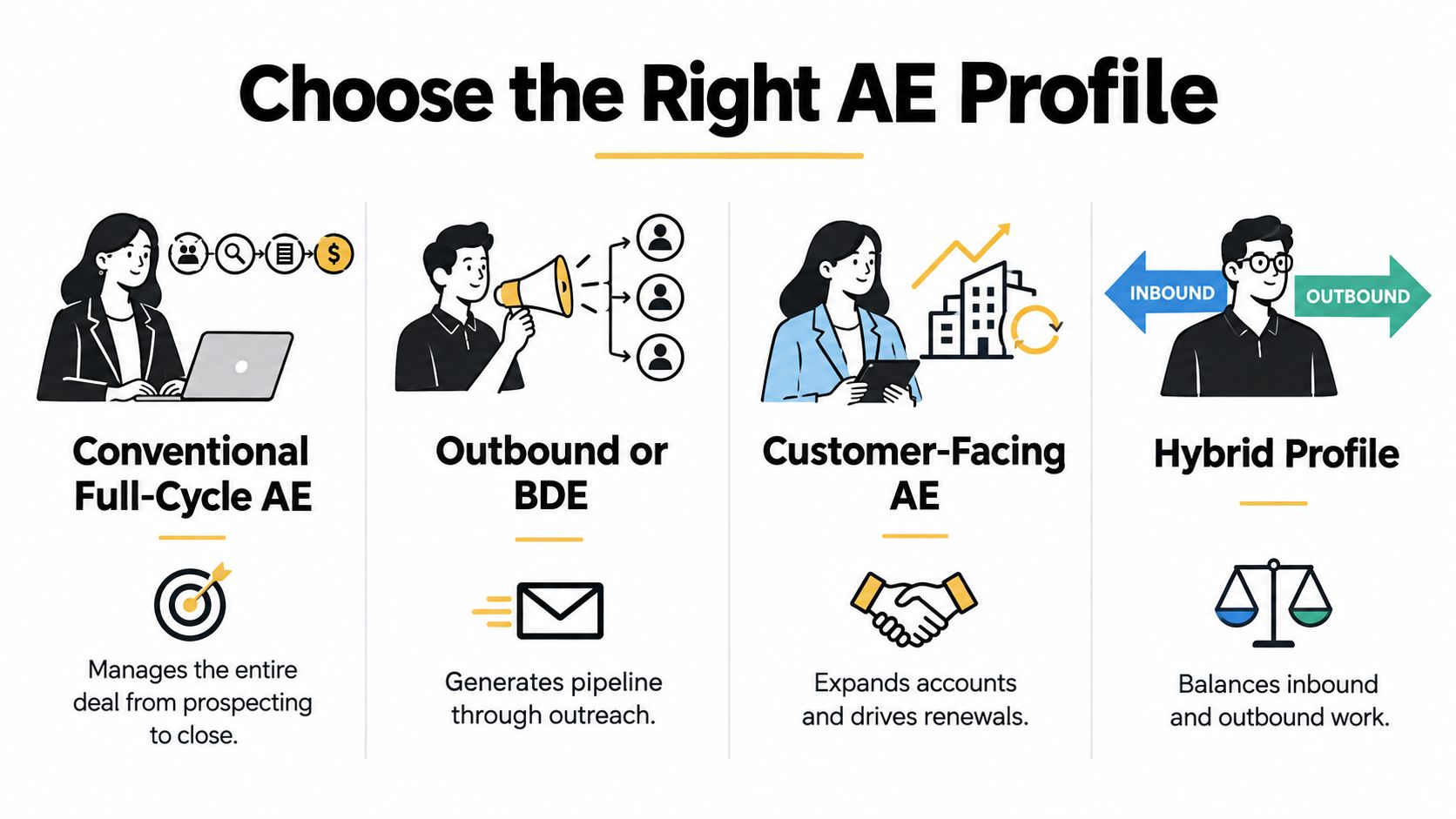
- Conventional full cycle AE: Owns prospecting through close inside a defined territory and process. Best when the motion, pricing, and buyer are already proven.
- Outbound or BDE leaning seller: Creates pipeline where inbound demand is thin. Best when market education and persistence matter more than order taking.
- Customer facing expansion AE: Grows and renews existing accounts, working closely with delivery teams. Best when land and expand drives revenue.
- FDE informed hybrid: Sits close to deployment, understands how the product works in the customer's environment, and carries feedback to product. Best when technical fit decides deals.
Mapping these against neighboring roles helps prevent title confusion, and a breakdown of types of go to market jobs is a useful reference when stakeholders use the same words for different seats. The healthcare robotics hire landed in the hybrid camp. Leadership debated expensive senior AEs versus juniors, but the right level was neither. They needed up-and-comers who had seen the path before without being set in their ways about how a traditional AE job should work, with a bit of forward deployed and business development skill mixed into the AE role.
Normalize the Evidence Before You Compare People
Never compare raw quota numbers across contexts. Normalize for attainment percentage, quota size, tenure under the plan, ramp period, territory inheritance, pipeline coverage, win rate, average deal size, and contribution to recurring revenue. Ask what the candidate personally created versus inherited. Ask how the buying committee was structured and what changed mid cycle. Cross functional evidence matters more as deals get technical, and one overview of in demand sales roles reports that 62% of top performing enterprise AEs work closely with customer success and product teams to tailor solutions. For a robotics seller feeding hospital feedback into product decisions, that collaboration isn't a soft skill. It's the job.
Hire for AI Judgment, Not Tool Trivia
AI fluency now belongs in the profile, but most job posts test the wrong thing. Listing prospecting tools or prompt tricks tells you little. Labor market tracking summarized in a Herizon labor market research release reports AI sales tools appearing in 63% of AE postings and prompt engineering in 30%, so tool exposure is common and cheap to claim. What separates strong candidates is judgment. Can they supervise an automated workflow, spot a bad output before it reaches a customer, explain uncertainty plainly, and preserve trust when the model is wrong? The best AI era AE may not have the deepest tool résumé. They'll be the consultative seller who challenges automation and still translates technical capability into a business outcome the buyer believes.
Build a Focused AE Sourcing Strategy
Good sourcing starts from the profile, not from a keyword search for a title. If the seat blends AE, BDE, and forward deployed work, candidates may currently sit in technical sales, solutions engineering, customer success, business development, or founder led selling roles. Search for the evidence, not the label. Someone who opened hospital accounts for a medical device startup, ran discovery with clinical and IT stakeholders, and carried deployment feedback to engineering may outrank a conventional SaaS AE with prettier logos.
Build a target company map around comparable selling environments. Prioritize companies with similar deal size, cycle length, technical depth, and stage. Then work warm paths through investors, advisors, customers, and former colleagues before cold outreach. When you do reach out cold, personalize around the actual problem. "We're hiring an AE" earns deletes. "We're a 200 person robotics company selling into large hospitals and still refining our services motion, and your background opening clinical accounts matches that stage" earns conversations.
Qualify Motivation Early
Ambiguity tolerant candidates self select when you're honest. Describe what's unsettled, what support exists, and what success looks like in the first two quarters. Candidates who light up at ownership will lean in. Candidates who want a mature territory and a finished deck will opt out, which saves everyone months. Structured thinking about channels helps here, and these candidate sourcing strategies for building targeted pipelines cover how to sequence outreach instead of blasting one list.
Remote and hybrid expectations also shape the pool, especially for sellers covering national hospital territories from home bases. If you're benchmarking how remote candidates find opportunities, you can find fresh remote roles to see how comparable employers frame location, travel, and territory ownership. That framing matters in your own outreach, because strong AEs compare the whole operating picture, not just base and variable.
Work With a Recruiter Without Outsourcing Judgment
A specialist partner earns their fee by understanding your product and stage well enough to reject polished mismatches. TekRecruiter, for example, recruits technical account executives who sell complex software, own quota, run technical discovery, and close with technical buyers, placing them on direct hire terms backed by a 90 day placement guarantee. Whoever you use, share the full context brief, not just the job post. Inspect the reasoning behind every submission. Ask why this person's evidence matches your motion, and push back when the answer is generic. Coordinate outreach so candidates don't get duplicate, conflicting messages. The robotics search turned when submissions came with a clear account of how each candidate had operated in unsettled environments, rather than a stack of impressive titles.
Test Selling Ability With Structured Interviews
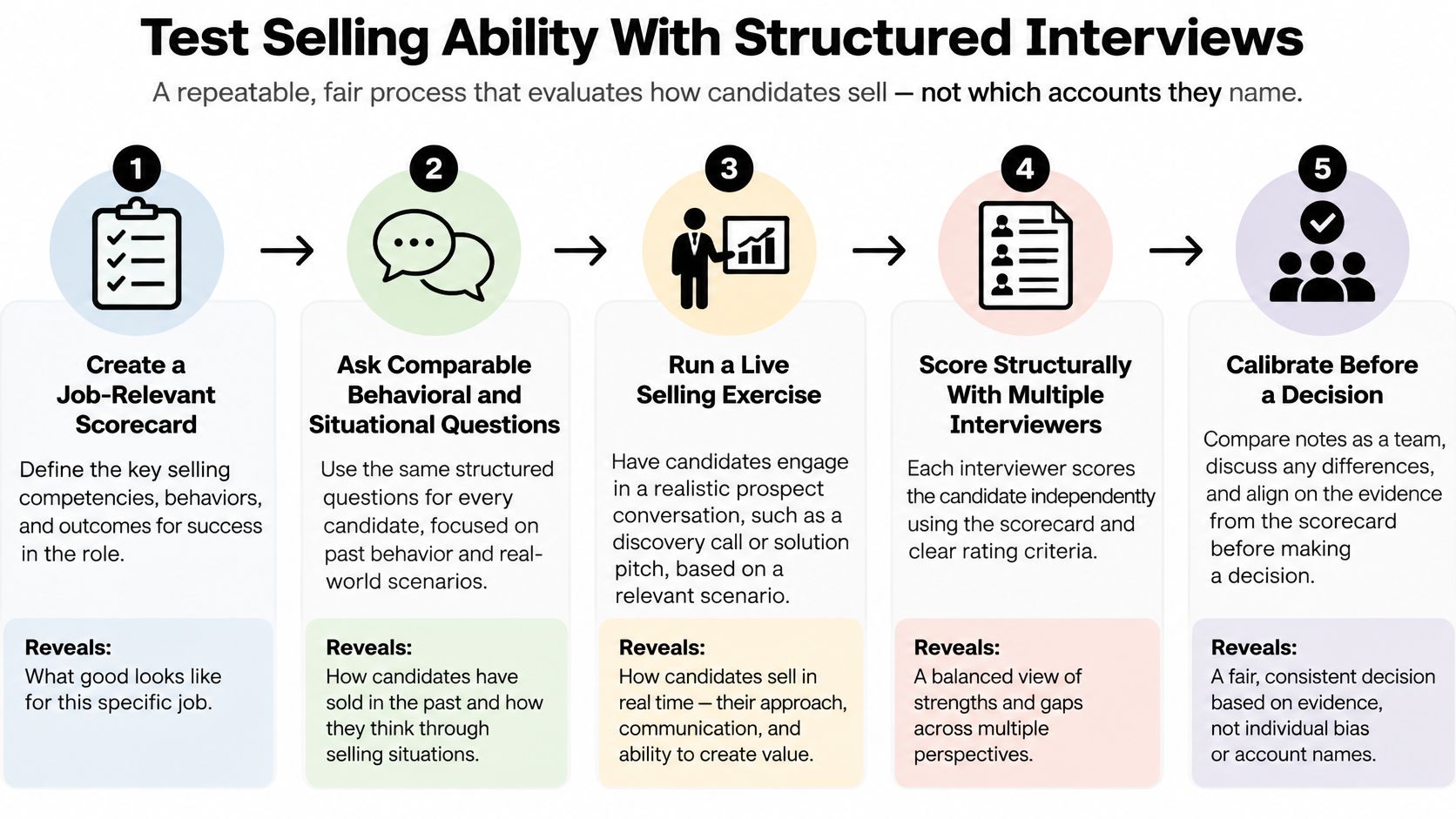
Conversational interviews reward charisma. Sellers are professionally good at conversations, so unstructured chats mostly measure how much the panel enjoyed the hour. Replace them with a structured, job relevant process where every candidate faces the same core questions and work samples, scored against criteria you wrote before meeting anyone.
The evidence for structure is strong. A guide to structured interviews and their predictive validity reports predictive validity of approximately 0.51 for structured interviews versus 0.38 for unstructured interviews, with work sample tests reported around 0.48 to 0.54. Meanwhile, an analysis of sales hiring failure patterns cites a study of more than 1,200 sales hires where interview performance correlated only 0.23 with quota attainment. Impressions are weak predictors. Scored evidence and realistic simulations do the heavy lifting.
Build the Scorecard First
Define competencies from your role brief, typically territory planning, discovery, qualification, business case construction, objection handling, forecast discipline, and cross functional execution. Attach anchored rating scales so scores mean something. A 1 might be an unstructured activity description, a 3 a repeatable process with evidence, and a 5 quantified, independently verified business impact. Interviewers score independently first, then calibrate together. That sequence limits groupthink and stops the most senior voice from anchoring the room.
For question design, these employer interview questions worth asking consistently are a solid starting bank you can adapt to the scorecard. Adaptation is the key word. Every question should trace back to a competency your environment requires.
Make Candidates Reconstruct Real Work
The single most revealing exercise is unglamorous. Have the candidate walk you through each job, deal by deal, in detail. Make them explain the customer problem, stakeholders, technical architecture, qualification logic, objections, implementation risks, commercial strategy, and measurable outcome. Strong sellers get more specific as you probe. Weak ones stay at headline level.
Vague responses are red flags, and answers that don't align with your client's situation or where the company wants to get to don't align either, no matter how confidently they're delivered.
Add a live discovery exercise that mirrors your buyer. For the robotics role, that could mean a simulated first call with a hospital operations leader, scored on pain identification, stakeholder mapping, technical dependency questions, and a measurable next step. Pair it with a written account plan or mutual action plan. Score both against predefined criteria, not against how slick the slides look. You're testing judgment, not production value.
Back the whole process with references that verify specifics. Don't ask whether the candidate was great. Ask about forecast accuracy, coachability, ownership when deals went sideways, and how they worked with product and delivery teams. Ask what territory and quota conditions surrounded the numbers on the résumé. References that confirm the deal reconstruction close the loop between story and fact.
Run It Like a Funnel
Sequence the stages so each one filters on different evidence. A recruiter screen checks eligibility and motivation. A structured career interview tests the track record in context. The work sample tests live selling. A panel with sales, product, and technical stakeholders tests cross functional fit. References verify. Then the panel calibrates scores before anyone advocates for a favorite. Changing questions between candidates destroys comparability, so hold the structure even when a candidate seems obviously strong or weak in the first ten minutes.
Make the Offer and Build for Success
An offer is a contract about reality, not a celebration document. Spell out level, scope, territory, quota model, variable compensation mechanics, ramp expectations, support resources, and promotion criteria in writing. If the territory is unbuilt, the services motion unsettled, or the target vertical still being tested, the candidate should read that before signing, not discover it in week three. Sellers who accept ambiguity with open eyes stay. Sellers who feel sold a different job leave, and they usually leave loudly.

Level the offer to the profile you chose, not to market anxiety. The robotics company nearly overpaid for senior enterprise reps whose playbooks didn't fit, then nearly undercorrected with juniors who'd never seen a complex hospital sale. The up-and-comer band in between matched the actual work, so compensation could be competitive without buying the wrong seniority. When negotiation starts, these salary negotiation timing and practices for employers help you sequence conversations so numbers don't get traded before scope is agreed. Trade on scope, territory quality, and ramp structure openly. Those variables change earnings more than small base differences, and experienced sellers know it.
Onboard Toward Customer Learning, Not Internal Theater
Most AE onboarding front loads product decks and back loads customers. Reverse it, especially when the motion is still forming. A strong ramp plan gets the new hire into customer conversations, site visits, and win loss reviews early, pairs them with product and deployment staff, and gives them a structured way to report what they're hearing. For a hospital robotics seller, time on the floor with clinical and operations users teaches more in a week than a month of internal enablement.
- Customer immersion: Scheduled calls and visits with existing accounts in the first weeks, with notes reviewed against the role brief.
- Product fluency: Enough technical depth to explain how the system works, where it breaks, and what implementation demands.
- Territory context: Account history, prior attempts, partner relationships, and known blockers documented in one place.
- First proof of impact: One early, scoped win, such as a qualified pilot or a mapped expansion path, that proves the approach.
Close the Loop With Post Hire Data
Connect the scorecard to outcomes. Track how interview and work sample scores line up against ramp time, pipeline quality, forecast accuracy, customer engagement, and quota attainment at six and twelve months. Signals that don't predict anything get cut. Signals that do get weighted more in the next search. That review cadence is what turns one good hire into a hiring capability instead of a lucky break.
Create a Repeatable AE Hiring System
Everything in this guide compresses into one sequence you can run for the next requisition. Write the product and market context brief. Agree the scorecard and the profile blend, including how much BDE or FDE work the seat really carries. Decide what evidence you'll accept and how you'll normalize it across different selling environments. Source against that profile, interview with structure and work samples, verify with targeted references, calibrate before deciding, and attach the offer to an onboarding plan that starts with customers.
The metric that matters most during the process isn't a funnel ratio. It's alignment quality. Put yourself in the position of your client's customers and judge whether this candidate has demonstrably worked with similar buyers at a similar stage. What people claim they've accomplished matters less than whether the detail of their past work matches the problem in front of you.
Final Checklist Before You Open the Role
- Unresolved decisions named: Equipment versus services, partner involvement, target vertical, and pricing questions are written down, not assumed away.
- Evidence gaps identified: You know which claims you'll verify through work samples and references because interviews alone can't prove them.
- Stakeholders aligned: Sales, product, and technical interviewers share one scorecard and one definition of the profile.
- Post hire validation planned: Ramp, forecast, pipeline, and attainment outcomes will be compared against scores on a set cadence.
The healthcare robotics lesson is the one to carry forward. When the product and motion were still evolving, adaptable, customer facing builders beat polished candidates trained only in mature playbooks. Define your environment, hire the seller whose demonstrated behavior matches it, and you'll stop paying enterprise prices for the wrong kind of experience.
If your next AE hire needs to sell a technical product into complex accounts while your motion is still taking shape, TekRecruiter can help you define the right profile blend and screen candidates on real deal evidence, technical discovery, and ownership. Visit us to start a search built around your product, your stage, and where you want the business to go.
 Ron SmithPresident & Lead RecruiterTekRecruiter