Go to Market Recruiting: A Practical 2026 Playbook
A practical go to market recruiting playbook covering role profiles, sourcing, interviews, compensation, onboarding and the KPIs that prove your hiring works

You're probably staring at a hiring dashboard that looks busy but doesn't tell you the truth. There are reqs open, interviews happening, and candidates in motion, yet the pipeline still feels fragile, the team keeps missing the same profiles, and the next revenue plan depends on roles nobody seems to define the same way twice. That's the point where go to market recruiting stops being a resume exercise and starts being an operating system problem.
The mistake is treating every commercial hire like a generic sales search. GTM hiring spans sales, marketing, customer-facing technical roles, and revenue operations, and those functions need different scorecards, different interview loops, and different measures of success. A recruiter who understands that distinction can save a quarter. A team that doesn't usually burns one.
Why Go to Market Recruiting Is Different in 2026
A CRO opens a req for a “senior GTM hire,” interviews a stack of polished candidates, and still misses the number six months later. The problem usually is not talent scarcity. It is role definition. The company hired for the wrong selling motion, the wrong stage, or the wrong mix of technical and commercial judgment. In 2026, that mistake costs more because GTM roles now cut across product, engineering, marketing, sales, and customer success, while still carrying clear revenue accountability.
The labor market reflects that broader spread. The U.S. Bureau of Labor Statistics projected total employment to grow from 167.8 million jobs in 2023 to 174.6 million in 2033, a gain of 6.7 million jobs, or 4.0%. In the same overview, sales representatives of services were projected to rise from about 1.170 million to 1.215 million, and sales engineers from 59,700 to 63,400 BLS projections overview. The takeaway is simple. The mix of commercial work is getting wider, and hiring has to keep up.
The role map that matters
Treat GTM recruiting as four families with different output expectations:
- Sales, including AEs, managers, and sales development.
- Marketing, including demand gen, product marketing, and marketing ops.
- Customer-facing technical, including sales engineers, solutions consultants, technical account executives, and GTM engineers.
- Revenue operations, including RevOps, sales ops, and related systems roles.
That framing does more than tidy up org charts. It forces the key question: what throughput should this hire improve? Pipeline creation, win rate, demo-to-close conversion, implementation speed, forecast accuracy, system adoption. If you cannot name the output, you are not ready to hire.
This matters most in hybrid roles. Teams keep confusing AI tool familiarity with revenue competence. A GTM engineer who can wire up prompts and automate workflows is useful. A GTM engineer who can improve handoffs, reduce rep admin, and increase qualified pipeline is valuable. The same distinction applies to RevOps architects and technical AEs. Tool fluency is a method. Revenue impact is the job.
Practical rule: hire for the motion you run today, not the story you want to tell in the board deck.
A 12-month hiring sequence should follow that rule. Early on, you may need one or two AEs who can source pipeline and close deals, then add a sales engineer once technical friction starts slowing late-stage opportunities. As the motion matures, RevOps and GTM engineering matter more because they make the revenue system measurable, faster, and easier to diagnose. If you want a useful outside reference for how this category is commonly framed, the go to market overview from TekRecruiter is a good starting point.
The stage question that decides the hire
Founder-led hiring is about proving the motion. Early scale-up hiring is about making that motion repeatable. Enterprise hiring is about control, integration, and process discipline.
So the same title can describe completely different work. A “Senior AE” at a seed-stage company may need to build territory logic, run discovery without much support, and create pipeline from noise. A “Senior AE” at a larger company may need to operate inside established forecasting rules, coordinate with specialists, and close within a defined system. Both can be strong sellers. Only one fits the environment.
Go to market recruiting is different because revenue roles are not interchangeable widgets. They multiply the output of the teams around them. A good hiring plan makes that multiplier visible before the search starts, and it measures candidates by the business throughput they can improve, not by how fluent they sound in the latest tools.
Role Profiles, Scorecards, and a Weighted Rubric
A vague role profile creates vague candidates. If a posting says “Senior AE, SaaS,” the debate starts late, the interview loop drifts, and everyone ends up defending a different idea of success. Fix the role before you fix the search.
Start with the mission. Then define the context, the essential experiences, and the behaviors you can observe in interview.
A clean profile has four parts:
- Mission. What must this hire move?
- Context. What motion, stage, and customer type are they joining?
- Must-haves. Which experiences must already be present?
- Observable competencies. What should you hear, see, or verify?
That structure matters because titles hide real differences. A technical AE in a startup may need to shape discovery, handle product friction, and create their own pipeline. A GTM Engineer may need to connect automation to revenue outcomes, not just manage tools. A sales development representative career path also shows the same pattern, adjacent roles can look similar on paper and still need different standards in practice.
Use the job profile to force clarity before you open sourcing. If you need a model for turning a vague request into a tighter role description, the writing a position description guide is a useful reference because it pushes the write-up toward outcomes instead of filler. Keep the document short enough that a hiring manager will use it.
The scorecard should do the heavy lifting. Treat it as a weighted rubric, not a memory test.
For customer-facing technical roles, weight the evidence by the business problem, not by whoever speaks the loudest in debrief. Role-specific execution should carry more weight where the job is hands-on. Customer problem-solving should matter everywhere. Technical fluency belongs on the sheet, but it should never crowd out commercial judgment. HEART behaviors deserve a category too, because low-trust behavior breaks teams even when the résumé looks strong.
A simple rubric for an Account Executive, Sales Engineer, or GTM Engineer might separate role-specific execution, stakeholder problem-solving, technical fluency, commercial judgment, and HEART behaviors. The exact split depends on the role. What matters is that the weighting is explicit.
Here is the part many teams skip: set a floor for the dimensions that protect the hire. A Sales Engineer who is polished but cannot explain trade-offs is a bad hire. A GTM Engineer who can build automation but cannot tie it to revenue process improvement is a bad hire. I would rather see a candidate score lower on polish and higher on evidence than the reverse.
The same logic applies to AEs. Weight discovery, forecast discipline, pipeline creation, and close strategy based on the motion you are hiring for, then score each independently. Separate the must-haves from the nice-to-haves, and do not let the loudest interviewer rewrite the rubric in debrief.
The AI Fluency Trap in Hybrid GTM Hires
A candidate walks into a hybrid GTM interview fluent in Claude, Copilot, Gemini, CRM workflows, and automation terminology. The conversation sounds advanced. Then you ask which revenue process changed, how it changed, and what evidence supports the result. The answer often becomes vague.
Demand for AI skills is spreading beyond engineering. In an analysis of 2,100 job postings from June 2025 to June 2026, requests rose from 23% to 33% in marketing and from 11% to 17% in sales. Mentions of assistants such as Claude, Copilot, and Gemini more than doubled, while generic automation language declined AI skills analysis. Tool vocabulary now appears in more job descriptions, so it carries less signal by itself. Your hiring process must test judgment and measurable execution.
For GTM Engineers, RevOps architects, and technical AEs, require one complete intervention story. Ask the candidate to explain:
- The original business problem.
- The data quality constraints they faced.
- The workflow or experiment they selected.
- The cross-functional dependencies they managed.
- The metric movement they influenced.
- What they would change next time.
Listen for a connected chain from problem to business result. Someone who improved routing, clarified lifecycle definitions, or reduced handoff friction can explain the decisions, trade-offs, and operating change. Someone repeating “AI optimized the workflow” is describing a tool, not demonstrating ownership.
The interview should also test restraint. Automation applied to weak segmentation, dirty CRM data, or unclear ownership can multiply errors and slow revenue operations. Ask where the candidate rejected automation, what control they introduced, and how they monitored the result. That reveals whether they can protect data quality while improving throughput.
Fluency in tool names is performance. The scarce capability is turning a workflow into a measurable revenue result.
If a candidate cannot connect an intervention to a business outcome, do not hire them into a hybrid GTM role. Strong candidates can describe what they built, why they chose it, what changed afterward, and which result they still needed to improve.
Sourcing Strategies and Outreach That Convert
Stop sourcing GTM talent like a generalist recruiter. The market is divided by role family, seniority, and selling motion, so sourcing effort should follow the hardest-to-fill roles first. A passive enterprise AE, technical AE, and RevOps leader need different channels, messages, and screening criteria.
Segment by role family and seniority
Set sourcing priorities before opening every channel at once.
- Passive senior sellers need direct outreach built on credibility, relevant scope, and a clear reason to engage.
- Sales engineers and technical AEs respond better when the message addresses product complexity, customer type, and the technical demands of the sales motion.
- RevOps and GTM engineering candidates assess systems ownership, process influence, and whether they will improve operations rather than maintain disconnected tools.
- Early-career commercial candidates are often easier to reach through referrals, talent communities, and inbound channels.
Your employer brand should reinforce the same story as your outreach. The Spanish-language convierte tu equipo en canal de ventas guide from Ploot offers a practical reminder that employees and their work can support recruiting credibility. For a recruiter-focused approach to building a pipeline instead of waiting for applicants, TekRecruiter's candidate sourcing strategies guide provides useful direction.
Outreach should sound like the job
A cold note to a passive AE should be short and specific. Name the sales motion, customer segment, and scope of the role. Lead with the business problem or opportunity, not generic culture language. Senior candidates decide whether to reply based on relevance.
A message to a Sales Engineer moving from customer success should use a different argument. Recognize the adjacent experience, then explain the path into pre-sales, discovery, and solution design. The candidate needs evidence that the move is credible, including the problems they would solve and the teams they would work with.
Screen early for the hard stuff
Ask about:
- Territory or segment fit.
- Motivation for the move.
- Compensation expectations.
- The sales or operating motion they have run.
- Whether they prioritize scope, title, compensation, or stability.
Early screening protects recruiter and hiring-manager time. It also exposes deal-breakers before offer discussions, where searches often fail because the difficult questions were postponed.
Use this rule: if the candidate's compensation target or motion preference does not fit the role, stop the process early. A clean funnel is built by removing mismatches before they consume interview capacity.
Interview Design, Behavioral Questions, and Calibration
Structured interviews are the fastest way to stop GTM hiring from turning into guesswork. The U.S. Office of Personnel Management says higher structure improves validity, evaluator reliability, evaluator agreement, and reduces adverse impact, and it recommends tying questions to competencies defined through job analysis OPM structured interviews. A meta-analysis summarized in that review found an average interview validity coefficient of 0.27 and estimated true validity of 0.38. Structure is the difference between a repeatable process and a room full of opinions.
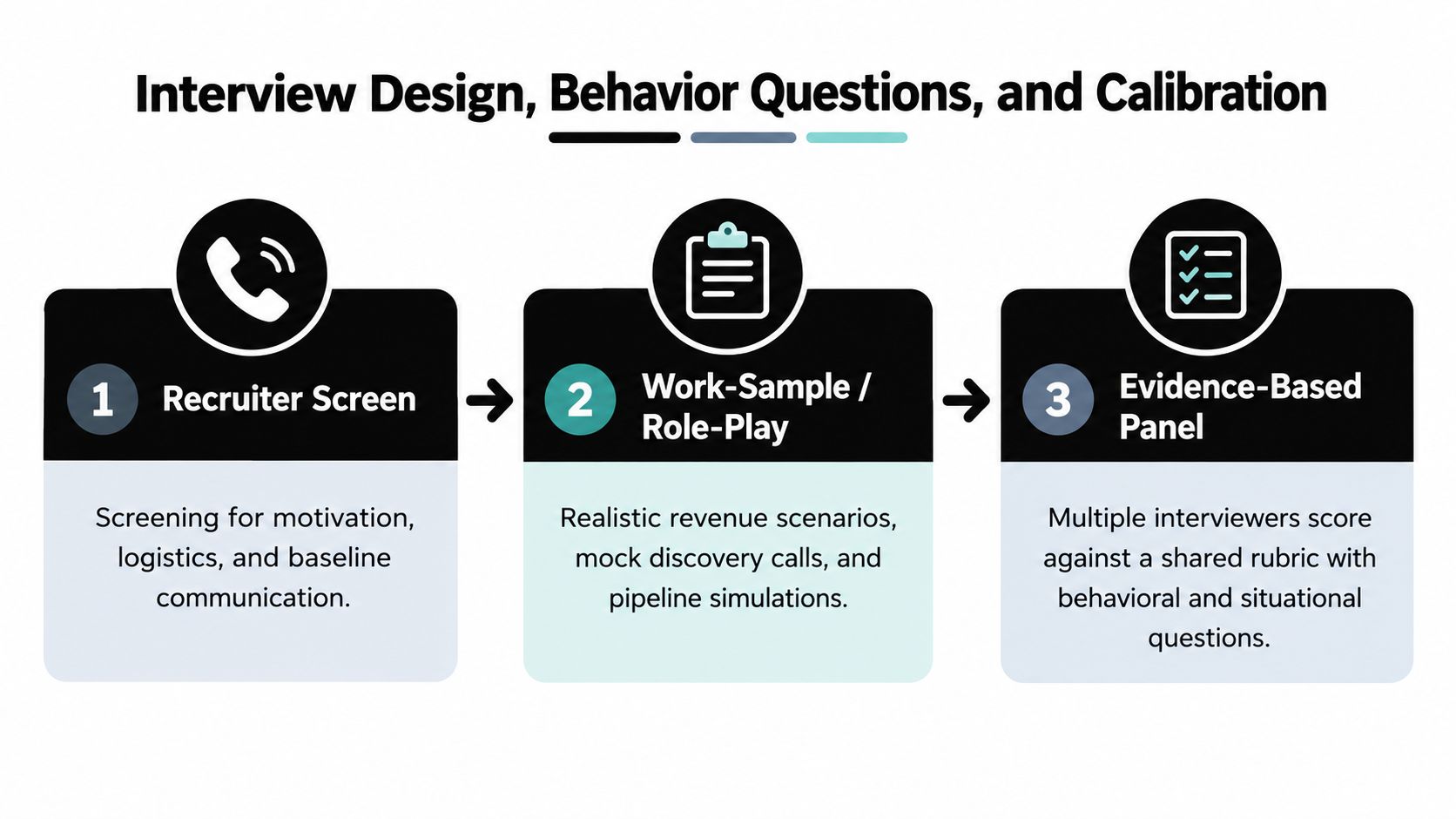
Use a three-stage loop
Keep the loop tight.
- Recruiter screen. Check motivation, logistics, and baseline communication.
- Work sample or role-play. Watch them do the job.
- Evidence-based panel. Compare independent scores against the rubric.
This sequence works because it forces evidence early and delays gut feel until after you have seen performance. If the candidate cannot handle the role-play, do not waste time debating culture fit. If they can, the panel should focus on proof, not personality.
Ask questions that force evidence
For a Sales Engineer, ask how they handled technical discovery when the prospect's problem was unclear. For an AE, ask them to break down a stalled deal and explain what they did to reopen it. For a GTM Engineer, ask which workflow they changed, who pushed back, and how they proved it was worth keeping.
Use the same questions for every candidate. Score with anchored rubrics before the interview starts. Then require each interviewer to submit independent scores before any group debrief. That keeps one senior seller from talking the room into a weak yes.
An AI interview prep tool can help candidates rehearse, so do not confuse polished delivery with real judgment. The interview has to test the candidate's reasoning, not their ability to memorize strong answers.
Calibrate like a hiring system
If the process changes from candidate to candidate, it is broken. So is any loop where charisma outruns evidence or “culture fit” becomes a cover for vagueness. GTM hiring should measure throughput and decision quality, not how likable someone sounds in a room.
If the interview loop would not survive review from legal or operations, it is too loose.
Compensation, Offers, and the First 90 Days
A strong offer starts before the call. If you do not know what the role should pay, how the team will onboard it, and what success looks like in the first quarter, you are improvising at the most expensive point in the process. Good candidates get confused, counteroffers become more attractive, and hiring managers blame the market for a process problem.
Comp should match scope and revenue responsibility, not title inflation. If the role owns pipeline, technical credibility, or process change, the package has to reflect that reality. Under-scoping the hire and hoping performance will stretch later is how teams create churn before the person has a fair shot.
The first 90 days need to be set before the offer goes out. Use artifacts that show real output, not activity theater. A seller should know which account plans they will own. A GTM engineer should know which workflow, dashboard, or routing logic they are expected to ship. A customer-facing technical hire should know which customer references, internal process wins, or technical handoffs will prove they are working.
That is also where onboarding stops being an HR formality and starts becoming part of the hiring decision. TekRecruiter's best practices for onboarding guide matches this view because it treats onboarding as part of the search outcome, not a cleanup step after acceptance.
When demand is still uncertain, contract-to-hire or near-shore support can reduce risk. Use that path when the company needs capacity fast, wants to validate a motion, or needs a specialist while the permanent search is still forming. It fails when leadership expects a short-term hire to act like a long-term owner without giving them the authority, context, or time to succeed.
Counteroffers need discipline too. If a candidate is already moving through multiple processes, speed and clarity matter more than polished messaging. The offer has to be simple enough that the candidate can explain it to their manager, their spouse, and themselves without sounding like they are gambling on your company.
The right decision is not compensation alone, or onboarding alone, or ramp alone. It is the full system. If the package, the first-quarter expectations, and the support plan do not fit together, the hire starts at a disadvantage.
KPIs, Funnel Diagnostics, and Continuous Improvement
A GTM recruiting funnel can produce a full interview calendar and still fail to produce productive hires. Manage it as a throughput system, with defined stages, measurable conversion, and service levels that expose bottlenecks before they delay revenue plans.
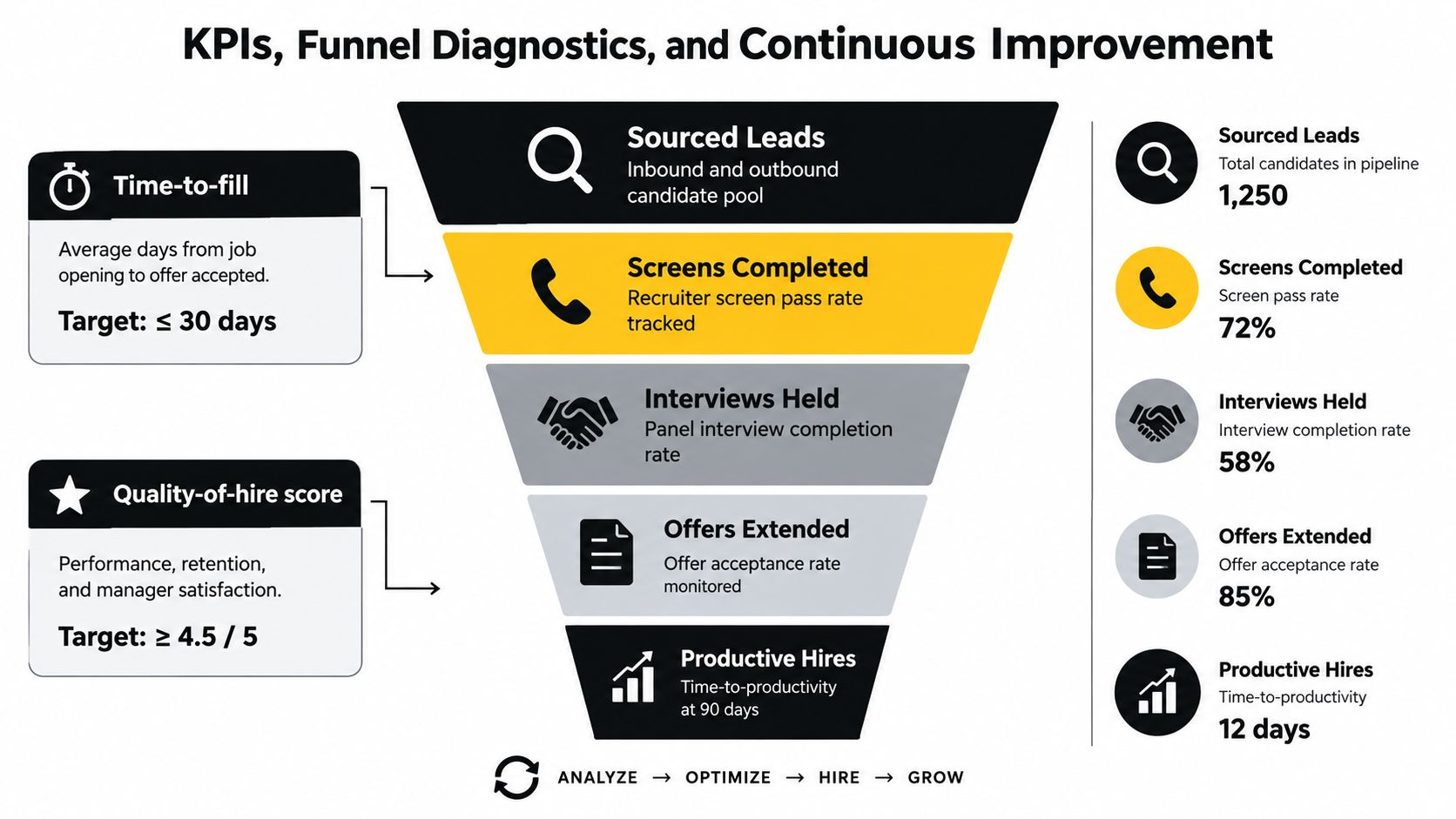
Define the funnel the same way every time
Use one sequence for every search:
Sourced lead → qualified screen → hiring-manager interview → technical or commercial assessment → final panel → offer → accepted offer → productive hire
Measure conversion at each stage by role family, source, recruiter, interviewer, geography, and seniority. A source that produces screens but few hires is weak for that role. An interviewer who consistently causes candidates to drop out is creating a process problem, not revealing a candidate problem.
Back-solve the plan from the target
The recruitment funnel benchmarks page reports roughly 3% application-to-interview conversion, 27% interview-to-hire conversion, 73% to 84% offer acceptance, and a 39-day median nonexecutive time-to-fill from SHRM benchmark reporting. Treat these as directional guideposts, not universal targets, since enterprise searches routinely run longer than the 39-day median.
If the goal is 10 accepted hires, work backward from acceptance and interview-to-hire conversion. Then compare actual results with the expected flow each week. This prevents a familiar failure mode: a calendar full of interviews that cannot support the hiring target.
Hold the process to service levels
Set a few operating rules and enforce them:
- Résumé review within 48 hours
- Interview feedback within 24 hours
- Offer approval within one business day
Review post-hire outcomes alongside funnel activity. Ramp attainment, quota contribution, retention, and hiring-manager satisfaction show whether the process produces revenue-capable talent or merely fast decisions. Speed without quality creates rework. Quality without speed leaves approved roles open.
Keep this in mind: a GTM funnel is healthy only when it predicts productive hires, not when it records completed interviews.
Review these metrics weekly. A recruiting leader can then show the CRO where throughput is breaking, whether the issue is sourcing, assessment, decision speed, or early performance. That connects recruiting activity to the revenue system.
TekRecruiter helps companies hire across the revenue stack, including GTM Engineers, RevOps developers and architects, marketing automation specialists, sales engineers, and technical account executives. If you are building a go to market recruiting process that must withstand growth pressure, visit TekRecruiter to compare how a specialist partner can support sourcing, screening, and hire quality without turning the search into guesswork.
 Ron SmithPresident & Lead RecruiterTekRecruiter