Types of Go-to-Market Jobs: A Complete 2026 Guide
Explore the types of go-to-market jobs in 2026, from GTM engineers to RevOps architects, with hiring tips, KPIs, and role breakdowns.

38 positions is how many go-to-market hires we've filled this year, and the mix tells the story better than any job board trend. The largest share weren't account executives or marketers. They were people who build the systems that find, qualify, and convert customers. If you're still sorting the types of go-to-market jobs into sales versus marketing, you're hiring from an outdated map.
Why Go-to-Market Roles Matter More Than Ever
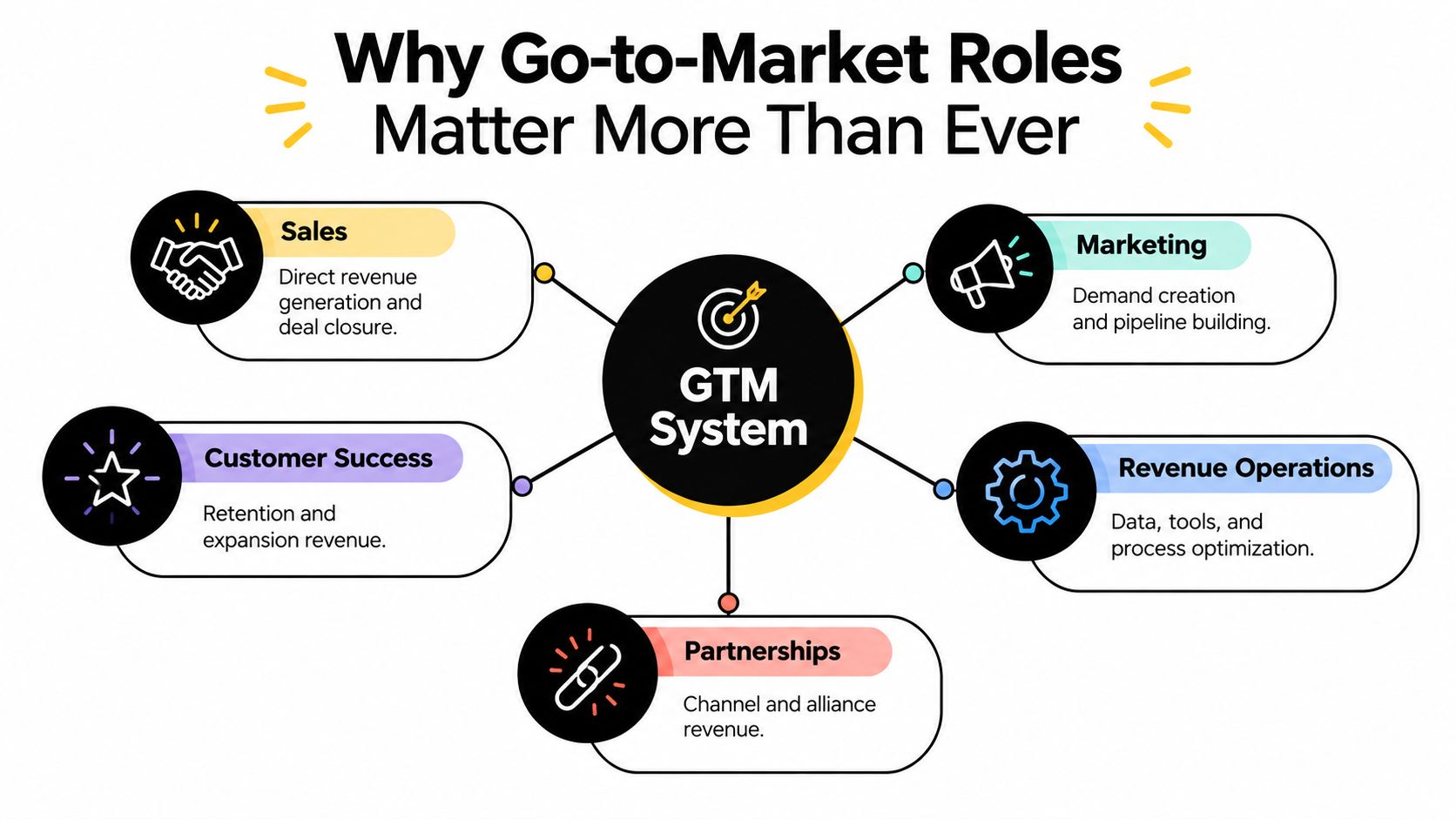
Go-to-market isn't one occupation. It's a commercial system where sales development creates pipeline, account executives close it, marketing generates and qualifies demand, revenue operations connects the data and workflows, and technically fluent specialists translate product capability into customer value.
The scale underneath that system is large. The Bureau of Labor Statistics count of sales and related occupations put the workforce at nearly 13.4 million workers in May 2024, about 8.7% of total U.S. employment, including 56,690 sales engineers. That total covers consumer facing and business facing work, so don't read it as a count of SaaS GTM jobs. It does show how much of the economy runs on commercial execution, and why the technical sliver inside it matters. Sales engineers are few by comparison, but they sit where complex products either become credible to buyers or stall.
A system, not a department list
Most hiring mistakes start with an org chart. A founder says they need marketing, when the actual gap is lead routing and enrichment. A VP of Sales asks for another account executive, when reps are losing hours to duplicate records and unclear qualification rules. A Head of Customer Success hires for relationships, when expansion depends on product usage data reaching the account team reliably.
Treat GTM as connected work and the roles sharpen quickly. Demand creation needs people who understand segments, signals, and messaging. Demand conversion needs sellers and technical validators who can run discovery and prove fit. Revenue operations needs owners for definitions, forecasting, and handoffs. Post-sale growth needs people who drive adoption before renewal risk shows up in a spreadsheet.
Why technical fluency keeps spreading
Buyers now evaluate software, hardware, data flows, security, and implementation effort at the same time. That pulls technical skill into roles that used to be purely commercial. It also creates jobs that didn't fit older taxonomies at all, including GTM engineers, RevOps architects, marketing automation developers, and AI platform leads for GTM.
A GTM hire who can't explain how data moves between your CRM, product, and billing system will struggle in most modern revenue teams, even if the title sounds nontechnical.
Use the sections that follow as a decision reference. If you're defining a role, start with the lifecycle map. If you're hiring builders, go to the technical roles. If you're unsure whether you need a builder or an operator, the comparison of GTM engineering and RevOps will save you an expensive mis-hire.
Mapping GTM Roles to the Revenue Lifecycle
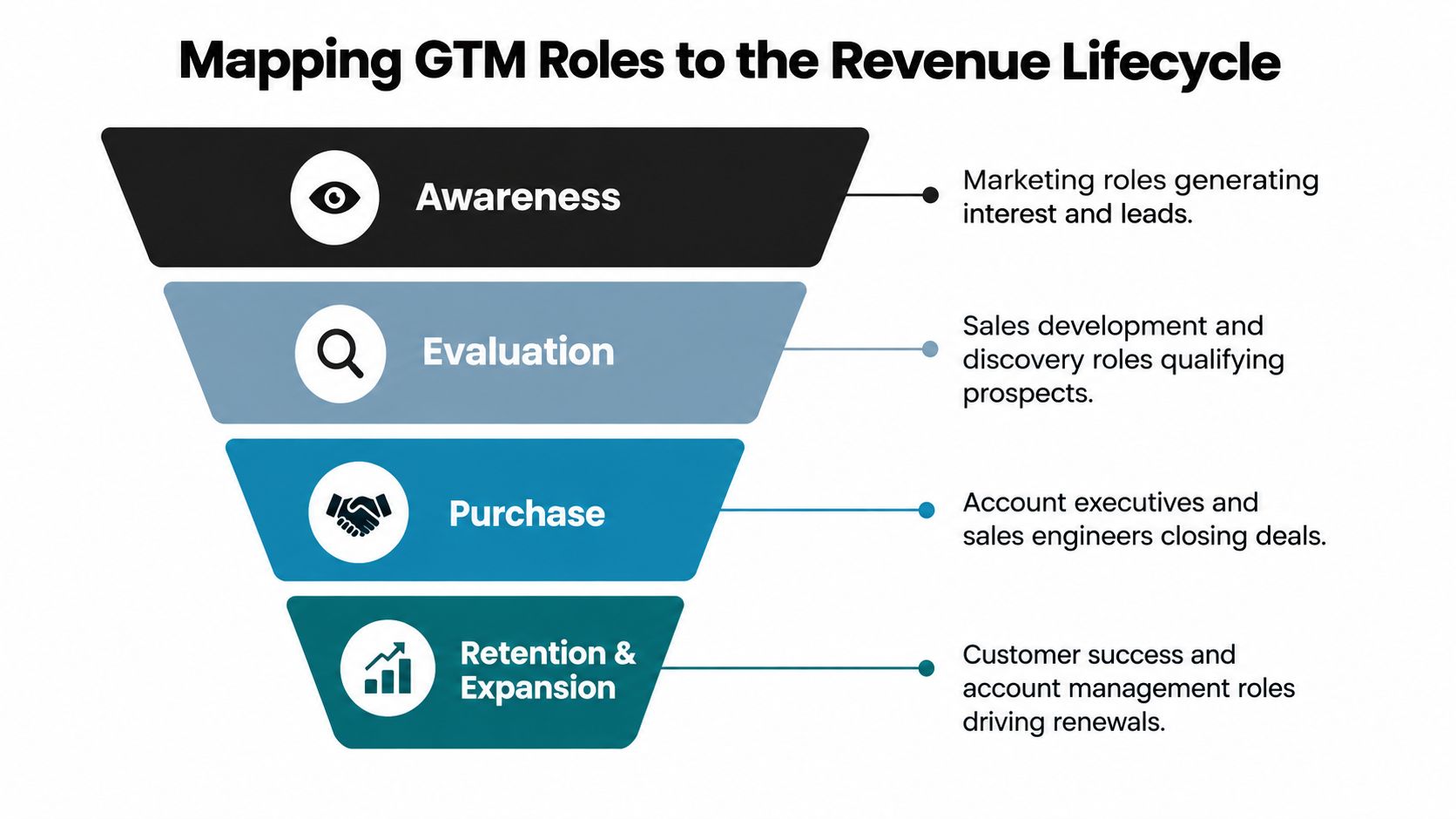
Titles drift. Lifecycle ownership doesn't. The cleanest way to sort the types of go-to-market jobs is to ask which stage a person owns, what they receive, what they hand off, and which measurable output proves they did the job.
Salesforce's sales role taxonomy draws the same kind of distinctions, separating quota-carrying sales representatives, SDRs and BDRs, partner representatives, sales leaders, and sales operations personnel, with operations covering enablement, revenue operations, and deal desk. That structure works because it follows accountability rather than slogans.
Who owns each stage
- BDRs and SDRs: They prospect into target accounts, qualify interest against agreed criteria, and create pipeline account executives can work. Judge them on qualified opportunities and conversion quality, not activity volume alone.
- Account executives: They convert qualified opportunities into revenue. Their job includes multithreading, commercial negotiation, forecast accuracy, and knowing when to bring in technical help instead of bluffing through it.
- Sales engineers and solutions roles: They validate that the product fits the customer's technical and business requirements. Their output is a credible solution, a successful proof of concept, and a technical win the AE can close.
- Customer success and account management: They drive adoption, retention, and expansion after signature. Good ones spot usage patterns early and connect product value to the customer's operating goals.
- RevOps and GTM systems roles: They govern and build the machinery connecting every stage, from lifecycle definitions to routing, forecasting, and dashboards.
That map exposes gaps fast. If SDRs pass accounts that AEs reject, you don't have a motivation problem. You have undefined entry criteria, weak account data, or scoring that rewards the wrong signals.
Write the job spec around handoffs
A usable GTM job description names five things. It defines the owned lifecycle stage, the customer segment, the handoff criteria, the decision authority, and the measurable output. Leave any of those vague and you'll interview people for different jobs under one title.
Take a sales engineer. Product demonstrations are the visible part and the least useful hiring signal. Evaluate discovery quality, architecture fit, proof-of-concept conversion, support through security and procurement, and technical win rate. Those outputs tell you whether the person moves deals or performs them.
Apply the same rigor to a GTM engineer or marketing automation specialist. Test integration design, data quality, workflow reliability, attribution, and measurable pipeline impact. When the spec names the interface the role operates, you stop treating GTM titles as interchangeable and start hiring for the work that breaks when nobody owns it.
Technical GTM Roles and What They Actually Do
The technical side of GTM is where our placement volume has concentrated, and it's the area hiring managers describe worst. They ask for someone strategic and hands-on, then can't say which systems the person will own in the first quarter. The roles below are distinct, even when one strong hire covers parts of two at an early stage company.
The workspace below captures the split attention these jobs demand, code on one screen and commercial performance on the other.

GTM engineers build revenue infrastructure
A GTM engineer builds the technical layer that lets marketing, sales, and customer success operate on the same data. Current role descriptions assign them integration of CRM, marketing automation, sales engagement, and product systems, along with automating lead routing, scoring, enrichment, and follow-up, maintaining revenue data quality, building attribution models and dashboards, and improving handoffs among marketing, sales, customer success, and finance.
In practice the scope often runs end to end. Published GTM engineer responsibilities include building prospecting and outbound infrastructure, connecting CRM, calling, product, and billing systems, and creating real-time reporting for pipeline, activity, conversion, ARR, retention, and individual performance. If a candidate has only administered one tool, they aren't ready for that breadth.
Interview for shipped systems. Ask them to walk through an integration they built, the data model behind it, what broke, and how they measured the effect on pipeline or rep time. Vague tool lists tell you nothing.
Growth engineers run experiments against revenue
Growth engineers overlap with GTM engineers but lean toward testing. They design, run, and iterate on growth experiments, then work with marketing, sales, RevOps, and engineering to remove friction from the customer journey. One published specification also describes weighted account scoring using ICP criteria and intent signals, AI assisted persona-specific messaging, data orchestration, and human review queues that let SDRs spend judgment on priority accounts.
That work sits close to what growth engineering specialists are hired to do in product led and sales assisted motions alike. Judge candidates on experiment design, instrumentation, and whether they kill weak tests quickly. A growth engineer who can't explain a failed experiment's readout is guessing with better vocabulary.
The walkthrough below gives a useful sense of how this builder role operates day to day before you write your own version of the spec.
RevOps developers and architects design the operating model
RevOps developers implement the workflows inside the revenue stack. RevOps architects decide how objects, stages, and integrations should be structured so forecasting and attribution stay trustworthy as the company grows. Senior hires should handle a data model exercise, talk through integration trade-offs, and convert an ambiguous executive goal into fields, rules, and a reporting plan. If they can't, hire them as administrators and price the role accordingly.
Customer-Facing Technical Roles in GTM
Some GTM professionals build internal systems. Others stand in front of customers and make a technical product believable. Confusing those two groups produces job descriptions asking one person to run proofs of concept, own renewals, and rebuild the CRM. Nobody good applies.
The meeting below reflects where these roles earn their keep, in working sessions where technical detail and commercial stakes are on the same screen.

Sales engineers win the technical decision
Sales engineers sell products or services that require technical expertise, including software and the support around it. They're the bridge between product, engineering, sales, and the customer, and their job is to turn requirements into a validated solution a buyer can defend internally.
Strong sales engineers run discovery that changes the deal. They surface integration constraints, security requirements, and deployment risks early, then shape a proof of concept with pass and fail criteria agreed in advance. Weak ones demo features and hope.
That's why sales engineering hiring should test discovery quality, architecture fit, proof-of-concept conversion, and technical win rate rather than presentation polish alone. Give finalists a messy customer scenario with missing information. Watch what they ask before they propose anything.
Solutions architects design for what happens after signature
Solutions architects go deeper on design. They map the customer's environment, define how the product integrates with existing systems, and flag where implementation will need custom work or process change. In enterprise deals they often work across pre-sales and early delivery, which protects the AE from selling something the team can't deploy.
Evaluate them on written solution designs, trade-off reasoning, and how clearly they state assumptions. A candidate who designs for the demo environment instead of the customer's production environment will cost you renewals later.
Technical account executives carry adoption and expansion
Technical account executives work the post-sale side of the commercial relationship. They understand the customer's technical roadmap well enough to guide adoption, spot expansion paths, and bring product feedback back with evidence rather than anecdotes. We've placed technical account executives alongside BDMs and other GTM roles this year, and the pattern is consistent. The ones who succeed read usage data, talk to practitioners, and tie both to budget owners.
Judge them on adoption, retention, and expansion outcomes, plus the quality of their account plans. Ask how they'd handle a technically satisfied user base with a disengaged executive sponsor. That answer reveals whether they're commercial operators or support staff with a quota.
Field note: The fastest way to separate these three roles is timing. Sales engineers win technical trust before signature, solutions architects design the path through it, and technical account executives grow value after it.
Emerging Hybrid Roles and the AI Platform Lead
AI is redrawing the boundary between technical and commercial work. The labor market signal is hard to ignore, since AI skill demand and wage premium data shows AI-skill job demand grew 69% faster than the overall job market and the average wage premium for workers with AI skills reached 62%. GTM teams feel that pressure directly because their workflows are full of data, timing, and personalization problems AI can improve.
Our own placement mix this year makes the shift concrete. Of the 38 GTM positions we've filled and counting, 40% have been go-to-market engineers, with growth engineers, RevOps developers and architects, sales engineers, and technical account executives each representing a meaningful share, plus smaller numbers of marketing automation engineers, heads of go-to-market, and GTM AI platform architects and engineers. Traditional titles still matter. They just aren't where demand concentrates.
Why hybrid roles keep multiplying
Companies have learned that better systems for approaching the market, finding the right customer, and reaching that customer at the right time affect revenue and profit directly. So they hire people who combine software development, data architecture, automation, and revenue ownership in one seat. GTM engineers, growth engineers, RevOps developers, marketing automation architects, and technical account executives all sit somewhere on that spectrum.
The hiring problem is depth. How much engineering does each hybrid role need, and where does responsibility stop before it collides with product engineering, marketing, sales, or operations? Sort candidates into three types. Builders create internal revenue systems. Customer-facing technical sellers translate capability into business value. Operators govern data, attribution, workflows, and forecasting. Hybrids blend two of those well. Nobody blends all three at senior depth.
The AI platform lead owns the foundation
The AI platform lead for go-to-market is the role more clients ask about now, and we've filled more of them recently. The logic is simple. If GTM engineering depends on AI, bolting on individual AI features isn't enough. Someone has to build the platform that natively supports and touches revenue operations, marketing, finance, operations, and HR, with shared data, controls, and access patterns.
That's adjacent to, but broader than, traditional AI platform engineering. The GTM variant gets judged on commercial outcomes as well as platform reliability. Evaluate these candidates on shipped systems, measurable revenue impact, experimentation judgment, and cross-functional influence. Generic communication skills won't tell you whether they can build a platform other teams will adopt.
For SaaS companies especially, the fastest growing GTM talent often doesn't fit legacy recruiting taxonomies. Write the spec around systems owned and outcomes expected, then title it after.
GTM Engineering Versus RevOps Where the Line Is
Hiring managers use GTM engineering and RevOps interchangeably, then wonder why the person they hired thrives at half the job and resents the rest. The mandates overlap, but they aren't the same work. The GTM engineer versus RevOps comparison puts it plainly. GTM engineering designs and deploys the technical architecture, while RevOps governs the operating cadence that keeps teams aligned.
Side by side
| Dimension | GTM Engineering | RevOps |
|---|---|---|
| Core mandate | Build integrations, automation workflows, scoring models, AI orchestration, and experimentation pipelines | Own definitions, KPI hierarchy, routing service levels, process documentation, and cross-team alignment |
| Primary output | Working revenue infrastructure that ships and scales | Operating consistency that makes pipeline and forecasts trustworthy |
| Success signal | Less manual work, cleaner data, faster execution | Shared definitions, reliable cadence, fewer handoff disputes |
| Interview test | Design and critique a system or workflow | Define lifecycle stages and a forecast methodology |
Think of RevOps as the owner of rules and rhythm. What qualifies as a lead. Which KPI outranks another when they conflict. How fast a routed lead gets worked, and who answers when it doesn't. Companies building scalable outbound revenue systems still need that governance layer, or the automation scales inconsistency instead of pipeline.
GTM engineering, by contrast, turns those rules into running systems. That's the build work behind RevOps engineering searches when clients need architecture and implementation, not only process ownership. RevOps scope itself is broad, spanning lifecycle definitions, territory and quota administration, CRM architecture, lead routing, forecasting, compensation data, attribution, enablement workflows, pipeline governance, renewal reporting, and executive dashboards, which is why Gartner's revenue operations overview frames it as a cross-functional discipline across marketing, sales, and customer success.
Which one do you hire first
If your teams argue about definitions and forecasts, hire RevOps leadership first. If everyone agrees on the process but executes it by hand in spreadsheets, hire the builder. Small companies often need one person covering both, which works until governance meetings crowd out build time or shipped systems drift from agreed definitions. Name the split in the interview process. Give builder candidates a systems exercise and operator candidates a stage definition and forecast exercise, with an owner, entry criteria, exit criteria, required fields, service levels, and an auditable system event for every stage.
Why Environment Fit and Domain Fit Decide GTM Success
Skill checklists are the easiest part of a GTM search and the least predictive part. The miss we see most often is environment fit. Companies hire someone whose background and personality don't match their stage, their size, or their way of working, then act surprised when a strong résumé produces weak results.
GTM exposes that mismatch faster than most functions because it's top of funnel execution. Misalignment on strategy and working style doesn't hide for two quarters. It shows up in pipeline quality, conversion, and stalled handoffs within weeks.
Enterprise habits fail in startups, and the reverse is also true
An enterprise operator may expect defined territories, mature enablement, deal desk support, and clean data. Drop that person into a startup where they must build the list, write the sequence, fix the routing, and sell the meeting, and they'll drown in ambiguity they view as dysfunction. A startup generalist dropped into an enterprise may move fast and break governance that exists for good regulatory or forecast reasons.
Neither candidate lacks talent. The environment changed what good looks like. Screen for it directly. Ask what support structures existed around their best results, what they personally built versus inherited, and how they operated when process didn't exist yet. Candidates who can explain the whole picture of their work, how it was built, why, and what it did for the business, give you far better signal than polished answers anyone could generate.
Domain fit controls ramp speed
Domain fit is the second overlooked filter. Ramp speed matters more in GTM than in most roles because front-of-funnel mistakes are visible immediately and directly affect results. A rep or GTM engineer who misunderstands the buyer's world targets the wrong accounts, scores the wrong signals, and writes messaging practitioners ignore.
Technology product companies and technology software companies illustrate the difference. Selling and building systems around a physical product with deployment constraints isn't the same motion as selling software that provisions in an afternoon. That distinction touches nearly every GTM role, from discovery questions to proof-of-concept design to expansion timing.
The right domain and stage fit doesn't guarantee results, but the wrong fit almost guarantees a slow, expensive ramp that teams misdiagnose as a performance problem.
What aligned fit produces
A robotics client shows what's possible when the fit is right. We placed their head of go-to-market, who built a strong team of SDRs, BDMs, and go-to-market engineers, then developed, won buy-in for, and executed a go-to-market strategy that positioned the company as a leader in humanoid robotics. Much of the product hadn't fully launched, yet the company achieved sales on pre-orders through 2028 within seven months of hiring that head of go-to-market, who then partnered with us to fill the remaining gaps on his team.
That outcome didn't come from a generic skill match. It came from stage fit, domain credibility, and sequencing the team build correctly.
A Practical Hiring Checklist for GTM Roles
Good GTM hiring follows a sequence. Define the work, define fit, then test both with exercises that resemble the job. Skip steps and you'll run polished interviews that predict nothing.
Build the spec before you source
- Name the lifecycle stage: State what the role receives, what it hands off, and which criteria govern both.
- List owned systems and decisions: Separate systems the hire builds from processes they govern and customers they face.
- Set first outcomes, not traits: Replace claims about being strategic with deliverables like a routing rebuild, a scoring model, or a proof-of-concept playbook.
- Calibrate stage and domain fit: Write down the environment assumptions, including data maturity, support structures, and buyer type.
- Design the exercise last: Test the actual interface, whether that's data model design, technical discovery, forecast methodology, or experiment readouts.
Early career candidates deserve the same clarity. AI exposed junior roles increasingly call for strategic thinking, stakeholder management, resourcefulness, and data-driven decisions, and PwC's global AI jobs barometer findings reflect that rising skill floor. Portfolio work can substitute for tenure when it's concrete, such as a lead-routing workflow, a CRM and product data integration, a revenue forecast, an AI assisted support workflow, or a documented technical discovery process. Durable skills to probe include SQL, APIs, experimentation, systems thinking, writing, and stakeholder communication. Specific tools matter less, since stacks turn over.
GTM Role Quick-Reference Matrix
| Role Family | Primary KPIs | Interview Focus |
|---|---|---|
| GTM Engineering | Pipeline impact, data quality, workflow reliability, manual work removed | Shipped integrations, scoring and routing design, attribution logic |
| Growth Engineering | Experiment velocity, conversion movement, qualified pipeline from tests | Experiment design, instrumentation, killing weak tests |
| RevOps | Forecast reliability, handoff adherence, stage conversion integrity | Lifecycle definitions, KPI hierarchy, forecast methodology |
| Sales Engineering | Technical win rate, proof-of-concept conversion | Discovery quality, architecture fit, security and procurement support |
| Technical Account Executive | Adoption, retention, expansion | Account planning, usage analysis, executive alignment |
| Head of GTM | Pipeline creation, team output, pre-order or revenue milestones | Strategy buy-in, team sequencing, stage and domain judgment |
Watch for red flags across every family. Candidates who can't explain their work end to end, who inherited every result they claim, or who show low resourcefulness and transparency rarely improve under quota pressure. Screen for ownership and execution evidence, not confidence. The checklist above, applied in order, turns the types of go-to-market jobs from a title list into a hiring system you can defend.
If you're defining or filling GTM engineering, RevOps, sales engineering, or technical account executive roles and want candidates screened for technical depth, environment fit, and domain fit, TekRecruiter can run that search with you. Tell us the lifecycle stage you need owned and the systems involved, and we'll bring you people who've shipped that work before.
 Ron SmithPresident & Lead RecruiterTekRecruiter