What Is Go-to-Market Recruiting and Why It Matters
Learn what is go-to-market recruiting, which roles it covers, and how it differs from general hiring. A practical guide for building revenue teams in 2026.

A CRO needs more qualified pipeline, but the hiring plan is still a debate: add account executives, bring in a RevOps lead, or fix the demand-generation program first? Each option could help. The expensive mistake is opening a requisition before identifying what's constraining revenue.
What is go-to-market recruiting? It's the deliberate hiring of cross-functional specialists who turn a product into repeatable revenue. That means recruiting against the company's actual commercial motion, not treating every revenue problem as a request for another salesperson.
What Go-to-Market Recruiting Means
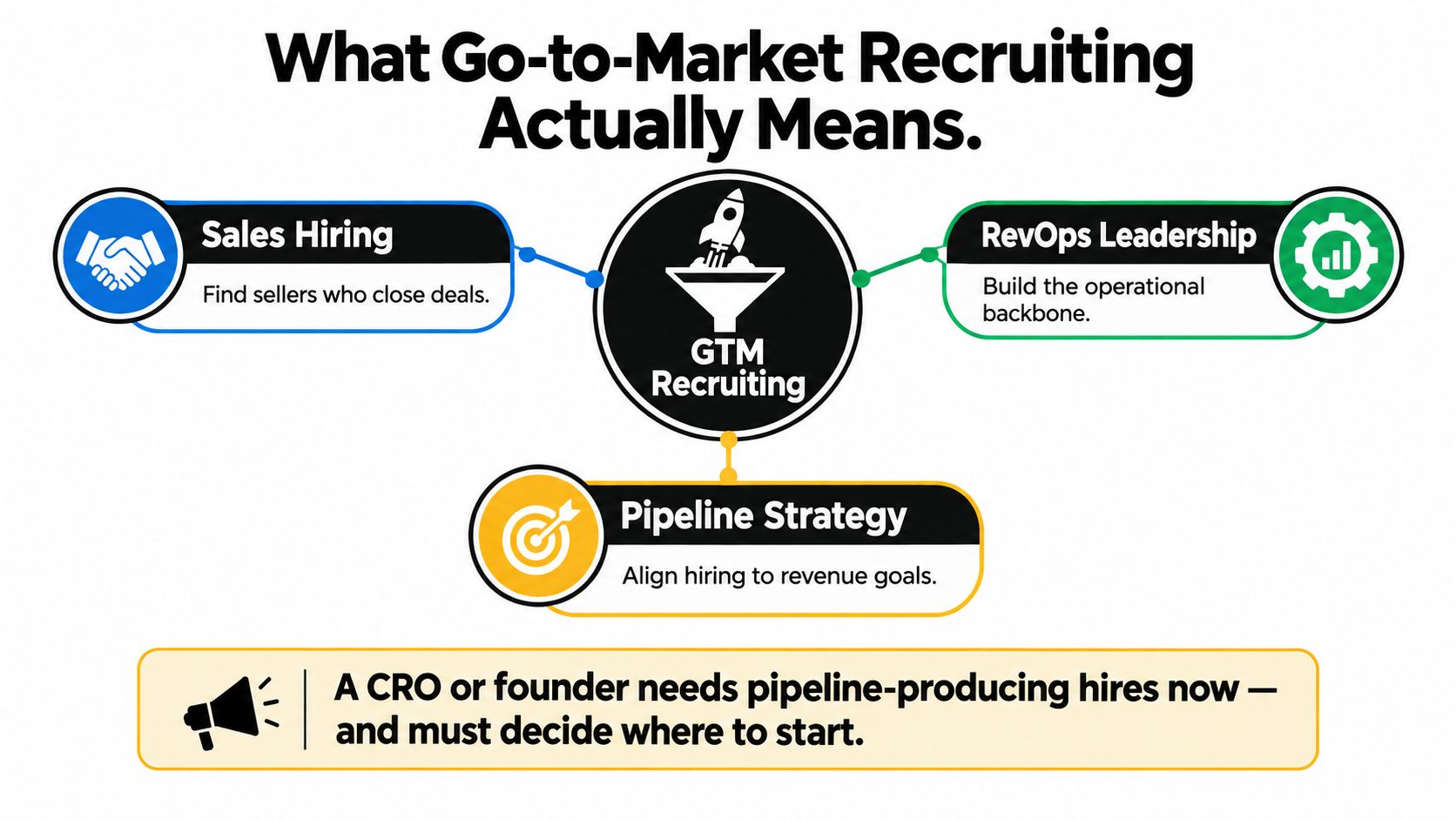
Go-to-market recruiting means hiring the people and designing the capabilities a company needs to bring its product to customers, generate demand, close business, retain accounts, and support revenue through connected systems. Depending on the commercial model, that workforce may include marketing, business development, account executives, sales and solutions engineers, customer success, growth, revenue operations, and technical roles linking product delivery to commercial outcomes.
Start with the operating model, not a list of familiar job titles. In a 2022 survey of more than 200 senior B2B sales and marketing leaders, 40% defined go-to-market as taking a new product to market, while just under one-third described a wider remit covering customer-facing activities such as marketing, sales, growth, and retention (Demandbase's 2022 C-suite GTM benchmark report). Those definitions imply different workforce designs. A launch team and a team accountable for the full customer journey need different capabilities, sequencing, and measures of success.
Start with the commercial motion
The same Demandbase survey found that 56% of respondents operated a product-led growth model, compared with 23% using a lead-based approach and 20% using an account-based approach. Use the company's acquisition and retention model to shape the hiring plan. A SaaS business built around product-led acquisition may need technical pre-sales expertise, lifecycle marketing, customer expansion, and reliable revenue data, rather than a sales team organized mainly around outbound activity.
Before opening a requisition, map how customers are acquired, converted, served, and expanded. Then identify the constraint, the capability needed to address it, and whether a hire is the best answer. A pipeline gap, weak technical validation, and poor retention call for different roles, but each may also point to a systems or process problem. GTM engineers and RevOps talent can improve how the commercial system operates, so weigh their impact and ramp time against adding frontline headcount.
Practical rule: Hire for the commercial system you need to build, and open a role only when its contribution to that system is clear.
How GTM Recruiting Differs From General and Technical Hiring
A generalist recruiter, an engineering recruiter, an executive search consultant, and a GTM recruiter can all fill roles. They're not evaluating the same thing.
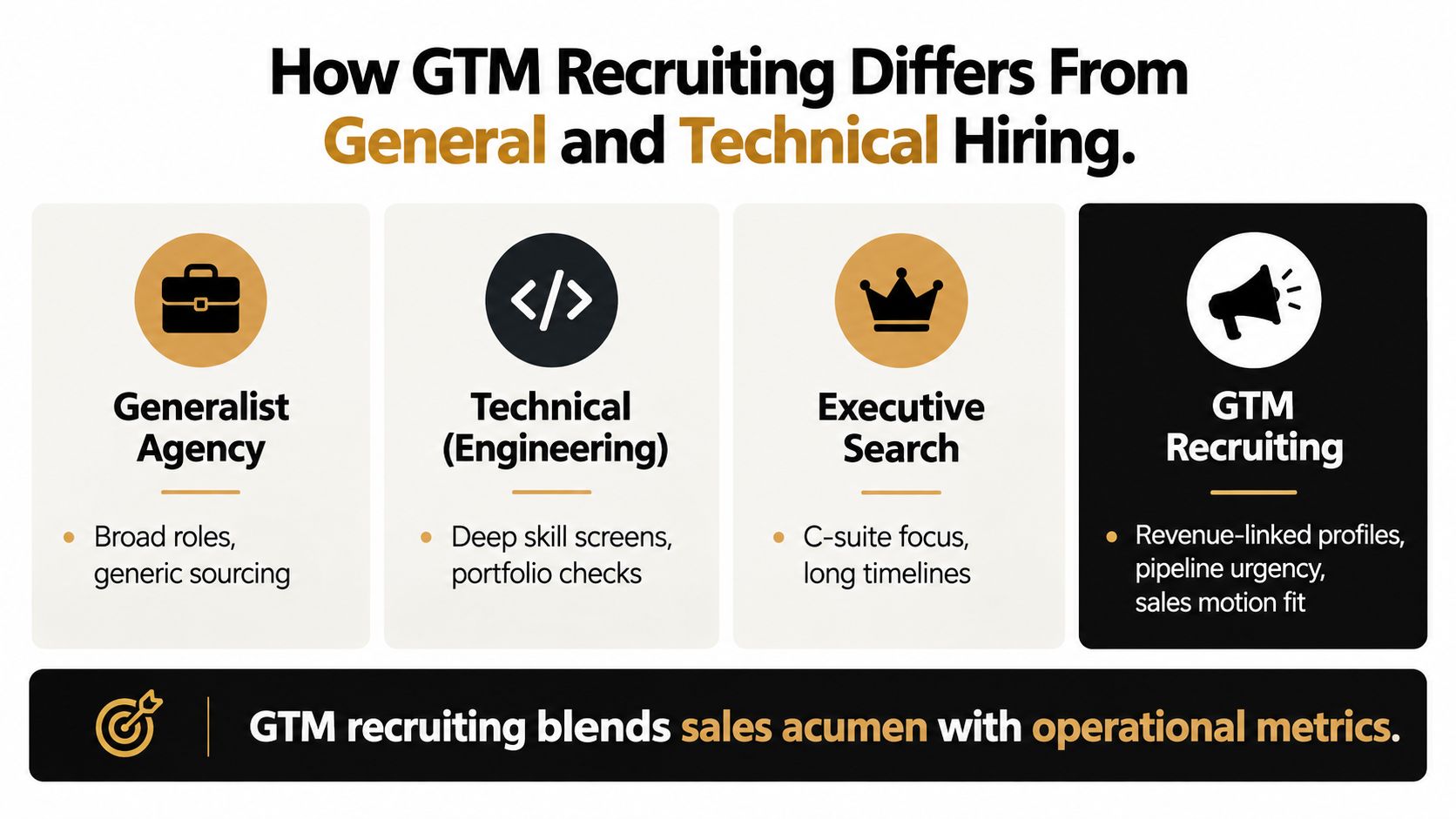
| Recruiting lens | What it prioritizes | Where it fits |
|---|---|---|
| Generalist agency recruiting | Broad sourcing, résumé alignment, and candidate flow | Roles with familiar requirements and clear, transferable profiles |
| Technical recruiting | Depth in software skills, systems, and technical problem-solving | Engineering roles where technical ability is the core qualification |
| Executive search | Leadership scope, track record, and senior-level fit | VP and C-suite hiring, especially where discretion and leadership assessment matter |
| GTM recruiting | Revenue-system impact, customer-journey fit, and commercial execution | Roles connecting sales, marketing, customer success, technical work, and revenue operations |
GTM recruiting needs a wider scorecard than “has sold before” or “knows the CRM.” The recruiter should be able to assess ideal customer profile (ICP) fluency, discovery quality, technical pre-sales credibility, data discipline, and cross-functional collaboration. For an account executive, that includes how they qualify and forecast. For a solutions engineer, it includes whether they can connect product capability to a customer's technical requirements.
The operating-system dimension
Revenue operations shows why this work extends beyond classic sales hiring. Boston Consulting Group reports that go-to-market operations roles existed in the 1980s and earlier, initially as technical jobs such as analyst and CRM administrator positions. As technology stacks and buying processes grew more complex, companies increasingly needed operators who could connect customer data, automate workflows, improve forecasting, and coordinate revenue teams (BCG's analysis of go-to-market operations).
That history is a useful dividing line. A generalist recruiter may identify a candidate who has used Salesforce. A GTM recruiter should probe whether the person can explain how they used CRM data to improve routing, pipeline visibility, or sales execution.
A recruiter who can't evaluate the work behind the résumé will default to scripted checklists. For a clearly scoped engineering search, use a technical specialist. For senior leadership, use executive search. For roles that must work across customer-facing teams and revenue systems, use a recruiter who understands that operating context.
Roles That Fall Under a GTM Recruiting Plan
A useful GTM plan doesn't start with a list of titles. It starts with the revenue constraint, then assigns ownership to the role best equipped to address it. The same title can mean different work at different companies, so define the output before sourcing candidates.
| Role Cluster | Primary Revenue Constraint | Typical Ramp |
|---|---|---|
| SDRs and BDRs | Qualified pipeline creation and ICP qualification | 3–4 months |
| Account executives | Qualified pipeline conversion and forecast accuracy | 6–9 months |
| Enterprise account executives | Complex opportunity progression and close execution | 9–12 months |
| Sales and solutions engineers, technical account executives | Technical-validation throughput and proof-of-concept conversion | Define based on the sales cycle and technical scope |
| Customer success managers and operations | Retention, renewal execution, and account expansion | Define against customer lifecycle and portfolio needs |
| Growth marketers and marketing operations | Demand generation, campaign execution, and attribution integrity | Define against channels and campaign complexity |
| RevOps analysts, architects, and leaders | Routing quality, data integrity, forecasting, and revenue-team coordination | Define against systems scope and operating model |
| GTM engineers and revenue-systems builders | Workflow automation, lead enrichment, and seller-facing systems | Define against integration complexity and deployment ownership |
Published B2B SaaS benchmarks place ramp at roughly 3–4 months for SDRs, 6–9 months for account executives, and 9–12 months for enterprise account executives (B2B SaaS metrics and benchmarks guide). Those windows should change when you hire. Don't assume a new seller will immediately add full capacity, and don't set a start date without checking whether the manager can coach and onboard effectively.
Build roles around constraints, not activity
For sales engineers, assess technical fluency and the ability to move buyers through validation, not just presentation skill. For RevOps, look for evidence of better routing, forecast discipline, attribution, or data quality. A marketing operations hire should be tied to the reliability of campaign execution and reporting. Customer success roles should own clear retention and expansion outcomes rather than a vague mandate to keep customers happy.
When you're mapping the wider marketing organization, this guide to building your go-to-market team can help clarify how marketing roles fit alongside sales and operations. For SaaS companies hiring across commercial and technical functions, TekRecruiter's go-to-market recruiting practice covers roles including GTM engineers, RevOps developers and architects, marketing automation specialists, sales engineers, and technical account executives.
The staffing plan should account for time-to-productivity, manager capacity, territory coverage, and pipeline creation. Headcount alone doesn't tell you when new capacity will become productive.
Why the Real GTM Hiring Problem Is Often Job Redesign
The next GTM hire isn't always the right answer. Sometimes the company is trying to recruit its way out of a workflow problem, an outdated job description, or responsibilities that could be redesigned around automation and existing employees.
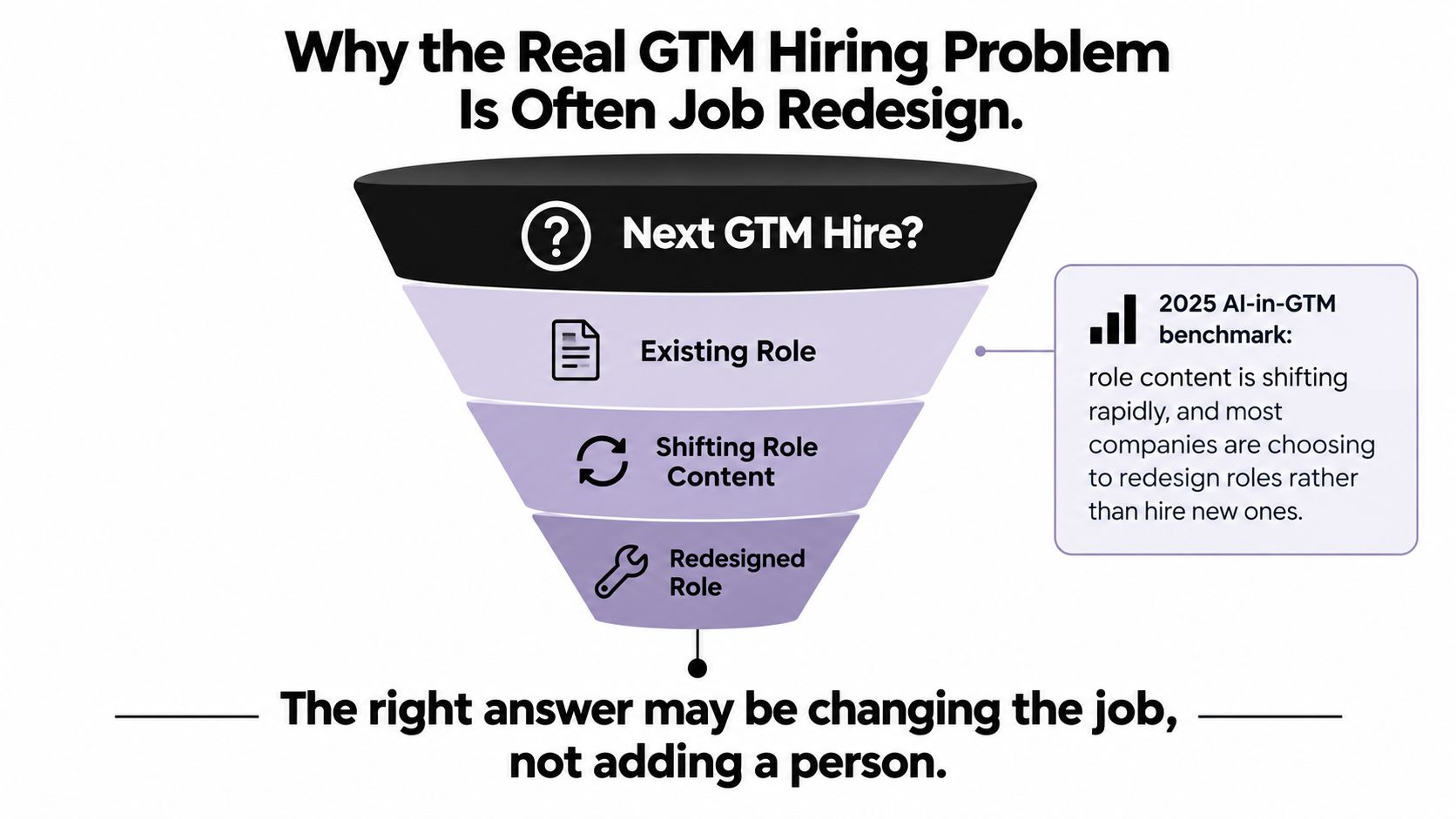
A 2025 benchmark reported that 86% of GTM professionals use AI tools daily, 84% report moderate or significant productivity gains, 62% of companies are reskilling employees rather than reducing headcount when automating, and 56% of roles are already affected by AI-driven automation (2025 AI in GTM report). The practical message isn't “stop hiring.” It's that companies should decide what the job needs to become before hiring someone to do it.
Diagnose before opening the requisition
Work through the operating problem in order:
- Name the bottleneck. Is the team missing qualified pipeline, struggling with slow lead follow-up, losing opportunities during technical validation, or failing to retain customers?
- Identify the gap. Is this a missing capability, an outdated job design, a workflow that could be automated, or work an existing employee could take on after reskilling?
- Define ownership. Decide which outcomes belong to the seller, marketer, RevOps operator, GTM engineer, or AI-enabled generalist.
- Write the role last. Open a requisition only after you can describe why the gap requires a new person and how the hire will be evaluated.
AI may automate parts of lead scoring, CRM updates, data enrichment, or workflow orchestration. That doesn't remove the need for judgment. It changes what you should test: whether a candidate can design a reliable process, spot bad data, handle exceptions, and explain what the system changes for the revenue team.
Before publishing, pressure-test the responsibilities and ownership boundaries in a practical guide to writing a position description. A better job description won't fix a weak operating model, but it can reveal one before you spend time and budget recruiting against it.
An End-to-End GTM Hiring Workflow
A hiring loop can move quickly and still produce weak decisions. Set clear gates, agree on the evidence each interviewer must collect, and connect the process to the operating outcomes the role will own.
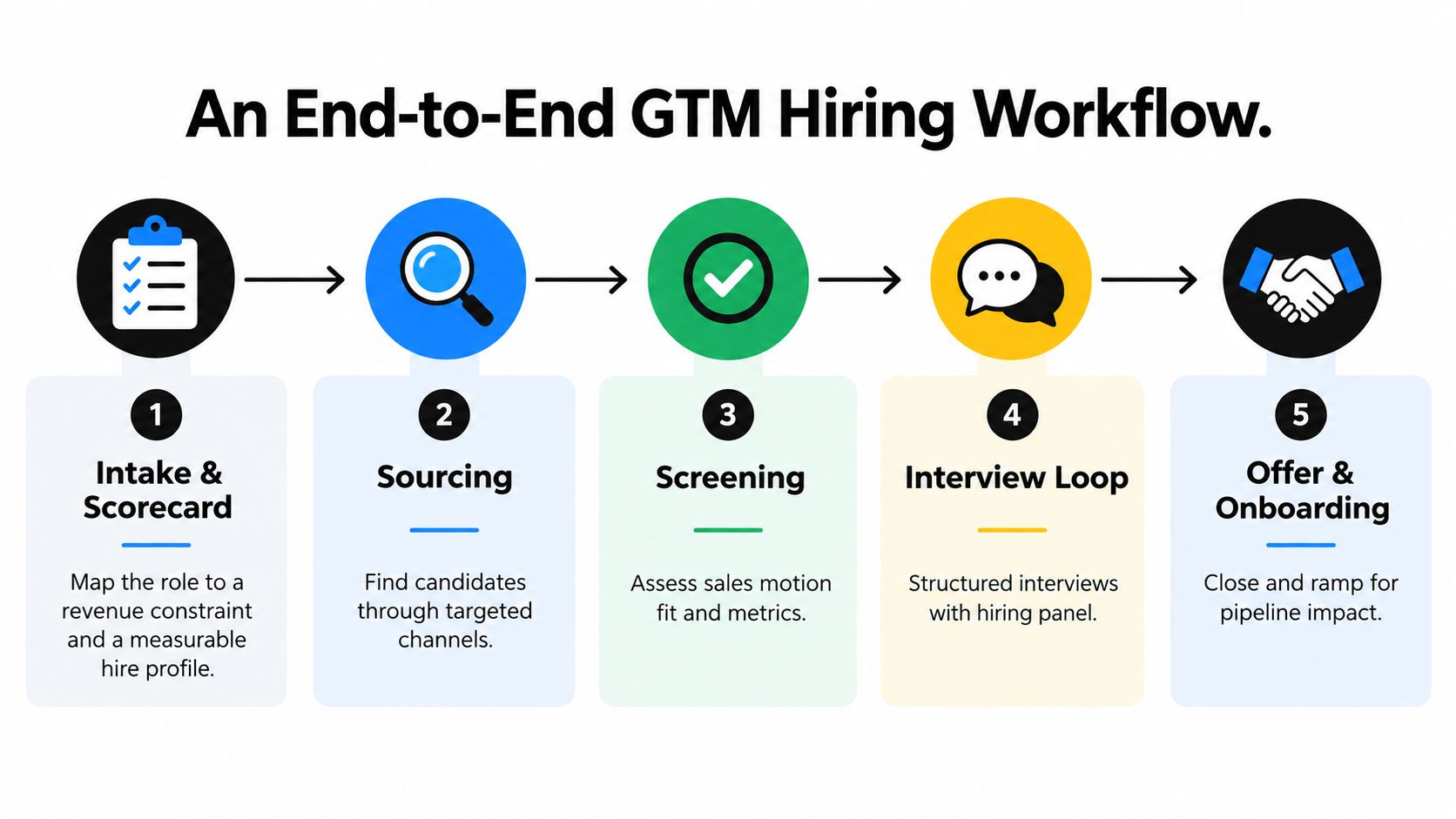
- Intake and scorecard design. Confirm the capabilities and outcomes the hire will own, then agree on how the team will assess them. Separate required evidence from preferred experience. A candidate can do the work without following the career path the hiring team expects.
- Sourcing and pipeline shaping. Use referrals, targeted outreach, a talent community, and a specialist recruiting partner when appropriate. Review the first candidate submissions together and adjust the search before building a large interview pipeline.
- Structured screening. Ask consistent, role-relevant questions about sales-motion fit and ownership. For technical GTM roles, assess how candidates work through a routing design or system walkthrough. A résumé's tool list is weak evidence of practical judgment.
- Interview loop and debrief. Assign each interviewer a distinct area to assess. Debrief within a day, while evidence is fresh, and resolve disagreements against the scorecard rather than personal preference.
- Offer and onboarding handoff. Set compensation expectations early, explain equity when it is part of the package, and check references against the candidate's stated contributions. Give the manager a documented ramp plan, coaching expectations, and an early pipeline review.
Set gates that keep the loop useful
Watch whether submitted candidates earn interviews, whether interviewers return evidence-based feedback promptly, and where qualified candidates leave the process. If submissions repeatedly miss the mark, change the intake or search profile. If interviewers disagree on the evidence, recalibrate the scorecard before adding candidates.
Sales engineering teams can use practical interview guidance such as this SE hiring hacks podcast episode, which focuses on improving the sales-engineering hiring process.
Acceptance is not the end of the recruiting handoff. Pass the scorecard, interview evidence, and agreed success measures to the manager, so onboarding starts with a clear account of the problem the hire was brought in to solve.
Direct Hire Versus Contract and Managed Service Options
Choose the engagement model based on the work and the risk, not a vendor's preferred contract. A permanent role, a short-term capacity gap, and an undefined operating need shouldn't all receive the same hiring solution.
| Model | Best fit | Trade-off |
|---|---|---|
| Direct hire | A known, ongoing seat with clear ownership | The company commits to a permanent hire before seeing the person perform in the role |
| Contract-to-hire | A fit or workload that needs validation before conversion | The team must set expectations for the evaluation period and conversion decision |
| IT staff augmentation | A need for skilled, embedded capacity under the company's direction | The company still owns the operating plan and day-to-day management |
| Nearshore hiring | Scaling work with talent in a compatible time zone and a cost-sensitive model | Managers need to plan communication and ownership across locations |
| Executive search | VP and C-level GTM leadership roles | Senior hiring needs careful alignment on mandate, authority, and success measures |
| MSP or outsourcing search | A capability better delivered by a supplier than by one employee | The business must manage the supplier relationship and define service outcomes |
Route the problem to the right model
Use direct hire when the role is permanent and the company knows what success means. Choose contract-to-hire when the work is real but the fit or long-term structure needs to be proven. Staff augmentation suits an embedded project or capacity gap where the company can direct the work. Nearshore may fit roles that need close working-hour overlap and a cost-sensitive delivery model.
For a senior commercial leader, executive search makes sense when the company needs a focused search for a defined mandate. If the business needs a managed service, specialist implementation partner, or outsourced capability, search for a supplier instead of squeezing that work into an employee requisition.
TekRecruiter offers direct hire, contract-to-hire, staff augmentation, nearshore recruiting, executive search, and MSP or outsourcing search. To compare the trade-offs between permanent and contract employment in more detail, use this guide to direct hire versus contract employees.
The decision rule is simple: hire a person for a role, add contract capacity for a workload, and find a supplier when the gap is a service the company shouldn't own internally.
Metrics That Show Whether the GTM Hiring Engine Is Working
A recruiting dashboard and a revenue dashboard answer different questions. Don't mistake a busy recruiting funnel for proof that the company hired well.
| Dashboard | Measures | Leadership question |
|---|---|---|
| Recruiting conversion | Time-to-fill, submit-to-interview, interview-to-offer, offer acceptance | Are we finding relevant candidates and moving decisions efficiently? |
| Hiring velocity | Hires against plan, role aging, requisition load per recruiter | Can our recruiting capacity support the hiring plan? |
| Quality and productivity | Ramp-adjusted performance, retention, early pipeline contribution, win-rate movement | Did the hire improve the revenue system after joining? |
A high number of résumés submitted isn't a revenue outcome. Submit-to-interview ratio is more useful as an early signal of whether the recruiter and hiring team agree on the profile. As of 2026, 82% of candidates submitted through TekRecruiter get interviewed, a figure that is most useful when considered alongside downstream retention data.
Read the patterns, then change the process
If time-to-fill is rising, ask whether the role is hard to source, the requirements are too narrow, or interview decisions are taking too long. If the submit-to-interview ratio is weak, recalibrate the scorecard and intake before increasing sourcing volume. If candidates get interviews but rarely reach offers, examine the interview experience, compensation alignment, or the evidence the panel expects.
If the ratio is high but retention is poor, don't congratulate the sourcing team. The profile may be attractive on paper but misaligned with the actual job, manager, or sales motion. Quality-of-hire measures help connect recruiting decisions to what happens after someone starts, as discussed in this guide to quality-of-hire metrics.
More submissions tell you that recruiting is busy. They don't tell you whether the team is hiring the right operators.
Review recruiting conversion, hiring velocity, and post-hire quality together. A single metric can suggest where to investigate, but the combination tells you whether to change the job profile, the interview process, the recruiting capacity, or the onboarding handoff.
A 60-Day Plan to Stand Up or Scale a GTM Team
Use a short, sequenced plan to turn the hiring decision into operating capacity.
- Days 1–10: Identify the revenue constraint, map ownership across the customer journey, and draft scorecards for the roles that require new hires.
- Days 11–25: Open the priority requisitions, calibrate interview panels, and choose a hiring model for each role.
- Days 26–45: Run structured sourcing and screening. Set clear expectations for feedback and debriefs so qualified candidates don't stall.
- Days 46–60: Close the first wave, hand off the scorecards and success measures to managers, and launch the dashboards for recruiting velocity and post-hire quality.
TekRecruiter screens GTM candidates using HEART: High agency, Execution, Accountability, Resourcefulness, and Transparency. Those traits matter in SaaS GTM work because operators must take ownership, deliver across functional boundaries, and explain how their work connects to commercial outcomes.
If you're deciding whether your next move is a direct hire, contract capacity, a nearshore search, or a redesigned role, TekRecruiter recruits across GTM engineering, RevOps, marketing automation, sales engineering, and technical account roles. Bring the revenue constraint and the roles you're considering, and ask for a hiring plan that matches the operating model.
 Ron SmithPresident & Lead RecruiterTekRecruiter