Fractional CMO Services: Costs, Models and When to Hire
Fractional CMO services explained: what they include, what they cost, how engagements run, and when a part-time CMO beats a full-time hire.
Your team is publishing content, your agency is sending reports, and sales still wants to know where the next qualified opportunity will come from. You're approving marketing decisions between product meetings because nobody else owns the whole picture.
Fractional CMO services can solve that leadership gap. But buying executive advice won't help if nobody can execute it, and a modest retainer can become an expensive commitment once you add the people, tools, and campaigns behind it. Choose this model for the decisions you need someone to own, not the salary you hope to avoid.
What Fractional CMO Services Include
Say you run a 40-person SaaS company with a strong product and a stalled pipeline. A marketer handles content, an agency runs paid campaigns, and the founder keeps rewriting the homepage. Everyone has work to do, but nobody decides which buyers matter most or which activities deserve funding.
A fractional CMO is an experienced senior marketing executive who works with your company part-time. You agree on their availability, whether that's a few days each month or a more embedded schedule, and they report to the CEO while setting priorities and directing the people delivering the work.
Think of a part-time chief pilot who sets the flight plan and checks every instrument. The crew still flies the plane. Without that crew, the flight plan won't get you anywhere.
What you're actually buying
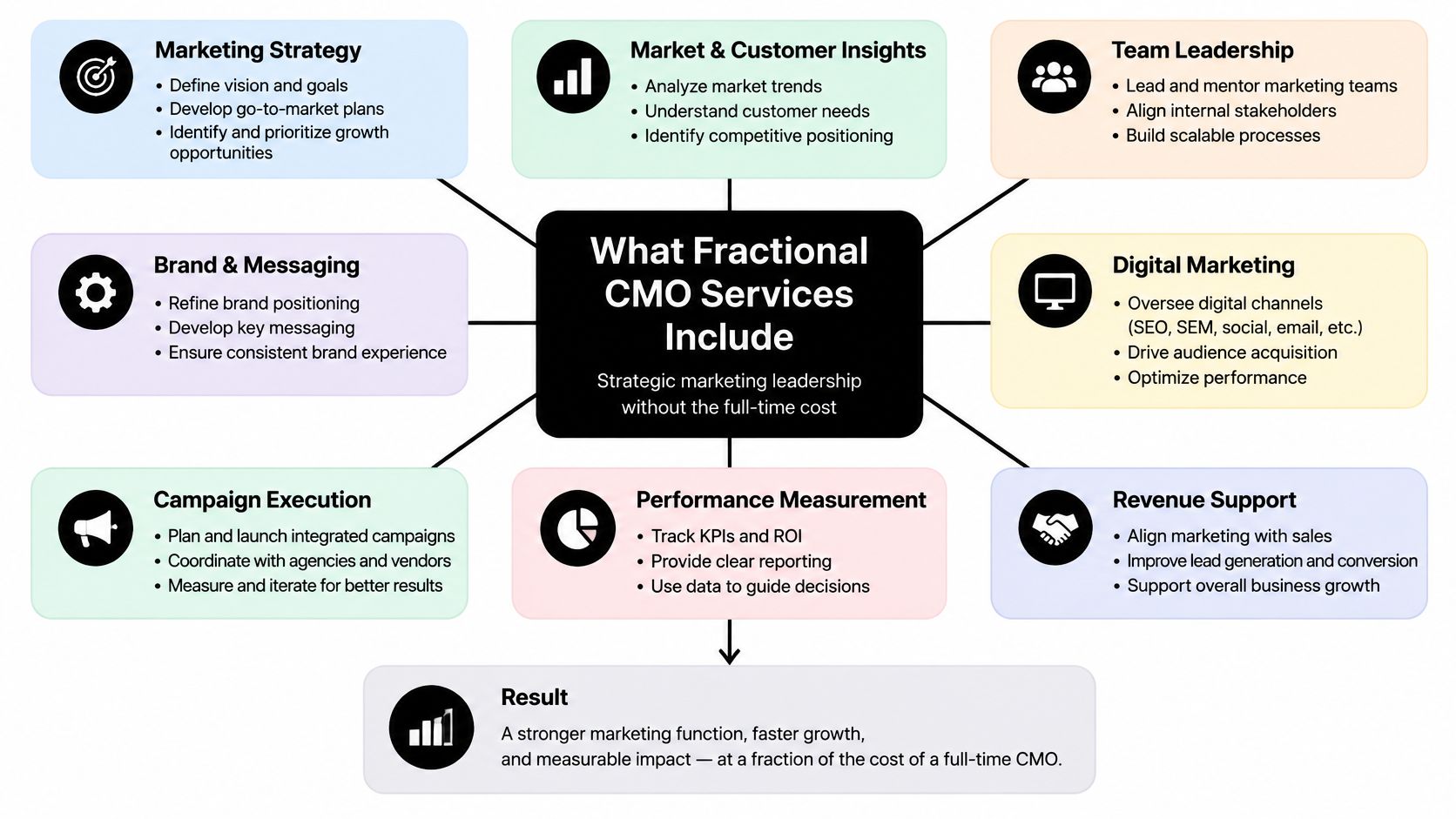
The remit should connect commercial choices with execution:
- Positioning and messaging: Define the target buyer, buying trigger, competitive alternative, and reason to choose your product.
- Channel mix and budget: Decide where to invest, what to stop, and which assumptions need testing.
- Demand generation: Coordinate campaigns around an agreed offer and sales motion.
- Lifecycle and retention: Align onboarding, expansion, and customer communications with customer success.
- Measurement: Establish usable reporting rather than separate dashboards with conflicting answers.
- People and vendors: Write hiring briefs, direct marketers, and hold agencies to clear standards.
The scope of that leadership role is easier to see as a connected system.
Outsourcing marketing work is already established: among 219 valid responses, companies reported outsourcing an average of 20.18% of marketing activities in the Fall 2023 CMO Survey. That measure includes agencies, vendors, and partners, not fractional CMOs specifically.
For the SaaS company, the executive might decide that poor qualification matters more than additional traffic. They would set the requirements for lead routing and nurture, while a marketing automation specialist implements the workflows in HubSpot or Salesforce.
The model fits a senior-judgment problem. It isn't a campaign-execution team, and it shouldn't be a temporary staff filler with an executive title.
Pricing Models and Monthly Retainers
| Pricing basis | Reported figure | Context |
|---|---|---|
| Monthly retainer under $5,000 | 29.5% of surveyed providers | Lower price band; confirm allocated days |
| Monthly retainer $5,000–$8,000 | 40% of surveyed providers | Most common surveyed band |
| Monthly retainer $8,000–$10,000 | 18.5% of surveyed providers | Upper-middle price band |
| Monthly retainer above $10,000 | 12% of surveyed providers | Top band; confirm seniority and scope |
| Hourly rate | $176 average per hour | Middle 50% range $125–$200 per hour |
The monthly figures come from a 2024 survey of 250 fractional professionals cited by Randy Wattilete's fractional CMO cost guide: 29.5% charged below $5,000, 40% charged $5,000–$8,000, 18.5% charged $8,000–$10,000, and 12% charged more than $10,000. Treat this as a survey of fractional professionals, not a guaranteed quote for a SaaS marketing executive.
For the hourly benchmark, Go Fractional's 2026 State of Fractional Work report, based on 27 fractional CMO job postings and reported by Boomp, recorded a $176 average hourly rate, with the middle 50% between $125 and $200. Posted rates and contracted retainers aren't interchangeable.
Choose the fee structure around the work
A monthly retainer works best for ongoing leadership. Specify reserved days, meeting availability, preparation, asynchronous decisions, and whether unused time carries forward. A retainer without a capacity agreement invites disagreement about responsiveness.
An hourly arrangement suits bounded support, such as reviewing a budget or interviewing candidates. It's less useful when you want someone to exercise continuous judgment without asking permission to spend time on every decision.
A project fee suits a defined output, such as a go-to-market plan or marketing organization redesign. Include acceptance criteria and implementation support, or you may receive a polished presentation that nobody can use.
Buying rule: Compare proposals by reserved capacity, decision responsibility, and deliverables. Comparing the monthly fee alone tells you very little.
Seniority, industry depth, team-management responsibility, and hands-on delivery should all affect the quote. Access matters too: scheduled working sessions aren't the same service as availability during a launch or board preparation.
Consider a hypothetical Series A company requesting two days a week while negotiating within the table's mid-band retainer. Don't assume the price buys that schedule. Require the proposal to state whether those days are dedicated, how much time meetings consume, and who handles work between them.
Before signing, settle these questions:
- Capacity: What time is reserved, and what requires an additional fee?
- Delivery: Which outputs will the executive personally produce?
- Exclusions: Are paid media, software, contractors, and creative separate?
- Commercial terms: What are the notice period, renewal terms, and cancellation obligations?
How a Fractional CMO Engagement Runs
Start with access and authority, not a campaign launch. The executive needs CRM access, financial constraints, sales context, and permission to challenge existing commitments.
Use the following as a proposed operating schedule, not a promise that every company will move at the same speed. In the opening leadership meeting, agree how the CMO reports to the CEO and how marketing decisions reach the annual growth plan and board reporting.
Put the work in the right sequence
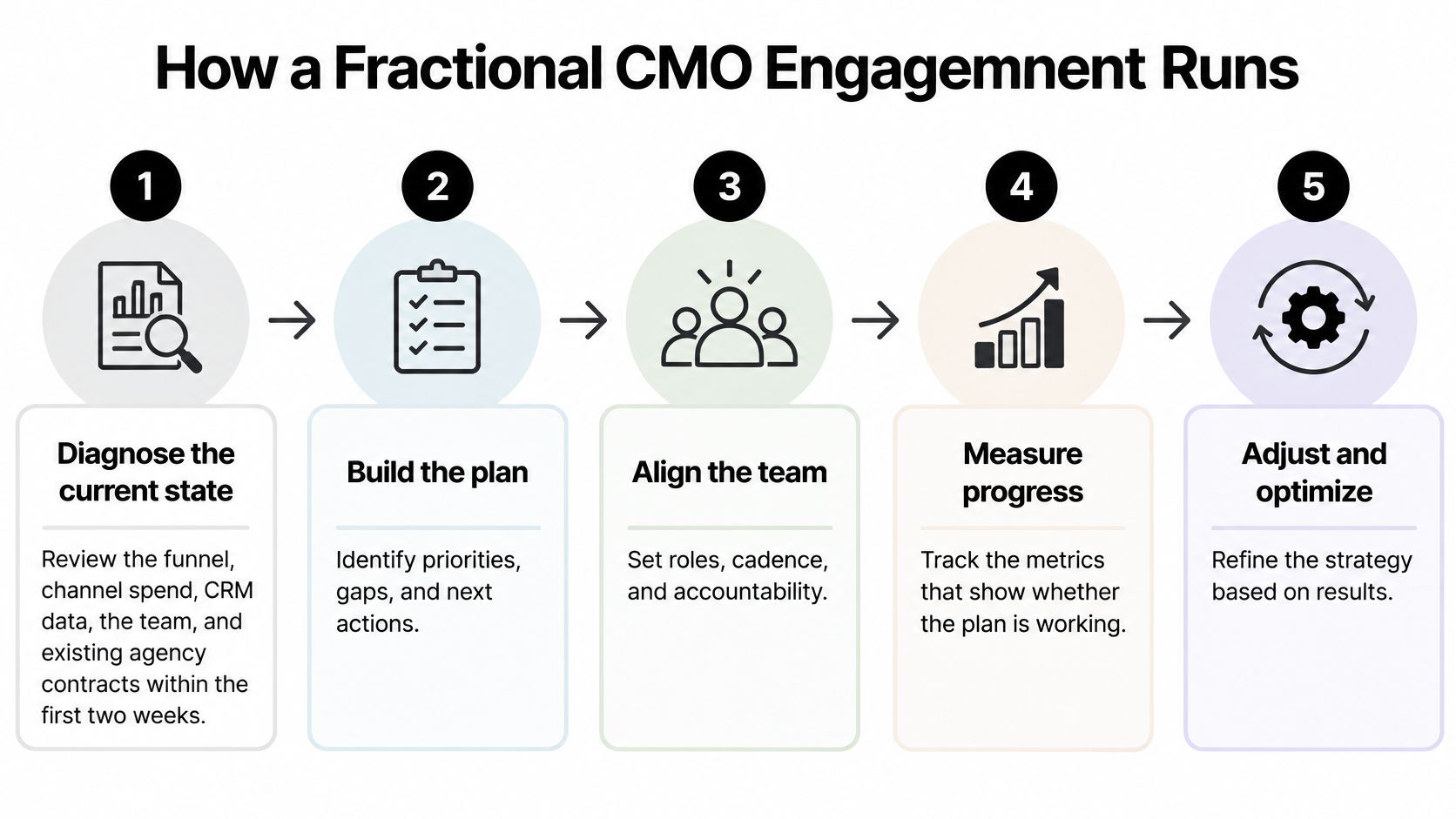
Diagnose the current state. Reserve the opening fortnight for reviewing funnel stages, channel spend, CRM records, team capacity, and agency contracts, then validate the findings with sales calls and customer conversations. The common mistake is launching campaigns before checking whether tracking, qualification, or follow-up is broken.
Set the commercial goal. Agree on the business outcome, the sales assumptions behind it, and the budget available to pursue it. Don't let a pipeline target rest on an untested assumption about deal size, sales capacity, or close rate.
Build a quarterly roadmap. Assign owners, hypotheses, dependencies, and a driver-based budget covering people, agencies, media, martech, content, and analytics. The usual failure is approving a list of activities without specifying what each activity should change.
Install the operating rhythm. Schedule weekly leadership check-ins, monthly forecast-versus-actual reviews, and quarterly allocation decisions, with a decision log recording what changed and why. Avoid status meetings where everyone reports activity but nobody resolves blocked work.
Direct or hire the team. Turn capability gaps into role briefs, interview criteria, agency briefs, and working standards; a go-to-market recruiting plan should follow the commercial plan rather than precede it. Don't hire a generalist into a specialist implementation problem.
Prepare the handover. Document playbooks, transfer tool administration, and name the person who will inherit each recurring decision. Leaving this until the engagement ends creates dependence on the executive's memory and personal accounts.
The engagement should move from diagnosis toward coordinated delivery and adjustment.
Make channel tests specific
A channel plan needs more than a label such as community marketing. If buyers discuss your category on Reddit, assign someone to assess subreddit rules, recurring questions, useful contributions, and the boundary between participation and promotion. Bazzly's Reddit marketing guide can support that assessment before anyone treats Reddit as another advertising placement.
For a healthy opening quarter, require a clear funnel map, a funded test for each priority channel, named delivery owners, and a dated decision meeting. Revenue may take longer to materialize in a long sales cycle, but the executive should still explain what the team has learned and what decision follows.
Who Owns Results and What to Measure
Strategy isn't an accountability boundary. If the engagement promises direction but names no commercial outcome, you're buying advice, regardless of the title.
Make the ownership discussion explicit before the team starts work.

A fractional CMO may direct employees and vendors without controlling employment decisions or spending approvals. Give them authority to change the work they're accountable for, and document dependencies they can't resolve alone.
The pressure to build capacity is tangible: the 2026 CMO Survey highlights report reports marketing headcount growth of 2.5%, with companies projecting 2.6% growth for the following year. A leadership engagement therefore needs a credible plan for using available capacity, not an assumption that additional staff will appear.
Write an ownership agreement
Name the primary outcome, such as sales-accepted qualified pipeline or marketing-sourced revenue contribution. Then identify who can approve offers, pause channels, redirect agency work, and authorize spending.
Keep dependencies visible. The CEO retains responsibility for company-level funding decisions; the sales leader owns sales execution; product and customer success own delivery obligations assigned to them. Use clear go-to-market role definitions to prevent unassigned work from disappearing between departments.
Agree on these reporting definitions:
- Qualified pipeline: Opportunities meeting documented fit, need, and sales-acceptance criteria.
- Sourced revenue: Closed business credited to marketing under an agreed origin rule.
- Influenced revenue: Closed business with qualifying marketing interactions, reported separately from sourced revenue.
- Customer acquisition cost: Acquisition spending divided by acquired customers, with included costs stated.
- Payback period: Time needed to recover acquisition cost using the agreed margin basis.
- Pipeline velocity: How opportunity volume, value, conversion, and sales-cycle length combine.
CRM governance matters more than dashboard polish. Lock stage definitions, ownership fields, attribution rules, and reporting cutoffs before comparing performance.
Use the leadership discussion to connect those measurements to actual decisions.
Review evidence and enforce a stop rule
Set an opening-month review for baseline quality and ownership, a following review for implementation and early conversion evidence, and a quarter-end review for commercial progress. Match the evidence expected to the sales cycle rather than demanding closed revenue before opportunities can reasonably mature.
For example, agree to pause a channel when it misses its qualified-pipeline or payback target over its defined test window. Require a written case for extending the test.
Accountability means explaining the result, making the next decision, and acting within agreed authority. It doesn't mean guaranteeing revenue while sales, product, and funding decisions sit elsewhere.
Total Cost and the Exit Path
Don't approve fractional leadership because someone promises a large discount against a full-time executive. Compare complete operating models, not a consulting invoice with an employee's fully loaded compensation.
The right calculation includes everything required to execute the plan. A lower leadership fee doesn't remove the need for campaign production, systems administration, or sales enablement.
Build the complete budget
| Cost category | What to include |
|---|---|
| Leadership | Retainer, additional availability, travel, and transition work |
| Delivery capacity | Employees, agencies, contractors, design, and copywriting |
| Distribution | Paid media, sponsorships, events, and partner activity |
| Systems | CRM, automation, analytics, integrations, and implementation |
| Remediation | Data cleanup, tracking repairs, and migration work |
| Commercial support | Sales materials, training, and customer research |
For the permanent-hire alternative, include salary, employer costs, incentives, recruiting, and the team and tools that executive would still require. Compare equivalent work over the same planning horizon.
Say a proposal covers leadership meetings and a growth plan, but excludes landing pages, campaign operations, and CRM cleanup. A competing proposal includes those capabilities through a delivery team. The first has a lower retainer, but you can't call it cheaper until you price the missing work.
Cost safeguard: Put every required resource beside a named payer and an approval owner before accepting the engagement.
Check for duplicated responsibility too. If an existing agency already bills for strategy, clarify which planning responsibilities it will retain after the executive starts.
Define what ends the engagement
Permanent executive hiring remains a relevant destination: Fusion Search Partners' marketing leadership hiring analysis reports 501 global CMO appointments in 2025, up 61.6% year over year, with 83% filled externally. Fractional leadership can support a search or capability build rather than replace permanent hiring indefinitely.
Use these decision criteria:
- Urgency: Choose bridge leadership when decisions can't wait for a permanent search.
- Expected duration: Identify whether the assignment ends with a strategy reset, a completed transition, or a successor's readiness.
- Control needs: Prefer embedded leadership when daily executive intervention is necessary.
- Handoff readiness: Require documented systems, accessible accounts, and an internal decision owner before departure.
- Recruiting responsibility: State whether the fractional leader will define, interview, and onboard the eventual team.
Make renewal a deliberate decision. Extend the engagement because a defined leadership need remains, not because nobody planned how to operate without it.
Fractional CMO Compared With Other Options and When to Hire
| Option | Time commitment | Accountability | Best fit |
|---|---|---|---|
| Fractional CMO | Part-time, with agreed working days | Strategy and team direction, delivered through internal staff and vendors | Growth-stage company needing senior direction |
| Full-time CMO | Full-time employee | Executive ownership of marketing outcomes | Stable scale with budget for a permanent executive |
| Interim CMO | Full-time for a set period | Delegated executive authority during the transition | Leadership gap during a search |
| Marketing agency | Project or retainer scope | Delivery of defined work, not default ownership of company strategy | Campaigns, content, or other specific execution |
| Marketing consultant | Project-based | Advice and agreed diagnostic deliverables | One-off diagnosis or audit |
Choose the missing capability, not the most senior-sounding title. A team that knows its audience, offer, and priorities but can't build campaigns needs production capacity. A team running conflicting campaigns without a coherent commercial plan needs leadership.
A fractional CMO suits a growth-stage business that needs strategy and team direction without continuous executive presence. A full-time CMO suits an organization whose complexity and management demands justify a permanent departmental leader.
An interim CMO fills a temporary executive vacancy with the authority needed to run the department during a transition. An agency delivers specified work, while a consultant helps answer a bounded question, such as why conversion deteriorated or whether a market-entry plan is credible.
The benefits and compromises
The strongest benefit of fractional leadership is right-sized senior capacity. You can reserve experienced judgment for consequential decisions without inventing a full-time workload to justify the appointment.
A defined engagement can also help you get moving while you shape the permanent organization. But availability must be negotiated, not assumed from an impressive résumé.
The compromises are operational:
- Limited daily presence: The leader won't attend every conversation where priorities drift.
- Delivery dependence: Internal staff and vendors must have the capacity and competence to act.
- Coordination demands: Shared calendars, approval delays, and unclear escalation paths can consume the time you bought.
- Context switching: A leader serving other clients needs disciplined preparation and realistic availability.
Don't confuse outsourcing marketing leadership with outsourcing the entire revenue function. If you're also evaluating external sales support, review how companies that outsource sales divide prospecting, qualification, and closing responsibilities. Someone inside the business still needs to coordinate the customer journey across those boundaries.
Make the hire or no-hire decision
Hire when the product sells, the growth problem is identifiable, and capable people need direction. The model is especially useful when you want to develop an internal successor or keep commercial decisions moving during a permanent search.
Wait when you're still changing the offer constantly, can't fund execution, or expect the executive to personally produce every asset. Choose full-time or interim leadership when the role requires daily executive presence and continuous management.
Before approving a search, make sure you can answer yes to each requirement:
- Owned outcome: Can you name the commercial result and the authority attached to it?
- Funded execution: Have you approved the resources needed beyond leadership?
- Successor plan: Does someone know what they'll inherit?
- Review date: Is there a scheduled decision to continue, change, or stop?
This week, write a hiring brief with the outcome, requested days per month, and internal owners. Use it to evaluate candidates on decisions they've made and systems they can explain, rather than channel vocabulary.
At TekRecruiter, we charge no upfront costs, and every service is contingent on the client hiring someone who starts. Clients can begin by scheduling a call with Ron Smith.
TekRecruiter helps companies find and vet leaders and specialist providers against a defined business need. Visit TekRecruiter to schedule a scoping call with Ron Smith, and bring your outcome, capacity requirements, and execution budget so we can assess the right fractional leadership fit.
 Ron SmithPresident & Lead RecruiterTekRecruiter