Hiring Software Engineers: The 2026 Playbook
A complete hiring software engineers playbook for SaaS leaders. Learn how to write JDs, screen for HEART, and build a high-performing team in 2026.
Hiring software engineers in 2026 means competing in a market that is still expanding, with 267,700 projected U.S. jobs added from 2024 through 2034. The old habit of using algorithm puzzles to screen for raw coding speed isn't enough anymore, because AI has changed how strong engineers build, debug, and ship.
Your roadmap is late, your senior backend seat is still open, and the candidates who can move product are getting pulled into offers from software, finance, healthcare, retail, manufacturing, and security teams at the same time. The companies that win are the ones that stop treating hiring like resume sorting and start treating it like an execution system.
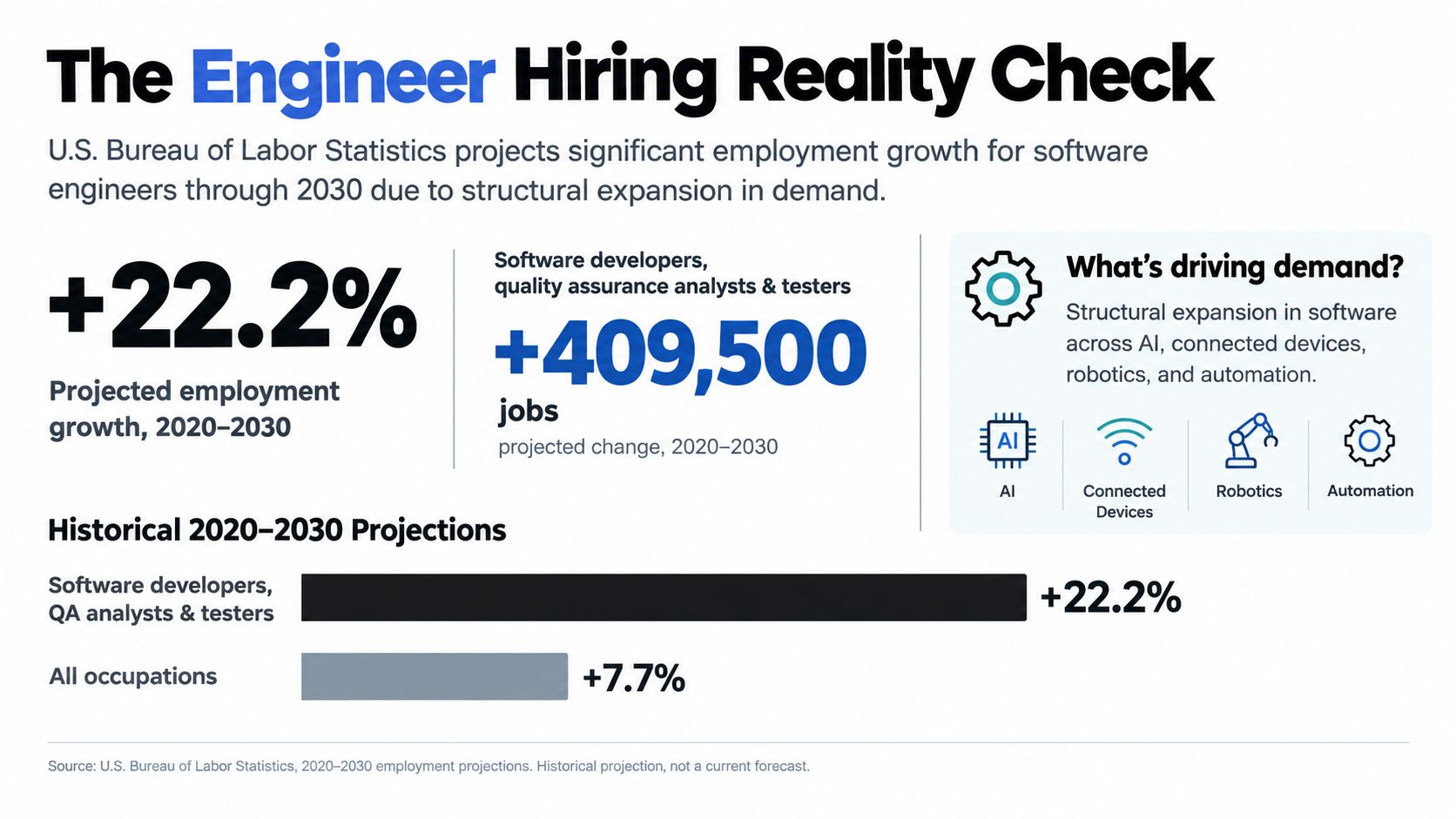
The Engineer Hiring Reality Check
The fastest way to waste a quarter is to hire a smart-looking engineer who can't ship. I've seen teams celebrate a “strong” offer acceptance, then spend months discovering that the new hire needed heavy handholding, avoided ownership, and couldn't make trade-offs when production issues showed up.
That mismatch is happening in a market that's still getting tighter in practical terms. The U.S. Bureau of Labor Statistics projects software developer employment to rise by 15.8% from 2024 through 2034, adding about 267,700 jobs, and says that pace is more than five times the average growth rate across occupations, which is why competition now comes from outside traditional tech companies too. For hiring leaders, that means the search isn't just about backfilling one seat, it's about building a repeatable system that can compete for scarce technical judgment. BLS projection on software developer growth
What the best hiring teams stop doing
They stop posting vague requisitions that read like every other software job on the internet. A request for “rockstar full-stack engineers” tells strong candidates nothing about what they would own, and it gives weak candidates room to guess.
They also stop pretending one interview loop can reveal everything. If the role touches product, infrastructure, or security, the screening needs to expose how the person thinks under ambiguity, how they handle incomplete information, and whether they can explain decisions in terms the rest of the business can use.
Practical rule: if the role can't be described in terms of shipped outcomes, the hiring process will drift toward credentials instead of capability.
When you need a benchmark for senior-level search quality, a role board like We Are Distributed senior roles can be a useful reference point for the level of specificity strong engineering jobs tend to carry. The point isn't to copy another company's posting, it's to calibrate your own expectations to the market.
Defining Roles and Writing Winning Job Descriptions
A job description should make a good candidate lean in and a misfit self-select out. Most fail because they stack every possible skill into one list, then wonder why the applicants are either too broad to be credible or too narrow to be useful.
Start with the actual work
Before writing anything, define what this person will be responsible for in the first months on the job. That means naming the system area, the kind of problems they'll solve, and the business outcome tied to the work. A platform engineer who hardens deployment flows is not the same hire as a product engineer who ships customer-facing features every sprint.
A clean way to draft the role is to separate three things, the mission, the must-haves, and the stretch skills. The mission should read like a real assignment, not an HR summary. The must-haves should be limited to the capabilities without which the person can't succeed. The stretch skills are where you allow room for growth instead of filtering out strong generalists.
For a practical example of how job language shapes candidate quality, the position description guide from TekRecruiter is a useful internal standard to compare against your own wording.
Write for people who ship, not people who collect keywords
Candidates who ship code notice when a posting sounds like a scavenger hunt for tools. If the role really needs AWS, PostgreSQL, Terraform, and incident response maturity, say so. If the biggest challenge is partnering with product and design to reduce cycle time, say that too.
Good job descriptions answer one question clearly, what does success look like here?
The best descriptions also give engineers a reason to care. That's where mission matters, but only if it's concrete. “Build the next generation of finance infrastructure” is vague. “Own the services that move money safely and make reconciliation reliable” gives an engineer something real to evaluate.
Candidates who care about signal-heavy application materials often study resources like cover letter tips that get interviews because the same principle applies in reverse, specificity beats generic polish. If your JD is specific, your applicant pool usually gets sharper.
Sourcing Strategies and Nearshore Options
Once the role is clear, sourcing becomes a mix of speed, reach, and budget discipline. Direct recruiting works well when you need a long-term owner. Contractors help when the roadmap is urgent and the scope is contained. Nearshore options add another useful lever when you need strong engineers who can collaborate in overlapping time zones.
Compare the hiring models before you start outreach
| Model | Best For | Cost Profile | Time to Start |
|---|---|---|---|
| Direct hire | Core product ownership, long-term continuity | Higher fixed commitment | Slower |
| Contractor | Short projects, overflow work, specialized tasks | Flexible, usually lower commitment | Faster |
| Nearshore team | Shared hours, tight collaboration, rapid scaling | Often more efficient than domestic search | Fast |
| Staffing partner | Hard-to-fill roles, volume hiring, urgent backfill | Adds service cost | Fastest |
The right mix depends on the work, not the org chart. A lot of teams waste time insisting every engineering need should be a permanent hire, then suffer because the roadmap needed three months of concentrated execution, not another full-time search cycle.
Use channels according to the kind of candidate you need
Referrals remain valuable because they cut through noise, but they don't scale on their own. Job boards can help widen the funnel, though they usually attract plenty of people who match keywords and very few who match the actual problem. Recruiter-led search becomes more useful as the role gets more specialized, especially when you're hiring for platform, security, data, or AI-related engineering.
Nearshore hiring is often overlooked for the wrong reasons. Teams assume time zone overlap, communication, or quality will be trade-offs, but that's usually a sourcing problem, not an inherent one. If your manager, product lead, and engineer can work in the same window every day, you can move faster than a team that only talks in delayed async threads.
For a useful way to think about channel mix, candidate sourcing strategies is a practical reference point for balancing direct search, referrals, and specialized help. It's especially relevant when your internal team is already overloaded and you can't afford to burn cycles on unqualified outreach.
Practical rule: don't choose the channel you like, choose the channel that actually reaches the profile you need.
One service option in this space is TekRecruiter, which sources and places software engineers, including direct hire, contract-to-hire, staff augmentation, nearshore, and executive search. That kind of mix matters when your hiring plan needs both speed and continuity.
Modern Technical Screening and Interview Frameworks
A candidate can clear a coding puzzle and still miss the mark in a real engineering team. That gap is wider now that AI tools are part of everyday development work.
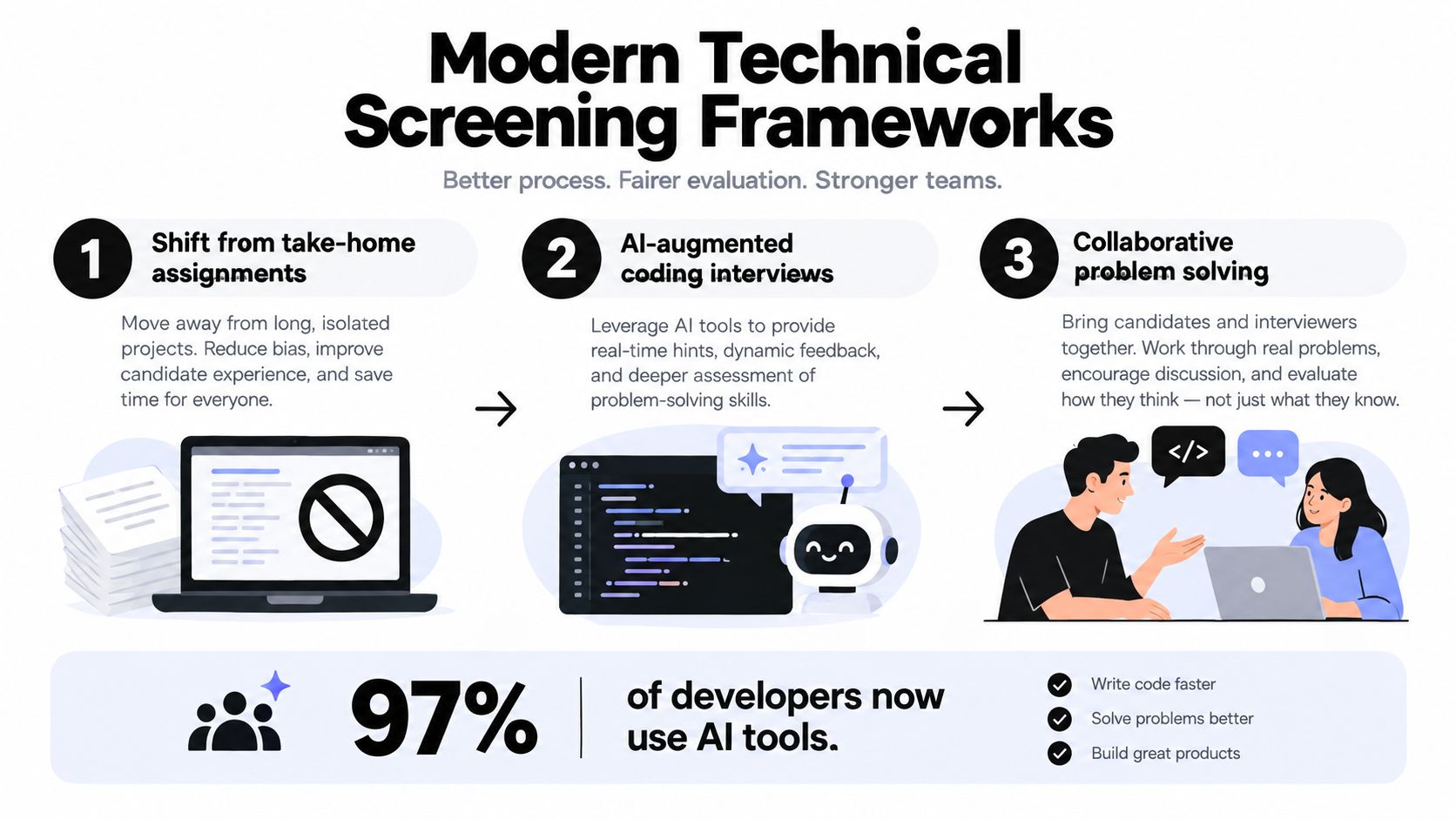
HackerRank's 2025 Developer Skills Report found that 97% of developers use at least one AI tool, and roughly one-third of code is now AI-generated. The interview has to reflect that reality. The right question is whether the candidate can frame the problem, choose a sane architecture, validate generated code, and spot failure modes before they reach production. The work now sits closer to judgment and accountability than to memorized algorithm drills.
Replace puzzle tests with work samples
Use an AI-permitted work sample. Give the candidate an ambiguous product or production problem and let them use the same tools they would use on the job. Score how they think, not just what they produce.
Watch for how they narrow the problem, whether they raise security concerns on their own, how they explain trade-offs, and whether they can test and review code that may have been partially generated. If they rely too heavily on the tool and cannot defend their decisions, they are not ready to own the system. If they move more slowly but can explain why the architecture works, what could fail, and how they would verify it, that is a stronger signal.
A useful reference point for shaping that conversation is system architecture design principles. Strong engineers tend to reveal themselves in how they reason about boundaries, dependencies, and failure paths.
For a structured hiring flow, our technical screening checklist helps teams keep the interview anchored to real execution instead of trivia.
Score for judgment, not just speed
AI fluency does not equal seniority. Fast code generation can hide weak understanding, and a candidate who cannot explain their choices may create more operational risk than a slower engineer with better instincts.
Use the interview to inspect the whole loop:
- Problem framing, ask what they would clarify before writing code.
- Architecture choice, ask why they chose one design over another.
- Validation discipline, ask how they would test, review, and ship.
- Ownership, ask what they would do if the first version failed in production.
Good interviews make candidates show how they think when the answer isn't obvious.
If your process still depends on algorithm drills, keep them as a small signal. A whiteboard puzzle may show comfort under pressure, but it rarely shows whether someone can help a real team ship reliable software.
The HEART Behavioral Assessment and Offer Strategy
Technical competence gets someone through the door, but the people who move product share a different pattern, they take ownership, communicate clearly, and keep showing up when the work gets messy. That's why a behavioral lens matters just as much as the technical screen.
Screen for HEART traits, not vague “culture fit”
The HEART framework is useful because it describes what ship-ready engineers do in practice. High agency means they move without waiting to be pushed. Execution means they close loops. Accountability means they own misses instead of explaining them away. Resourcefulness means they solve around constraints. Transparency means they share bad news early.
The behavioral interview should make those traits visible. Ask for a time they inherited a broken system, a time they disagreed with a design decision, and a time they had to explain a mistake to stakeholders. Listen for who they involved, what trade-offs they made, and whether they can describe the outcome without hiding behind team language.
When a candidate can only talk about their favorite technology, you still don't know how they operate under pressure.
The best signal is not charisma. It's whether they show a pattern of steady ownership. A strong engineer doesn't just say they “helped,” they can explain what they drove, what they verified, and what happened after the change landed.
Close the offer with the right mix of certainty and flexibility
Offers fail when they're built around what the company wants to pay instead of what the candidate needs to see. Engineers compare more than salary. They look at the scope of ownership, the quality of peers, flexibility, and whether the company ships.
The strongest offer conversations are direct. Explain the role, the business problem, the growth path, and the working model. If the compensation has room to move, use that room thoughtfully rather than hiding behind a generic package. If flexibility is part of the value proposition, be explicit about what's real and what's policy-bound.
One of the fastest ways to lose a strong engineer is to oversell a role during recruiting and then reveal the constraints after the offer goes out. That doesn't just kill trust, it signals that the team can't manage the hiring process cleanly. Candidates notice.
Onboarding, Retention, and Scaling Your Team
The first month after an offer is where a lot of hiring ROI is won or lost. A good engineer who lands in a fuzzy onboarding process spends their first weeks chasing access, decoding ownership, and trying to infer priorities from half-finished docs.
Make the first weeks operational, not ceremonial
Give every new hire a clear path to their first meaningful contribution. They need environment access, a named manager, a working map of the codebase, and a concrete target that gets them into production reality quickly. If they spend too long in orientation, they'll stay detached from the business problem.
Retention starts with clarity. Engineers stay when they can see how their work matters, when their manager gives straight answers, and when the team respects their time. The first few weeks should make it obvious how decisions get made, where the docs live, and who owns what.
For a practical checklist on making those first days less chaotic, best practices for onboarding is a useful reference for the details that often get missed.
Scale with the right operating model
If demand outgrows internal hiring capacity, it helps to separate three problems, delivery speed, team shape, and long-term capability. Managed service providers, outsourcing firms, and fractional leaders are useful when you need a function delivered, not just a person placed. Staff augmentation works better when you want work to happen under your direction while keeping roadmap control in-house.
The key is to avoid using a scaling model for the wrong purpose. A short-term build spike can be handled very differently from a sustained platform bet. If you treat both the same, you either overhire or under-deliver.
Practical rule: scale the work before you scale the org.
The goal is continuity. You want a hiring and retention system that keeps good engineers engaged, keeps the codebase moving, and gives you enough flexibility to respond when the business changes direction.
If you're hiring software engineers and the process feels noisy, TekRecruiter can help tighten it up with direct hire, contract-to-hire, staff augmentation, nearshore, and MSP search support. Visit TekRecruiter if you want a recruiting partner that focuses on engineering talent, technical screening, and shipping-ready teams.
 Ron SmithPresident & Lead RecruiterTekRecruiter