Software Engineering Hiring: The 2026 Playbook for CTOs
A practical 2026 playbook for software engineering hiring — sourcing, AI-aware interviews, hiring models, onboarding, and the KPIs that prove it works.
Your pipeline is full, your calendar is packed, and the team still asks the same question in every hiring meeting, who is going to ship with us this quarter? Meanwhile, candidates look better on paper because AI makes polished answers easy, interview loops drift from one engineer to the next, and the product team keeps treating every open req like a revenue emergency.
That's the software engineering hiring problem in 2026. Not sourcing alone, not interview design alone, not comp alone. The metric that matters is time-to-shipping-engineer, measured from requisition open to the first merged PR that reaches production, because that's when hiring starts paying back the team.
The Hiring Problem Every CTO Is Solving in 2026
The mistake most CTOs make is starting with channels. They ask whether they need referrals, agencies, or inbound, when the central issue is inside the company: too few people are able to contribute to production quickly, and every delay magnifies the gap.
Three external pressures make that gap worse. The U.S. software market still points to sustained demand, with the Bureau of Labor Statistics projecting 15.8% growth for software developers from 2024 through 2034 and about 267,700 added jobs, plus roughly 133,080 annual openings for developers, QA analysts, and testers BLS projection. Globally, the World Economic Forum's Future of Jobs Report 2025 says software and application developers are among the fastest-growing roles, based on a survey of more than 1,000 employers representing over 14 million workers across 55 economies WEF report. Hiring is still hard because demand is structural, not temporary.
The four constraints you actually feel
First, open reqs multiply faster than headcount budgets. Second, AI raises the bar for judgment while stuffing your funnel with candidates who can sound competent without being competent. Third, distributed teams make interview ownership blurry, so nobody owns the decision quality end to end. Fourth, leadership wants proof that each hire ships revenue, not just lines of code.
Practical rule: if a hiring tactic doesn't shorten the path from req open to production impact, it's decorative.
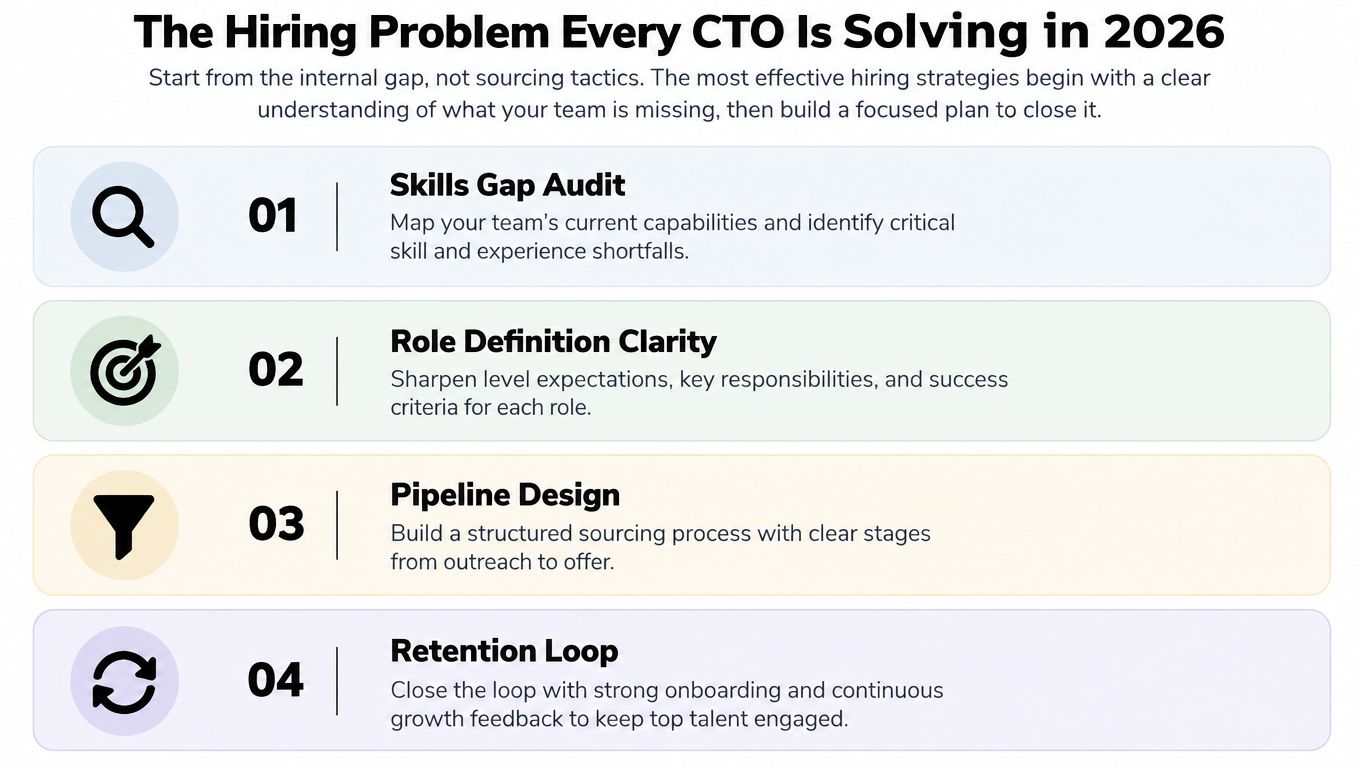
Treat the rest of your process as a set of levers on that single KPI. Sourcing changes how fast the funnel fills. Assessment changes how much bad signal you waste time on. Interview loop design changes decision speed. Onboarding determines whether a “hire” becomes a shippable engineer or another expensive delay.
Building a Sourcing Mix That Fills the Funnel
Sourcing is a portfolio decision, not a moral one. If your team treats referrals as a religion and outbound as a backup plan, you'll get whatever the market hands you, not the mix your roadmap needs.
Compare channels by what they move
Here's the clean way to look at it.
| Channel | What it's good at | What it's bad at | Best owner |
|---|---|---|---|
| Employee referrals | Fast trust and higher context | Can narrow diversity of thought if overused | Engineering leaders plus recruiters |
| Inbound brand and content | Pulling in candidates who already know your product | Slow to build, inconsistent without a publishing engine | Marketing and talent |
| Outbound recruiting and agencies | Precision targeting for scarce roles | Requires sharp screening or you flood the loop | Recruiters and hiring managers |
| Community and open-source presence | Credibility with senior engineers | Hard to measure in the short term | Senior engineers and founders |
If you need people shipping now, bias toward outbound and referrals. If you need a stable funnel over time, keep investing in inbound and community. The right mix depends on whether your constraint is speed or cost.
A budget split you can defend
For a cash-conscious startup, spend most of your effort on channels that compress time-to-first-screen and produce qualified conversations fast. Referrals should be easy, outbound should be disciplined, and community should be targeted, not performative. If you're a scale-up, the mix shifts toward pipeline predictability, which means more structured inbound and better partner support.
Don't turn referrals into a popularity contest. Tie the bonus to a hire who clears probation or a first meaningful delivery milestone, and make the rule transparent so people don't feel tricked into becoming unpaid sourcers.
If you're hiring across borders or for constrained relocation cases, a resource like JobGlance engineer visa listings can save time when you need to understand which candidates are even viable before you engage them.
For teams building a repeatable pipeline, the sourcing playbook in TekRecruiter's candidate sourcing strategies is a useful reference point for turning channel mix into process. The point isn't to chase every source. It's to own the mix with named people, a quarterly review, and a hard cutoff for channels that don't convert into shipping engineers.
Designing AI-Aware Technical Assessments
Banning AI in interviews doesn't protect signal. It often hides it. Candidates already use AI tools, and the hiring question is whether they can verify output, make trade-offs, and ship under constraints.
Stack Overflow's 2025 Developer Survey found that 84% of respondents were using or planning to use AI development tools, while only 31% were currently using AI agents and 38% had no plans to use them Stack Overflow survey. That gap matters. You're not hiring “AI users” in the abstract, you're hiring engineers who can supervise AI without losing judgment.
Use four signals, not one coding exercise
1. Problem framing and ambiguity handling. Give an intentionally underspecified production problem and ask the candidate what they need before coding. Strong engineers clarify scope, constraints, and failure modes first.
2. Trade-off reasoning under real constraints. Ask what they'd choose if latency, compliance, cost, or team ownership changed. Good candidates can explain why one path is safer, faster, or easier to maintain.
3. Code review on a flawed pull request. Show them a messy diff and ask what they'd approve, reject, or rewrite. This exposes how they think about architecture, tests, naming, and risk.
4. Incident-response walkthrough. Give them a production failure and ask how they'd diagnose it, communicate it, and prevent recurrence. That separates people who can prompt from people who can operate.
For teams that need a structured format, Form Timer's hiring tests use cases are worth reviewing because timed environments can support consistency without forcing artificial whiteboard theater.
What to do when someone refuses to show work
Set the policy up front. AI use is allowed when declared, but the candidate must explain the inputs, the reasoning, and the verification steps. If they won't walk through their process, that's a signal in itself. You don't need surveillance. You need a loop that rewards transparency.
For a deeper view on evaluation design, TekRecruiter's machine learning engineer assessment guide is a practical companion if your team hires for technical depth and wants assessments that survive senior-engineer scrutiny.
Rule of thumb: if a candidate can't defend the diff, they don't own the work yet.
Running an Engineer-to-Engineer Interview Loop
Most interview loops fail because ownership is fuzzy. One interviewer likes the candidate, another wants more signal, and the hiring manager shows up late to settle a process that should have been set before interviews started.

A senior engineering loop needs five named stations: recruiter screen, hiring-manager alignment, technical depth, system design and architecture, and engineer-to-engineer conversation. Give each station one owner and one job. If a station tries to cover everything, it produces weak signal and slows the whole funnel.
Assign one job to each station
The recruiter screen checks role fit and scope, not deep technical quality. The hiring-manager alignment sets the bar before anyone interviews. Technical depth should probe the candidate's strongest area, not trivia. System design tests how they reason about scale, maintainability, and product constraints. Engineer-to-engineer conversations should feel like peer work, not a performance review.
Use the debrief to compare evidence, not vibes. Every interviewer should answer the same question: what did this person do that shows they can ship here? If the answer stays vague, the loop failed earlier.
Calibrate monthly or drift will win
Run one monthly calibration session with interviewers who have already sat in the loop for a few cycles. Re-score a past candidate packet together, compare notes, and call out where someone is grading too harshly or too loosely. New interviewers should shadow before they score.
Strong loops get faster because interviewers trust the rubric, not because they talk louder in debrief.
Keep the process moving with a recorded debrief summary and a written decision owner. If the hiring manager waits until after the loop to “make the call,” you have already lost the time advantage of structure.
For interview-loop calibration and debrief design, use a rubric template that forces interviewers to score the same dimensions and record the same evidence.
Choosing Between Direct Hire, Staff Aug, Nearshore, and MSPs
Hiring models are not interchangeable. The wrong one looks efficient on paper and then eats six weeks of product time.
Use one KPI to decide: time-to-shipping-engineer. Direct hire, staff augmentation, nearshore, MSPs, and outsourcing all move that number differently, and you should pick the model that shortens it without handing away control you need.
Use the matrix your board can understand
| Model | Time to First PR | Cost per Quarter | IP Control | Ramp-Down Risk |
|---|---|---|---|---|
| Direct Hire | Slower start, stronger long-term contribution | Higher upfront cost, lower churn risk | Highest | Lower once embedded |
| Staff Aug | Fast | Moderate | Strong if managed well | Moderate |
| Nearshore | Fast if the talent pool is aligned | Often lower than domestic hire | Good, depends on governance | Moderate |
| MSPs | Fastest for capacity | Predictable, often bundled | Lower direct control | Higher if the supplier model is weak |
Direct hire is the right move when the role owns product direction and long-term architecture. Staff augmentation fits when your engineering leadership is already strong and you need more delivery bandwidth. Nearshore works when time-zone overlap and English fluency matter, and you want better economics than a domestic contractor bench. MSPs and outsourcing fit when a supplier can run the work better than a single employee can.
Match the model to the situation
A Series A building its first commercial product should favor direct hire for core product roles and use staff augmentation only as pressure relief. A scale-up migrating cloud infrastructure can use nearshore or staff aug for execution support while keeping architecture in-house. An enterprise modernizing a legacy stack should be selective, because supplier coordination can erase the savings. A CTO with thin management bandwidth should choose models that reduce coordination load, not add it. A fractional CTO search is a leadership problem first, so decision ownership matters more than headcount.
For teams comparing supplier-led options, the TekRecruiter guide to managed services vs staff augmentation is the right starting point. If you need a recruiter-led path that includes permanent roles, contract-to-hire, staff augmentation, nearshore, and supplier search, TekRecruiter covers those models.
Stress-test the vendor before you sign
- Ask for time-to-first-PR examples: Do not accept “fast” as an answer. Ask how they get someone productive.
- Check governance: Find out who owns technical decisions, code review, and escalation.
- Review ramp-down terms: You need a clean exit if the model does not fit.
- Inspect stack alignment: If they propose a stack you cannot hire for later, you are buying future scarcity.
The wrong model does not just cost more. It steals management attention, and that steals shipping time.
Candidate Experience and Engineering Onboarding
Candidates don't just leave because another offer is higher. They leave because your process feels disorganized, slow, or careless. Then, if they do join, they can still stall out when onboarding is tribal knowledge instead of an actual plan.
Treat candidate experience like a funnel
Measure the obvious touchpoints. Application acknowledgment, recruiter response time, interview scheduling, post-interview communication, offer, and pre-boarding all matter. If any one of those is sloppy, your strongest engineers will read it as a preview of how the company operates.
Fix the common leaks fast. Send acknowledgments automatically. Give candidates one coordinator. Close feedback loops quickly, even when the answer is no. A slow “yes” often looks worse than a clean “no.”
Candidate experience is an operating signal. Engineers notice whether your company can coordinate itself.
Onboarding should be designed like production readiness, not orientation theater. The first week should get the machine working, the first month should create one owned deliverable, and the first 90 days should end with a real retrospective between the hire and the hiring manager. Senior hires need more context, not less structure.
Use a 30-60-90 plan that actually ships
At day one, the engineer sets up the environment and ships something tiny to production. By day 30, they own a meaningful deliverable. By day 60, they shadow on-call and contribute to a runbook. By day 90, they review progress with their manager and clarify scope for the next quarter.
For teams that need a practical onboarding template, TekRecruiter's onboarding best practices are a solid reference point. The point is simple. If onboarding doesn't shorten the path to the first production contribution, it's overhead.
Tracking Hiring KPIs Your CFO Will Read
Most hiring dashboards are junk because they mix vanity with accountability. A useful dashboard has leading indicators, process indicators, and outcome indicators, and every line has one owner.
Build one view with three layers
Leading indicators tell you whether the funnel is healthy. Use pipeline coverage, screen-to-onsite rate, and offer acceptance rate. Process indicators show where time is leaking. That's where time-to-shipping-engineer, days-in-stage, and interviewer calibration drift belong. Outcome indicators show whether the hire was worth it. Track 90-day retention, six-month shipping velocity, and hiring-manager satisfaction.
If time-to-shipping-engineer climbs, read the dashboard like a detective. Weak pipeline coverage points to sourcing. Strong pipeline but weak screen-to-onsite points to assessment. Good interview conversion but slow first delivery points to onboarding. Don't guess.
Give every metric an owner
A metric without an owner is decoration. Recruiters own funnel health. Hiring managers own bar alignment and decision speed. Engineering leaders own interviewer calibration. The onboarding manager or manager-of-record owns shipping velocity after day one.
Decision rule: when one metric falls, don't add another meeting. Find the stage that failed and fix that stage.
Use a 90-day rollout plan to get the system live. First, define the KPI set. Second, assign owners. Third, set the review cadence. Fourth, remove any interview step or sourcing channel that doesn't move the ship date forward. That is how software engineering hiring becomes a program instead of a series of emergencies.
If you want help turning hiring from a noisy process into a shipping system, TekRecruiter works on software engineering staffing, direct hire, contract-to-hire, nearshore, and executive search for tech teams. Visit TekRecruiter if you want a recruiting partner that can help you reduce time-to-shipping-engineer without losing rigor in sourcing, assessment, or onboarding.
 Ron SmithPresident & Lead RecruiterTekRecruiter