Recruiting for Software Engineers: A 2026 Practical Guide
A practical guide to recruiting for software engineers in 2026: sourcing, technical evaluation, candidate experience and choosing a hiring strategy.
In 2025, 65% of recruitment professionals said they wanted to use more AI at work, yet 57% admitted they weren't properly trained to do so, according to the CoderPad and CodinGame State of Tech Hiring 2025 report. Engineering teams feel that exact mismatch from the opposite side of the table. Hiring managers buy sourcing automation and AI screening widgets while their actual hiring funnels lose qualified developers before an offer ever goes out.
Effective recruiting for software engineers isn't a volume contest. It's a measurable operating pipeline with discrete conversion points, clear owners, and predictable leak spots. When a search stalls, pouring more applications into the top rarely fixes the bottleneck.
A reliable hiring system does two things consistently. First, it measures where strong candidates drop out and repairs that broken stage before spending another dollar on ads or sourcing seats. Second, it tests for engineering judgment rather than keyword familiarity at every step, from the opening role scorecard through the final debrief.
Why Software Engineer Hiring Is Harder Now
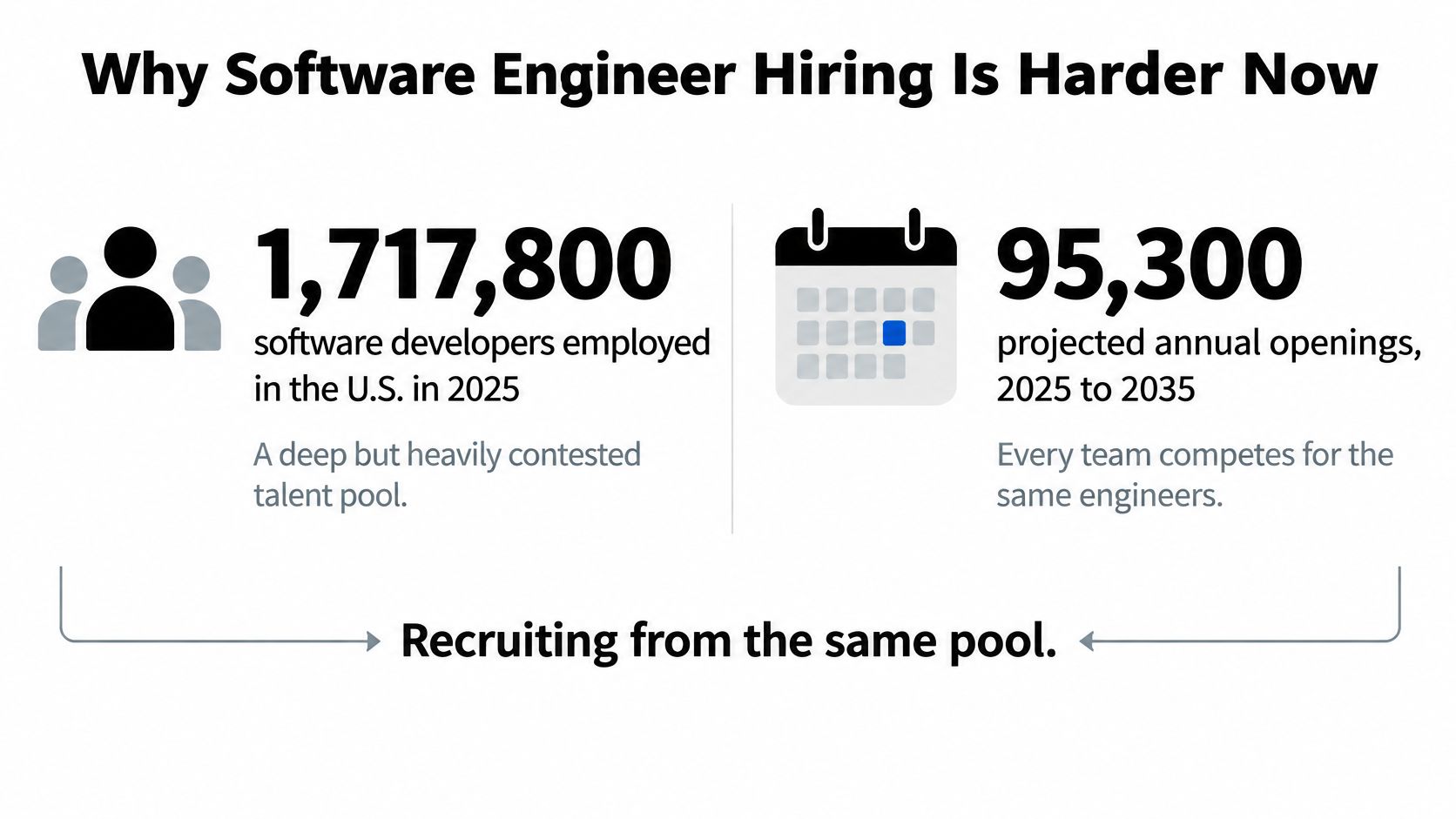
Every technical hiring manager is fishing in the same finite pond. In 2025, the U.S. had 1,717,800 software developers employed nationwide, with 95,300 projected annual openings from 2025 to 2035, according to O*NET and the U.S. Bureau of Labor Statistics. Those annual openings combine new headcount with replacement demand from retirements and career changes, which means most hires don't come from fresh graduating classes. You're almost always persuading a working engineer to leave another company's codebase for yours.
Long-term job growth tightens that contest further. The U.S. Bureau of Labor Statistics projects software-developer employment to increase by 15.8% between 2024 and 2034, adding roughly 267,700 jobs, the largest projected gain among the AI- and IT-related occupations in its analysis. Across the broader category of computer and mathematical occupations, employment is projected to grow 10.1% over that decade, more than triple the 3.1% growth projected for total U.S. employment. Demand spans AI systems, cloud data processing, software development, research services, and technical consulting, so product teams now compete with AI infrastructure labs and cloud consultancies for the exact same senior builders.
Three Leaks That Drain Your Recruiting Funnel
Think of your hiring process as a pressurized funnel with six joints. Once a strong engineer leaks out through a vague job post, a clumsy recruiter screen, or a three-week silence after an interview, you can't pump them back in. Three structural pressures turn small process flaws into empty seats:
- Competing headcount across overlapping stacks: A backend engineer who knows Python, PostgreSQL, and distributed queues can take a SaaS product role, a data platform role, or an AI tooling role in the same week.
- CV-to-role mismatch: Resumes list frameworks and titles rather than production ownership, so keyword filters routinely advance candidates who shipped minor tickets while rejecting builders who architected core services.
- Decision latency against parallel offers: Strong engineers rarely interview with one company at a time. Teams that take an extra week to schedule a hiring manager review lose finalists who already hold signed offer letters elsewhere.
Map the pool before writing the post. List every open role, group positions by seniority band and core stack, and estimate how many engineers in your target region actually match each profile before you publish a single job listing.
Doing that sizing work upfront prevents wasted quarters. If your scorecard demands production Rust, Kubernetes operator experience, and fintech compliance within commuting distance of a mid-sized city, you'll spot an empty talent pool on day one instead of week nine.
The Recruiting Pipeline Stage by Stage
Every software hire moves through six stages: role definition, sourcing, screening, technical evaluation, offer, and onboarding. Teams often obsess over sourcing while ignoring the downstream stages where good candidates disappear. Reviewing each stage's deliverable, owner, and failure mode turns recruiting from guesswork into an engineering discipline.
| Stage | What it produces | Usual owner | Common failure |
|---|---|---|---|
| Role definition | Scorecard with outcomes and must-have skills | Hiring manager with recruiter | Tool lists replace outcomes |
| Sourcing | Shortlist of matched profiles | Recruiter | Only job boards are used, so passive engineers are missed |
| Screening | Recruiter call notes and fit decision | Recruiter | Keyword matching passes weak candidates and rejects strong ones |
| Technical evaluation | Scored interview loop | Engineering panel | Interviewers score different criteria |
| Offer | Written offer and negotiated terms | Hiring manager and recruiter | Slow decisions let candidates accept other offers |
| Onboarding | Ramp plan and first 30-day check-in | Engineering manager | No plan, so early attrition goes unnoticed |
Where Good Candidates Actually Leak Out
Role definition breaks down when a hiring manager hands over a laundry list of tools instead of expected outcomes. Writing "five years of React and TypeScript" attracts people who touched React in maintenance mode, whereas "owns a customer-facing web application and ships weekly releases" filters for engineers who carry features into production.
Screening fails next when recruiters check off buzzwords instead of probing work context. A recruiter who asks whether a candidate "knows AWS" gets a yes from almost everyone. Asking which AWS failure mode last woke them up on call separates hands-on infrastructure engineers from developers who only deployed through a CI script.
Technical evaluation collapses when four interviewers improvise four different bars. One engineer grades whiteboard syntax, another checks culture vibes, and nobody measures system maintainability. Even if a strong candidate survives that loop, a slow offer stage kills the deal when compensation approval sits in a finance queue while a competing employer sends a clean written offer.
Audit Last Quarter Before Buying More Volume
Say a product team pulled in 200 applications last quarter, ran 18 technical screens, and extended only 3 offers. Buying another job-board package would only flood recruiters with another 200 mismatched profiles. That conversion pattern points straight to broken role definition and weak screening.
Pull your applicant tracking system data from the past 90 days right now. Count the exact number of candidates entering and leaving each of the six stages, then circle the single steepest drop-off. Fix that leak first before changing anything else in your funnel.
Choose Your Hiring Strategy Before You Post the Role
Posting a senior job requisition by default ignores how sharply the developer labor market has split. According to a HatchWorks analysis of the software engineer shortage, new-grad hiring at large technology companies sits roughly 65% below 2019 levels, while total engineering hiring at those companies is down 11%, and early-stage startup engineering hiring is 7% above 2019 levels. Market data in the same report shows senior roles account for 71% of recent growth in software postings, while only 4.5% of postings are entry-level.
That imbalance creates an operating trap. If every company tries to hire exclusively senior engineers, salary budgets blow out and nobody builds the internal bench for future tech leads or staff architects. Choosing the right hiring model depends on your real constraint: delivery speed, mentoring bandwidth, or total budget.
| Strategy | Time to productivity | Manager bandwidth | Retention and cost |
|---|---|---|---|
| Senior-only direct hire | Fast if the hire lands | Low to moderate | Scarce pool; cost set by US market rates |
| Graduate or apprenticeship pipeline | Slow, usually months | High mentoring load | Builds in-house capability; cost not benchmarked here |
| Nearshore extension | Moderate, depends on onboarding | Moderate | Providers claim lower cost; verify against your own quotes |
| Contract-to-hire | Fast start, then a conversion decision | Low | Trial period limits risk; retention not benchmarked here |
Match the Model to Your Actual Bottleneck
Senior-only direct hiring makes sense when a squad needs an owner who can untangle legacy architecture immediately and managers don't have spare hours to coach. The trade-off is vacancy time, because you're targeting the tightest slice of the market.
Graduate or apprenticeship pipelines pay off when your product roadmap spans years and you have senior engineers willing to spend real hours reviewing pull requests and pairing. Without dedicated mentors, junior hires stall and burn out within a year.
Nearshore team extension widens your pool across overlapping U.S. time zones while keeping live standups and pairing intact. At TekRecruiter, we place nearshore engineering and technical talent in Latin America alongside U.S. searches, and we recruit for direct hire, contract-to-hire, and staff augmentation when clients want to add engineers directly onto their own teams. If you're weighing permanent headcount against flexible staffing models, reviewing the trade-offs between direct hire and staffing agencies clarifies where each contract structure protects your budget.
Contract-to-hire and staff augmentation also shine during domain-specific sprints where full-time scope isn't settled yet. Say a proptech squad has engineers who browse property data tutorials while scoping an MLS and parcel ingestion service, and leadership isn't sure whether the data pipeline will need a permanent architect after launch. Bringing in a contract-to-hire engineer lets the team validate both the workload and the engineer's production habits before committing permanent headcount.
Lock Your Strategy This Week
Pick one primary hiring strategy and one backup before you publish your next role. Write a one-page scorecard tied to 90-day outcomes, set a calendar reminder to review stage-by-stage pipeline conversion at the 90-day mark, and bring a fixed checklist of delivery questions to any staffing partner you evaluate.
Sourcing Channels That Reach Working Engineers
Passive engineers make up the majority of experienced talent, and casual interest doesn't mean they're refreshing job boards. In a 2025 survey of 4,040 developers across 177 countries, 80% said they were at least casually open to new roles, according to daily.dev's State of Trust Data. Openness only opens the door for a relevant conversation; it doesn't compel someone to submit a resume to a generic portal.
Reaching working builders requires mixing channels deliberately, because each channel surfaces a different kind of engineer.
Comparing Five Practical Sourcing Channels
Employee referrals reach trusted peers who already understand the technical bar of the engineers referring them. They move fast and convert well, though referrals tap a narrow social circle and dry up quickly once a team hires more than a handful of people in a quarter.
Job boards reach active seekers who are ready to interview immediately. You'll spend the most screening hours per hire here because application volume is high and signal is uneven. Rather than spreading spend across generic aggregators, teams can check the WaterJobsIntel engineering job board rankings to see which specialized boards attract technical candidates in specific domains.
Open-source contributors give you direct access to engineers shipping production code in public. Look at recent pull requests, issue triage threads, and maintainers on libraries your stack relies on, such as FastAPI, Terraform providers, or React state libraries. Sourcing here takes manual research time, yet ten minutes reading an engineer's pull request comments reveals more architectural discipline than five pages of resume bullets.
Technical communities and meetups connect you with curious builders who attend local Rust, Python, or SRE groups, present at regional conferences, or answer tough debugging threads in niche Discord and Slack servers. This channel rarely fills an urgent requisition in a single week, so treat it as a steady relationship channel led by your engineering managers rather than a cold recruiting blast.
Specialist recruiting agencies reach niche, passive engineers when your stack is scarce or internal recruiters are stretched across ten requisitions. TekRecruiter recruits 10 engineering roles, including Software Engineering, AI Engineering, DevOps, SRE & Cloud Infrastructure, and Cybersecurity Engineering. Hold any agency to the exact same written scorecard and stage conversion standards as your internal team, and pair external searches with structured candidate sourcing strategies so you aren't dependent on a single funnel.
Write Outreach That Proves You Read Their Work
Generic InMails asking if an engineer is "open to exciting opportunities at a fast-growing company" get archived unread. Reference a real technical artifact and ask for a low-friction conversation:
"Saw your PR on the Go worker-pool repo fixing graceful shutdown under context cancellation. We're rebuilding our billing event consumer to handle similar burst drains without dropping jobs, and I'd love 15 minutes to share the architecture and see if the problem looks interesting to you."
That message works because it proves you understand the engineer's craft, states the concrete technical challenge upfront, and skips corporate fluff.
Track Channel Attribution to the Offer Stage
Avoid betting an entire requisition on one source. For a senior backend role, a balanced hypothetical mix might target 40% of shortlisted candidates from referrals, 30% from direct GitHub and community outreach, and 30% from a specialist recruiting partner. Measure every channel by how many candidates reach the final interview and offer stages, not by raw application count, and reallocate time monthly toward the sources producing real hires.
Designing a Technical Evaluation That Tests Judgment
Standard algorithm trivia tests who had free weekends to grind puzzle sites, not who can keep a production system healthy. In the Stack Overflow 2024 Developer Survey of more than 65,000 developers across 185 countries, 61% spent more than 30 minutes per day searching for answers or solutions to technical problems, while 70% of professional developers did not view AI as a threat to their jobs. Real engineering is continuous investigation, verification, and trade-off reasoning, so your interview loop should mirror that reality.
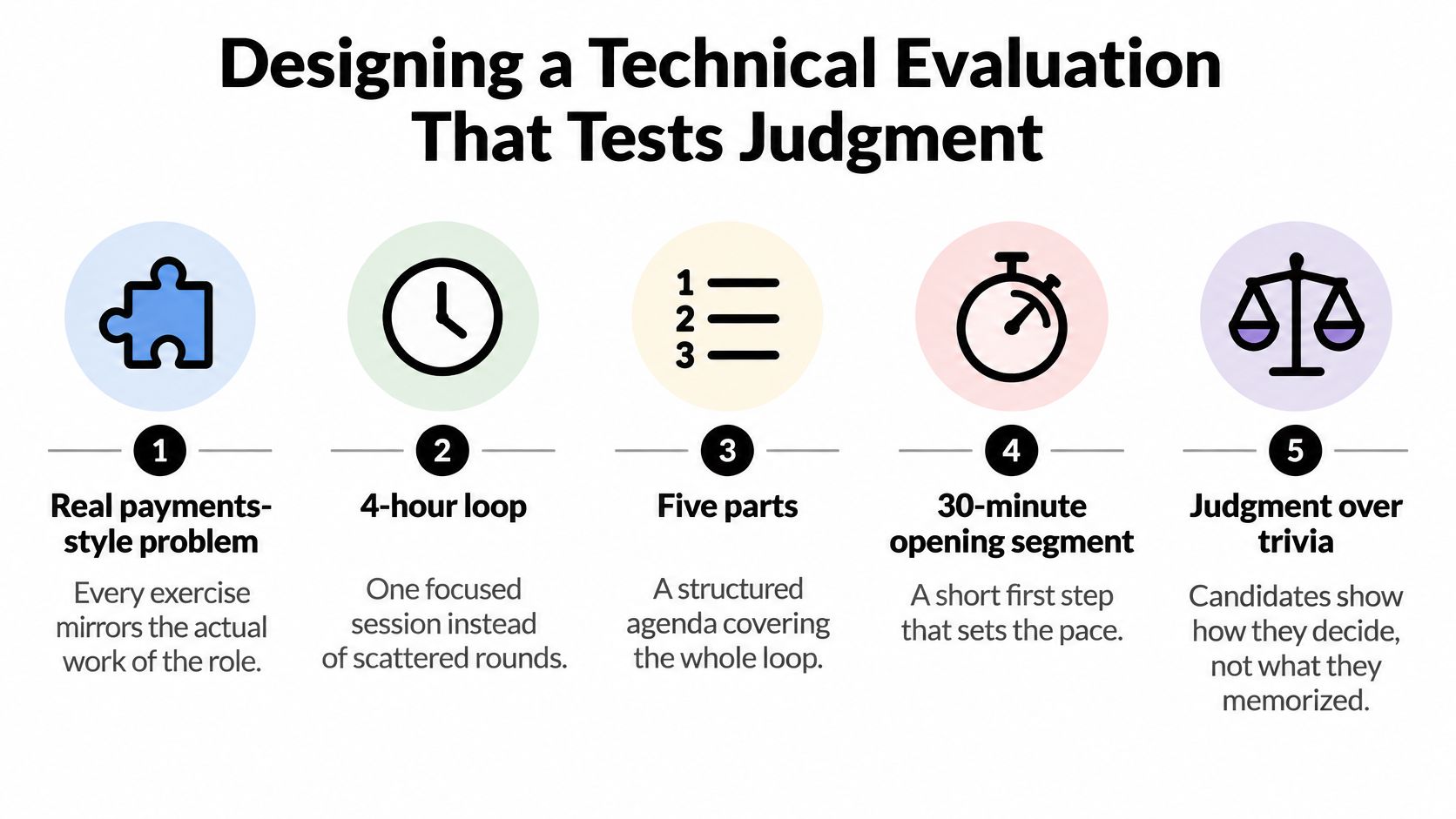
Tie every exercise directly to the team's actual domain. If the engineer will maintain a payments service, build the debugging session around duplicate webhook handling or idempotency keys rather than inverting a binary tree.
A Focused Four-Hour Interview Loop
A tight, respectful loop protects candidate energy and gives your panel clean signal in 4 hours total:
- Recruiter and role alignment screen (30 minutes): Confirm core experience, compensation range, timeline expectations, and one deep story about a system the candidate owned.
- Live pairing on a realistic bug (60 minutes): Drop the candidate into a sanitized repository with a failing integration test, let them use documentation normally, and watch how they isolate root cause.
- System design tied to your real service (60 minutes): Walk through an active architecture constraint on your roadmap. A team building voice infrastructure, for instance, should anchor the prompt around real operational boundaries like call lifecycle and latency targets instead of a generic social-feed clone.
- Pull request review (60 minutes): Hand over a realistic 200-line pull request containing subtle race conditions, missing error handling, and a noisy abstraction, then discuss what blocks merge versus what can wait.
- Structured panel debrief (30 minutes): Score each rubric dimension independently before sharing opinions aloud so evidence drives the decision.
| Format | What it tests best | Main risk |
|---|---|---|
| Live pairing session | Thinking aloud and debugging under normal conditions | Anxiety can hide real skill |
| Take-home project | Independent work and code structure | Candidates may spend far longer than planned or use AI without disclosure |
| System design discussion | Trade-off reasoning and experience with scale | Generic answers if the problem is not tied to the team's real system |
| Pull request review | Judgment about quality, risk and maintainability | Reviewers may focus on style instead of impact |
| Structured debrief | Consistency across interviewers | Loud voices can dominate without a scorecard |
If you swap live pairing for a take-home assignment on certain roles, cap the realistic build time at roughly three hours and tell candidates explicitly what tools are allowed. Pairing structured scoring with strong technical screening interview habits keeps weak fits from consuming six hours of senior engineering calendar time.
Calibrate Interviewers Before Going Live
Before rolling out a new prompt, record two mock or internal practice sessions and have two interviewers score the exact same answer independently against your written rubric. Anywhere their scores diverge by more than one point on a four-point scale, rewrite the rubric anchor until both engineers agree on what a passing answer looks like.
Run this quick audit on your existing loop before your next candidate enters final rounds:
- Domain alignment check: Does every coding and design exercise resemble work the hire will perform in their first 90 days?
- Time-box discipline: Does the entire process stay at or under four focused hours of candidate interview time?
- Written rubric check: Does each interviewer submit written evidence tied to specific scorecard competencies before reading anyone else's notes?
- Role-specific scope: Have you stripped out generic puzzle questions that none of your current senior engineers use on the job?
Telling AI Fluency From Engineering Judgment
Vacancy pressure tempts teams into bad shortcuts. According to a Stack Overflow Blog analysis of the developer market, AI-engineer roles stay vacant for a median of 74 days, compared with 44 days for general software-engineer roles, even while overall U.S. software-development postings remain roughly 24% below pre-pandemic levels. A separate survey cited in that same analysis reported that 85% of developers use AI tools, while 45% of AI-generated code contains a known security flaw.
When almost every developer uses coding assistants like GitHub Copilot, Cursor, or Claude Code, asking whether a candidate uses AI tells you almost nothing. The scarce skill isn't prompting a model to spit out a large block of TypeScript. It's catching the silent authentication bypass, memory leak, or brittle dependency that the model confidently wrapped in clean formatting.
Interview Probes That Expose Real Ownership
Skip hypothetical questions about favorite AI plugins and test verification habits directly during your pairing or architecture rounds:
- Load and failure walk-through: Ask the candidate to inspect an AI-assisted function they accepted and point out exactly where it degrades under tenfold traffic, which automated tests prove it won't regress, and which production metrics they'd alert on after deploy.
- Post-merge incident rollback: Present a scenario where generated code passed CI and peer review, shipped to production, and started dropping queue messages. Ask how they isolate the blast radius, roll back safely when a schema migration is involved, and tighten guardrails afterward.
- Pre-merge security and dependency check: Ask what they inspect in generated code before hitting approve, listening specifically for input validation, secret handling, permission boundaries, and unvetted third-party packages.
Separate Senior Signals From Rehearsed Fluency
Strong senior engineers surface constraints before you prompt them. They name who gets paged at 2 a.m. if a retry loop storms a downstream database, and they smoothly revise their design when you inject a new constraint like strict data residency or a tighter latency budget.
Weak candidates sound articulate while the assistant is open, then stall the moment you question a line they didn't think through. Another red flag is a take-home submission written in textbook model cadence that handles zero domain edge cases and can't survive basic "why did you pick this library?" follow-ups.
Run the two-minute tool-off check. Ask the candidate to close their AI assistant and explain their solution's control flow, failure modes, and main trade-off from scratch in two minutes. Engineers who own their code sail through; candidates who leaned on generated guesses unravel immediately.
Score Every Probe Against One Shared Rubric
Give interviewers explicit anchor lines so nobody grades on gut feel:
- Failure analysis rubric: Scores high when the candidate identifies concrete bottlenecks (connection exhaustion, lock contention, unbounded retries) and pairs them with specific telemetry; scores low when answers stay generic ("I'd add more tests and monitor CPU").
- Rollback discipline rubric: Scores high when the candidate distinguishes reversible code deploys from irreversible data migrations and proposes feature flags or backward-compatible rollouts; scores low when they assume
git revertfixes every production incident. - Verification rubric: Scores high when the candidate systematically audits auth scope, error paths, and package provenance in generated code; scores low when passing unit tests is treated as complete proof of safety.
Candidate Experience That Keeps Strong Engineers
Even in a cautious market, sloppy communication drives away your best finalists. In 2025, 74% of developers surveyed said they struggled to land jobs, according to the HackerRank 2025 Developer Skills Report of 13,732 respondents across 102 countries conducted in late 2024 and early 2025. Candidates who spend months navigating black-hole portals and silent rejections remember the rare engineering team that runs a sharp, transparent process.

Your interview process is the strongest proof of how your engineering org operates day to day. Publish the exact timeline in writing before the first screening call: total rounds, duration of each session, who leads each step, and when the final decision happens. That single commitment reinforces your employer value proposition far more credibly than a careers-page manifesto.
Service-Level Rules Your Team Can Actually Keep
Hold internal recruiters and external partners to the exact same responsiveness standard. At TekRecruiter, we reply to every applicant we move forward with in our hiring process, and your internal hiring team should enforce a strict two-business-day response ceiling after every interview stage.
Share interviewer names and roles at least 24 hours before each round so candidates can prepare informed questions. Deliver brief, substantive feedback after each stage, and when you pass on a candidate, give a clear role-fit reason instead of radio silence. Once a competitive finalist finishes the panel, move from debrief to a written offer within roughly five business days.
Watch how structured hiring transparency shapes candidate trust in this short walkthrough of engineering recruitment best practices:
When a finalist tells you they have a competing deadline and asks for a faster decision, don't scramble or quote an unapproved salary band just to buy time. Confirm the exact date and time you can deliver a signed answer, tell them if an executive sign-off is needed, and send a brief status update if anything moves by even half a day.
A Candidate Communication Template You Can Copy Today
Standardize your stage updates so no candidate ever guesses where they stand:
- Subject line: Next steps for [Role Title] at [Company Name]
- Decision date: We'll share our decision from this round no later than [Day, Date, Time Zone].
- Upcoming panel: You'll meet with [Interviewer Name, Title] for [Session Topic, Duration] and [Interviewer Name, Title] for [Session Topic, Duration].
- Feedback or decline reason (when applicable): Our panel appreciated [Specific Strength Observed], and we're moving forward with another direction because this role requires [Specific Gap Tied to Scorecard].
Clear expectations, tight timelines, and honest rejections turn even declined candidates into future referrals when the next requisition opens.
If your engineering pipeline is leaking strong builders between sourcing and offer, we can help you fix it without slowing down your roadmap. We recruit software engineers, AI engineers, DevOps and cloud infrastructure specialists, and nearshore Latin America talent through direct hire, contract-to-hire, and staff augmentation, screening every candidate through peer-to-peer technical conversations rather than keyword checklists. Visit TekRecruiter to map your next open role and build a calibrated shortlist that holds up in production.
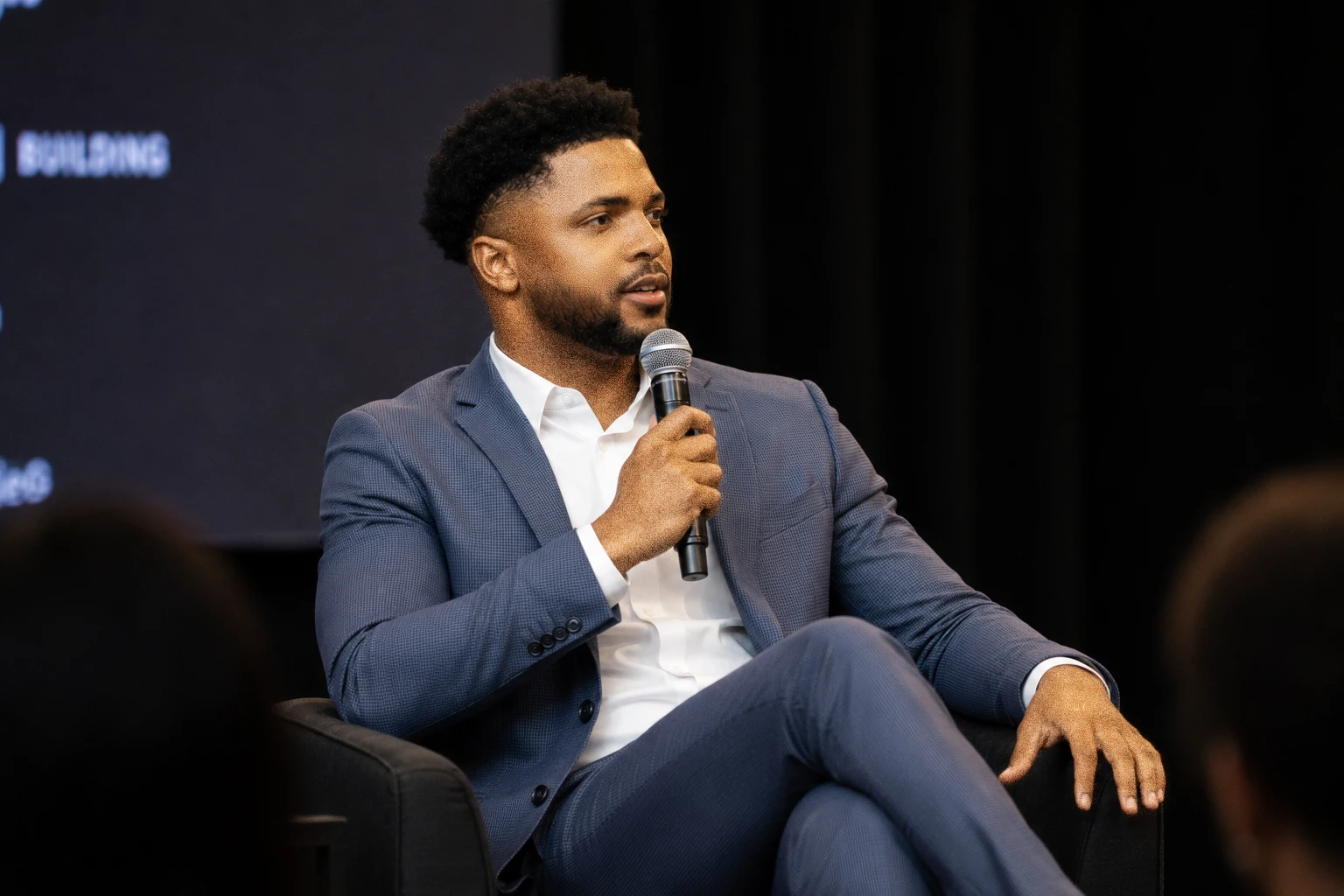 Ron SmithPresident & Lead RecruiterTekRecruiter