Software Engineering Hiring Trends in 2026
Analyze 2026 software engineering hiring trends. Discover data-driven recruiting tactics, AI screening shifts, and flexible staffing models for tech leaders.
The most popular advice about software engineering hiring trends is also the least useful: “Hire engineers who know how to use AI.” That instruction confuses tool familiarity with engineering judgment. A developer can generate code quickly and still miss a data-leak risk, design an unobservable service, or ship a dependency that fails under production load.
The market is sending a more precise signal. Long-term demand for software remains strong, but employers are concentrating scarce headcount on engineers who can own systems, validate AI-assisted work, and connect technical decisions to business outcomes. At the same time, companies are weakening the junior pipeline by removing the very tasks through which early-career engineers traditionally built experience.
CTOs need a workforce design response, not another list of fashionable skills. That means separating core architectural ownership from flexible delivery capacity, rebuilding junior development through structured apprenticeship, and replacing rote interview puzzles with evidence-based assessment.
The Structural Reality of Tech Talent Demand
The tech hiring correction changed hiring behavior, but it didn't erase the underlying need for software engineering. The U.S. Bureau of Labor Statistics projects software-developer employment to rise from 1,692,100 jobs in 2023 to 1,995,700 in 2033, an increase of 303,700 positions, or 17.9%, compared with 4.0% growth across all occupations. The BLS occupational projections for software developers and related services show a durable employment base rather than a short-lived technology boom.
That demand is also spreading beyond traditional technology companies. BLS projects employment in computer systems design and related services to increase 19.5% from 2023 to 2033. Software developers accounted for 713,700 jobs in that industry in 2023, with 163,500 additional software-developer positions projected by 2033. Finance, healthcare, government, manufacturing, and professional services increasingly compete for engineers who can modernize systems, secure data, integrate platforms, and support digital operations.
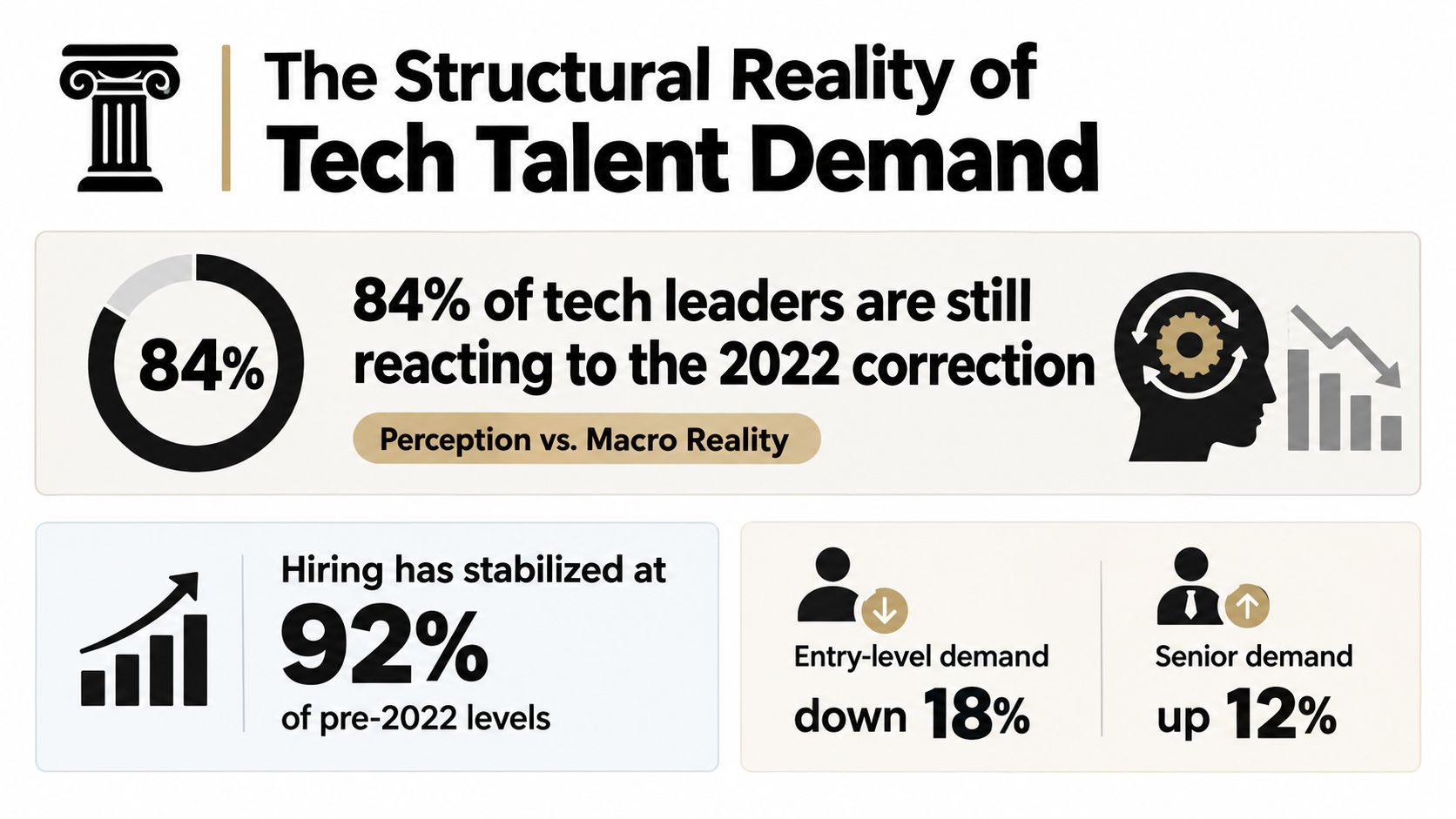
The infographic contains claims that aren't supported by the verified market data available here, so leaders shouldn't use its unsupported figures as planning inputs. The defensible conclusion is qualitative: software hiring can fluctuate, but software dependence keeps expanding.
Why replacement hiring matters
CompTIA reported nearly 450,000 active technology job postings in April 2025, including almost 203,000 new listings during that month. In August, it counted 446,763 active technology postings, with 37,180 newly posted software-developer and software-engineer openings, the largest total among the technology occupation groups listed in that analysis. These figures appear in CompTIA's technology hiring report.
Those postings don't mean every company is expanding aggressively. They reveal a more complex market in which employers recruit for specialized capabilities while also replacing people who leave. CompTIA forecasts that the U.S. technology workforce will grow at roughly twice the rate of overall employment during the next decade, while replacement needs are expected to average about 352,000 technology workers annually from 2024 through 2034. A temporary hiring slowdown therefore doesn't remove recruiting pressure. It changes where that pressure appears.
Planning rule: Treat hiring as an operating capability, not an emergency response. The companies that wait for a perfect market compete with every other employer when demand returns.
A practical workforce plan should map engineering demand across industries, not just benchmark against venture-backed software companies. For broader context on how digital capability is reshaping employment, Access Courses Online career insights offers a useful view of the wider skills market.
Seniority and AI Capability Are Taking the Growth
Hiring volume can look healthier than the opportunity available to early-career engineers. Indeed Hiring Lab data reported by CNBC shows that software-development postings remained approximately 27.5% below their pre-pandemic level, while senior roles represented 71% of the increase in postings between May 2025 and May 2026. Titles mentioning AI accounted for 37% of that increase, according to CNBC's analysis of software-development hiring.
The result is a two-layer market. Employers still need implementation capacity, yet the strongest incremental demand favors engineers who make a small team more productive through sound judgment. These engineers define architecture, manage incidents, integrate data and models, improve reliability, and decide whether an AI-generated solution is suitable for production.
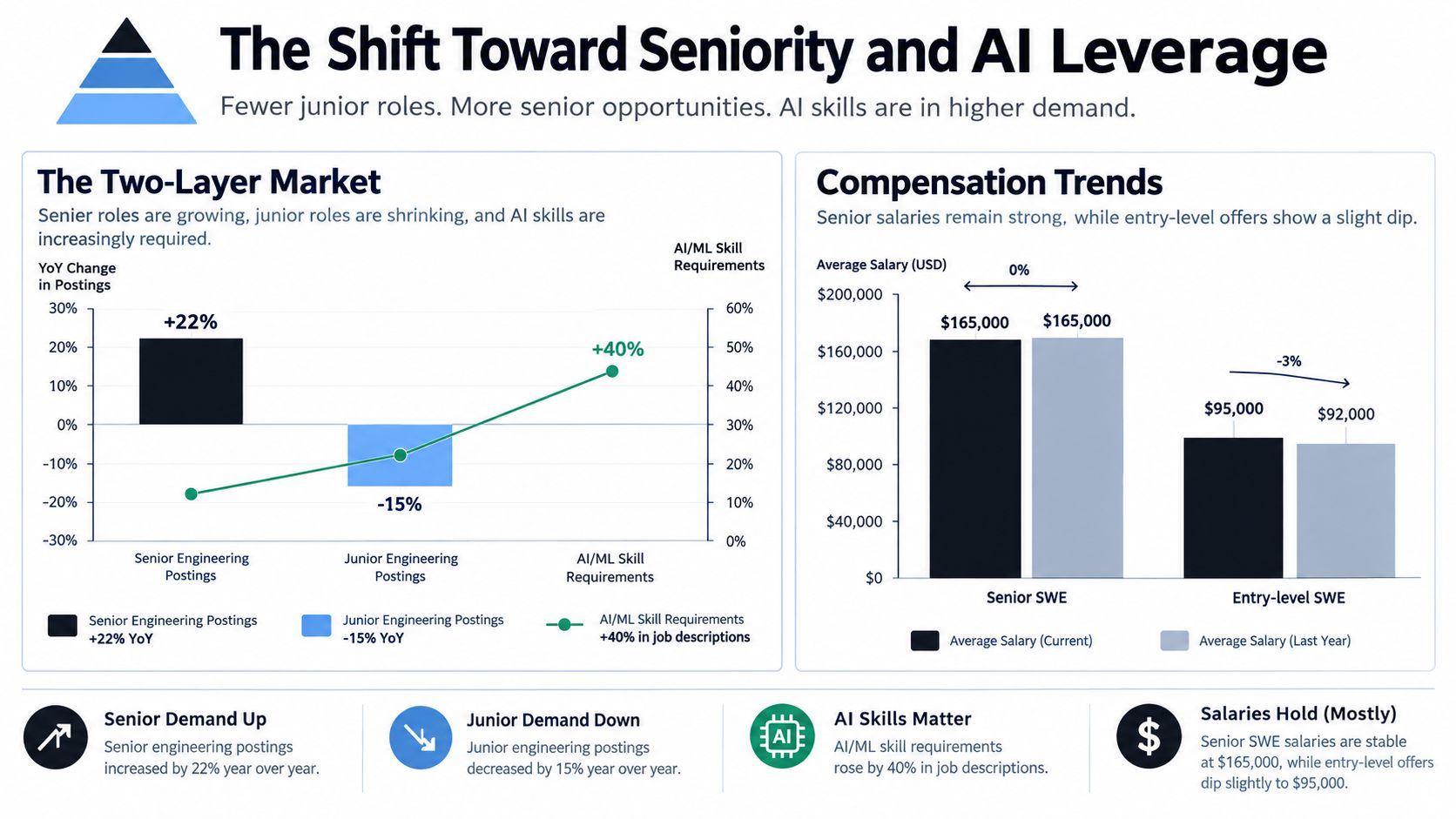
The chart contains unsupported figures, including specific year-over-year changes and salary amounts, so it should not serve as verified evidence. The narrower signal is more useful: senior ownership and AI-related capability are taking a larger share of selective hiring growth.
Rewrite the job, then rewrite the screen
A language checklist no longer separates a senior engineer from someone who has memorized framework terminology. The job description should specify the decisions and outcomes the hire will own.
For example, replace “build backend services in our preferred framework” with “own service boundaries, failure handling, observability, and rollback decisions for production APIs.” The revised line gives candidates a clearer target and gives interviewers evidence to assess. It also exposes whether the role requires independent production judgment or structured implementation work.
Use the same standard for AI-assisted delivery. Ask candidates to explain where an AI tool helped, which output they rejected, how they checked security and correctness, and who remained accountable for the result. TekRecruiter's guide to hiring AI engineers provides a relevant reference for defining these conversations.
The interview should test architecture ownership, production responsibility, and business connection through concrete examples. Ask why a design was chosen, what constraints shaped it, how the system behaved in production, and what changed after an incident. Require evidence that a technical decision improved a product, reduced risk, or enabled delivery.
Fundamentals still matter. Test them in context. A candidate who can discuss latency, consistency, access control, test strategy, and operational ownership provides a stronger signal than someone who produces a flawless isolated solution but cannot explain how it survives contact with users.
The hiring implication is uncomfortable: one senior hire may solve a system bottleneck that several generalist hires won't. That does not make every role senior. It means leaders should separate work requiring independent production judgment from work that can be safely structured, reviewed, and developed. This distinction supports a workforce design that combines targeted senior direct hires with carefully supervised delivery capacity where the work is repeatable.
Fixing the Broken Entry-Level Engineering Pipeline
The junior pipeline isn't disappearing because software has stopped mattering. It's breaking because AI-assisted development compresses many beginner tasks while employers remain reluctant to create structured learning environments. New graduates therefore face a paradox: companies still need more software capability, but they increasingly expect early-career hires to contribute beyond routine code production.
Recent market data reported by HatchWorks shows new-grad hiring at large technology companies was about 65% below 2019 levels, while AI-exposed entry-level roles grew 35% since 2019 even as other entry-level roles declined 10%. The figures point to a changing entry signal, not a simple end to junior work. The relevant source is HatchWorks' analysis of the software-engineering shortage.
Replace the old entry signal
A junior candidate shouldn't need to demonstrate senior architecture. They should demonstrate that they can learn safely, expose uncertainty, and verify their work. A credible early-career scorecard can include:
- A shipped project: The candidate explains the users, constraints, architecture, tests, deployment process, and unfinished work.
- A review exercise: Give the candidate a small pull request containing ordinary bugs, weak error handling, or a security concern. Assess what they notice and how they communicate it.
- AI-output verification: Let the candidate use an approved AI tool, then ask them to identify incorrect assumptions, missing tests, unsafe dependencies, and edge cases.
- Incident reasoning: Present a failed deployment or degraded service. Look for a calm sequence of diagnosis, containment, communication, and follow-up.
- Learning behavior: Ask what feedback changed their implementation and how they validated the improvement.
This approach makes AI assistance visible instead of pretending candidates work without it. It also separates polished submissions from genuine engineering judgment. Candidates who want to understand how their interests align with changing technical work can use resources such as find your strengths and stream as a starting point for reflection, but employers still need direct evidence through practical assessment.
Build a learning environment deliberately
A junior program needs defined ownership, review capacity, and progressively harder work. Pair an early-career engineer with a senior reviewer, give them a bounded service or workflow, and make review quality part of the development plan. Don't assign production-critical ambiguity before the person has learned the team's standards for testing, observability, security, and escalation.
Contract-to-hire can provide another bridge. A company can begin with a scoped engagement, observe how the engineer communicates and responds to review, then convert when the evidence supports a permanent role. Nearshore apprenticeships and distributed teams can widen the pipeline when managers provide clear documentation, overlapping working hours, and consistent mentorship.
The contrarian conclusion is straightforward: AI makes structured development more important, not less. If companies remove all beginner work without replacing it with supervised progression, they save near-term effort while weakening the experienced talent pool they will need later.
Matching Staffing Models to Roadmap Bottlenecks
A CTO shouldn't use one staffing model for every engineering problem. A permanent employee, a contractor, a nearshore team, and a managed service solve different constraints. The right question is not “Which model is cheapest?” It is “Which model gives us the required ownership, speed, flexibility, and knowledge retention?”
A practical decision matrix
| Engagement Model | Best Use Case | Time to Impact | Cost Profile |
|---|---|---|---|
| Direct hire | Core product architecture, long-term platform ownership, engineering leadership | Deliberate, dependent on search and notice periods | Ongoing employment investment |
| IT staff augmentation | Short-term delivery capacity, migration support, backlog pressure, specialized implementation | Fast, once the contractor is available | Variable capacity cost, limited long-term overhead |
| Nearshore team | Repeatable development, cloud modernization, QA automation, data work, or a distributed delivery pod | Fast to moderate, depending on team readiness | Flexible external capacity with geographic cost advantages |
| Managed services | A defined operational capability where a provider can own delivery, tooling, and service outcomes | Fast for established providers, with less internal management | Service-based spend tied to scope and governance |
Direct hire fits proprietary systems where context and long-term judgment compound. If the roadmap depends on an internal AI platform, a security architecture, or a product domain that differentiates the company, permanent ownership usually matters more than immediate capacity.
Staff augmentation fits a bottleneck with a clear boundary. A cloud migration, test automation push, or temporary release backlog may need skilled hands now, but not permanent headcount after the work ends. The internal team retains technical direction while the contractor expands execution capacity.
Nearshore delivery works best when leaders can define interfaces, acceptance criteria, and review standards. It isn't a substitute for architecture ownership. It can be a strong way to add engineers in compatible time zones for implementation, maintenance, and carefully scoped product work.
Where managed services belong
Managed services make sense when the company needs an outcome or operating capability rather than an individual contributor. Security monitoring, infrastructure operations, service desk functions, and specialized platform administration may be better delivered by a provider with established processes. The trade-off is reduced direct control, so the contract must define service levels, escalation paths, documentation, access, and exit terms.
TekRecruiter's decision guide to managed services versus staff augmentation offers a useful framework for comparing these choices. A sound plan can combine models: direct hires own the architecture, nearshore engineers expand delivery, and a managed provider handles a capability that isn't strategically differentiating.
The mistake is using flexible staffing to conceal an ownership gap. If nobody inside the company can make final architectural decisions, adding capacity only increases coordination risk.
Updating Technical Scorecards for the AI Era
AI tools are already part of normal development behavior. Stack Overflow's 2025 Developer Survey reports that 84% of respondents were using or planning to use AI tools in development, up from 76% the prior year, and more than 36% had learned AI-enabled tools for work or career advancement during the previous year. The Stack Overflow 2025 Developer Survey supports a clear hiring conclusion: banning AI in interviews tests an artificial workflow.
That doesn't mean every candidate should be judged on prompt cleverness. CoderPad's 2026 hiring research reports that 36% of surveyed developers focused on AI/LLM application skills, while system design, debugging, fine-tuning, and collaboration are gaining importance as code generation becomes easier. Employers should test whether candidates can turn generated output into reliable software.
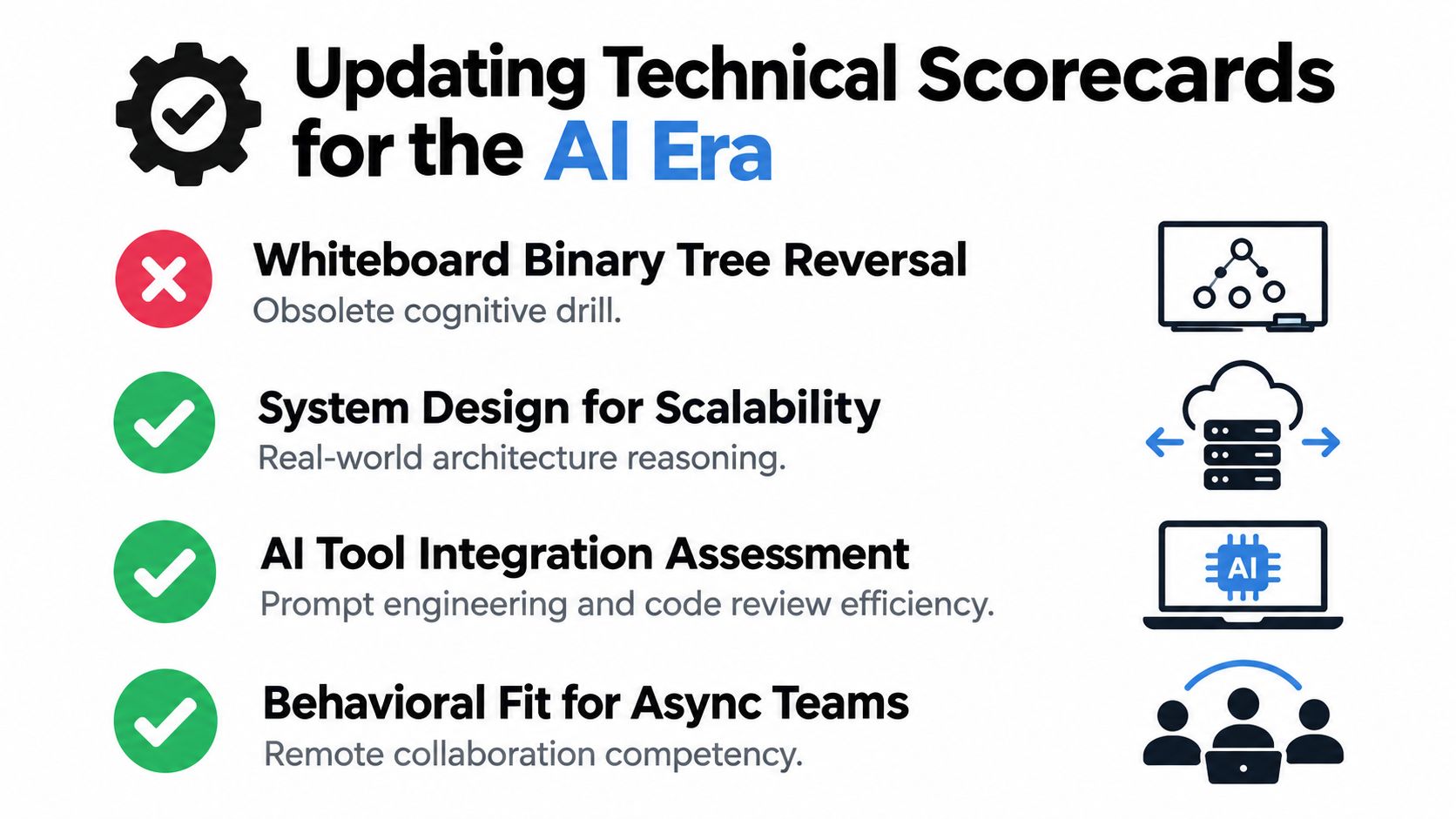
The infographic uses a useful direction, but its labels should be treated as guidance rather than verified market statistics. A modern scorecard should preserve core engineering fundamentals while adding explicit evaluation of AI-assisted work.
A five-part scorecard
System design comes first for ownership roles. Ask candidates to design a service under realistic constraints. Evaluate decomposition, data modeling, reliability, security, observability, and the trade-offs they make when requirements conflict.
Implementation still matters, but context matters more. Give candidates a bounded task in a language relevant to the role. Permit normal tools where appropriate, then evaluate tests, error handling, readability, dependency choices, and their explanation of the solution.
AI verification should be observable. Provide generated code with subtle defects. Ask the candidate to identify incorrect assumptions, write evaluation tests, check privacy implications, and explain when they would reject AI assistance altogether.
Debugging reveals operating maturity. Use logs, traces, failing tests, or a simplified incident narrative. Strong candidates form hypotheses, gather evidence, narrow the fault, and communicate risk before proposing a fix.
Collaboration closes the loop. Ask candidates to explain a disagreement, a review comment they changed their mind about, or a time they made a technical limitation clear to a nontechnical partner.
The technical screening interview guide can help teams turn these areas into a consistent interview loop. Scorecards should use anchored evidence, not impressions such as “seems senior” or “communicates well.”
Interview standard: Assess whether the candidate can specify, generate, inspect, test, secure, deploy, and explain software. Code generation is only one stage of that chain.
Avoid replacing one distorted signal with another. A binary-tree exercise may be relevant for a narrow algorithmic role, but it shouldn't stand in for production reasoning in a platform, product, or infrastructure interview.
The Case for Specialized Technical Recruiting Partners
Generalist recruiting often begins with keyword matching. That can find someone who lists Python, Kubernetes, or machine learning, but it can't reliably establish whether the person designed the system, inherited it, or used an AI tool to produce a polished description of it.
Specialized technical recruiting changes the first conversation. A recruiter with engineering fluency can ask how the system was built, why a particular architecture was selected, what failed, how the team measured success, and which trade-off the candidate would revisit. Those questions don't eliminate the need for an employer's interview, but they improve the quality of the shortlist.
Screen for behavior, not vocabulary
A useful screening model examines five behaviors:
- High agency: The candidate identifies problems and moves work forward without waiting for perfect instructions.
- Execution: They can describe what shipped, not merely what they discussed.
- Accountability: They own failures and can explain the corrective action.
- Resourcefulness: They find a path through incomplete information and constrained systems.
- Transparency: They communicate uncertainty, risk, and trade-offs early.
These behaviors matter because AI can help produce fluent answers, resumes, and code. It can't substitute for a coherent account of decisions made under real constraints. Recruiters should press for sequence, evidence, and consequences rather than accepting broad claims about innovation or ownership.
The agency relationship also needs discipline. A specialized partner should understand the role's technical boundary, calibrate against the team's interview standards, and explain why each candidate fits the actual work. The employer still owns the final decision, compensation, onboarding, and development plan.
TekRecruiter is one example of a technical recruiting partner that combines an AI-native sourcing and matching system with recruiter-led conversations, including screening for High agency, Execution, Accountability, Resourcefulness, and Transparency. The useful principle isn't the brand. It's the division of labor: software can help identify and organize candidates, while technically informed humans test judgment and context.
Your Action Plan for 2026 Engineering Hiring
Start with the roles, not the tools. This week, divide open and planned positions into three groups: architectural ownership, scoped delivery, and developing capability. Remove generic language requirements and state the production decisions, collaboration expectations, and business outcomes each role must own.
Next, audit the interview loop. Keep language, algorithms, databases, distributed systems, and cloud fundamentals where they matter, but add a realistic AI-assisted exercise, code review, debugging scenario, and system-design discussion. The role definition and interviewing guide can help structure that review.
This quarter, pilot a blended workforce plan:
- Direct hire for systems and decisions that create durable product advantage.
- Staff augmentation or nearshore delivery for bounded migrations, backlog reduction, testing, and implementation.
- Contract-to-hire or apprenticeship for early-career talent that can grow through supervised work.
- Managed services for operational capabilities where an external provider can own a defined outcome.
Track evidence rather than vanity metrics. Review interview pass-through by stage, time spent by interviewers, quality of submitted work, ramp progression, retention, and the percentage of hires who reach independent ownership. Revisit the scorecard when those signals disagree.
The durable advantage won't come from predicting every software engineering hiring trend. It will come from building a hiring system that learns faster than the market changes.
TekRecruiter helps technology companies recruit software, AI, cloud, DevOps, data, and engineering leadership talent, while also providing direct hire, contract-to-hire, IT staff augmentation, nearshore, and managed-services search options. If your roadmap requires stronger technical screening or flexible delivery capacity, visit TekRecruiter to discuss the workforce model that fits your next bottleneck.
 Ron SmithPresident & Lead RecruiterTekRecruiter