What Does a GTM Engineer Do? Duties, Tools and Skills
Here is a clear answer to what does a GTM engineer do: responsibilities, tools, skills and how the role drives revenue teams.

A GTM engineer builds and maintains the systems that move target accounts from identification to measured pipeline. The enrichment, scoring, routing, sequencing and reporting that sit between a list of names and a forecast leadership trusts all belong to that person.
Most sales and marketing leaders meet the role sideways. They go looking for someone to fix lead routing, or to explain why three reps worked the same account in one quarter, and someone tells them the job has a name now. It does, and the name covers more ground than the title suggests.
The work touches the CRM, the data layer and the sales process at once, which is why tool lists confuse people more than they help. It's easier to understand a GTM engineer by what they're accountable for and what sits outside that line than by the platforms they've used.
What a GTM Engineer Is and Why Companies Hire One
Outbound sequences are reaching people who changed jobs. Inbound leads still go to a rep who left. At quarter-end, sales and marketing leaders cannot identify which campaign produced the pipeline because campaign fields were never populated. The team has contacts, tools and activity, but the connections between them are failing.
Those failures call for systems ownership. Reps are the taps in the building's plumbing: they notice when the water stops, but fixing the pipes requires someone responsible for how the system works.
A GTM engineer designs and maintains the connections between customer data, enrichment providers, intent signals, CRM platforms, scoring, routing, outbound sequences and reporting. Nebor's analysis of GTM engineering statistics describes growing demand for this work as companies seek more pipeline without increasing sales and marketing headcount at the same rate. The role draws on software development, data operations, revenue operations and growth experimentation.
The clearest definition is an ownership test: who builds the workflow, who sets its rules, and who owns any production software it depends on?
For a broken routing workflow, the GTM engineer handles the technical implementation. The sales or revenue operations owner determines the assignment policy, including which rep should receive which accounts. When a change requires production application code, ownership needs to be clear with the software engineering team. Technical ability does not automatically give the GTM engineer authority over sales policy or every connected codebase.
That boundary makes the hire useful. Leaders get someone accountable for making approved processes work across systems, while retaining responsibility for the commercial decisions those systems execute. Success means leads reach the intended owner and campaign records support measurement. Sending more email alone does not establish revenue impact.

When build work is ready but full-time headcount is not approved, teams can hire a fractional GTM engineer to get initial workflows live. The scope still needs clear boundaries: what the person will build, who approves the rules, and how the team will measure the resulting pipeline. Those decisions make the engagement accountable before a permanent hiring commitment.
The Core Responsibilities of a GTM Engineer
Every responsibility in this role hangs on the same six-step chain: pick target accounts, enrich them, score fit, route to an owner, trigger the action, and measure the result. Platform names change. The chain doesn't.
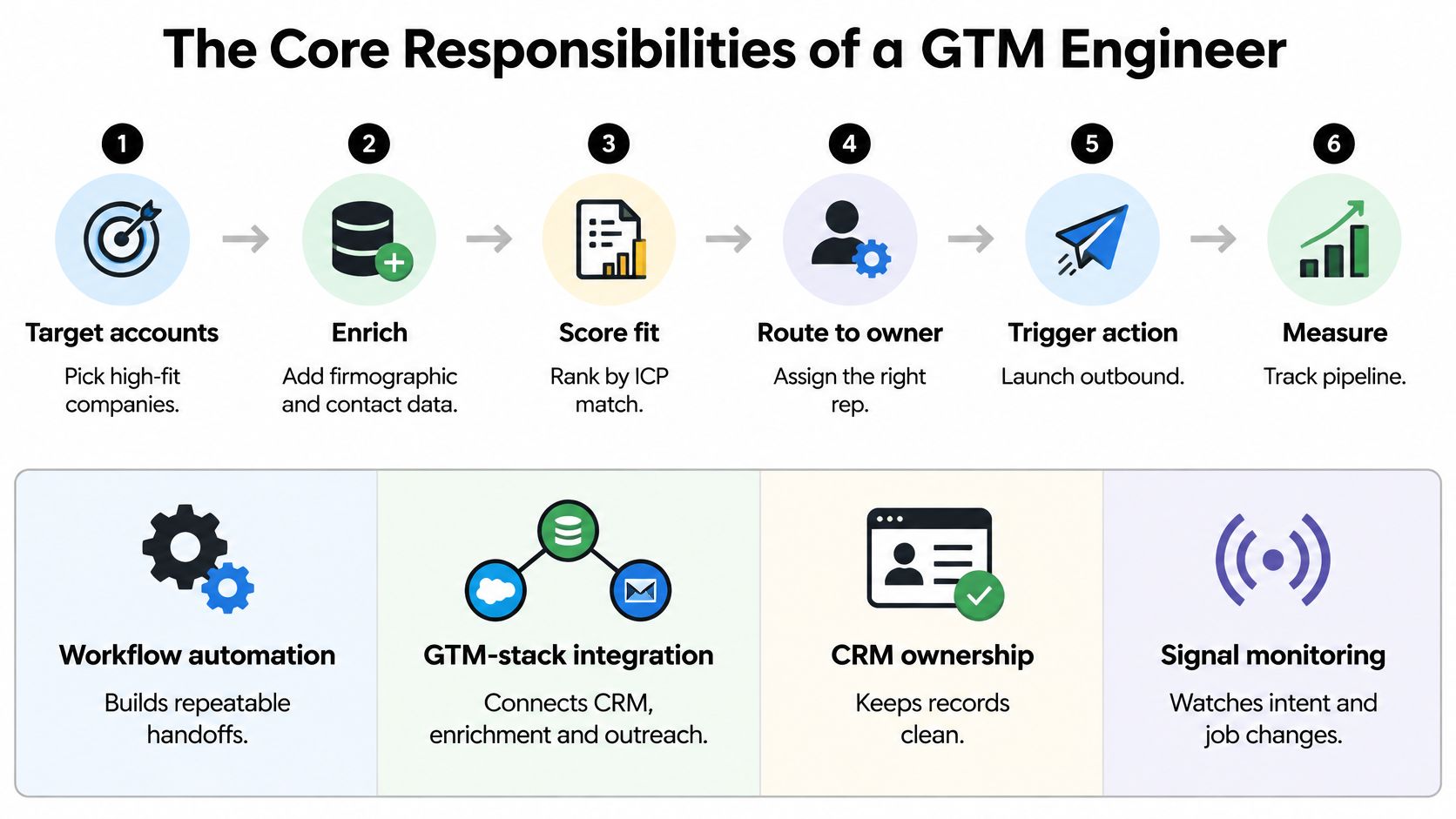
| Responsibility | What the Work Involves | Example Output | Business Result |
|---|---|---|---|
| Lead generation | Finding accounts that match the ICP and show buying signals such as hiring or launches | Weekly target account list | More qualified pipeline |
| Integrations | Connecting CRM, sequencing, data warehouse and other systems through APIs and webhooks | Working sync between systems | Fewer manual handoffs |
| Data enrichment | Appending firmographic, technographic and contact data to account records | Enriched account profiles | Sharper segmentation |
| CRM data quality | Deduplicating and validating records, setting field ownership, checking for stale data | Audited, clean records | Reliable forecasting |
| Routing and scoring | Scoring accounts against the ICP and assigning them to owners or sequences | Routing rules by territory and fit | Faster lead handling |
| Reporting and measurement | Building dashboards and tracking conversion by signal and source | Pipeline dashboard | Evidence for revenue decisions |
Where the hours actually go
The work spans the full chain from finding potential buyers to making data usable for decisions. In a 2026 survey of roughly 228 practitioners across 32 countries, 91% reported working on lead generation, 89% on integrations, 78% on data enrichment, 67% on CRM data quality, and 54% on reporting dashboards, according to Shruti Kaushik's write-up of the practitioner survey.
Practitioners describe the job in this video, which is worth watching before you write a job description.
Underneath the task list sits a design job. A GTM engineer translates ICP definitions, qualification criteria and sales-process rules into executable pipelines: combining firmographic, technographic and intent data, applying deterministic or model-based scoring, deduplicating and validating records, then routing qualified accounts to the correct territory, sequence or owner, as OctaveHQ's glossary entry on the GTM engineer lays out.
The cause and effect is operational, not abstract. Cleaner records improve segmentation. Reliable routing cuts the delay between a lead arriving and a rep touching it. Synchronized lifecycle fields make funnel reporting consistent across teams that otherwise argue about whose numbers are right.
The part nobody puts in the job description
Monitoring is where the hours go: deliverability, workflow failures, data freshness, attribution and conversion outcomes, then revising the system through controlled experiments. A workflow that wrote bad data overnight costs more trust than one that never ran.
The line that matters: a CRM administrator reports on the process. A GTM engineer builds the machinery that runs it.
That distinction reshapes the roles around it too, and TekRecruiter's account executive hiring guide is a useful companion read on what shifts on the closing side once routing sharpens.
Where GTM Engineering Ends and RevOps Begins
The overlap is large and documented. Nine of the ten most common GTM engineer responsibilities also appear in RevOps postings, with workflow automation, GTM-stack integration and CRM ownership leading both lists, according to Richard Angapin's GTM engineer skill-map analysis. Titles won't settle the boundary. Ownership will.
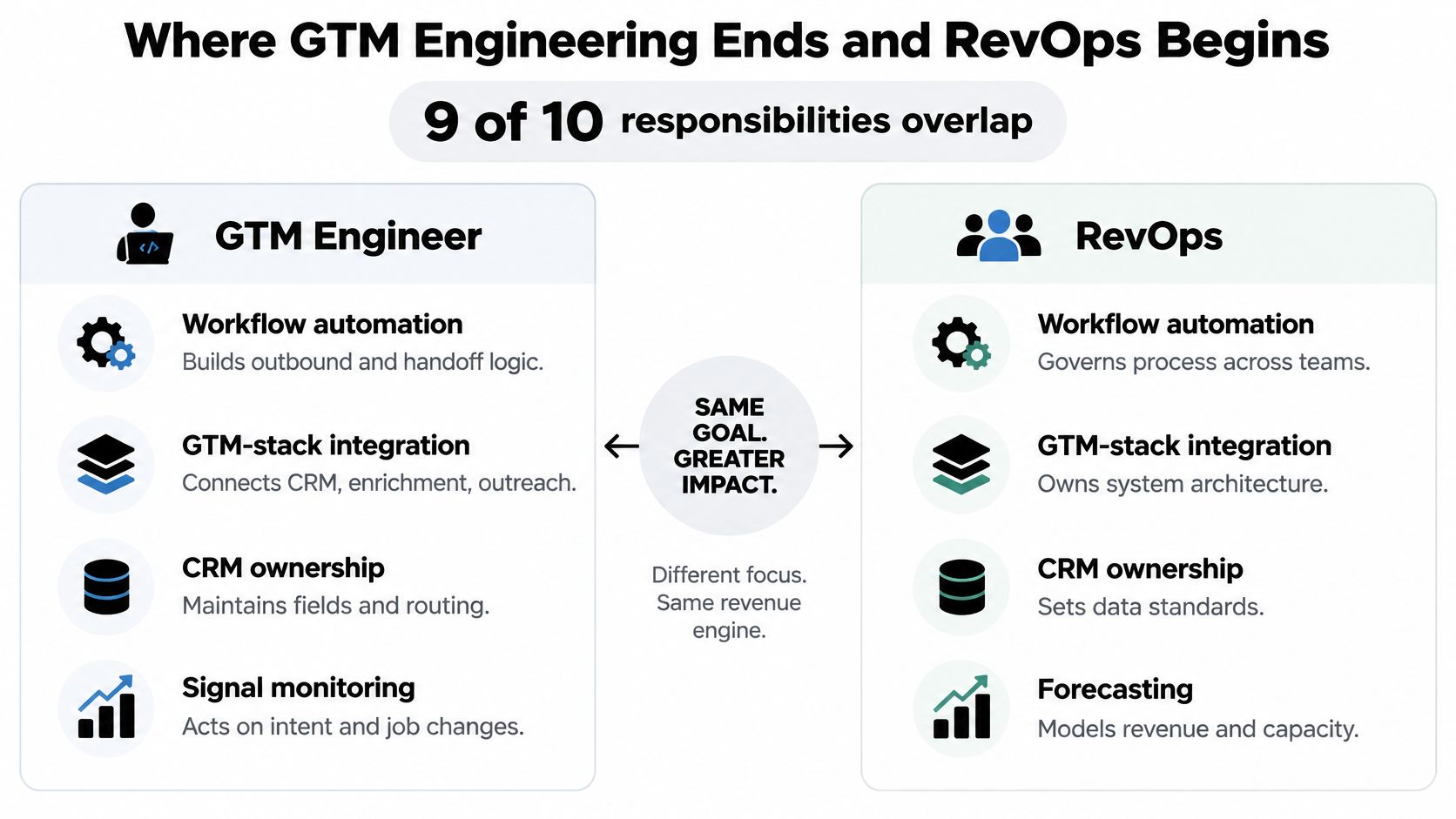
The structural difference is what each person is accountable for producing. A GTM engineer designs the data model and the automation built on it. RevOps sets process policy, forecast methodology and territory rules. A sales engineer adapts the system to technical buyers and runs the demonstrations. Software engineering owns production-grade product or infrastructure code, along with the security review and uptime guarantees that come with it.
| Role | Primary Output | Usually Owns | Usually Does Not Own |
|---|---|---|---|
| GTM engineer | Revenue workflows and integrations | Data model, enrichment, automation and sync logic | Sales quota or pricing policy |
| RevOps | Process policy and revenue reporting | Forecast methodology, territory rules and funnel definitions | Building custom integrations at scale |
| Sales engineer | Technical demonstrations and buyer adaptation | Product demos, proofs of concept and technical deal support | Internal data pipelines |
| Software engineer | Production product and infrastructure code | Product features, uptime and security review | Sales process rules and campaign logic |
A simple ownership test
Three questions resolve most arguments about who should do the work.
- Does it change a sales rule? Stage definitions, territory carve-outs, quota logic and forecast categories belong to RevOps. The engineer implements the rule but doesn't set it.
- Does it change how records flow between systems? Field mapping, enrichment order, sync direction, deduplication logic and webhook behavior belong to the GTM engineer.
- Does it need formal testing, security review and an uptime promise? Then it moves to software engineering. A workflow that runs a hundred times a day for the revenue team and a service that thousands of customers depend on aren't the same risk class.
The title is less predictive than the operating boundary. Interview for boundary judgment, not for tool familiarity.
That matters most at hiring time. A candidate who can build a clever enrichment workflow may still lack the judgment to operate it safely at scale, which is the difference between a promising builder and someone you'd hand production data to. TekRecruiter's breakdown of RevOps engineering as a career path shows how often those two titles describe the same person.
Common Tools and How They Fit Together
Platform names change faster than the job does, so the stack is best learned as categories and as the flow of data between them.
| Category | Example Platforms | Typical Task |
|---|---|---|
| CRM | Salesforce, HubSpot | Maintaining account, contact and lifecycle records |
| Enrichment | Clay, Apollo | Appending firmographic, technographic and contact data |
| Sequencing and outbound | Outreach, Salesloft | Running multi-step outreach triggered by routing rules |
| Automation and orchestration | Zapier, Make, n8n | Connecting apps through webhooks and API calls |
| Data warehouse and SQL | Snowflake, BigQuery | Deduplication checks, stale-record queries and funnel reporting |
| Scripting | Python, JavaScript | Custom API logic and data transformations |
Trace one signal to see how the categories connect. A hiring alert lands in the warehouse. A scoring rule rates the account against the ICP. The CRM record updates with the new headcount field. The router assigns an owner based on territory and segment. The sequencing tool picks up the trigger and starts a first touch. A dashboard row records what happened.
Sequencing sits at the end of that chain, and how a tool structures multi-step cadences matters before you buy one. Flowkon's sales engagement platform guide covers that ground well.
Where the stack breaks
Three failure modes account for most of the mess in a revenue system.
- Duplicated fields across the CRM and the warehouse. Two definitions of "active account" guarantee two pipeline numbers.
- Webhooks that fail without an alert. The record just stops updating, and nobody notices until a rep asks why the account went quiet.
- Enrichment fields that go stale. A title from last spring drives a sequence this fall and reaches the wrong person entirely.
The tool list matters far less than knowing which system is the source of truth for each field. Write that down, one row per field, and half the integration arguments disappear. If you want the deeper technical path behind the warehouse side of this work, TekRecruiter's post on analytics engineering as a discipline explains where that specialist takes over.
Skills, Background and Pay Levels
The skill mix is hybrid. Enough software to build integrations and automation: SQL for data checks, API and webhook work, workflow automation, scripting in Python or JavaScript when a no-code step won't hold. Enough RevOps knowledge to understand funnel stages, lifecycle fields and forecasting. Enough business sense to connect a workflow to pipeline rather than to a screenshot of a workflow.
What separates strong candidates: they ask what the workflow must achieve, which system owns each field, and how success gets measured, before they write anything.
The usual backgrounds are revenue operations, sales operations, marketing operations, software engineering and solutions engineering. Nobody arrives with a standard career path, and the strongest people tend to be self-taught operators who started automating their own manual work and kept going.
How the work gets scoped
A typical week is maintenance and small builds, with a large project every so often. The maintenance is unglamorous: checking that overnight workflows ran, refreshing target lists, merging duplicates, adding a routing rule sales asked for on Monday, testing a new handoff on a handful of records before it touches thousands. The large projects are CRM migrations, a new tool joining the stack, or rebuilding routing after a sales reorg.
That rhythm changes how you write the role. A GTM engineer whose calendar is consumed by month-end reporting will never ship the automation you hired them for. Protected build time belongs in the job description, not in a verbal promise.
| Level | Annual Salary Range |
|---|---|
| Junior | $70,000–$90,000 |
| Mid-level | $90,000–$120,000 |
| Senior | $120,000–$160,000 |
| All postings reviewed (October 2025) | Median advertised $127,500 |
A 2025 guide from mAccelerator on GTM engineer roles and skills lists those three level bands, from $70,000 to $90,000 for junior roles up to $120,000 to $160,000 for senior ones. A review of more than 1,000 postings in October 2025 put the median advertised salary at $127,500, according to Apollo's GTM engineer salary analysis. Posted ranges are a partial sample of the market, so treat them as reference points when you set a band.
If the role grows into serious data plumbing, the hiring criteria start to resemble another discipline closely, and MyCulture data engineer hiring guide is a useful cross-check on what to screen for.
Measure Revenue Impact and Decide Whether to Hire
Count of workflows shipped is a vanity metric. More automation can lower performance when it produces duplicate records, irrelevant personalization, compliance exposure or low-quality outreach, which is the measurement gap Devrix's GTM engineer tutorial identifies. A GTM engineer should be accountable for system reliability and decision quality, not for shipping volume.
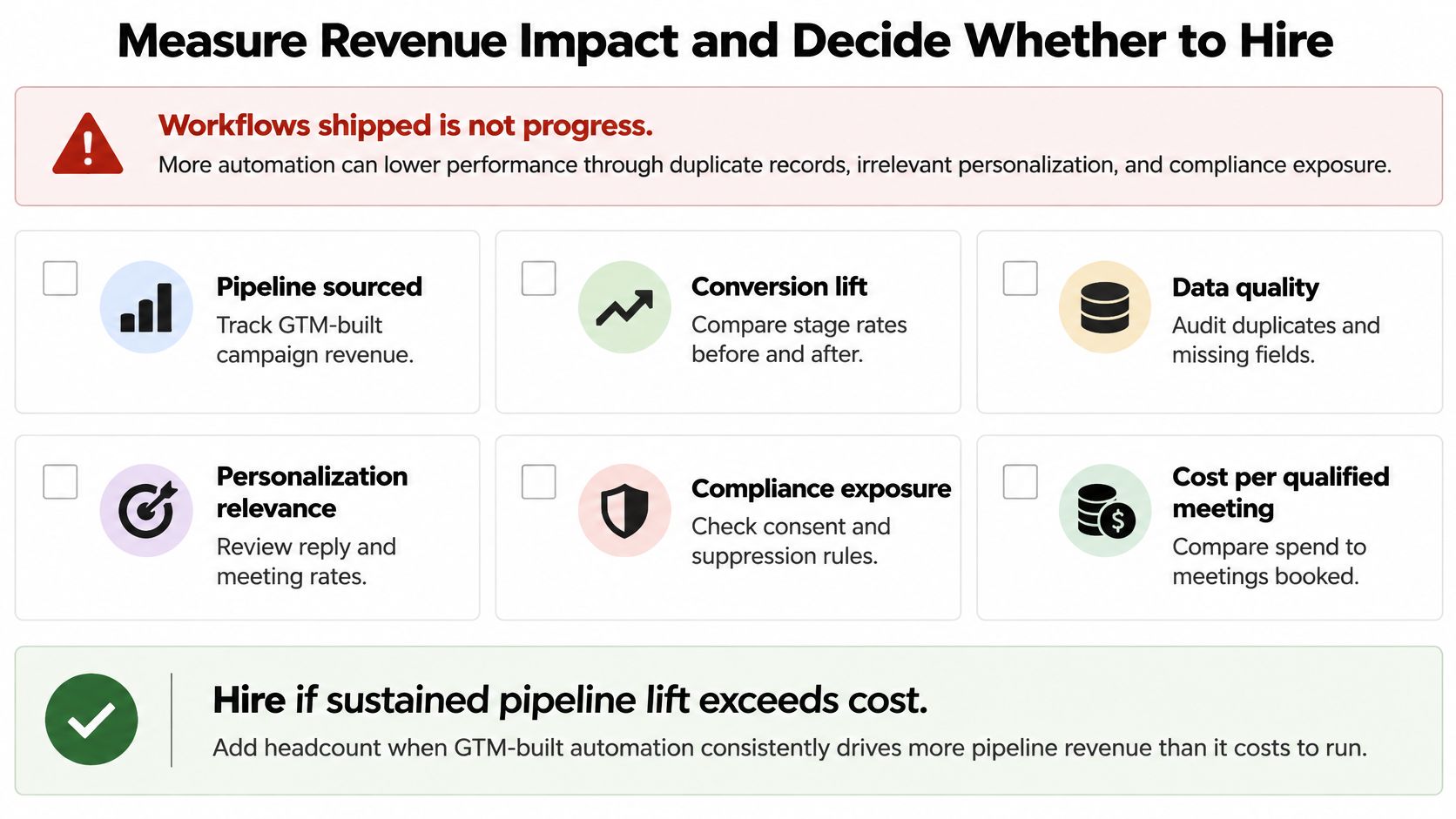
Track system health before pipeline
Instrument the machine before you judge its output. Watch data-quality error rates, routing latency, the share of accounts meeting ICP criteria, workflow failure rates and rep time recovered. None of these need a revenue model to interpret, and all of them predict whether pipeline numbers will hold.
If routing latency climbs while pipeline looks flat, the system is degrading and the dashboard hasn't caught up yet. A rep waiting two days on a lead that used to arrive in twenty minutes is a leading indicator, and it belongs in the weekly review.
Then track the revenue chain
Once the system is trustworthy, follow the money: conversion by buying signal, opportunities created, pipeline velocity, win rate and revenue retention. Separate genuine impact from activity inflation with a holdout group or a phased rollout, comparing treated accounts against untouched ones over the same window.
Practical rule: if you can't name the accounts your GTM engineer's workflows did not touch, you can't prove they did anything.
Interview for judgment, not tool lists
Ask candidates to walk through a failed automation. What broke, how much did it cost the business, which leading indicator exposed it, and how did they redesign the measurement plan afterward? A candidate who can answer that in specifics has operated a system under load. One who can only list platforms has watched other people do it.
Decide whether the role fits
Hire a GTM engineer when the CRM holds records nobody trusts, when the tools don't share data, when sales still depends on hand-built lists, and when pipeline growth is limited by targeting rather than headcount. Fix the ICP and qualification rules first. The engineer automates a definition that has to exist before they arrive, and automation built on a fuzzy process just repeats the confusion at higher volume.
The role can be hired directly, on a contract-to-hire basis, or through a specialist recruiter. TekRecruiter recruits for go-to-market roles including GTM engineer, growth engineer, RevOps developer or architect, marketing automation developer or architect, solutions or sales engineer and technical account executive. Hiring starts with a 20-minute call where we learn the need, the stack, the budget, the timeline and any contract, IP, security and location requirements. TekRecruiter's post on what go-to-market recruiting covers explains how those searches run in practice.
Write a one-page scope before you talk to anyone: the first three workflows, the systems each touches, the owner of every field involved, and one success metric per workflow. Then test every candidate against it.
TekRecruiter recruits the GTM engineers, growth engineers and RevOps developers who build these revenue systems, and we screen for people who can explain how they built a workflow, why it mattered and what it did for the business. Bring us the scope and the stack, and we'll bring candidates who have run systems like yours under real volume. Start with a 20-minute call and visit TekRecruiter to book it.
 Ron SmithPresident & Lead RecruiterTekRecruiter