What Is a Technical Recruiter? Roles, Skills and Process
What is a technical recruiter? Learn what they do, which roles they fill, how they assess candidates and how they differ from general recruiters.
Your engineering manager needs a senior backend engineer who knows Kubernetes and can explain technical decisions to product teams. You've got a job description and a pile of résumés, but it's hard to tell who's operated a production system and who's listed the right tools.
Someone has to turn that request into a focused search, a credible shortlist and an informed hiring decision. That's where a technical recruiter comes in. Their most useful skill isn't spotting keywords. It's finding out whether a candidate can explain the work behind them.
What a Technical Recruiter Does in Plain Terms
A technical recruiter is a recruiting specialist who identifies, evaluates and helps place people in technology roles. Those roles include software engineering, data science, cybersecurity, cloud infrastructure, product and technical sales.
Think of the recruiter as a translator between the team's engineering problem and the candidate's past work. They need to understand both well enough to recognize a useful match, explain gaps and avoid presenting someone whose experience sounds relevant but doesn't fit the assignment.
In the backend search, a capable recruiter wouldn't stop at asking whether Kubernetes appears on the résumé. They'd clarify what the manager needs:
- Ownership: Will this engineer operate services after deployment or hand them to another team?
- Architecture: Is the challenge building new services, untangling a monolith or improving reliability?
- Communication: Will they explain delivery trade-offs to product managers or work mainly within engineering?
Technical fluency makes the difference
The specialization exists because technical titles conceal substantial differences. A platform engineer might build internal deployment tools, while a site reliability engineer, or SRE, might focus on service reliability, operational risk and incident response. Neither title tells the recruiter enough without context.
Recruiters can work inside an employer's talent team or at an agency serving several clients. Engagement arrangements also matter, particularly in public-sector hiring. For readers trying to understand that setting, erecruit's explanation of how government ICT labour hire works offers useful context about the hiring model.
So, what is a technical recruiter in practical terms? It's someone who combines recruiting skills with enough technical understanding to turn a staffing request into an evidence-based search.
They don't need to build the system themselves. They do need to recognize when a candidate's explanation deserves deeper engineering evaluation.
A technical recruiter is hired to answer a working question: can this person do the work the team actually needs?
Roles Technical Recruiters Fill and What They Verify
A job title alone is a weak signal. A senior engineer at a startup might own an application from database to deployment, while someone with the same title at an enterprise might maintain a single service.
The recruiter needs to establish what the candidate did.
Common technical roles and what the recruiter verifies
| Role | Core Skills to Check | Evidence to Verify |
|---|---|---|
| Software Engineer | Language, system design, testing | Features shipped to production, scale handled, level of ownership |
| DevOps and SRE | CI/CD, infrastructure as code, incident response | Uptime results, on-call history, incident postmortems |
| Data and Analytics Engineer | SQL, pipelines, data warehousing | Data volumes, pipeline reliability, data quality work |
| AI or ML Engineer | Model training, evaluation, deployment | Models in production, evaluation methods, monitoring |
| Cybersecurity Engineer | Threat detection, cloud security, compliance | Incidents handled, controls implemented, audit results |
| Product Manager | Roadmapping, discovery, metrics | Products launched, metrics moved, trade-offs made |
| Technical Account Executive | Product knowledge, discovery, technical demos | Deals closed with technical buyers, demo quality, pipeline |
| Solutions or Sales Engineer | Architecture, integrations, demos | Customer implementations, integration complexity handled |
The market's breadth makes careful interpretation necessary. The U.S. Bureau of Labor Statistics projection estimates approximately 106,100 annual openings for software developers, quality-assurance analysts and testers over its projection decade. That figure covers those occupations, not every technology role.
Turn a role family into useful questions
For a DevOps search, ask the candidate to describe the last outage they helped resolve. A useful answer identifies the symptoms, investigation, recovery steps and changes made afterward. Naming Terraform and Kubernetes doesn't establish operational responsibility.
For a sales engineer search, ask about a difficult customer integration. Did the candidate diagnose authentication problems, explain API limitations and negotiate a workable implementation, or deliver the standard demo?
For a data engineering search, ask how the candidate handled broken or late-arriving data. That reveals more about production readiness than familiarity with a particular warehouse.
Emerging titles require extra clarification. An AI engineer might build model-backed applications rather than train models. Forward deployed engineering and go-to-market engineering can combine customer-facing work, integrations and software development. The recruiter must agree on the actual deliverables before choosing candidate sourcing strategies.
Take your current job description, identify its closest role family and write down two pieces of work evidence you'd want before advancing anyone. Those become the starting point for a useful screen.
The Technical Hiring Workflow From Intake to Offer
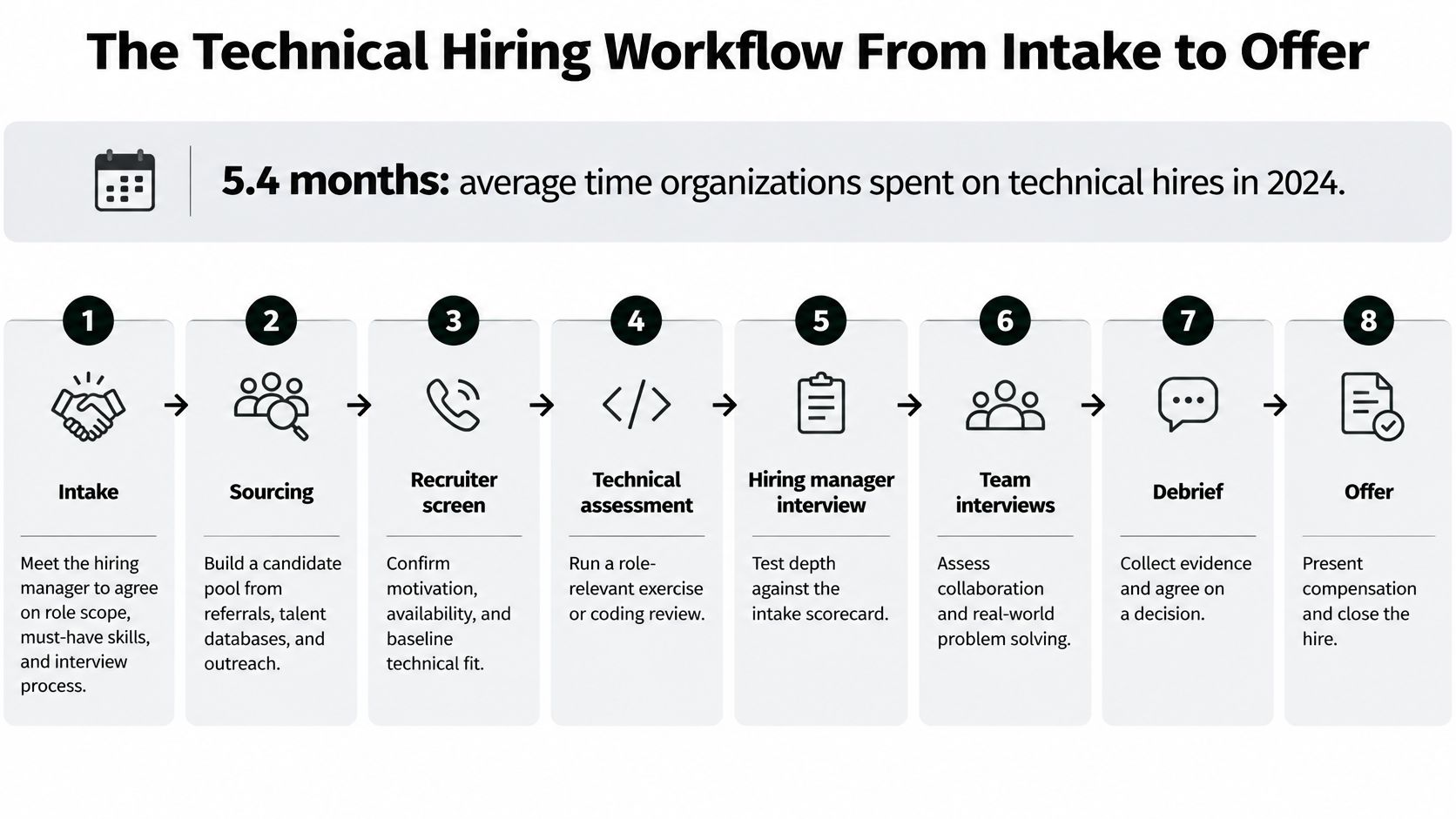
Organizations spent an average of 5.4 months recruiting for technical positions in 2024, according to the Linux Foundation's State of Tech Talent Report. A recruiter's job includes keeping that process purposeful, not just keeping calendars full.
The visual below summarizes the main hiring checkpoints.
Give each stage an owner
Intake. Meet the hiring manager to separate essential competencies from trainable tools and agree on interview responsibilities. The common slip is accepting a vague wish list, then building the wrong candidate pool.
Sourcing. Find candidates through referrals, developer communities, technical networks and job boards. Searching only résumé databases can exclude relevant people who aren't actively applying.
Recruiter screening. Check motivation, baseline technical fit, availability, compensation expectations, location and work-authorization constraints. Leaving practical requirements until the offer stage creates avoidable surprises.
Structured assessment. Use a shared scorecard and a job-relevant exercise. For timed quizzes, teams can track completion times for applicant quizzes with Form Timer, but shouldn't mistake speed for competence unless speed matters to the job.
Candidate submission. Give the hiring manager a concise summary of relevant projects, personal ownership, strengths and unresolved questions. Copying the résumé into an email leaves the manager to repeat the screen.
Interview coordination. Schedule the right interviewers and collect written feedback before the debrief. Slow feedback can leave candidates waiting while they consider other offers.
Offer. Check current compensation benchmarks, explain the package and discuss concerns or counteroffers without pressure. A common mistake is discovering late that the candidate's priorities don't match the opportunity.
Close and follow-up. Confirm the start date, hand over onboarding information and check whether the agreed role matches the new hire's responsibilities. Treating acceptance as the finish line leaves preventable misunderstandings unresolved.
Locate the bottleneck before adding interviews
Track how long candidates wait between stages and name the person responsible for the next action. If qualified candidates stall after panel interviews, more sourcing won't fix the underlying problem.
A best-practice recruitment process for engineers should make those handoffs explicit, including who can approve an offer.
For an additional perspective on the recruiting role, watch the video below.
How Technical Recruiters Separate Real Depth From Keywords
A résumé can look convincing until the candidate can't explain why their team chose a particular design. The recruiter's task is to investigate that gap without turning the conversation into a trivia contest.
Start with a project and follow the reasoning:
- Purpose: What problem did the system solve, and who needed it?
- Personal contribution: Which decisions and implementation work belonged to the candidate?
- Constraints: What alternatives did they reject, and why?
- Operation: What happened under load, what failed and what changed?
- Outcome: How did they determine whether the work helped the business?
A candidate who used Azure rather than AWS may still understand infrastructure automation, observability and incident response. The recruiter should explore that transferable capability instead of rejecting the person for a missing platform keyword.
Build a scorecard around the work
Define must-have competencies before interviewing. Map each competency to a real responsibility, ask candidates the same core questions and record observable evidence rather than impressions.
In SHL's analysis of 1.9 million software-development assessment responses, programming and algorithms appeared in 65% of assessments, while data structures appeared in 22%. Recruiters should supplement coding results with job-relevant evidence about system design, debugging, collaboration and delivery ownership.
At TekRecruiter, we screen candidates through peer-to-peer technical conversations rather than keyword matching. Our technical screening interview approach centers on understanding the candidate's work, not merely recognizing the tools they name.
Evidence signals a technical recruiter checks
| Signal | Strong Evidence | Weak Evidence |
|---|---|---|
| Ownership | Explains a design they chose and why | Uses “we” throughout without identifying personal decisions |
| Architecture trade-offs | Names rejected alternatives and their costs | Lists tools without explaining choices |
| Production impact | Quantifies latency, uptime or revenue change | Makes vague claims of improved performance |
| Debugging | Walks through a failure and its root cause | Can't describe a failure they handled |
| Learning ability | Explains how they learned an unfamiliar stack | Offers no evidence of adapting beyond familiar tools |
| Communication | Explains complex work to a non-engineer | Uses jargon without context |
Weak evidence is a reason to probe, not an automatic rejection. Confidentiality can limit disclosure, and collaborative engineers naturally use “we.” Ask for clarification before drawing conclusions.
Assessment safeguard: Automated scores are inputs, not verdicts. A hiring manager must validate technical conclusions that exceed the recruiter's expertise.
Ask a recruiter how they define competence, what evidence accompanies a shortlist and who validates uncertain technical claims. Strong answers name a role-specific scorecard, project-level findings and an accountable engineering interviewer.
Technical Recruiters Compared With General Recruiters
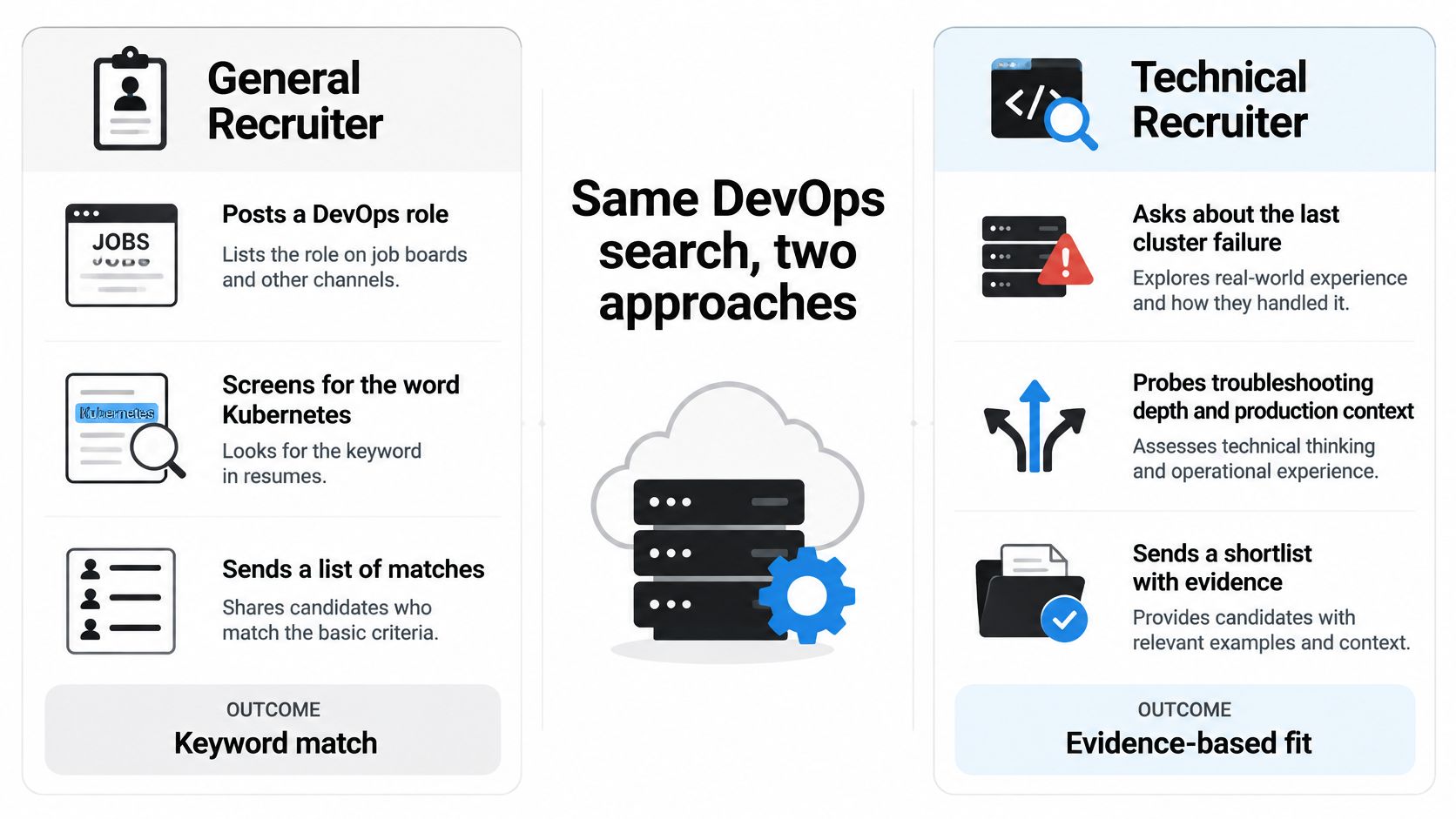
Consider a DevOps search run in different ways. A keyword-led recruiter posts the opening, looks for Kubernetes and sends matching profiles. A technically informed recruiter asks how candidates diagnosed a cluster failure and what they changed afterward.
That contrast describes approaches, not an absolute division between job titles. A strong general recruiter can learn a technical domain, and a technical recruiter can still conduct a shallow screen.
The comparison illustrates the distinction.
Technical recruiter vs general recruiter
| Criterion | Technical Recruiter | General Recruiter |
|---|---|---|
| Vocabulary | Stacks, architectures, technical role families | Job families and general skills |
| Screening method | Technical conversations and project questions | Structured behavioral and résumé screening |
| Hiring manager input | Translates technical requirements into competencies | Usually starts from a broader job brief |
| Candidate pool | Engineering, data, security, product and technical go-to-market | Mixed departments across the business |
| Success measure | Technical hire quality and early performance | Placement speed, volume and overall fit |
| Sourcing channels | Developer communities, technical networks, referrals | Job boards and general professional networks |
| Typical background | May include engineering, technical sales, product or specialist recruiting | May include general HR, sales or staffing |
Choose based on the judgment required
The practical difference is how much domain interpretation the recruiter can handle independently. For a receptionist search, evaluating customer communication and scheduling experience may be enough. For an infrastructure lead, someone must distinguish routine deployment work from responsibility for production reliability.
A technical recruiter should also help a manager challenge unnecessary requirements. If the team can teach its deployment tooling, rejecting an otherwise capable engineer for lacking that exact tool may narrow the search without improving the eventual hire.
General recruiters remain useful for broad departmental hiring and high-volume coordination. Many employers blend both roles, with a general talent partner managing the process and a specialist supporting technical assessment. Neither arrangement excuses inconsistent questions or poor candidate communication.
Use a technical recruiter when success depends on interpreting technical evidence. Use a general recruiter when broader recruiting skills meet the requirement and the hiring team can supply any specialist judgment.
For candidates, the distinction sets expectations. A technically informed recruiter should explain the team's work, distinguish confirmed requirements from open questions and acknowledge what they need to check with engineering.
Common Misconceptions About Technical Recruiters
They only forward résumés. A useful recruiter explains why someone merits an interview and identifies what still needs validation. A forwarded profile without that reasoning is administrative support, not meaningful assessment.
They must write production code. Recruiters need enough fluency to follow a technical explanation and ask informed follow-up questions, not enough to implement every system they recruit for. They also can't override a hiring manager's technical judgment and shouldn't pretend otherwise.
Automation and credibility need scrutiny
AI makes technical recruiters redundant. AI can support profile discovery, pipeline organization and information summaries, but someone still needs to interpret ambiguous experience and investigate inconsistent answers. The recruiter remains accountable for explaining the process and escalating uncertainty rather than presenting an automated match as established competence.
Recruiters necessarily understand the roles they fill. In daily.dev's 2025 survey of 4,040 developers across 177 countries, only 15% of developers said recruiters understand the technical roles they're hiring for. Recruiters should demonstrate engineering literacy through accurate explanations and relevant questions, rather than expecting candidates to trust the title.
Credibility comes from asking a useful question, understanding the answer and being honest about what still needs checking.
Look for concrete signs of good practice: clear assessment instructions, disclosure of AI use and a named person who can answer questions. A credible recruiter explains how decisions are made, distinguishes verified findings from assumptions and tells candidates what happens next.
Decide Whether a Technical Recruiter Fits Your Hiring Need
Choose the engagement around the work you need done and who'll manage it. The hiring options below involve different commitments, so clarify responsibilities before starting a search.
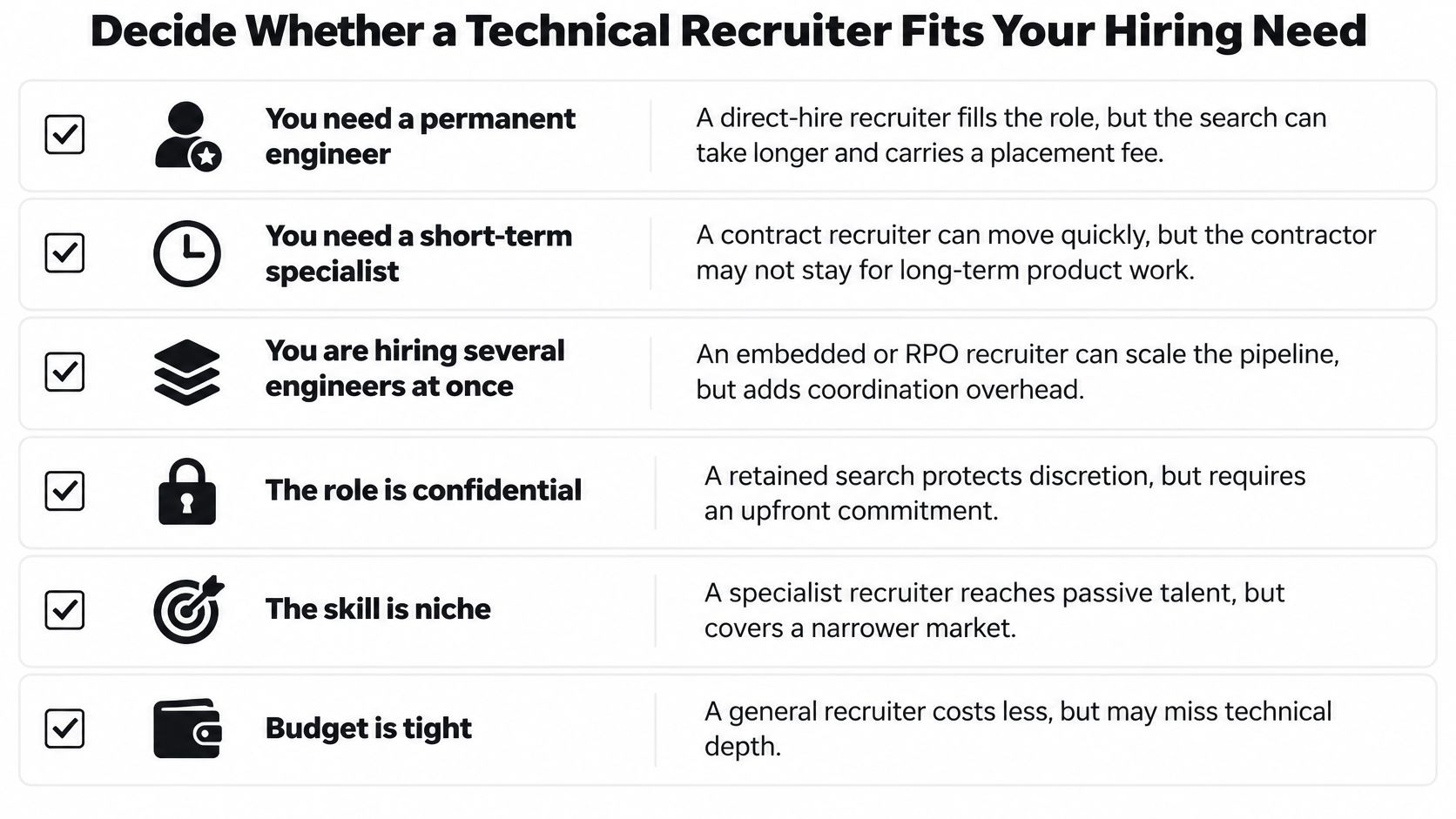
You need a permanent engineer. Direct hire supports long-term employment, but a placement fee and the quality of the screening matter; our Direct Hire service is for full-time, permanent technology and engineering hires.
You want to evaluate a contractor before committing. Contract-to-hire allows evaluation through actual work, but conversion terms need agreement early.
You need engineers under your management. Staff augmentation extends your team's capacity, but your managers retain delivery responsibility and must provide project context.
You're considering technical recruiting as a career. Practice explaining projects, technical trade-offs and measurable outcomes, while recognizing that technical learning doesn't replace relationship-building skills.
You already run a hiring process. Write the scorecard and assign stage owners before outreach, accepting the upfront preparation needed to prevent inconsistent evaluation.
Our recruiting options include direct hire, contract-to-hire and staff augmentation for clients adding people to their own teams. This comparison of direct hire and staffing agencies can help clarify the arrangement.
Today, list three requirements from your open role and pair each with evidence from the roles table. Take that short brief into your first recruiter conversation.
TekRecruiter helps companies add technology and engineering professionals through direct hire, contract-to-hire and staff augmentation. Visit TekRecruiter with your role requirements and the project evidence you need candidates to demonstrate, so we can discuss a search grounded in the work your team needs done.
 Ron SmithPresident & Lead RecruiterTekRecruiter