Headhunter vs Recruiter: Which Hire Fits Your Role
Headhunter vs Recruiter explained for tech leaders: sourcing, vetting, fees and which model fits your role and timeline.

The standard advice on headhunter vs recruiter is a seniority rule: send the leadership roles to a headhunter, keep everything else with a recruiter. It's tidy, it's everywhere, and it falls apart the first time you run both models against the same difficult engineering search. Say a firm calling itself an executive search practice forwards eight profiles pulled from its own database, none of whom can explain the systems they claim to have built. Then say a generalist technical recruiter delivers a calibrated shortlist for a niche infrastructure role in days, because she's spent years having real conversations with people who do that work.
The title tells you nothing useful in either case. What tells you something is the engagement model, the sourcing method and the depth of assessment behind the shortlist. Those three variables decide whether you get a person who can ship, or a stack of resumes you now have to screen yourself.
So treat the two words as descriptions of a service, not as quality grades. A headhunter who only finds and forwards heads is doing less work than a recruiter who understands how software is built, why an architecture was chosen, and what the product is supposed to do for the business. The rest of this piece is about how to tell those two providers apart before you sign anything.
Headhunter and Recruiter Side by Side
Short answer: a headhunter hunts specific people who aren't applying, a recruiter runs the hiring process, and the contract you sign decides which of those you receive.
| Dimension | Headhunter | Recruiter |
|---|---|---|
| Primary focus | Identifying and approaching people who are not applying | Managing the full hiring funnel, including applicants and screening |
| Typical searches | Senior, scarce or confidential roles | Repeatable roles across many levels |
| Sourcing method | Outbound research, market mapping and referrals | Job postings, applicant flow and proactive outreach |
| Fee model | Often retained, but check the contract | Often contingency, but check the contract |
| Technical vetting | Only as deep as the firm's in-house engineering expertise, verify it | Structured screening against role criteria, verify it |
| Best judged on | Passive-candidate conversion and shortlist precision | Funnel speed and hiring throughput |
A headhunter fits scarce, confidential or senior searches where the ideal candidate is unlikely to apply. A recruiter fits repeatable roles with a workable applicant pool.
Read the rows as tendencies, not promises
Every row describes a typical model, not a guarantee. Firms vary enormously in how much technical knowledge they bring to the same engagement, and two providers using the identical label can run completely different processes. One will map the market and hold a forty minute conversation about distributed systems. The other will run a keyword search and hit send.
That variance matters most in engineering hiring, because judging technical depth is the hard part of the job. Finding a name that matches a stack is easy. Establishing that the person owned the architecture, handled the incident, and can explain the trade-off they accepted is the work you're paying for.
Practical rule: the row that matters most for your open role is the row that should decide your provider.
Before you contact anyone, pick that single row. If your problem is that nobody suitable is applying, you're buying sourcing. If your problem is that you can't tell who's real, you're buying assessment. If your problem is six similar openings and a slow process, you're buying throughput. Naming the row will save you more money than negotiating the fee.
Where the Two Titles Come From and Why They Blur
A recruiter is the broader category. According to the U.S. Bureau of Labor Statistics occupational profile for human resources specialists, recruitment specialists (also called recruiters or talent acquisition specialists) find, screen and interview applicants for job openings. That's a substantive job description. Screening and qualification sit inside the role, not outside it.
In practice the recruiter may advertise the vacancy, manage applicant flow, coordinate interviews, keep hiring managers on schedule and fill roles at many levels of seniority. It's an operational job with a funnel attached.
The specialist meaning of headhunting
"Headhunter" traditionally describes something narrower: a search professional who identifies and approaches people who aren't actively applying, usually for senior, scarce or confidential positions. As the comparison of recruiter and headhunter careers at Careery explains, this model is associated with executive search, where research, market mapping, referrals and direct outreach matter more than job board volume. The same source traces executive search becoming a recognizable industry after the labor market disruptions of World War II, when organizations had to replace skilled workers entering military service, and notes that by the 1970s it had developed into an established professional services sector.
That history explains the prestige attached to the word. It doesn't guarantee the method.
Why the boundary collapsed
Modern recruiters contact passive candidates every day. Some headhunters work on specialist nonexecutive searches. Nothing regulates either title, so anyone can print it on a website, and plenty of firms calling themselves technology staffing specialists know very little about technology.
That's the gap we built TekRecruiter around. Our founder is a software engineer, and our recruiting team is in house rather than outsourced to freelancers, because the judgment call on a technical candidate can't be handed to someone who's never had the conversation.
Ask three engagement questions instead of trusting the label:
- Retained or contingency? Are you paying for the search work, or only for a placement?
- Exclusive or nonexclusive? Is one firm accountable for the slate, or are several racing to submit first?
- Proactive or application led? Will the firm go and find people, or wait for people to arrive?
For a technology employer, "headhunter" signals targeted access and deeper search work. "Recruiter" may describe broad volume hiring or highly specialized sourcing, depending entirely on the provider. The word is a starting hypothesis. The three answers are the evidence.
How Each Model Finds Candidates
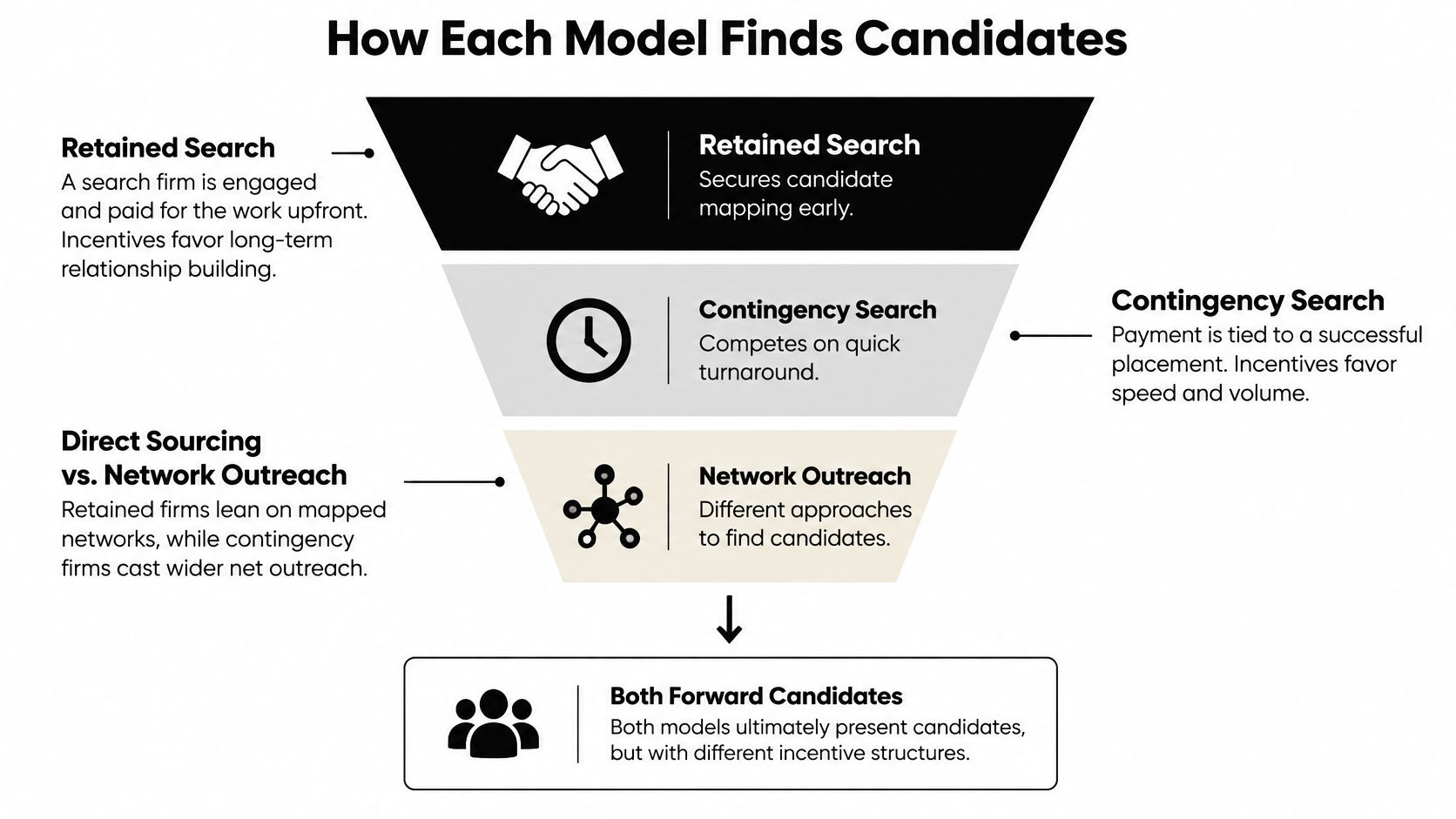
Sourcing is where the two models diverge first, and where the fee structure shapes behavior. A retained search pays the firm for the work, in stages, whether or not a placement lands quickly. A contingency search pays only on a successful hire, which rewards speed and volume, because the firm carries all the risk and competes with whoever else got the same requisition.
Neither structure is dishonest. They just produce different habits. A retained consultant can afford to spend two weeks mapping a market before naming anyone. A contingency consultant who does the same thing may lose the placement to a faster firm.
Market mapping versus database sourcing
Market mapping means building the list from scratch: which companies run this stack, which teams own this problem, who inside those teams did the work. Database sourcing means searching files the firm already holds. Both are legitimate. Only one of them is proactive for a role that didn't exist last month.
An industry dataset covering 2,100+ firms, published in RecruiterFlow's headhunter vs recruiter breakdown, reported that 71% of placements came from candidates already in the firm's database before the role opened. Read that as a warning about labels, not as an indictment of databases. Calling yourself a headhunter doesn't prove you went out and found anyone.
The same vendor dataset reported interview conversion of 77.9% for retained search submissions against 44.3% for contingent submissions. Treat those as vendor published figures worth verifying, not as proof of causation. Retained mandates may attract more committed clients, better defined roles and calmer stakeholders, all of which lift conversion on their own.
A firm's existing network is an asset. A firm that only searches its network is selling you yesterday's market.
Three checks a CTO can run on any provider
- Share sourced for this role. Ask what percentage of the slate was found specifically for your requisition, and what percentage came from the existing database. Then ask for the outreach log behind the first number. Our own approach is documented in these candidate sourcing strategies, and we maintain an evergreen network across our focus areas precisely so the mapped work starts from a warm base rather than a cold search.
- Shortlist to interview rate. Of the people submitted, how many did hiring managers want to meet? A low rate means the firm is outsourcing its screening to you.
- Time to a qualified slate. Not time to first resume. Time to a shortlist you'd interview. We present 3 to 4 candidates in about a week, and that's the number to hold any provider to.
Then ask the questions that reveal method rather than marketing. Which companies did you map for this stack? Who referred the strongest candidate, and why did they trust you with the introduction? Who owns the relationship with that person after the hire, and can they explain your architecture back to you? A provider who answers those in specifics has done the work. One who answers in adjectives hasn't.
How Each Model Vets Technical Candidates
The common claim is that headhunters skip vetting and recruiters do it. Half true, and the half that's false will cost you a bad senior hire. Plenty of executive search firms run disciplined assessment. Plenty of contingency recruiters run none at all. The label predicts neither.
What separates the two behaviors is whether the firm treats qualification as its job. The U.S. Department of Labor's description of the federal hiring process shows what structured qualification looks like: specialists first screen applications for basic eligibility, then specialists or expert panels rate candidates against additional qualifications, and only the best qualified applications reach the hiring manager for final selection. The department lists written tests, education and experience reviews, interviews and other performance related assessments as evaluation mechanisms. Forwarding every plausible resume isn't a lighter version of that process. It's the absence of one.

Four questions that expose real technical depth
Ask the provider what its screen asks, then listen for these four:
- What did you build? Not the team's output. The candidate's own contribution, with clear boundaries.
- Why that architecture? What else was on the table, and what killed the alternatives?
- What trade-off did you accept? Every real system carries one. Candidates who can't name theirs usually weren't in the room where it was decided.
- What business outcome did you measure? Latency, cost per transaction, conversion, incident volume. Something with a number attached and a reason for caring.
Our tech recruiters at TekRecruiter screen through peer-to-peer technical conversations rather than keyword matching, and we've written up the mechanics in this technical screening interview guide. The conversation is the assessment. A keyword match tells you someone typed the right words.
AI made validation more valuable, not less
The UK government's AI labour market survey 2025 report found that 35% of organizations struggled to fill AI roles in 2025. The leading barriers were insufficient work experience (31%) and insufficient technical skills (30%). Those are exactly the two things a resume keyword can't verify and a fluent conversation can.
Meanwhile, automated applications and AI-assisted interviews weaken the signals employers used to trust. A polished answer is no longer evidence of a person who has debugged a production system at 2am.
The strongest model is hybrid. Use AI for market mapping, search, workflow and pattern detection, which is how our own operating system sources and pipelines talent. Then put technically fluent humans in the conversation about what was built, why, and what it did for the business.
The test to run before you engage anyone: hand the provider one real requirement from your stack, something like event replay idempotency or multi-tenant row level security, and ask what they'd ask a candidate about it. If the answer comes back as a list of technologies, you're buying resume forwarding. If it comes back as a question about failure modes, you're buying judgment.
How to Measure Whether Either Choice Worked
Most companies compare agencies on fee percentage and resume volume, then never check whether the hire worked. SHRM's 2025 benchmarking, reported in this recruitment metrics guide, found that only 20% of organizations tracked quality-of-hire, down from 27% in 2022. Four out of five employers are choosing between sourcing channels without measuring the outcome that decides whether the channel was worth paying for.
Speed benchmarks won't rescue that comparison either. The 2025 Recruiting Benchmarking Report put median time-to-fill at approximately 44 days for nonexecutive roles and 45 days for executive roles. Executive hiring isn't automatically slower when the search is well managed, which means "the headhunter took longer" is usually a process complaint rather than a structural fact.
The scorecard to build before the search starts
| Measure | Recruiter focus | Headhunter focus |
|---|---|---|
| Funnel efficiency | Time to qualified slate and slate-to-interview rate | Time to qualified slate, weighted by role difficulty |
| Passive-candidate conversion | Lower priority for repeatable roles | Share of shortlisted candidates sourced outbound |
| Shortlist precision | Interview-to-offer conversion | Interview-to-offer conversion on hard-to-fill roles |
| Compensation calibration | Offer acceptance rate | Offer acceptance with a market-rate check |
| Retained performance | First-year review and 90-day retention | Performance and retention at 6 to 12 months |
Segment every line by role level, sourcing channel and search ownership. A blended average across your junior and staff engineers tells you nothing about either provider. We keep the definitions we use in these quality of hire metrics so the same numbers mean the same thing across searches.
Shared measures, plus technical evidence
Both models should be judged on first-year performance evaluation, time to productivity, retention, hiring-manager satisfaction and skill fit. Those are the dimensions SHRM identifies as useful for hiring quality, and none of them require new software, just a named owner and a calendar reminder.
For technical searches, add objective validation to the file: evidence of shipped systems, architecture ownership, production scale, incident response, security or compliance exposure, and the ability to explain business impact. Capture it at offer stage, then compare it against the six month review. If the person who described owning a migration turns out to have watched one, you've learned something about the provider's screen, not just the candidate.
Choose the least expensive channel that reliably reaches the talent you need and clears your quality threshold. Everything above that line is a premium you should be able to justify in writing.
Which Hiring Situations Favor Each Model
Start with the operating environment. SHRM's 2026 benchmark, summarized in its state of recruiting insights, found the median share of nonexecutive roles filled externally rose to 97%, with median nonexecutive time-to-fill of 39 calendar days. Almost nobody is filling ordinary roles from an internal bench. External access is a daily operational need, not an occasional project.
The same benchmarking work found internal pipelines were used for executive hiring by only 50% of extra-large organizations and 25% of large organizations. Succession depth thins out exactly where the stakes rise, which is why senior searches need a different method rather than a faster version of the same one.
Matching the situation to the model
| Hiring situation | Better-fit model | Why it fits |
|---|---|---|
| Several comparable openings with active applicants | Recruiter | Standardized workflow and throughput |
| Routine engineer hire in a deep applicant pool | Recruiter | Efficient screening of people who already apply |
| Executive role such as VP or Head of Engineering | Headhunter | Passive search and stakeholder calibration |
| Confidential replacement for a sitting leader | Headhunter | Discreet outbound search with no public posting |
| Niche stack with few public candidates | Headhunter or technically strong recruiter | Scarce talent who rarely apply, needing a technical screen |
The reasoning behind each row matters more than the verdict. Multiple comparable openings reward a repeatable process, because the second and third hires reuse the calibration from the first. A routine engineer hire in a deep pool rewards fast, structured screening, since the candidates are already raising their hands.
An executive mandate is a different problem. The right VP of Engineering is running someone else's team and isn't reading job boards, so the work is research, referrals and a slow, credible approach. Confidential replacements add a constraint that rules out posting entirely: you can't advertise the job of someone still in the seat.
The same logic travels outside engineering. A sales leader scaling outbound capacity faces a shallow, high-churn applicant pool, which is why specialized partners such as Hire SDRs exist for that role family rather than a generalist posting and hoping.
The edge case that breaks the seniority rule
A generalist recruiter with real technical knowledge will outperform a headhunter on a niche role, every time. If she knows what the stack does, who uses it, and which questions separate a practitioner from a resume, she has both the network and the assessment. The headhunter with a bigger brand and no domain fluency has neither.
That's why we run direct hire, contract-to-hire and staff augmentation alongside executive search rather than pretending one engagement model fits every requisition. The situation sets the model. The title on the website doesn't.
Questions to Ask Before You Sign
Send these five questions to every provider on your list, in writing, before you agree to terms.
- Who owns the candidate relationships after the hire? Can you contact the people directly, and does the firm keep talking to them? We stay in constant communication with our internal pipeline, which is what makes the next search faster than the last one.
- What does the replacement guarantee cover, and for how long? Get the window, the trigger conditions and the exclusions in the contract itself, not in an email. Our guide to crafting a recruiting agency contract covers the clauses worth arguing about.
- Can you explain why this candidate's prior work matches our architecture and business problem? Keywords aren't reasoning. Ask for the reasoning.
- Who runs the technical conversations? Names and backgrounds, not "our screening team." You want peers of your engineers, not a coordinator reading a script.
- Will you share post-hire scorecard results? A firm confident in its assessment will show you retention and performance data from prior searches.
Where the work is better done by a company than a person, we apply the same discipline: we talk with the customer first, no supplier pitches until we've narrowed the field, and we bring the best three options that fit with our reasoning written down so the customer talks with those suppliers directly and chooses.
Then do the work in order. Write the role's real requirements, pick the model from the situation table, and send the sourcing and vetting questions plus this list to at least three providers. Run your own technical conversations regardless of who sources the slate. No outside firm can replace your judgment about who belongs on your team, and any provider that suggests otherwise is selling you something.
We recruit the people who build, ship and sell technology, and we screen them the way this article describes: peer-to-peer technical conversations, evidence of what was built and why, and 3 to 4 candidates in about a week rather than a pile of resumes. Every engagement is contingent on someone starting, so you're not paying for a search that goes nowhere. If you've got a role where the right person is critical, bring it to TekRecruiter and we'll tell you which model fits it.
 Ron SmithPresident & Lead RecruiterTekRecruiter